

Unless there is a particular connection, the average Rolfing practitioner won’t get many military clients. Despite growing up in liberal hippie Austin Texas, practicing aikido (often called “the art of peace”), and leaning more left than right, I ended up marrying a Cold War veteran who works in Public Affairs for the Army. He says, “There is a misconception that military service or involvement requires a conservative mindset. It does not. It is a microcosm of society. You’ll have conservatives, liberals, and everything in between. It is interesting to note that the military has a higher percentage of “unchurched” or nonreligious individuals than a cross-section of comparable American society.”
I had no interest in military matters until after I began training in aikido in 1989. In practice, I met many military and former military martial artists. Most people think of training in martial arts as a way to be more aggressive. In fact, being able to find a place for this natural energy is deeply centering in proper context. But that’s another article. I found myself preferring to train with military veterans, given a choice. I loved the respect for life and honesty.
When I met my future husband at a martial arts seminar, I found the sincerity of his practice compelling. Three years later we were married (despite the sincerity of our practice!) and he got a job at the Grafenwoehr Training Area in southeastern Germany. It took me six months to start the Grafenwoehr Massage Program in the post gym. For six years I worked with the department of Morale, Welfare and Recreation branch as their primary massage and bodywork contractor. Despite my national certification, training in trigger point therapy, eventual certification by the European Rolfing Association, and attempts by several medical personnel, I was never put on the referral list.
Military health care in the United States is largely self-contained. Referrals to health practitioners outside the military tend to be infrequent and highly political. I had to present myself to new doctors as they arrived, and try to convince them that I was doing something real. Fortunately I was around for a few years and developed a reputation for effectiveness. Of course, I was usually the “Last Resort” before surgery. Until we get our marketing and research angles, goals and evidence clearer, this seems to be our fate as Rolfing practitioners.
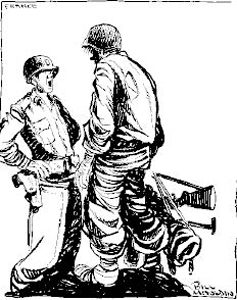
“Straighten those shoulders!
How long have you been in the Army?”(1)
While I never got on the referral list, I did manage to make personal connections. The big problem with marketing Rolfing to the military is that the fix-it focus is even sharper than in civilian medicine. Civilians can take time to heal, or quit when they hurt. Soldiers can’t, and won’t.
A private accused of malingering was sent to me by the physical therapist. This Army captain, currently deployed, had been on my table herself. The private had presented with sciatica. I had the “bellyache,” as Dr. Rolf liked to say, “backed off” within a quarter hour with remedial trigger point and lateral/spiral line work. We continued with a little work closer to the core of his issues. He told me he wished I could talk to his sergeant, who thought he was faking. I said I’d be glad to show the sergeant exactly where it hurt. I was pretty steamed.
Issues troubling military folks are the same as for other physically active humans, cranked up a few notches. Military physical fitness programs are comprehensive, incorporating basic conditioning and even Pilates and yoga. Military posture (as seen in the illustration) imposed on sub-standard structure is one problem, cursory attention to physical training details is another. Non-commissioned officers have to produce soldiers who can pass the sit-ups, pushups and running test with only an hour each morning to train. So they run, do pushups and sit-ups. Bodies with a tendency towards flexion, strengthened only along the front line, just flex inward more. If they made time for the complete program, the results might be beneficial in the long-term, instead of just being about passing tests.
Those who get to jump out of airplanes and helicopters incur the wrath of gravity even more than those who simply take on an extra sixty pounds of rucksack for road marches. The large hinges of the body take an incredible beating, jumping, carrying, hauling and pushing, and tend to need lots of help.
One regular client I had as a massage therapist was chief warrant officer for the aviation battalion. One leg had been broken multiple times on jumps. It was lumpy putty, right down to chipped, chunky bone. He would talk to me about his master’s thesis in sociology as I unraveled scar tissue and tried to give him a little more room to move. That Christmas, he sent his junior officers to me for sessions. A few months later, my husband told me that he had died in a motorcycle crash on the windy Bavarian forest road between the two main posts on the training area. Shock and disappointment gripped everyone who knew him. He was an experienced pilot and motorcycle rider. It was the only military memorial service I attended. Tears still come to my eyes, as I remember the roll call of the unit, ending with his name, unanswered…then Taps.
Some might ask why I put up with this stressful environment. It was where I lived, and these people I worked with, treated and saw every day were my friends and family. Overseas, far from family of origin, we make deeper connections than most people in ordinary neighborhoods normally do. We help each other out more, we take more care, and we pay more attention. It’s simple survival, on military posts in other countries. It’s a deeply passionate, emotional way of life. Unfortunately, the roller-coaster ride can become a kind of addiction to excitement.
I was asked by this journal to address shock and trauma, however, I am no psychologist and no soldier. Through my own experience I can only empathize, have deep respect, and attempt to sit calmly with what I feel through the skin of those I have contact with. Undeniably, my own fabric is deeply warped with this experience. I am reasonably certain that I would never have come to this opportunity had I not somehow been suited for it. Needless to say, it’s not for everyone. The lifestyle of the military leaves an indelible mark on everyone participating, even civilians.
Most military members seeking Rolfing / structural integration will have had the opportunity to be screened and counseled for psychological problems. Post-traumatic stress syndrome can take months or years to appear, however. Many former soldiers do somatize their problems into chronic pain. Many are just physically damaged.
If you need to refer a military client with trauma issues, get in touch with your local Veterans Affairs Officer. They operate Veterans Centers for counseling and other referrals. This is your best resource. The Center will have a list of psychologists and social workers you can call or refer to. Many of them will be happy to talk to you about their experiences and be generous with information. I’m not personally familiar with the effects of Somatic Experiencing on military personnel and welcome follow-up from those who are.
Garry Trudeau, Doonesbury cartoonist, created The Long Road Home and The War Within, two compact comic volumes dedicated to the service injury and subsequent recovery efforts of his Army National Guard officer character DB in Iraq and subsequent adaptation to life as an “amp” (amputee). These volumes added immensely to my understanding. My main resource is my husband, who provides brilliant, practical and intimate understanding of the physical, emotional and intellectual needs and concerns of military personnel. Recently I chatted with a social worker who worked with the military in the “bad old days” about the issues in a person who is and has been feeling compelled to do things in conflict with their image of Self as a “good person.” Most of what I understand is that I don’t need to understand. I just need to be there and be present. It’s no more or less than any odyssey our clients bring to us in our varied capacities.
Early in my days as a massage therapist on the Grafenwoehr Training Area, a young man with a crutch and a bandaged leg and head knocked on my door. He had recently been severely injured in battle and was at home on the Army post in Germany recuperating.
“Hey, do you do gift certificates?” he asked.
“Absolutely!” I said, blinking a little.
“Yeah, my wife is really stressed out since I got back from Iraq and I want to do something to help her relax.”
I gave him my card and sent him to the front desk. . . and cried on my husband’s shoulder that night.
Recently at a jazz bar in San Antonio, Texas, Hubby and I struck up a conversation with a veteran (Vietnam, two tours) and his wife. We talked about post-traumatic stress disorder and how he only realized he had it after he retired in his early sixties. Sitting at the same table was a former Dutch Army soldier who as a child had survived WWII. Engrossed in listening, I was not so interested in the injuries they had endured, but in the strength of their adaptability and joie de vivre.
Whatever else I do in my life, my time both in Germany and with the U.S. military gives me perspective, stories to tell, and histories to honor.
Resources
VA in your state: http://www1.va.gov/directory
Volunteer: http://www.volunteer.va.gov
Emily D. Gordon is a Certified Rolfer and certified massage therapist (Maryland). Her website is www.katsujin.com
(1)Used with permission from Stars and Stripes.
©Stars and Stripes.
Tales from the Garrison[:]