

On December 21, 2007, I closed my Rolfing practice of thirty-three years. Not without grief! It has been an exceedingly rich and rewarding part of the tapestry of my life.
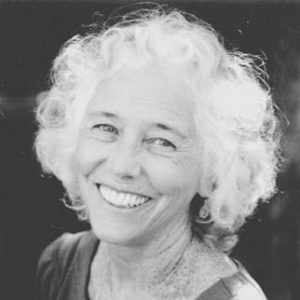
It all began for me in January of 1970 when I accompanied my husband, Sam Keen, who was leading a month-long seminar in theology and human potential at Esalen Institute. Ed Maupin led one of our afternoon explorations, an introduction to Rolfing. I lived in constant pain in those days. At the end of the workshop, I went to Ed and asked him if he thought Rolfing would be helpful for me. He looked at my tense, severely arched body, and allowed, with kindly understatement, that it probably would.
My first three sessions were held on the floor of his cabin, high in the hills above Big Sur. Rolfing was rough in those days. We who were receiving Rolfing compared our bruises in the Esalen baths, and I cried a lot during my sessions. But after the first session, when I practiced my yoga, I breathed in and breathed in and breathed in . . . And after my second, I wept as I walked the mud paths of Esalen barefoot in the January rain, because for the first time in my memory, my feet opened out of their high arches and touched the ground.
When we left Esalen after the seminar and returned to Del Mar, I drove up to Los Angeles each week to continue my Rolfing with Dorothy Nolte. Each session was a difficult and extraordinary initiation. My sixth was particularly hard: I had one of those tight high butt s, that are considered cute and sexy, but are very painful to live with.
Sam had been skeptical about the Rolfing, even though he had had three sessions also at Esalen. He was out of town when I had my sixth. We had a bedtime ritual of going to sleep on our bellies side by side; as we were settling, he would reach over and pat me on the bottom and say “Good night, honey.” The first night that he was home after my sixth session, he reached over to pat me as usual. Then the light went on, and Sam was sitting up in bed, throwing back the covers, exclaiming, “What happened to your ass?”
That made a believer of him. He went to Dr. Rolf herself to get the rest of his sessions, interviewed her for Psychology Today, and wrote what I believe was the first article on Rolfing that she permitted to be published in a popular magazine—“Sing the Body Electric.”
I was working at Kairos Institute, just east of Del Mar, doing movement warm-ups for the workshop participants on weekend mornings. I met Rolfing practitioners who came to work there—Gael Ohlgren (then Karlan), Stacy Mills, and Giovana D’Angelo. My ten-year-old daughter did not have good support from her legs, so I arranged for fi rst Stacy and then Giovana to work with her, I remember watching in amazement as Giovana straightened her legs before my eyes. Even more amazing was that my daughter was transformed from a quiet bookworm, hiding behind her veil of hair, to a kid who was out racing around on the beach and playing basketball. (Lael Keen is now a Rolfi ng Instructor and Rolf Movement Instructor, based in Brazil.)
The fall of 1970 found our family in Prescott Arizona where Sam and I both had teaching appointments at Prescott College. I was teaching dance and yoga. My eyes had been opened by my Rolfing, and I was concerned about the restrictions I saw in my students. So I contacted Esalen and asked for Rolfers to come and work with my dancers. Jan Sultan came, and Gael and later Stacy. One of my students was Tom Wing, the college librarian, who had told me when we met that he had always wanted to dance. Jan took him through the Rolfing series, and the process was as transformative for Tom as it had been for me and Lael.
The early seventies was a turbulent time for many of us. Suffice it to say that by the fall of 1972, Sam had returned to California to live with a young woman he had met at Esalen, and I had married Tom Wing.
In 1973, Tom and I, with my children, moved to Boulder to study Rolfing. Tom began his studies with Dr. Rolf in the fall of 1973. At the end of his audit, I was invited into class for Dr. Rolf to demonstrate how Rolfing awareness could benefit the practice of yoga. I will never forget that afternoon. I met Dr. Rolf for the fi rst time, looked into her piercing blue eyes and fell in love. She had me demo my yoga sequence, then guided me through it again, cueing me. I have a video tape of that session, but alas, no sound, so her words are lost. Except that they totally transformed my yoga.
Even though that was the only time I was in class with her, I feel her to be one of the most important teachers of my life. Tom did all his training with her, audit practitioner, and advanced, and was very generous in sharing with me in the evenings all that he was learning, so I feel as if I got a strong transmission through him. Other teachers also transmitted the Rolfing vision to me—Emmet Hutchins, Peter Melchior, Jan Sultan, and teachers with whom I later taught and from whom I learned in the process—Jeff Maitland, Gael Ohlgren.
I was interested in doing the movement work, then taught by Judith Aston and called Rolf-Aston Structural Patterning, so while Tom was studying Rolfing, I was taking Patterning lessons from Marya Byron. I was so excited about what I was learning that I practiced for an hour or more every day. The movement work touched me even more deeply than the structural work. My high tight chest began to soft en, and for months, I wept every day as I practiced, then got up off the floor and went about my life with my hand on my chest like a Victorian heroine.
As a dancer, and for many years a theologian’s wife, I had puzzled about how the same word, “grace,” could be used to describe both a relationship to God and a quality of movement ascribed to dancers and athletes. As I practiced the Patterning, I began to understand. “Grace” as it is used theologically describes a harmonious relationship between God and the person in grace. Grace in movement is also about harmony. From Patterning I learned to move in harmony with the gravitational field. What a change from the attempt to defy gravity! What ease and peace came into me as I learned! Someone once told me that the gravitational field was the physical manifestation of God’s love. I love that!
With the Patterning, I began to learn—I am still learning—to be gentle with myself. Such a concept! Discovering ways to move that were easy, efficient and comfortable was revolutionary for my tense and striving body. Ease and gentleness with ourselves and others is such an important learning for all of us in our hard-driven culture. It has been a blessing all these years to have the opportunity and the tools to open that possibility for my clients.
During that time, I also began to discover that bringing the principles of the movement work to my daily activities evoked a quality of presence that had profoundly spiritual implications.
In the fall of 1974 I did the final piece to prepare for Patterning training—auditing a Rolfing class. I audited with Emmet Hutchins in the conference room of a motel on 28th Street in Boulder. Another huge initiation.
Then I went to California and began my Patterning training. I did three levels of training with Judith in the next two years. I am deeply grateful for all that I learned from her. It has formed the core of my work for all these years. Judith was especially brilliant in her realization that how a Rolfing practitioner uses his/her body is crucial to the quality of the work that results. In the early 1970s she began teaching lead-in classes for Rolfing students before their practitioner training. It was an important beginning in the gentling of Rolfing.
In my opinion, the importance of the way a practitioner uses her body cannot be overstated. Throughout my career I have struggled with my students’ denial of that. “I just need to get the Rolfing done. Don’t bother me about my body.” We cannot impart what we don’t embody. How can I impart ease and release to a body I am working on with tension and force? When the practitioner is moving with contradiction of direction in his body, how can he impart integration? If she is off balance as she works, if he is pushing instead of melting into the tissue, the client resists, tenses in response, and the work becomes unnecessarily painful, even traumatic. Yes, some work can still get done, but the unfortunate reputation that Rolfing still has, of being unbearably painful, results from just this neglect of the practitioner’s body use. I strongly believe that sophisticated body use should be inextricably woven into the teaching of the Ten Series.
Sadly, in l977, Judith and Dr. Rolf, after many long arguments, came to a parting of the ways. Judith was taking her own direction, and it evolved that she was working from different premises than those Rolfing was based on. Premises were very important to Dr. Rolf. Judith separated from the Rolf Institute and renamed her work Aston Patterning. It was a difficult and sad divorce for all of us who were devoted to both teachers. We had to choose. Tom and I had no question; Rolfing and its premises claimed our loyalty.
In 1978 Gael Ohlgren, Roger Pierce, and I picked up the teaching of the movement lead-in classes. We began contacting other Patterners who had chosen to stay with the Rolf Institute. In October of that year, eight of us gathered, from the east and west coasts and between, at my home in Boulder, to begin sharing our work and planning a movement program for the Rolf Institute of Structural Integration. It was a high, exciting time. During that week we met with the faculty education committee and presented our program. Our high energy was fairly well dampened. They told us to wait, gather more input. So we did. And we persisted.
In the fall of 1979, we offered our first Rolf Movement training. Megan James and I co-taught it. In the mornings we audited the Rolfing training, across the hall in what was called the Annex, in our new Rolfing facility at 3rd and Pearl in Boulder. In the afternoons, we gathered in the Skylight Room and worked with movement. Our first group of Rolf Movement Teachers was certified in the spring of 1980, Jane Harrington and Vivian Jaye among them.
Teaching that first training was a stretch and an adventure. At the end of the first week, I was quite upset with Megan. We met to consult. I laid it down. We must do this and this, we must not do that, etc. etc. Megan listened. Then she said in her low rich voice with her wide smile, “But, love, I don’t teach that way.” I learned tons from Megan. We turned out to be excellent complements to each other, I bringing continuity, structure and boundaries to our teaching, she bringing irreverent spontaneity, inspiration and laughter. She died in 1986 of AIDS, a sad loss to our community.
In those days, Rolf Movement Practitioners did not have to be Certified Rolfers. We felt it was important for our movement students to understand Rolfing, hence our morning audit of the Rolfing class in the first phase of our training. But in our early trainings only a few of our students were trained in the structural work. Some, like Jane Harrington and Carol Agneessens, did their Rolfing training after their movement training. I was a Movement Teacher for almost twelve years before training in the structural work. Having movement as my only tool for all those years taught me deeply how powerful the movement work is, how much it can do, how effectively it can stand on its own. I don’t remember exactly when we decided that all Rolf Movement Practitioners should first train in the structural work. It was probably a good decision, but perhaps has resulted in fewer movement practitioners having movement as their first love.
Finally in 1980 our group of former Patterners and our newly trained Rolf Movement Teachers were accepted as members of the Rolf Institute. Megan and I became Rolf Movement Instructors on the faculty.
Our group of former Patterners, now called Rolf Movement Teachers, continued to meet between 1978 and 1980 in what we called Movement Exchange Workshops, not only sharing amongst each other, but also bringing in other movement teachers to enrich our practices. At one of these gatherings I met Emilie Conrad and was introduced to Continuum. With Continuum I accessed a still deeper level of holding in my body/psyche and found a deeper level of healing. Many of the tools of Continuum have become part of my teaching of Rolf Movement, have infiltrated my yoga, and continue to heal me.
From the time that we both trained in 1973 and 1974, Tom and I worked as a team, often with the same clients, he doing the structural work and I teaching the movement. In January of 1985, while walking in the snowy forest in Rocky Mountain National Park, I felt called to train in the structural work. I think my heart knew, though my mind was in no way ready to accept it yet, that our years as a team were ending. I talked to Peter Melchior and he said, “I always thought you were a closet Rolfer.” So I applied, wrote my paper on the diaphragms, and audited with Emmett in the fall of 1985. I did my practitioner training in the spring of 1986, and began a new practice, part structural and part movement. It was exciting to have both modalities in my hands.
As a Movement faculty member I continued to teach lead-in classes and Rolf Movement Certification trainings. Other teachers also shared this work. In 1991 I went to Brazil and co-taught the first movement training there with Gael. I came home and went into advanced training with Jan Sultan only a month later.
In the late 1980s and the early 1990s the faculty was exploring a number of different ways to shape the Rolf training: what forms might replace the old audit/ practitioner model, what ways we might integrate the movement into the basic training. I participated in a number of these experiments. It was exciting, trying new ways. The high point for me was a combined Rolfing and Rolf Movement training that I co-taught with Gael in the summer of 1992.
In 1993 I moved to Durango and stayed for five years. During that time, I decided to retire from the faculty. My health was wobbly and my stamina not up to the long hours any more. I sorely missed the excitement of teaching, but had more time to devote to my private practice.
I returned to Boulder in 1998 and went right into working with Dr. Joe Swartz in his chronic pain practice. Most of my clients were victims of auto accidents. I learned a great deal about whiplash, and how very lightly you need to touch someone so severely traumatized as many of my clients were.
I have explored a number of other healing modalities during my years as a Certified Rolfer. A year after my basic training I studied craniosacral therapy with Jim Asher and Jane Harrington. While in Durango I learned Reiki. I studied visceral work with Don VanVleet and later with Liz Gaggini. For an amazing year, I worked with Deborah Stucker, only beginning to learn her work with Rolfing the energy field, barely touching or not touching the physical body. All have enriched my work.
In the year 2000 I became very ill. I tried every conceivable traditional and alternative method I could find. Chronic fatigue, they called it, which means they have no diagnosis. I recovered enough to resume my work, but for the next seven years, struggled with fatigue, overriding it to continue the work I loved. Finally, in the fall of 2007, after yet another trip to the emergency room with frightening and inexplicable symptoms, I knew I had to let it go.
So now I am retired. Well, not entirely. After all, after a few months, I did take back two of my long-term clients injured by auto accidents, and also found that I was not yet ready to let go of giving Rolf Movement sessions for incoming Rolfing students. But it is a different life now, no longer shaped by my regular Rolfing schedule. I do only one or two sessions a week, some weeks none at all, instead of long full days of saying goodbye to one client as I welcomed the next.
In January 2008, after a friend gave me very moving ceremony and party to celebrate my retirement, I became quite depressed. What use am I now, I asked myself, if I am no longer of service? I found an answer in the words of Eckhart Tolle, at the end of his book, A New Earth. He speaks of the “frequency holders”:
‘Their function is to anchor the frequency of the new consciousness on this planet… They are here to generate consciousness through the activities of daily life, through their relationships with others as well as through ‘just being’. In this way they endow the seemingly insignificant with profound meaning. Their task is to bring spacious stillness into this world by being absolutely present in whatever they do. . . Their purpose is to do everything in a sacred manner. As each human being is an integral part of the collective human consciousness, they affect the world much more deeply than is visible on the surface of their lives.’
Do not imagine that because I quote these words that I have embodied them. Hardly, oh hardly! But they guide me, and show me my path again when I feel lost. And though I do very few sessions now, it is Rolfing, so deeply a part of me, that I will be expressing as I seek to “do everything in a sacred manner.”Receiving, Learning, Teaching, Becoming…[:]