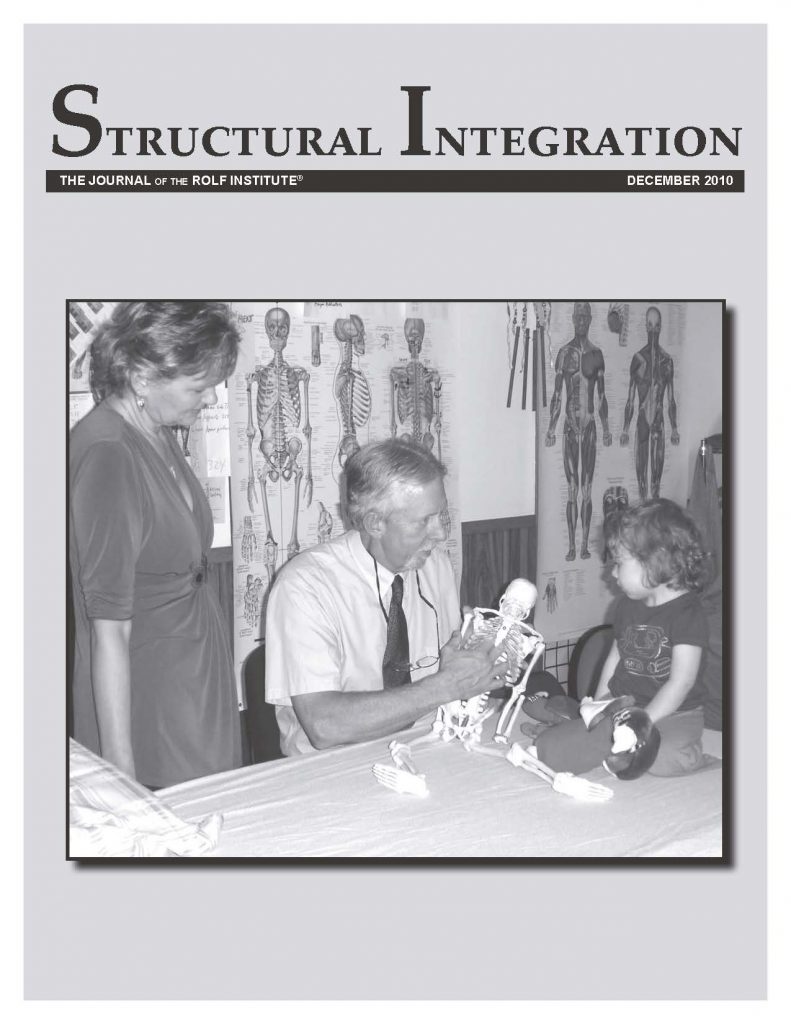
The following collection of articles offers insight into part of the current process of training Rolfers at the Rolf Institute of Structural Integration (RISI). The starting point was a Phase II project by then-student Vivian Gettliffe. Her instructor, Thomas Walker, suggested that she write up her class project to submit to Structural Integration: The Journal of the Rolf Institute.
The timing coincided with our theme on professional development, and we encouraged Gettliffe, her instructor, and her mentor Darrell Sanchez to develop an article giving us not only Gettliffe’s project but also a window into the broader context of the educational objectives of the Phase II projects and the optional mentoring chosen by some Rolfers-in-training during their studies at RISI.
Anne Hoff, Editor-in-Chief
Robert McWilliams, Managing Editor
Editor’s Note: Mentoring is available to Rolf Institute of Structural Integration (RISI) students as an optional part of their training, usually between Phases II and III of the basic training. The following article/discussion is a product of the mentoring relationship between Vivian Gettliffe and Darrell Sanchez. Mentoring is also pursued by many Rolfers post-certification, as will be discussed in later articles in this issue. (Please let RISI know if you are interested in receiving or offering mentoring.) Below, Gettliffe and Sanchez share with us a discussion of Gettliffe’s Phase II project, prefaced by their individual remarks on the mentoring process.
Preface: Remarks on Mentoring
A Mentee’s Experience of Mentoring – Vivian Gettliffe
Mentoring between Phases II and III is recommended, but not required, by the Rolf Institute of Structural Integration (RISI). Like many other students, I have turned for support in this educational experience to a local Rolfer who has worked with me and my family. Boulder Rolfer Darrell Sanchez (who discusses the survey in the interview “Through the Lens of Experience”) supervised my Ten-Series work with practice clients between the two training phases. The format for the mentoring has been quite varied, ranging from extended assessments, to my observing his work, to his observing and instructing me as I work, and quite often, when appropriate, to “four-hands” work. This learning experience has been subsidized by the clients, who were happy to have the Ten Series and Darrell’s expertise at a discounted rate. It has been great for me to know that even if I have a moment of bewilderment, or get bogged down, he will get the client out the door in optimal condition!
I chose to work with Darrell because of the double layer of expertise he brings to the Rolfing SI process. As is evident in “Through the Lens of Experience,” even when he is not directly addressing the client’s non-structural “channels” of experience, he is acutely aware of and responding to them with sensitivity and support. It has been enriching to witness this aspect of his work during the mentoring sessions with clients.
In addition to these hands-on mentoring sessions, I have also called on Darrell at critical junctures of my training for other types of support. His encouragement helped me through the sense of panic I felt in Phase I when I couldn’t feel what everyone else seemed to be feeling under the skin and my heart would start pounding the minute I touched someone. At the beginning of Phase II, I felt so devastated by another student’s negative feedback that I didn’t think I would be able to continue. Again, some supportive words from Darrell in an email made all the difference.
Darrell has received extensive lists of educational objectives related to the mentoring – not from RISI, but from me. After discussion concerning these objectives, we signed an agreement related to the mentoring and its format. Since then, he has been bombarded with revised and expanded objectives, as well as questions and comments related to this learning experience. Unfortunately, it has now become clear that it will take a lifetime to achieve my educational objectives. Some of what we have been working on between Phases II and III includes use of time, visual assessments, use of active and passive movement in conjunction with touch, ergonomics, and questions regarding direct or indirect work, including how to gauge which is appropriate in a given moment with a given client.
I don’t know any classmates who have made as much use of the mentoring as I have. It has been a significant expense added to the cost of the Rolfing training. However, in my case, I don’t see it as something optional. Without the support and encouragement my mentor has provided, it would have been much more difficult to make it past the stumbling blocks I ran into in the first two training phases. I’ve heard Dr. Ida Rolf’s comments about tolerance for uncertainty repeated by many Rolfers, yet this is something that comes easier for some than for others. Thanks to the extra boost from the mentoring, I’m hopeful that by the end of Phase III my underlying base of confidence (one end of Darrell’s “polarities”) will be sufficient to allow me to begin practicing this wonderful art, even in the face of everything I haven’t yet mastered and knowing I will be a novice for years to come.
A Mentor’s Perspective on Mentoring – Darrell Sanchez
Over the years I have served as mentor for a number of Rolfing Structural Integration (SI) SI students. The experience has ranged from supervising one or two sessions to providing much more extensive support. The students reported that these experiences were of value to them, and I believe that to be the case. Mentoring fills in gaps by addressing some of the myriad questions that arise from basic training but cannot be answered sufficiently due to time constraints. It also provides guided and focused practice of practical skills, and practical applications of concepts that are introduced in basic training but addressed to only a limited extent.
As students, practice on one’s own or with fellow classmates certainly has value. That practice naturally leads students to deeper perceptions and stimulates a desire for insightful answers that practicing alone or with another student cannot provide. Mentoring fills this need in addition to honing seeing, touching, and listening abilities. The mentoring process accelerates the assimilation of both knowledge and skills, bringing students much farther in their ability to perform Rolfing SI than if they were to proceed without it.
At the same time, the mentor also benefits from this archetypal relationship. Experienced practitioners often feel a need or desire to teach or guide others who are motivated to acquire insights and abilities perceived to be valuable. Mentoring is one way to accomplish this. In the process, the one who is mentoring inevitably learns and gains from the relationship as both mentor and student point themselves in the direction of mastery. The mentor may truly have gained some knowledge and skills that could be nobly imparted to the one seeking learning, but the mentor also has a working edge. As mentors, not only must we develop further clarity in the conceptualization and expression of our approach to the work, but we are also challenged to examine the information conveyed within the wider context of the professional domain, so that our teaching or modeling is clear, accurate, and measured against a larger field of Rolfing experience than our individual practices.
Balance is the key as the student’s questioning calls us to continually weigh our approach and interpretations against those of the field at large. As our work is contemplated by the student, we cannot help but reflect on and refine it. In the archetypal sense, the mentor is always learning and always beginning anew as if a pupil. The student is always a source of unexpected insight.
A Discussion on the Trans-structural Survey
Editor’s note: This discussion concerns Gettliffe’s Phase II project, discussed in her article “A Student’s Project: Survey of Trans-structural Experiences in Phase II” (page 8).
Vivian Gettliffe: What is underlying all of these “trans-structural experiences?”
Darrell Sanchez: The so-called trans-structural experiences your survey describes reflect a process of movement and transformation happening across the whole person, not just the structure. What attracts us to Rolfing Structural Integration (SI) as students and keeps us interested and excited as Rolfers is this inherent and profound potency of transformation that exists in [the] Rolfing [process].
When you touch someone’s structure you’re tapping into all the channels of human experience that comprise [the person’s] wholeness: the felt sense, movement, sensory perception, conscious thought and interpretation or meaning, emotional experience, imagination or imagery, social connection, personal and generational history . . . We artificially piece things out so we can talk about and understand them, but in reality there’s a dynamic unity. One thing affects the others.
There’s an essential drive toward transformation, a transformational necessity that is often unleashed across these channels as structural integration releases rigidity and creates room for movement. It’s an inner force [that] involves the conscious and unconscious mind working together to produce change in the context of primal polarities.
VG: What do you mean by “primal polarities,” and how does the Rolfing SI fit in?
DS: Creative transformation is the result of an interplay of polarities. Life is not a fixed state but a play between motion and stability. Embracing and living with a dynamic balance between motion and stability, opposites, is characteristic of health and one way of describing the creative life. The interplay of stability and motion helps us to feel secure while allowing us to satisfy our curiosity, to explore and interact with our environment.
The problem arises when there’s too much of one or the other instead of a relative balance of both, so you get someone who’s bogged down in rigidity and fixation, or else dispersing too much into chaos and instability. Physical compensations in tissue help stabilize a structure, but they can also prevent optimal movement or flow of energy. In releasing these and promoting organization of more chaotic structures to more stably support flow, Rolfing [SI] invites a dynamic tension between these two forces that brings about a new level of a more fluid whole being, one that can relate through many channels to the interplay of these polarities. Creative transformation begins to express itself across our whole being, including in the ways your survey describes, when structural changes allow us to hold the two [polarities], and they play, feed off of each other, inform each other. We don’t get too dispersed in chaos or too bogged down in order.
VG: So you think the results of the survey are more about the effects of Rolfing SI in general than the context we were in as students?
DS: In a context like your [Phase II], there’s an unspoken group agreement about going to a deeper level with the process. There’s a single intent, which is learning about the Rolfing experience, so it’s to be expected that the work would be very impactful. In a way, I’m surprised that the numbers from your survey were not higher. I assume this was not the first Ten Series for most of you. Maybe more movement and transformation occurred during the earlier Rolfing experiences, which is probably part of why you all decided to become Rolfers to begin with.
Transformation, meaning fundamental change, is inherent in Rolfing SI. We are agents of change for people’s relationship to gravity, and that has profound effects. If I’m facilitating properly, proceeding through a basic series with respect to Rolfing SI, if I do my job, then everybody has some kind of new awareness or insight, change of meaning or perspective, self-reflection, unsolicited memories or emotional releases, sometimes even an existential crisis where the person explores or reconsiders his or her reasons for being or purpose in life. That’s what I would hope for; it tells me that the series has brought the client to a new way of being embodied in the world. That happens, not 100% of the time, but a lot more than 50%, which is higher than your percentages.
VG: Can you describe more specifically what these changes would look like in a client’s life?
DS: For example, a person might be inspired to re-evaluate his or her relationships . . .
VG: Some of our teachers mentioned clients getting divorced after a Ten Series. I hate the thought of clients getting divorced due to Rolfing sessions with me!
DS: I can’t tell you how many times that has happened. Rolfing [work] is a catalytic process. It’s uncanny how many people come to the process for whatever reason, and somewhere through the basic series they say, “I’m gonna get a divorce,” or “I’m gonna finally . . .” do whatever, fill in the blank. Whatever they were waiting on, whatever was in a state of inertia, starts to move and change. Finding some new purpose in life, finally quitting a job that wasn’t going where it needed to . . . .
Take any of the channels. You’re thinking about life differently (the belief channel). You have insights into your grief, sadness, anger (your emotions), or you feel more alive in your body. Or suddenly you can imagine something is possible that you didn’t think was close to being possible. Or you realize you need to change your diet . . .
VG: Or buy new shoes!
DS: . . . or buy new shoes, or take that trip to Argentina.
VG: You make it all sound so positive, but what about the activation? Isn’t that typically trauma-related?
DS: If we look at the world we live in, everyone is overwhelmed at some level. Overwhelm is the definition of trauma, and yes, it often equates to more sympathetic activity.
VG: Our class sure seemed to experience a lot of activation, and two-thirds of it seemed to relate directly to people’s pasts!
DS: The body is a kind of file cabinet for experiences. All experiences, our relationships, everything that feeds into our senses, what we see, hear, taste . . . those experiences, those memories register in the cells and tissues of our bodies. We adopt a certain posture or attitude toward the world based on the accumulation of those stored experiences combined with our present perceptions. We get used to walking, standing, being in a certain way, never opening those files. Then you go into the Rolfing training, and maybe for the first time, you’re tapping into areas that haven’t been tapped into before, opening files you didn’t know or had forgotten were there.
VG: A research article from one of my counseling classes seemed to imply that when trauma-based sympathetic activation occurs, there is a six-hour window within which either reconditioning or reinforcement occurs. If a client gets activated and the activation isn’t promptly processed in a way that helps to resolve it, then it seems like there is some retraumatization.
DS: Retraumatization and bringing something to the surface are two different things. I’ve had issues come up for me when receiving work that I may follow up with for days or weeks at a time. Was I retraumatized, or did it help facilitate the clearing of old, traumatic material that takes some time to resolve? Typically, in the creative process there’s a feeling of discomfort, dissonance, confusion, or pressure that precedes the emergence of novelty, but this doesn’t necessarily equate with trauma. If we are resourcing our clients, and if we ourselves are a resource for them in the process, then we are facilitating change to the traumatized material rather than retraumatizing them.
VG: I definitely don’t want to retraumatize anyone!
DS: The chances of retraumatizing are much less than you think, not as scary or as likely as you think. Even so, it’s good to keep that thought in our minds, that humbling idea that yeah, I have the potential to retraumatize this person. That’s one side of it; the other is, if we don’t go to where the change needs to happen, there will be no change. The definition of transformation is to change the nature, function or condition of something. That’s why people come to us, to Rolfing SI. If clients are coming in for the series, then ideally they’re coming in to change the nature, function or condition of their being.
VG: Consciously they’re coming in to change the nature, function or condition of their structure.
DS: Or maybe they just want to get their shoulder or back fixed! You tell them, “we can work on the shoulder and maybe it will get better, but we have to start working on other things if you really want it to change.” You educate them about the series, and then it’s up to them. If they let you, you begin to address their whole structure. You change their ankle and leg, and that changes how they use the leg, how they relate to the ground, how they’re living on the earth. Before you know it they’re into brand new territory, into new beliefs, affects, interpersonal relations, self-images.
VG: What if one of my clients does get into a traumatized space in the course of our work together? What can I offer, how can I help as a Rolfer who doesn’t yet have the training in psychotherapeutic or trauma-resolution processes?
DS: Offer references. Refer to people who do have the training. In the context of the session, slow things down, get [the client] back to the present moment. Don’t push your agenda. Make sure [he or she is] ok and feels ok. Go back to the approaches you described that Thomas Walker suggested in your [Phase II] training: draw the client’s awareness to [his or her] felt sense, engage conscious thought processes, offer a supportive, connected relationship. Offer resources and be a resource for the client.
VG: I was surprised that activation took the form of dizziness so often, and was also surprised by it taking the form of nausea. Have you experienced this in your practice?
DS: Yes. As people’s bodies reorient, movement channels open up, there are new proprioceptive sensations, centers of gravity shifting . . . suddenly your head is sitting differently on your spine. Or you’re able to have this wide peripheral vision that you’ve never had before. How many people go through life looking down, and suddenly they’re looking to the horizon! Or people come out of a rigid holding pattern into a spine that’s moving. This is physiologically disorienting, not to mention conceptually. Dizziness and nausea are motion sickness types of symptoms. Hopefully the Rolfer helps to get them balanced and grounded, and they reorient quickly. It’s not necessarily a bad sign if it doesn’t persist.
VG: Beyond the question of trauma or activation, how can I understand and support creative, transformational processes happening in my clients?
DS: If you experience these processes in your own life, clearing and understanding your own material, then it will be easier to recognize when someone else is changing.
VG: What might the signs of change be, for example?
DS: When [clients] come in and start sharing their experiences. They start to have memories. Or they may say, “I don’t know what’s happening. Is this common?” or “I feel like I’m standing differently.” “I feel like I’m relating to people differently,” or “I feel like people are relating to me differently.”
VG: How often do you think people have experiences like the survey brought out, but don’t report them to their Rolfer?
DS: Often. They may not be open about it. Outward changes are usually recognizable to an observer. Inward changes to our being aren’t so easily identified. Others may not always see the alterations and evolutions of our perspectives, perceptions, cognitions, emotions; changes to the inner felt spaces of our lived experience, to how we experience ourselves and our relation to the world. If the Rolfing [work] is having an impact on the client’s structure you can pretty much assume that these other channels are being affected at some level as well, even if the impact isn’t fully comprehended.
VG: Going back to my question about how to understand and support these processes in a client . . . .
DS: Remember that the client is not the only one working with this creative, transformative edge. We as Rolfers are also working with that every time we have a session.
VG: How is the Rolfer working with a creative, transformative edge?
DS: The Rolfer must hold any number of polarities in the interaction with the client, all the while inviting and responding to the client’s body’s creative process. Some of these polarities might include direct/indirect, asking/listening, suggestion/response, weight/space, stability/mobility, mind/body, structure/function, fascial/fluidic, energetic/physical, support/freedom, active/passive, stillness/flow . . . .
To understand the client’s experience you have to undergo your own transformations. You have to experience the essential transformational necessity yourself . . . the play between chaos and order. You have to be creative, to practice the ability to hold two polarities at once, to be able to say it’s not “either/or”. What would it be like if I held both direct and indirect, yin and yang, chaos and order, stability and motion? We become the ground that resolves those polarities by having the ability and experience of holding them. And then you will recognize it in your clients; you’ll see what they’re struggling with. It’s not always easy to be in the presence of ambiguity and dichotomy, holding onto one’s strong beliefs while still being open to receiving new information.
VG: So how does one support people going through this?
DS: One of the biggest of these polarities in Rolfing SI is the old way versus the new way of being embodied in the world, letting go of the compensation and accepting and embodying the emerging order. The Rolfing process is about that very creative thing. How do we support and how fast do we take away the compensations while encouraging and supporting the emerging new organization.
VG: In our training we’re learning how to do that from a structural standpoint.
DS: It’s already a lot to learn. It’s not in the scope of the basic Rolfing training to teach you how to do this from a psychological standpoint.
VG: Is it enough to get it right structurally for it to happen well in the other channels?
DS: It sure helps to have the structure more attuned to gravity. It goes back to us being in the world as physical beings. If we can experience confidence, harmony and joy in our bodies, you can imagine how that reflects on the other channels. But fixations in the other channels can also be obstacles. How well it translates to other channels within the individual depends on many factors and perhaps other processes: psychological, spiritual or philosophical, for example.
VG: In that case, how else can you support the client?
DS: Anything that supports and contributes to the health of the whole being. Again, offer and encourage resources. Within your scope of practice this could include functional movement and repatterning, talking with [clients] about the process, putting them at ease about changes (because we are going for changes; that’s what it’s about!). Finding practical ways to help them with the changes in their lives: ergonomics, referring them to other types of practitioners such as for counseling, nutrition advice, and so on.
A big part of Rolfing SI is educating, pointing out to people the nature of the process and where they are in it, to some degree normalizing, reassuring them about the creative healing process. Educate and resource the person at every stage and every step so that he or she begins to own the process.
VG: Is there anything else that this survey brings out that you feel would be useful?
DS: Understand that the very fact of being a student, and especially a Rolfing student, puts you in that space of creative, transformative movement that’s reflected in your classmates’ experiences. Look at the polarities you’re dealing with: “I think I know something . . . . I don’t know anything.” “I just learned something, and now I have more questions than I had before.” “One moment I feel confident, and the next moment I feel clueless, like I shouldn’t even be touching anyone.” “How am I supposed to decompensate these fixations at the same time as establishing this emerging order?” If you can live with these contradictions, creativity and artfulness will eventually emerge from them.
VG: What if you’re always on one side of those polarities?
DS: Thinking you know something is a trap. Thinking you know nothing is a trap. Don’t get too attached to either of those. That’s where our own work comes in, the practice of sensing where we are with respect to the polarities. If you can hold both of those perspectives at once it can lead you into a potent state of awareness.
You’re entering a field which requires tolerance of uncertainty. To be available to the creative surge one must do the work, tend to the details, and sit in the uncertainty of not knowing. The culmination of the creative process arises from uncertainty and the tension of polarities in a moment of wonder, and in that moment is a revelation of how to proceed. The moment of wonder is like a holographic grain of sand or multidimensional puzzle piece revealing the glory of the greater view.
I don’t know when my clients will make the transforming breakthroughs or if they will link their realizations to grand insights. I don’t know what the holographic grain of sand is or when and how it will arrive, but I’m willing to continue along an uncertain creative path to see, hoping for that divine emergence of meaning and understanding that is creativity, and that transforms both self and other.
VG: Are you talking about your Rolfing work or your counseling work?
DS: I’m talking about the creative transformational process that plays out in the wholeness of the person in response to the experience of Rolfing SI and in other modalities as well, and that is also playing out in the experience of the Rolfer. It involves an appreciation and surrender to a force immeasurably vast and incomprehensible to our conscious minds, a divine force that brings all things into being. We start to see beauty. We have this capacity to see and appreciate and feel this emerging beauty as someone’s being is coming into physical expression in this [structurally integrated] way.
Rolfing SI forces us to really be in this world, or at least confronts us with the reality that we are here as physical beings in this world, the world we have right now. We’re in a field of gravity; we must deal with it. Stop fighting against it. Get in tune with it. When our body gets in tune with the field of gravity, this opens us up to dimensions of energy we haven’t imagined yet; we can stop using our energy to fight gravity. It opens the door to a way of being in our bodies that will probably completely astound us down the road. What these bodies could be . . . we haven’t imagined yet what they could fully be. We’re barely scratching the surface with a process like Rolfing SI. It’s bigger than Ida Rolf. It’s something so magnificent and beautiful. To be humbly in that, to have the honor of witnessing and even facilitating that inspires a childlike awe and appreciation for something beautiful that is bigger than us.
VG: What is it? Where does it come from?
DS: Unanswerable. I call it the Divine. It’s the beauty of Creativity.
To have full access to the content of this article you need to be registered on the site. Sign up or Register.