

Introduction
I am writing this now in the hope that my own experience with post-cheilectomysurgery rehabilitation will be helpful for Rolfers working with a client in this situation, or even for themselves. I wrote in an earlier article (“Why I Got Foot Surgery”; June 2011 issue of Structural Integration: The Journal of the Rolf Institute®) about some of the elements involved in the decision to have surgery, and the immediate aftermath of the surgery to my left foot. It has, at this writing, been nine months since the procedure.
I had good experiences working with skilled Rolfing® Structural Integration (SI) practitioners familiar with the nerve confusion that appears to be pain but that can go away with gentle and persistent attention in weight-bearing. This meant, after the initial swelling went down, trying to find the left metatarsal-phalangeal (MTP) joint in a sort-of ‘freeze-frame’ of the toe-off phase of gait. While at first hard to deal with, the pain mostly went away after I realized that there was nothing organically wrong with that position, and that this was the best way to feed nourishing blood to the joint capsules and ligaments there. Motion, as they say, is lotion. I then progressed to rocking forwards and back through the leftfoot- back, toe-off position, paying attention also to the involvement on the right foot and hip. I preferred, at the beginning, to use a piece of foam (a swimming ‘noodle’ cut length-wise) under the left foot, for padding and proprioceptive reinforcement. I had long enjoyed walking on smooth, one-inch river rocks to stimulate articulate adaptive motion in the foot, too, and spent much time standing on squash balls just in front of the heel to stimulate Chopart’s-joint awareness in gait.

Figure 1: Rock walking to enhance wholefoot adaptability and proprioception, moving all directions: sideways, in a circle, backwards and forwards.
Interosseous Membrane Involvement
Even with this work, things seemed to be improving really slowly. My foot/ankle would feel better, and then tighten up again. I had been walking around and visualizing toe-extension movements, but still feeling like it was just hard to walk. Having decreased toe-hinge range for years had given a fairly stuck feeling in the left interosseous membrane (IO), and a rigid feeling of being unable to yield on the plantar surface in the loading-to-standing phase of gait as well. I was ecstatic to receive deep work from a fellow student at Russell Stolzoff’s workshop in Bellingham, Washington: two days later I was jubilantly striding through the Denver airport. The effect of a more released IO felt like a trampoline from my lower leg into the base of my foot, facilitating a ‘happy’ heel-strike moment in gait – happy because it allowed me a much improved sense of rebound, and also freed up the ankle aspects of plantar flexion. Three and a half months before that I needed to be wheeled through the airport, and had trudged through it several times after that. This time I bounced, and could keep up with the crowd (and even passed a few old people).
Getting Sagittal
Unfortunately, work was a bit slow this summer in Boulder, but this allowed me some time for a rehabilitative ‘stay-cation’ in which I invested time and some money in recovering sagittal motion. I bought a hybrid bike that rides like a dream, and it’s hard to express the joy that I felt in being able to speed down the lane, my focus expanded in all directions by the huge puffy clouds. I found that exercising the hamstrings, quads, and glutes really gave me more confidence in walking again. I started lifting weights in a little more consistent and targeted way. As a dancer (I almost wrote ‘former-dancer,’ but that doesn’t ring true), I know how to lift and remain flexible, and how to create exercises that demand a greater (as well as functionally useful) range of motion. I realized (again with the help of a colleague’s comments) that I was getting much too ‘gel’ (not tight exactly, just sort of dense), so started swimming again to become more ‘sol’ (i.e., liquid) in my movements. Now it feels good – just plain good – to feel my foot on the ground again. I believe that much of this is that the chain of movement from the foot to the pelvic floor has been opened, which frees up my breathing and allows joy to rise from my feet, in embodiment, to the top of my head.

Figure 2: Slide foot forward to increase ankle extension/plantar flexion in sagittal plane.
Ongoing Work,
I still need to work daily into the foot and ankle, now opting for movements that gently enhance plantar flexion. An example is lying supine and just sliding the foot from a bent-knee position towards leg extension as far as I can keep the toes on the floor. I allow the slight supination/inversion movement, hinging at the axis of Henke, as I know that this gives me maximum range of motion in this direction, and it is perfectly safe to do in an open-chain position. Earlier in my dance career, I would have been concerned about this shape of the foot, which we called ‘sickling’ (after the farm implement, not a sick person).
I have also been experimenting with more direct stretching of the joint, by really loading the MTP joint in slow squats, and moving from there into the big toe pushing into flexion. I was inspired to work in this way by my podiatrist, who warned that the main enemy in the joint post-surgery was scar tissue, not inflammation. Another very helpful medical expert was my friend Sue Abreu, M.D., a top-notch specialist in nuclear medicine, who simply said: “bone remodels.” She gave me hope that the bones in the joint may re-mold into greater range of motion. I have also discovered the effectiveness of manipulating my own first metatarsal bone. Facilitating release there allows me to better lever the MTP joint into sagittal motion by enhancing plantar flexion proximal to the big-toe first phalange. The joint then feels as if the toe is extending back more, relatively, and it feels much easier to walk.


Figures 3 A, B, C and D: Working in a forward lean against a wall, using double and single legs, then integrating spiral and flexion (only one twist direction shown; the other direction is good too).
Walking in Rhythm
Dancing at a party two nights ago felt wonderful. My foot was stiff in the morning, afterwards, and then warmed up with a few minutes of attention. I have these mantras: Stop obsessing on it! Then work into it. Then forget it again. Then work into it. Motion is lotion, and standing/walking on released feet is divine! (Even with no applause.)

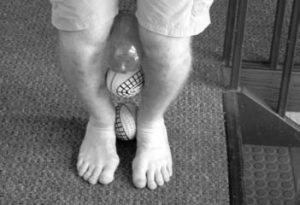
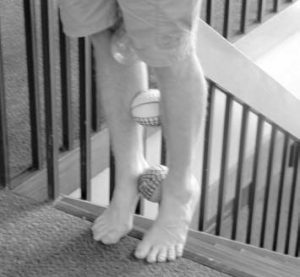
Figures 4 A, B and C: Self-tracking ideas with balls and straps
Notes on Photos
Some of my favorite work (because it is helpful) for my lower leg/ankle/foot since the surgery has been in open chain, non-weightbearing movements of flexion/extension and rotation of the foot/ankle/lower leg/whole leg, especially if someone is addressing tibialis anterior, posterior, or deeper, into the interosseous membrane. Pictured here are a few closed-chain movements designed to improve sagittal motion with load and lower-leg tracking through the ankle/foot/ toes in gait. I am ready for these now. They were difficult because of pain and restriction from swelling for the first few months after surgery.Rehab Notes, Post- Hallux-Rigidus Surgery[:]