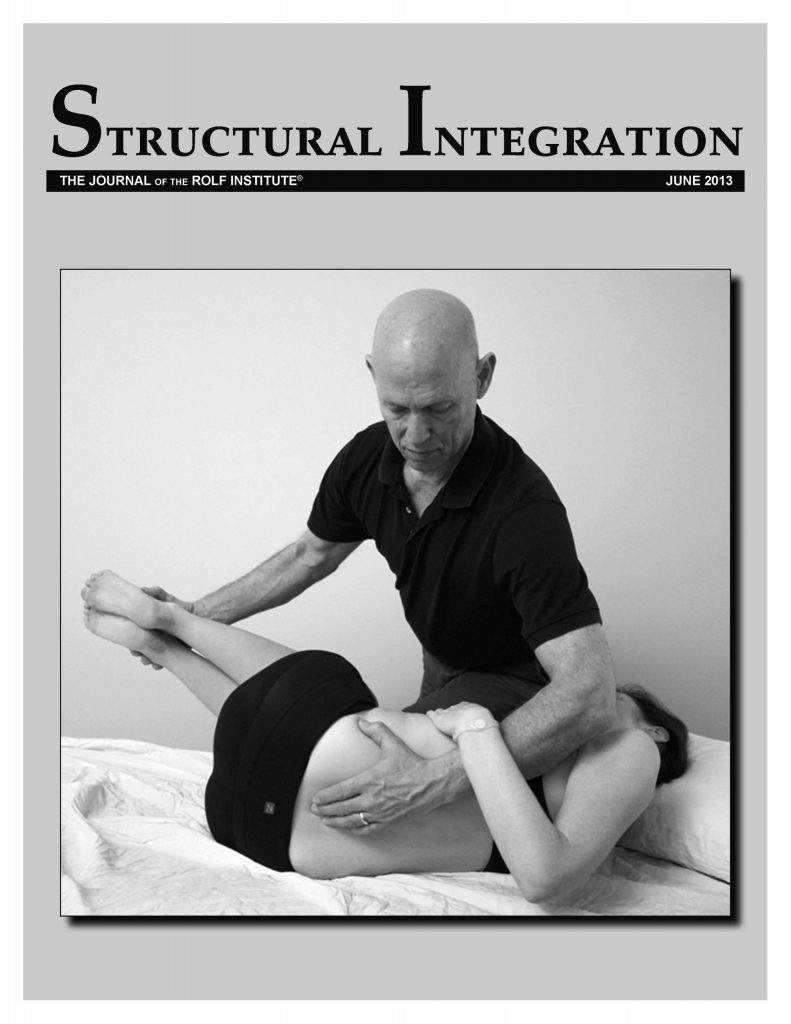
Anne Hoff: I initially contacted you when there was a discussion on the Rolf Forum LISTSERV about pain issues and solving pain. A lot of the comments were about modalities and techniques, things like releasing nerves. Then you wrote a very articulate post reminding us of the holistic paradigm of our work, and discussing how you worked. I really wanted this issue’s pain theme to include a discussion going back in our lineage, to the core of what we do, which is integration and how that itself can take care of pain. You studied with Ida Rolf, so I thought you would be a good person to speak to.
Nicholas French: I have to admit that often, when I read the Journal and listen to some of my colleagues or run across their posts on the Forum, I feel rather dim as a Rolfer. I’ve been interested in and studied some of the things they talk about, but I don’t have a scientific background and I often find my eyeballs rolling back in my head when I come to grips with scientific papers or dialogues: it’s not familiar ground. I’ve learned not to feel totally deprived because of that, and I’ve wondered why I have such a different outlook. In part it’s that Ida’s work and her viewpoint were so striking for me. She was one of the most articulate, really mesmerizing speakers I’ve known. She certainly demanded we know our anatomy and she referred frequently to scientific protocols, but her main emphasis was on the whole presence of the person – very different from the more medical view. She once said, “look, if you are interested in fixing things and focusing on symptoms, leave here, go to medical school. We’re after larger game.” She demonstrated the power of holistic emphasis, and it grabbed me, perhaps in part because one of my grandfathers was a homeopath (and surgeon).
My very first client in private practice was a guy who was a roofer and had some impressive injuries. He came in wanting me to fix his back, and I first noticed one of his lower legs [which] had been almost completely severed at the knee, so was not functional. I was thinking, “Is this some kind of curse or test?” Having no one there like Ida or Peter [Melchior], there was nothing to do but follow what I had been taught. The leg had been severed and reattached ten years before, but without nerve function. Imagine his surprise – and mine – when he suddenly noticed after the second session that he could feel the carpet under that foot. And by the end of the [Ten] Series, the lower leg was more functional, had movement and more feeling. That knocked my socks off. I realized this hadn’t been a curse, it was more like a gift saying “Think you’re smart? Well, just pay attention and you’ll learn.” I’ve been a fan of the Series ever since.
AH: Talk a bit about the Ten Series.
NF: It’s a difficult thing to describe. As is often pointed out by colleagues I admire, it is not a “list of moves.” One guy who attempted to imitate Rolfing® [Structural Integration] was Jack Painter, who called [his system] Postural Integration®. I was told he put out a book that had step-by-step instructions about putting your knuckles or a couple of fingers here or an elbow there, then pushing this way, now put them here and do this and that: a literal recipe. But of course, even if we could have videotaped Ida from various camera angles and printed out precisely what she did that was a brilliant series for one model, it would be an interesting artifact, but it would apply only to that person. It’s not follow the dance steps by putting your feet here and there, it’s a flow of perceptions and principles, which is what made it such a challenge to all of us. Ida urged us – and she was quite serious –to just follow her “Recipe” for the first five years. She knew that all kinds of other techniques would be very intriguing, especially when we felt confused or uncertain, or simply blank. She said, “Please just follow what I’ve given you for the first five years. After that, if you want to add stuff, go ahead.” I think she knew that if we really immersed ourselves in the Recipe and the principles and the incredible complexity of the human structure, we would recognize that we had stumbled into an infinite realm of discoveries, enough to keep us amazed and busy for a lifetime. Sure, we can learn a lot from others and expand our abilities, but if we are grounded in holistic insight, new methods are much likelier to extend our effectiveness instead of confusing – and perhaps reducing – it.
AH: There’s the question of how something is added. I studied visceral manipulation with an osteopath, and the way he worked didn’t look or feel like something that I could readily integrate into what I do. Later I took a visceral manipulation class from a Rolfer – Liz Gaggini – who had studied with osteopaths, but then spent years thinking about how to bring that work into structural integration [SI]. So when she taught, it was grounded in our work – how we see and how we use our hands as Rolfers. That showed me how to integrate that work within the paradigms of structural integration and holism, not add it as just another thing to do. I think that’s the challenge with all the other things there are to study.
NF: That’s an excellent point, and an important one to me, because the temptation to try and add on our latest love or fascination is probably common to all of us. When I was teaching I noticed how often my fellow teachers and I would be fascinated by some new book or process, which then would influence the next class we taught. In the mid-eighties, a bunch of us on the faculty spent a week in Santa Fe with osteopath John Upledger. He was teaching us his work and we were quite fascinated. His viewpoint was less about changing the structure of bones in the cranium than how one could affect the dura. So he quickly translated from Still’s bony emphasis to connective tissue. He got very fascinated with Rolfing [SI], and at one point said that he was seriously thinking of going for Rolfing training. Well, the result was that we were all wildly enthusiastic about what we were learning, and I remember Jan [Sultan] saying it was going to really transform Rolfing SI as a whole, not only in his practice but also our teaching. I think we were all fascinated by the idea. Jimmy [Asher] was the one who really followed it closest; the rest of us found ways to integrate some of what we had discovered into our own practices. I rarely do classic cranial work; I have great respect for that work and our colleagues who are trained in osteopathy, but I found that mostly it just gave me different ways to listen through my hands to the person I’m working with.
AH: I want to go back to that quote from Ida Rolf, “If you are interested in focusing on symptoms go to medical school, we are after larger game.” I think it’s a difficult path in many ways to be a Rolfer, to have been introduced in a pressure-cooker training to this wonderful new way of working, and then to go out in a world that really doesn’t know what we do. I wasn’t a Rolfer back in the late 60s, early 70s, but I imagine that there was a big difference then, as there was much more awareness in the culture of the possibilities for human transformation. Now what drives many people to Rolfing sessions is not that they had a friend who went to Esalen and had some mind-blowing experience, but that they are desperate to get out of pain. We have a holistic mindset of aligning the body in gravity so that wonderful, transformational things can happen, and they walk in saying things like, “My left knee hurts.” So to invite that person to think in a bigger way than he’s used to, it’s a challenge. It’s even more of a challenge if we are new and still exploring the Rolfing world and can get sucked into thinking I have to make the person happy and fix his knee, rather than have the kind of trust you had with your first client.
NF: In the 60s and 70s there was a different sense of possibility, but I’m not sure it’s made our work that much more difficult now. It’s always been a challenge to communicate what we are offering. One of the things that spurred me to write that response on the Forum was a letter from a colleague saying that he had tried the Series, didn’t think it worked well, and he had a family to feed. I fully appreciate his quandary, because I had a family to feed, too, and as a new Rolfer used to go over my notes with cold, tense fingers every time before a client came, trying to convince myself that I had absorbed enough information to be effective. Then I began to realize, to my surprise really, that rather amazing, impressive changes were coming from what I, a newcomer, was doing. And before long my schedule was packed – and it stayed full. All simply because of Ida Rolf’s rather radical vision of what is possible. The medical world has a lot of brilliance, and fine technical stuff, but they look at patients with a linear view and then try to impose solutions. Ida urged us to understand that the individual being is a very complex, rich source of information, and that the body is conscious, so if we engage in a dialogue with it – in whatever way we can – we can learn from that being what will help healing to manifest.
It takes work to educate clients: “Okay, I understand that your back really hurts, and the reason I’m starting up here is that I see a connection to that problem” – even something as simple as that. When I first started to practice and told people “I’m a Rolfer,” most would say, “What the hell is that?” But before very long people were saying, “Oh, yeah, I’ve heard about that” – or, “my aunt tried that,” or “my brother was raving about how it helped him,” and it’s simply because what we do works. People who’d heard or read that our work helped people out of pain came to us with these blank looks, and then we had to do this courtly dance of attending to their idea that we were going to help them get out of pain, but we were going to do it in a very different way, and we wanted them to simply pay attention to what was going on in the body and be as patient as possible. I think what’s really been remarkable is how much Rolfing [SI] has spread – all over the world – since Dr. Rolf began teaching it. But it still seems to be the tendency of most Rolfers to fall back into the more linear, rational approach, because that is the paradigm of Western culture. Sometimes it takes conscious effort to remind ourselves to think back, to remember what Ida said. Rosemary Feitis’ book Ida Rolf Talks About Rolfing and Physical Reality is a wonderful resource. I often lend it to clients who are really interested in the work, because that’s about as close as you can get to hanging out with Ida these days. (I also reread it periodically.) If they are open to it, I’m glad to tell them stories about her, about what I’m doing and why, and it helps refresh my awareness too, because so many people who come to me are just looking for some sort of quick fix.
AH: What do you say to that client who comes in and says, “I’ve got this bad shoulder and my neck hurts and I work at a computer and I heard you can fix it” – what do you say to get his mind open to the idea that it’s not just about trying to fix things?
NF: First, I tend to recall Dr. Rolf emphasizing the futility of chasing symptoms around, trying to fix them: “If you work on their symptoms, they will gradually get worse. Your job is to find the roots of those symptoms, which are simply the more obvious superficial indications.” It’s important to address their “help me out of pain,” so I might say, “I’ll be glad to do everything I can, but here’s how I see this process: I don’t think anyone has the power to heal another, but I’ve found that there is something that heals people if they are given the right help – and that’s a process that we do by working together.” As Dr. Rolf said, “As long as there’s life and breath left in a person, there’s always the possibility of positive change.” Some people are dubious, but you’d be surprised how many people say, “That’s really interesting, tell me more.”
I can give you an example. I had been [practicing] Rolfing [SI] for about three years and one of my closest friends and colleagues referred to me one of his clients, a large guy in his forties who had really persistent low back pain. Chuck had taken him through the Series, and sent over the Polaroids. I looked at them, and the guy had had really fine work, very nice changes. But the guy was still very concerned about his pain, as it hadn’t really changed. So I looked at him, and saw that he had lovely organization from the soles of his feet up through about L1-L3, but something else didn’t fit. The usual rational thought is if somebody has upper problems you work on the foundation, like fixing your house, and that’s what Chuck had done. In studying with Ida, I was fascinated by the different ways she saw, like, “What doesn’t fit?” When I looked, this guy’s upper body looked compressed, too short and still. It just didn’t fit. He had a nice, graceful-looking lower body, but the upper part looked like it was pulled down and tacked onto it way too tight. So when he laid down I started working on his upper body – either intuition or desperation. Naturally, he said, “You remember that I told you it’s my lower back, right?” I said, “Yep, I remember, it’s just that I’ve seen an important connection. Be as patient as you can.” I spent the larger part of the hour working on his shoulders and arms and upper ribs, and when he got up from the table he looked about four to six inches taller – and it’s the way he felt. He was happy as a kid; his back all of a sudden felt strong and good, and I was happy, too. I had seen something that had not occurred to me before about the power of accumulated tension in the arms and shoulders to affect the shape of the entire body.
So part of the proof of our work is that people get up with the kind of feeling that man had. Now it doesn’t always happen that quickly, and I was riding on some great work that my buddy did, but it’s an event I’ll always remember. So I’ll tell people Rolfing stories and listen to what they’ve got going on to engage them in the kind of attention that is open to who knows what – a different approach, a happy surprise, or something miraculous. I can’t count all the startling improvements I’ve seen in clients, many of which I didn’t think possible but were verified by their physicians – and I’ve heard plenty of similar stories from Rolfing colleagues.
AH: This is a beautiful example of that quote “we’re after larger game.” With that guy, everything was going to make you want to go work on the low back, try to make the client feel better, but you were able to hold this bigger picture of “there’s something else here, this guy’s been worked, it’s not as simple as his back’s the problem.” You had a lot of faith in your training to go for something that you didn’t have any guarantee was going to work.
NF: You’re right about that faith, but I can’t claim that I had a very clear perception of some important principle. I think it was an intuitive hit, and I figure that is an important, even essential, part of Rolfing work. I assume that all of us have that capability if we pay attention to it, or make demands on it, or simply trust that it’s there – especially when we are cross-eyed with uncertainty and wondering if we know anything. After all, C.G. Jung identified intuition as one of the four psychological functions, which, as he said, “. . . Is capable of seeing around corners.” Ida was obviously incredibly intuitive (or as some would say, “psychic”). I hope stories about her are a strong presence in the presentations of all our teachers.
I was lucky enough to have that sort of weird, tantalizing experience one day in my practitioner training, in a class taught by both Ida and Peter Melchior. I was working with my first model. It was an upper session, and as I was working on the right arm and shoulder I noticed Peter was nearby watching me, so of course I wanted to do just the right thing. I put my hands on the guy’s arm while I was thinking about it, and then I wasn’t sure so I sat back. Then I put my hands on his arm again, and I started seeing different possibilities. I went through anatomy, I went through his history, I went through structural theory. Every time I put my hands on him I was considering a different approach, trying not to overlook anything. After doing that four or five times, I was utterly paralyzed with possibilities and information. I looked up and Peter was just sitting there calmly observing, looking me right in the eye. I confessed: “I’m stuck.” He said, “That’s funny, you’ve already put your hands on the exact place about five times.” Hmmm. What if there’s something in me that knows more than I know consciously? So I went back to that arm – Peter was still watching – and did something that I hoped looked adequately “Rolfish.” There was a lovely change, and it not only looked a lot better, the guy said, “That feels so good!” Aha, something else to remember. Now, how can I learn to connect with that information? Peter just nodded and smiled.
I guess that’s why I often feel uncomfortable when I see Forum postings asking quasi-medical questions about how to deal with various symptoms and conditions. Believe me, I know that “Help!” feeling, but I’m not sure that the answers given – including the technical ones – are so helpful, because they can also short circuit an important and necessary process in the practitioner. Ida knew we would suffer with such doubts, and she urged us not to discount our training, all the information the client’s words and structure presented, or what we could discover if we were patient enough and hung out with the challenge long enough. When we feel “I’ve gotta be certain,” the typical cultural response is to focus on our more logical left-brain support. It can help – or it can blind us to other useful sources of information. She had obviously learned that intuition is an indispensable part of Rolfing work.
One day a student asked Ida for guidance in some important personal issue. She looked at the student in silence for what felt like a very long minute, and then said, “Why are you asking me that question? My answer might be perfect for me, but disastrous for you. Also, simply to ask me for the answer implies that I can know what to do and you cannot. That does not respect your own abilities. What I recommend is that you stop being lazy, get up off your behind and work to find the answer you need to discover.” No one has The Answer all the time, and there are varieties of awareness that are not ordinarily accepted by reasonable, scientific people. Class with Dr. Rolf could feel like being in a pressure cooker, and I figure that was by design. She knew that the human being is a much more complex matrix of systems than anybody has figured out, including the scientific world, and she knew that we would go out and represent her work to the world, her brainchild, and that we would immediately begin to meet with structural and emotional puzzles no teacher ever described. Oh boy. “Here I am, a baby Rolfer, and I am supposed to have the chutzpah to work with this person in this moment and actually accept money for it, so I damn well better do something that helps…but what?” We had to depend on our training and include all possibilities, including asking for inspiration. So when I see those Forum emails that sound like fourth-year medical students wanting a quick summary of how to fix something, I frequently think the suggestions given are really interesting, but what if they’re missing something else really important? Sometimes I’m tempted to point out that even the cleverest answers can interfere with other kinds of learning that would be of real help, the kind that comes only from finding oneself at the edge of the known world and having to call on those inner resources that aren’t activated any other way.
AH: There has to be a certain tolerance of anxiety on the practitioner’s part, a certain openness to not-knowing, to allow intuition to arise. I know for myself, the more I have been able to tolerate a feeling of “I don’t know what I’m doing,” miraculous things can happen. If I think I have to know what I’m doing, then I tend to work more out of a formula, more rigidly, and maybe I’ll still get results, but it doesn’t feel the same as when I surrender to the sense of “Okay, I don’t know what I’m doing, but I really want to work there for some reason so I’m just going to do it.”
NF: Good point: “I don’t exactly know what to do now, but I must do something . . . oh, how about this?” In the 70s going into the 80s, there was often a sense of a schism [in our community] between the ones who were considered the scientific, anatomical folks, and those who were the intuitive, metaphysical folks. Peter Melchior, a very bright, perceptive guy, said simply, “The metaphysicians need to learn more anatomy and the anatomists need to learn more metaphysics.” It’s just a matter of balance. At the time, one of the theories that was going around, at least among a few of the faculty, was that the Rolf Institute® qualified as a “mystery school.” So of course I wanted to know what a mystery school was, and was told it was an ancient religious tradition. The idea was that the students who came would be given all kinds of specific work to do, information to absorb, principles and ideas and all kinds of things they must master before they were ready to go out into the world. So the emphasis was on knowledge, but that was simply a way to keep their minds occupied; what was important, the real issue, was whether or not they wholeheartedly gave themselves to the discipline, could even find themselves falling in love with it. If the student sensed that there was something of deeper importance than simply following this formula or that strategy, then the heart would open and the spirit could enter – and that’s when she or he was actually “trained.” The rest was window-dressing, stuff to keep the mind entertained so that the good stuff could enter and elevate the soul. The idea shows up in many ancient cultures. Might not appeal to the scientific mind, but it is an interesting idea, no?
Nicholas French was certified as a Rolfer in 1976 and did the advanced training in 1979. He was on the Rolf Institute faculty for about ten years before leaving it to do Jungian psychoanalytic training. He currently practices in both disciplines in Dallas, Texas. Anne Hoff is a Certified Advanced Rolfer in Seattle, Washington.Integration Versus Fixing Parts.
To have full access to the content of this article you need to be registered on the site. Sign up or Register.