Introduction
As a novice practitioner of both Rolfing® Structural Integration (SI) and Asian bodywork therapy, I have slowly cultivated an interest in comparing and contrasting these two great holistic healing systems. My first manual therapy training was in AMMA Therapy®, a Korean form of bodywork based in traditional Chinese medicine (TCM). AMMA Therapy combines acupressure and massage techniques applied on a passive recipient, with the goal of bringing the body’s qi, or vital energy, into a balanced and free-flowing state. It was nearly a decade later that I began the study of Rolfing SI, a seemingly very different approach to well-being, which required a strong somatic component.
The “connective tissue” that unites these two studies for me is taiji (tai chi), my first love in the world of healing arts. Rooted in Chinese martial arts, taiji can also be looked at as a branch of TCM, due to its well-known health benefits. I have practiced several styles of taiji for fifteen years altogether, and have settled on a style called Yanjia Michuan, which emphasizes nei gong, or “internal energy development.” Taiji combines a biomechanical view based in palintonicity with the application of energetic theory. It then rigorously tests the practitioner’s embodied understanding of these principles through two-person practices. This makes Yanjia Michuan an ideal guide and companion through the rather forbidding border country I have begun exploring.
I admit that my knowledge of Asian healing traditions is quite limited. Asia is a big place with a wide variety of healing practices. Even within my chosen areas of study, I am only skimming the surface of what I know to be possible, what the masters of these arts are capable of. This article is intended as a starting point, a loosely organized collection of musings and scraps of practical experience that may lead others to initiate their own explorations. It is not intended to represent all Asian healing modalities, or to be a practical guide in itself.
Points of Palintonicity
In writing this article, my goal is to explore some aspects of TCM theory concerned with the geometry of the human body, and specifically to compare them to aspects of Rolfing theory. The Rolfing concept of palintonicity seems an ideal starting point for this exploration.
The TCM view of palintonicity can be related to the famous yin-yang symbol, properly referred to as the taiji symbol or The Supreme Ultimate. It depicts the dynamic balance of opposing forces that govern life, each necessary for the other to exist, and each containing the seeds of the other. Yin represents qualities of earth, darkness, solidity, stillness, nurturing, coolness, heaviness, and so on, while yang represents heaven/sky, brightness, emptiness, movement, activation, heat, rising, and so on. Various energies of the body are referred to as yin or yang as well, depending on their movements and functions. The spatial palintonicity sought after in SI is one aspect of this larger abstraction, and like other aspects depicts a harmonious interplay between opposing forces. Taijiquan (Supreme Ultimate Boxing) and Asian bodywork therapy both seek to engender a homeostatic balance between these forces.
Heaven and Earth
One manifestation of this is balance between the upper and lower extremes of the body. In regard to the entire body, the top of the head is considered yang and connected to the heavens, while the soles of the feet are considered yin and root the body into the earth. With regard to the spine, there is a similar polarity between the top of the cranium and the coccygeal region.
To be more precise, a point at the top of the head called Bai Hui (One Hundred Meeting Point), or Governing Vessel 20 (GV 20), represents the ultimate in yang energy. The Governing Vessel draws this energy along the spine to the top of the head. Taiji practitioners are directed to imagine GV 20 being “suspended from the sky,” or “pushed up toward the heavens.” This point can be found by placing both index fingers behind both ears, pointing upwards, and then drawing them together at the top of the head. When Bai Hui is lifted, one’s chin naturally draws in slightly. This is obviously slightly different from the Rolfing goal of getting the head evenly balanced, and is more geared to the lengthening and opening of the spine so that energy may flow freely along it for specific applications. In acupressure and acupuncture, this point is often used to sedate excessive yang energy, which may be associated with dizziness, headaches, irritability, or hypertension (Jarmey and Mojay 1999, 296). On the other hand, it can strengthen yang energy as well, and is used in the treatment of hemorrhoids, as well as for anal, rectal, or vaginal prolapse, which are considered to result from a lack of this upward energy; this treatment protocol exemplifies the general TCM concept of treating one pole of a polarity to affect the other. During SI sessions, I have used acupressure to GV 20 to stimulate a client’s connection to his sky resource, or help to enliven a client who has become too relaxed or groggy.
At the yin end of the trunk, we find a point called Hui Yin (Meeting of Yin) or Conception Vessel 1 (CV 1). Located approximately in the center of the perineum, it is a gathering place for yin energies, the diametric opposite of GV 20. While its location makes it a rarely used point for manual therapy, some taiji and nei gong practitioners learn to access it by “pumping” the perineum, letting it expand and drop with the in-breath, and rise and contract at the end of the out-breath. This pumping allows internal energy to be stored and circulated in the body, especially via the Governing and Conception Vessels (outlined below). As all Rolf Institute® graduates know, Rolfing SI also sees great value in gaining awareness of this area. Mary Bond’s The New Rules of Posture, for instance, contains an exercise relating the out-breath to the gentle drawing in of the perineum, which builds core stability (Bond 2007, 97-98). A nearby point, Governing Vessel 1, located between the tip of the coccyx and the anus, mirrors GV 20 in that it is used both to treat prolapse (strengthening yang) and to calm an agitated mind (sedating yang) (Jarmey and Mojay 1999, 295). This again illustrates the connection between opposite ends of the spine in TCM.
Even More Earth
In the feet, the primary location of connecting to the yin energy of the earth is known as Bubbling Springs, or Kidney 1. It is located behind the ball of the foot, about one-third of the distance from the toe to the heel, between the second and third metatarsals (Jarmey and Mojay 1999, 295). This seems to relate to the Rolfing concept of the “eye of the foot.” Rolfing Instructor Lael Keen refers to this general area of the metatarsals as the “suction cup” of the foot, which functions as a “coherent, diaphragm-like dome” (Keen 2011, 22-27). As one of the “diaphragms” in SI work, this area carries considerable importance for the whole body. In AMMA Therapy, Kidney 1 is often used to ground the body and mind, making a client calm and stable.
In taiji, Bubbling Springs is a site for energetic “rooting,” a process that can make someone very difficult to knock over, and also where energy is drawn up from the ground into the body, ultimately to be expressed by the arms. This happens on a subtle as well as on a gross mechanical level. Many schools of taiji emphasize getting the perineum (CV 1) approximately on a coronal plane with Bubbling Springs to enhance this delivery system. This is often accomplished by either letting the tailbone drop, or by gently pushing it forward while softening the low back, a feature of taiji that is often repugnant to Rolfers and yoga instructors alike, but which confers several distinct advantages for martial application and energetic development when used in the proper context.
The Central Axis and Its Development
The Conception and Governing Vessels mentioned above form a loop through the head and trunk of the body. They can be likened to great reservoirs of qi that supply the more commonly known channels such as the Heart and Kidney Channels, which are more like rivers. The major path of the Conception Vessel (Ren Mai) extends from the perineum to the mouth along the anterior midline, while the major Governing Vessel (Du Mai) channel extends from the perineum along the posterior midline, then over the top of the head and down to the mouth. Placing the tip of the tongue softly against the hard palate, slightly behind the teeth, completes this energy circuit. Practitioners of taiji and Zen and Taoist meditation often maintain this lingual posture, while Rolfing practitioners use it to maintain openness in the upper core (i.e., the throat).
A common method of building energy is to visualize the circulation of energy through these two vessels. This practice is known as the Microcosmic Orbit, and is a form of nei gong. A female practitioner who has gone through some basic stages of learning the meditation posture and practicing foundational exercises might practice something like this (the male orbit runs in the opposite direction):
The geometric pattern of this exercise illustrates a strong focus on building energy in the abdominal and pelvic regions. It is likened to drawing fire down from the head and placing it in the belly and is common in Asian healing and martial arts. In taiji, one is directed to bring the mind and qi into the belly. This has given me the impression that there is a distinct favoring of Hubert Godard’s G movement center (located in the pelvic region) over the G’ movement center (located in the upper thoracic region) in these traditions. Indeed, the G’ region is generally considered to be an inefficient place to carry one’s energy, as it is too much related to the emotions, which can bind and block qi. Likewise, carrying energy in the head leaves one prone to rumination and being “lost in thought.” Operating from G allows one to act “in the moment” before fear and anger arise, moving instinctively but also with a sense of connection to the world. (Technically, the center of one’s focus is generally a bit higher than G, and is in the neighborhood of Sea of Qi and Gate of Vitality mentioned above, putting it near the sitting rather than standing gravity center.)
This is not to say that the head and chest are disparaged, but that they are seen as energetically subordinate to the lower torso. Points along the Conception Vessel, on and below the sternum, are used to help release trapped energy downward into the Sea of Qi area. At the beginning of some Rolfing sessions I have used manipulation of these points, along the sternum and upper abdomen, to shift a stressed-out or tense client into a more parasympathetic state (my interpretation of the results) and prepare him for structural work – “energetic adaptability,” if you will.
A Network of Rivers
Qi is circulated through the body largely along the twelve Primary Channels, which tend to run longitudinally along the limbs, trunk, and neck, ending at the fingers, toes, and head. This is like a system of underground rivers, connected to each other at specific points. Along these channels are the many “potent” points, used in acupuncture and acupressure, places where the flow of these rivers may be easily affected. Famously (in our community), Helen Langevin, a researcher at the University of Vermont, has found an 80% correspondence between these potent points and intersections of planes of fascia, indicating the possibility that fascial tissue response may account for some of acupuncture’s effects (Schleip 2007, 31). The intermuscular septa of the limbs, for instance, are part of the course of several channels and are easy to locate. Importantly for manual therapy, these channels also correspond to larger surrounding regions, called Tendino-Muscle Channels, which supply qi to broader areas of tissue. Many of Tom Myers’s myofascial meridians from his classic work Anatomy Trains often correspond roughly to these Tendino-Muscle Channels, and that book’s second edition does include an exploration of some common ground between TCM and Anatomy Trains theory (Myers 2009, 273-280).
Directions of Flow
The flow of qi is largely upwards along the inner legs, through the torso and out the inner/palmar aspect of the arms, returning then along the outer arms and down the outer legs. The yin channels are grouped along the medial and anterior aspects of the limbs and torso, and contain earthly energy, which rises from the feet to the fingertips (the hands are held overhead in this model), while the yang channels convey heavenly energy downwards via the more lateral and posterior aspects of the limbs and torso. Some Primary Channels reach the head, and others interact with the head through deeper rivers that branch from them. Many of the channels are commonly known simply by the name of an internal organ that they are related to, rather than their full name. For instance, the Arm Lesser Yin Heart Fire Channel becomes “Heart Channel.” (The use of capitalization for organ names denotes a very different meaning compared to our familiar Western understanding. The organs themselves are viewed as complexes of energetic functions, and include mental, emotional, and even spiritual processes along with physical ones.) While this abbreviated nomenclature is convenient, it somewhat obscures the directional flow of qi, which is an important aspect of energetic geometry. Scott Pyeatt, in a Rolfing SI neural workshop, demonstrated that facilitating energetic flow in its “proper” direction according to TCM theory can have a normalizing effect on the reflexes of the legs and arms when, for instance, a client is unable to maintain femoral flexion against resistance.1
The channels flow very close to the surface at the fingers and toes, and here we often see points used for dramatic actions such as restoring consciousness or stopping bleeding. More proximally, they gradually deepen, and eventually interact directly with the internal organs. Proximal points are generally used for more subtle purposes such as strengthening the muscles or organs. So the distal points are a quick way to get the body’s “attention,” and I use occasional stimulation of them in my SI practice to make a proximal region more responsive to fascial interventions, when the proximal region lies approximately along the same channel.
The Mighty Kidneys
I would now like to explore the similarities between Rolfing SI and TCM theory by honing in on a channel of particular structural importance: the Leg Lesser Yin Kidney Channel, a.k.a. Kidney Channel. More than any other, I think that this channel pairs with the SI concept of “core,” at least in terms of whole-body support. On the surface, it runs from Bubbling Springs (described above) at the sole of the foot, through the deep posterior crural musculature, up the inner thigh and torso all the way to the clavicles. However – and this is a very important point – a deeper channel also passes through the perineum, interacting with the Microcosmic Orbit at the beginning of the Governing Vessel, and traveling up the spine, through the liver, diaphragm, and lung, to the root of the tongue (Sohn and Sohn 1996, 84-85). Additionally, the Tendino-Muscle Channel related to the Kidney Channel ascends from the big toe and along the adductors, bridging the pelvis at the iliopsoas tendon and traveling along the psoas to the front of the spine, passing through the diaphragm, the anterior longitudinal ligament, and the core muscular of the neck, including the longus and rectus capitis muscles (Sohn and Sohn 1996, 101; see Figure 1). Including the Tendino-Muscle Channel provides a more complete view for the bodywork therapist, indicating the practical biomechanical importance of this energetic pathway.
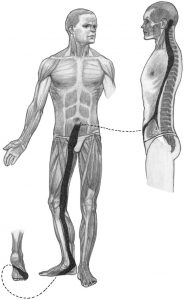
Figure 1: Lesser Yin Tendino-Muscle
Channel in the leg (from Sohn and Sohn,
AMMA Therapy; used with permission of
Healing Arts Press).
From all of this energetic anatomy, we see a pattern of deep, full-body stabilization at work. In TCM, the Kidneys are greatly responsible for the strength and health of the spine, as well as for will power (as in “backbone”). As in Rolfing SI, a TCM practitioner will often use points along the legs, including the Kidney Channels, to influence and support the spine. There is also a great deal of crossover between this channel and the Anatomy Trains’ Deep Front Line (DFL; see Figure 2), which is used by the body for underlying structural support. Myers himself considers the related Liver Channel to be a closer match to the DFL (Myers 2009, 278), and that channel does connect aspects of the inner leg, i.e., the adductors, to the visceral space and the nasal area. However, the Kidney Channel is unlike any other in its ability to connect the “core” of the legs to the entire spine via the psoas and pelvic floor.
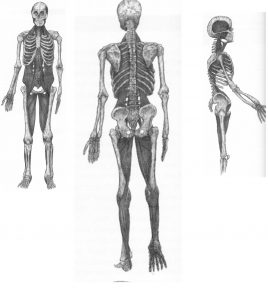
Figure 2: An early version of the Deep Front (or “core”) Line, illustration courtesy of
Tom Myers.
Taiji and the Functioning of Kidney Energy
Taiji also places special emphasis on the Kidney Channels. Besides the focus on the Bubbling Spring point, taiji relies on the rhythmic opening and closing of the groin (through which the Tendino-Muscle Channel passes) by rotating the pelvis over the legs, in effect squeezing the energy that rises from the feet and causing it to gain momentum and power as it travels along the spine toward the hands, as squeezing a garden hose causes a sharper spray of water. This is often coordinated with the breath for maximum effect. So this channel permits the drawing of energy from the ground, the transfer of it through the groin and along the psoas, and the sending of it along the spine on a wave of breathing. Incidentally, the concept of the Kidneys also includes one’s ability to draw breath deeply into the body, implying that the respiratory diaphragm is also an aspect of the Kidney organ complex – the ancient Chinese were less interested in anatomical specifics than general patterns of function.
Toward a Deeper Understanding
I hope that this short introduction has served to illustrate a bit of the crossover between the Rolfing and TCM visions of health, and also indicated the depths that await anyone seeking to thoroughly relate these visions. Behind the odd terminology and esoteric appearance of TCM there exists a wealth of practical information for the somatic bodyworker. I believe it could enrich our field.
Endnotes
Bibliography
Bond, M. 2007. The New Rules of Posture: How to Sit, Stand, and Move in the Modern World. Rochester, VT: Healing Arts Press.
Jarmey, C. and G. Mojay 1999. Shiatsu: The Complete Guide. London: Thorson’s Publishers, Ltd.
Keen, L. 2011 Jun. “The Arches of the Feet in Standing and Walking, Part One.” Structural Integration: The Journal of the Rolf Institute® 39(1).
Myers, T. 2009. Anatomy Trains: Myofascial Meridians for Manual and Movement Therapists. Edinburgh, U.K.: Elsevier.
Schleip, R. 2007 Jun. “Introduction to Dr. Langevin’s Research.” Structural Integration: The Journal of the Rolf Institute® 35(2).
Sohn, T. and R. Sohn 1996. AMMA Therapy: A Complete Textbook of Oriental Bodywork and Medical Principles. Rochester, VT: Healing Arts Press.