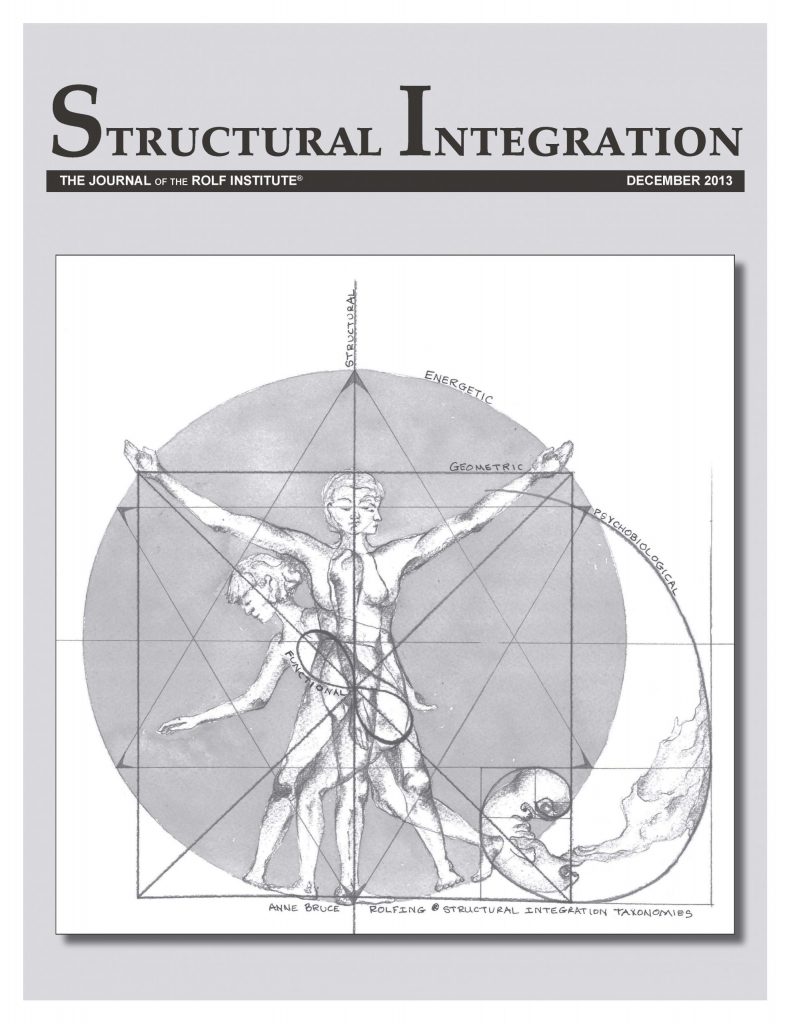
I studied sacred geometry1 about fifteen years ago because I was drawn to the concepts, the forms, and the ways these organize and exist in every living thing. Sacred geometry takes one into words like vesica piscis, tubed torus, Phi ratio, golden mean rectangle, Metatron?s Cube, Fibonacci sequence, the Platonic solids (sphere, cube, tetrahedron, octahedron, icosahedron, dodecahedron), and spirals. All of these lead straight to the subjects of patterns, fractals, systems theory, tensegrity, and quantum physics. Tensegrity, according to Scientific American (January 1998, 48) is ?the architecture of life.?
Anyone who has studied embryology has seen these concepts, over and over, but in the living form. The geometric shapes in embryological images, and in tensegrity, are hard to miss, though looking at three dimensions one might forget that these are the Platonic solids of sacred geometry. In The Ancient Secret of the Flower of Life, Drunvalo Melchizedek (1998, 183) says: ?In the beginning of your life in the womb, you were nothing but geometrical forms.? The ancient mystery schools would tell us that the sacred-geometry forms are also fields around the body.
These sacred-geometry forms exist not only for humans but also in trees, plants, mammals, fish, birds, insects, and the shells of crustaceans. They also form the structure of crystals and metals. This repetition in nature could well be why these geometric forms were considered ?sacred.? It is said that Pythagoras considered the dodecahedron to be so sacred that he prohibited speaking the word outside his school.
Tensegrity, fractals, quantum physics, systems theory, and sacred geometry (and their patterns, evolution, and expression through the physical form) are in my conscious awareness and in the ?field of consciousness? from which I work. These forms are life?s basic building blocks to organize, structure, inform itself, pattern, integrate, and enliven. I am much more informed in how to proceed with each client from this material than I am from knowing how the rectus femoris is supposed to function. I look upon anatomy as an essential learning ? similar to learning our alphabet, colors, and numbers as kids. These basics, however, are too rudimentary to guide us in functioning each day. You know your alphabet so well that you could recite it while doing three other tasks plus reminding yourself to return a phone call when you?re done. I think Rolfers should know anatomy like we know the alphabet, so we: 1) need not question our knowledge of it; 2) are not tempted to use it as the guiding principle; and 3) will incorporate bigger principles regarding life and consciousness into our map of this work. Anatomy, for me, is a crucial knowledge base and, at the same time, an incomplete truth.
Let me discuss further what I mean by ?field of consciousness?; ?in my conscious awareness?; ?incorporating bigger principles? into our map; and ?anatomy is an incomplete truth.?
I can go into nothing more than beliefs acquired from direct experience. I believe:
1. Anatomy lives in the world of doing.
2. Structure lives in the world of being.
3. Each world has its own distinct dynamics.
4. The world of being/structure is a higher principle, is closer to the truth, and is discernible through a palpable vibration and quality.
5. The world of being/structure includes: consciousness (which is evolving), the body as an energy field, and all of who a person is including divinity/spirit.
I believe tensegrity, fractals, quantum physics, systems theory, and what sacred geometry alludes to, also exist in this world of being/structure. These give a higher principle of understanding, integration, and complexity, but the complexity of it is the kind that, when embraced, actually produces simplicity.
For those who don?t have an innate love of geometry as I do, the beginning is the x and y axes, two lines, perpendicular to each other. This gives us two dimensions, and also the horizontals and verticals we all know so well in our Rolfing® Structural Integration work. The third axis, the z axis, produces depth, which gives us three dimensions, spirals, and all the concepts, forms and perspectives of sacred geometry.
The point of knowing sacred geometry is not so much that it directly feeds the practitioner with a ?how to.? The point is that it can expand our inquiry and concepts of: the cylinder model, the ?Line,? multidirectional span (palintonicity), and the influences of gravity. For example, how might your work change if your sense of palintonicity, or of transmission, came from the perspective that the body?s sense of itself, from where it orients, also continues out beyond the skin surface? How might your work change if you knew that the physical body knows this beyond-the-skin perspective and wants to function from it? How is its structure and function limited when we, as practitioners, embody that the skin surface delineates the end of a physical body and an anatomical middle delineates its core?
Some of you, and most of your clients, may not realize that we are bigger than our skin surface. I tell a client to remember a time when someone walked up behind him and he never saw a thing, never heard a sound ? but he knew, beyond a doubt, that someone was there. Nearly everyone has had this experience, and it proves to us that we are bigger than our skin surface.
In my experience, we are also much deeper than our anatomical middle. I can?t prove this in writing, but I can perceive when clients don?t have access to this deeper center, can coach them to find it, and then coach them to move from it. My ability to perceive this deeper center comes from experiencing it, from living it. It arose in me as a result of doing nearly ninety sessions as a Rolf Movement client. I completed this extended process of Rolf Movement six months before I began my basic Rolfing training.
After my basic training, I did Sessions Eight and Nine with my Ten Series clients just as I had been trained for about a year. That approach, however, never quite settled itself into my system. After a year, I shifted my integration work over to what I had known in my own body, this state of larger-than-skin and a core or center that is deeper-than-anatomical-middle. I?ve done integration sessions with clients this way ever since. When clients move from this state-of-being, integration spontaneously arises. In fact, organization and integration happen so pervasively and intrinsically that I am convinced the same could not have been achieved from our classic tissue work.
The body?s own innate wisdom is much greater and grander than what is contained in our anatomy books, and the body wants to have, experience, and express through these grander dynamics. Perhaps arising from both my extensive experience as a Rolf Movement client and my knowledge of sacred geometry, I hold a perspective that includes at least twelve to eighteen inches off the body while I am on tissues to do the integration sessions. While twelve to eighteen inches doesn?t encompass the fullness of the fields around a body, I have found that it is sufficient to engage enough dynamics so that structural integration can manifest and sustain at a higher level.
To date, the only way I know to transmit qualities of being to another person is through guiding another to find and experience it for oneself. This is true of more things in life than just our work, and it is why I stayed with doing my modification on the integration sessions. My approach to integration transmits the information to the client?s conscious awareness and activates qualities and dynamics of being that are already inherent, waiting to be able to arise, in tissues and in experience. I am currently designing a class to teach this integration approach to Rolfers so they can experience integration even more soundly in their own bodies and also facilitate it in their clients.
Fundamentally, a body wants to know, and have direct access to, up, down, front, back, side, side, superficial, and deep. A physical body knows these dimensions exist within, but also beyond, physical tissues. I say, ?the body knows? because that is exactly what it exhibits in organization and movement when it has the freedom to do so. Therefore, there are some restrictions in the physical body?s tissues for which you might find an interesting resolution if you were to play with ideas like: we are bigger than skin; we are deeper than anatomical middle; our bodies are an energy field; all movement originates in perception; and geometric form underlies our structure and innate body wisdom in the field of gravity.
<i>Deborah Weidhaas is in her twenty-second year as a Rolfer. In addition to structural integration, movement integration, and visceral manipulation, she is highly skilled in the mental, emotional, and spiritual material that arises for clients from our work. She lives and works in Los Gatos, California.</i>
Endnote
1. For a good overview of sacred geometry ? including its esoteric and practical roots, structure and consciousness, the natural world, science, math, and embryology ? watch ?Sacred Geometry Explained Part 1 of 2,? and ?Sacred Geometry Explained Part 2 of 2? at www.youtube.com.The Geometrical Taxonomy[:]
To have full access to the content of this article you need to be registered on the site. Sign up or Register.