Anne Hoff: Let’s talk about what happened in Japan with the Fukushima earthquake/ tsunami and nuclear disaster. What was your experience of the earthquake in Tokyo?
Hiroyoshi Tahata: The Big Shake happened at 14:46 on March 11, 2011. I was driving with my wife to pick up my son at his school. Aftershocks continued for a while, which was quite different from other earthquakes I had experienced. [Editor’s note: Minor earthquakes are a common occurrence in Japan.] Fortunately we got to my son soon, which was a relief. The TV news reported on the disaster over and over. One client told me that his body was getting frozen from watching the disaster news, and that it reminded him of previous earthquake trauma. Many people seemed activated from watching TV, even if they had not been hurt or shocked directly by the earthquake or tsunami. I was frustrated at not being able to reach my father; he lived near Fukushima, and phones were dead all day. I also tried to call a client who was supposed to come to my office the next morning – I wanted him to reschedule as the subway was partly offline and some areas had no electric power.
As I hadn’t been able to reach my client, I went to my office the next day, and he did show up on time for the appointment. His take on the earthquake was that it was just one of the various disasters that happen around the world, which happened to happen here yesterday. In this, he helped me understand that, in Tokyo, we were so affected by the TV, by media – more than by the direct experience of the disaster. After that, I managed to reach my father by phone. He had experienced the second world war, so he said to me, “It’s no problem, the situation is much better than that after aerial bombings during the war. It is just a tiny bit of radiation.“ His optimistic words encouraged me. I was beginning to see the situation more objectivity, and to see how many people far from the disaster area could be affected by media like the TV or Internet news.
News reports told us that foreign residents were fleeing Japan, and foreign artists were canceling concerts and tours here. This was disappointing and could easily lead to feelings of being “pariahs.” Further, local families who had babies or young children were concerned about radiation, and some started leaving Tokyo to go places further away from the Fukushima nuclear power plant (Fukushima is 141 miles from Tokyo). Under these conditions, it was not easy to settle or relax.
Similarly, the international school my son attends closed temporally. The advanced class in Somatic Experiencing® (SE) that I had booked in Tokyo was canceled. (It was held later.) A Rolfing® Structural Integration class, Unit 2 of a training with foreign instructors, was in progress at the time of the disaster, and was halted temporarily (which was probably upsetting to the students) with training completed only through session seven of the Ten Series. Ryoko Miyazaki, the coordinator, had a big job checking on the safety of each student after the disaster, and rescheduling the class; instructor Ashuan Seow came back to finish it in June, with the schedule shortened by two days. Japan Rolfing Association board members Kotaro Ogiya and Mio Shinriki devoted themselves to managing the rest of the overall training, which was ultimately completed in the autumn with a Unit 3 taught by Monica Caspari, despite a limited budget as some of the Unit 2 students opted to finish their training in Brazil.
The upside was that many international Rolfers and faculty members sent me uplifting messages, and I was very glad and relieved to learn that they still wanted to visit Japan and teach Japanese Rolfers even though the nuclear plant in Fukushima was not stabilized. I also felt more connection with my colleagues from this disaster. Giving sessions to others made me more present and encouraged, which functioned as a great resource for me. Engaging in my Rolfing practice made me feel needed.
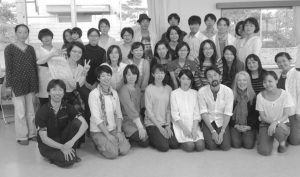 Figure 1: Rolfers and residents of Fukushima.
AH: What inspired you to volunteer in Fukushima, and how did you do that? How did you find a place to go and get the word out?
HT: I visited Shichirigahama, a coastal city about sixty-two miles from the Fukushima nuclear plant in the Sendai/Miyagi area of the Tohoku region in May 2011. It is one of the cities most damaged by the tsunami. I realized that this disaster could be a significant opportunity to learn and expand the possibility of our practice. I instinctively felt that I had to do something. I chose Koriyama in Fukushima Prefecture as the place to work, taking into consideration radiation – the area was quite influenced by radiation from the nuclear plant – and ease of access. I knew the Koriyama train station well from traveling through there to my grandparents’ home nearby, and I could make day trips from Tokyo using the super express train, allowing me to offer sustainable support through repeated visits. The residents of Fukushima have been dealing with a broad and diffuse fear of radiation as no one know how this level of radiation may affect the human body. People have to make a difficult decision to either stay and live under this situation or abandon jobs and homes to leave. Most stay. The radiation will probably last for a long period, which generates fear and rumors about local agricultural products. Undoubtably parents in particular might be concerned about the health of their children. I could not imagine how much stress they must live under, but I felt that this region needs our work.
Before visiting the disaster area, I held workshops in ‘somatic first aid’ (‘first aid’ because the goal was releasing shock, rather than changing structure) several times in Tokyo, with the workshop fees given to Save the Children to support the disaster area. I thought these would be good preparation for the upcoming work in Fukushima. One of the workshops was on sitting, which a participant took back to introduce in Fukushima as a volunteer – and later I myself taught it there, as the topic was useful to disaster victims in crowded temporary housing. Two videos of demonstrations (in Japanese) from my workshops are on YouTube (www.youtube. com/watch?v=g-m8j7xqnc0 and www. youtube.com/watch?v=En0XurUBC00). For my first visit to the area, I planned two Rolf Movement workshops and private sessions. I booked a rental space and announced the date and information on a Facebook page for the event and on my website. Rolfing colleague Yasushi Fujimoto and Sakiko Asai from the SE community joined me by promoting this event on Facebook. People who knew about Rolfing [SI] applied to participate through my website. Yasushi put the word out through a client who lived near Fukushima and put out a local flyer. We also utilized other social media like Twitter to announce the event. Since beginning with a small class of ten in December 2012, Yasushi, Sakiko, and I have grown the program, and on our third visit in September 2013 we had about ninety people attending and seven colleagues participating. Luckily, one local residente attending the first event was willing to coordinate the later ones; her network has broadened our access to residents of the region. Our view is that we have just started this work in Fukushima. The initial workshop was free; my second one had a nominal fee of about $10, based on the local coordinator’s recommendation that participants would feel more at ease paying some amount, which went toward the room rental and a babysitter for children of the attendees, as well as toward our dinner meeting after the workshop. We paid our own train fares. My third-workshop attendees paid what they felt was right for their personal situations.
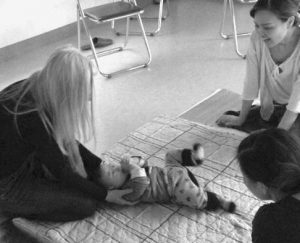
Figure 2: Rolfing and Rolf Movement Instructor Carol Agneesens working with an infant.
AH: What inspired people to try Rolfing SI/ Rolf Movement in this situation? Were any already familiar with the work?
HT: Most attendees were not familiar with somatic practice. Some just knew the name “Rolfing SI.” I thought the first workshop would be good preparation for future visits, introducing our work before setting a lot of slots for private sessions. The subject of the first workshop was how to support children (Part 1) and adults (Part 2) with touch to facilitate settling, and breathing with “Yielding.”1 After the workshop, we provided several private sessions for staff and attendees.
AH: Did you do structural work, movement work, or both in these sessions? Did you make any modifications to how you worked based on any shock/trauma you observed?
HT: I used a movement and perceptual approach rather than structural work. Because of the earthquake, clients had lost their sensation of trusting the ground, so Yielding work was a natural modality as it can allow people to feel safe by first settling into the ground. As any shock/trauma might cause a freeze response and disconnection from one’s senses, I thought it would also be helpful for attendees to get adaptability in the orienting response based on accessing the sensation of safety. Also, tracking sensation in the body can help people to be more present. Some other Rolfers focused on breathing or connectivity, which can help clients open immobilized areas. People living with increased radiation in the atmosphere might unconsciously hesitate to take full breaths. Any tools to increase body resources could help to reset the whole system. Sessions were twenty to thirty minutes. Deciding when/how to close the session was more important than in usual private sessions. I tried to be available to the clients’ in-the-moment needs, rather than think in the way I might in my regular private sessions in normal circumstances.
Whether the client was lying down or sitting, I found that putting one of my hands underneath some area of the body (e.g., pelvis or foot) provided a “scaffolding” that let the body start inhabiting that area again. Then, the body would be ready to open itself. The over-arching intention was to facilitate the person being more present, to reset the nervous system out of the shock response. Most frequently I would have the person lay supine on a mat or tatami floor with raised knees, and I would sit at a comfortable distance and put my hand underneath the soles of the feet, low back, elbows, scapulae, cervicals, and head. After touching for some seconds, I would remove my contact and come back to “my place.” If the body was more responsive than expected, I would take my hand off sooner. Then I would watch and track what was happening for a while, both for the client and in my own body. From this, the client might feel a sense of weight followed by a settling down into the mat, a place of contact that would allow rest. This is the foundation of the Yielding work. The body can be reset by rest, with yielding into the scaffolding. Then the body can restart its own process.
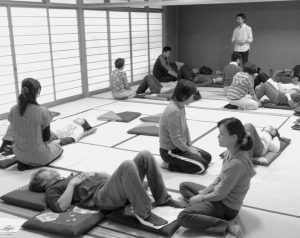
Figure 3: Hiroyoshi Tahata leading a workshop for residents of Fukushima.
AH: What special considerations did you hold that might be different than in your usual work? Did it give you any different personal material to have to process? Did it trigger anything in you of your own experience of the disaster?
HT: My intention focused on facilitating clients to have more body resource with a safe comfortable sensation with touch and tracking. Also, I did not stick to any particular technique, committing myself to be fully available to the needs of the client. I paid attention that intervention was titrated and avoided bringing about too much change. I never experienced anything being triggered in me and found myself highly present in the sessions. Interestingly, I sometimes felt I was more energized during the work there. Since working there, I’ve found my work in my private practice has become more efficient and I’m in a more centered state. So there were many rewards from this participation in Fukushima.
AH: How did the work impact people? Any stories you would like to share?
HT: The group work in the workshop had more effect than I expected. In exchanges where they took the role of practitioner, participants noticed the importance of feeling their own bodies, which affects the quality of this work. After experiencing the roles of both practitioner and receiver, they noticed that these relationships may be basic to all relationship with others (mother-child etc.). I’m very glad that even though the work is very simple, people can be aware of many things. There were other volunteer events, but they were more cognitively oriented, so our workshop about somatic sensing was quite new for the participants, who had had no prior guidance to direct their attention to their bodies and sensation. One attendee shared this with me:
This was a new paradigm I had never encountered. After the Big Shake, I have struggled with how we should protect our children from the radiation. As I try to do that seriously, my body gets tight. I realized how the dysfunction (immobilized neck and back) might be related to my state of my mind. . . . After exchanging work with each other, I felt so much expansion in my breathing and sensation. I could yield into the ground. The next morning I noticed I had slept well and was so refreshed for the first time since I had a baby five years ago. I noticed that it should be important for us to develop self-awareness. I continue to feel resonating in my body. Based on the last experiences in the workshop, I can pay attention more to myself like “Now, how am I doing?” or “Gradually, I am orienting the right way.” Other mothers of my acquaintance look so exhausted and shaky, feelings that may transmit to their children. I think we mothers need only look within ourselves to get back an inherent calmness for the kids.
Thus, the experience of being the practitioner could give parents new insight into relationships such as child-rearing.
AH: What other practitioners were out there in the field, what sort of things did you mutually observe, reflect on?
HT: Sakiko Asai, an SE practitioner and psychotherapist, has participated since the first visit. I am very thankful she’s there because she may be able to provide professional psychological care if it’s needed. She seemed to enjoy assisting in my demonstration and was a sympathetic presence interested as a somatic psychotherapist in what we are doing with touch. Rolfing and Rolf Movement instructor Carol Agneessens joined us when she was in Japan; she led a movement meditation in group work and gave beautiful sessions for kids. Rolfer Yasushi Fujimoto as a start-up member contributed a lot to this project. Rolfers Mihoko Takahashi, Masaki Miura, Nobuhiro Miyahara, Takeshi Hirahara, and Seiji Kamimura have joined our group and given wonderful sessions. All said it was a wonderful experience. It was impactful to feel that our work with touch is so important for a disaster area. More than expected, the people in Fukushima could feel differences and be more open to sensation in their bodies after the workshop and private sessions. We got a really good response to our work and can see its potential, and feel the important role we can play as Rolfers. After every single visit, I saw my colleagues more energized and satisfied.
AH: Are there any people you have worked with multiple times, and how do you see the work affecting them over time?
HT: Some people have come to us a few times. The workshop seemed to encourage self-reflection and gave them some tools to give the work to others. I think the workshop can develop more relationships there, and repeater attendance seems to increase responsiveness. In closing, I’d say that this was not just us serving others as volunteers, it was also valuable training for us in extending past our usual limitations.
Endnotes