
Purpose of This Article
This article will provide an overview of a specific aspect of voice physiology and its practical use by singers. I will be speaking to the Rolfer who works with singers (or is a singer herself) or has an interest in further study in this area. I will be utilizing a set of singing principles that were developed by an Italian physician, P. Mario Marafioti, whose specialty was problems of the voice. He worked with Enrico Caruso and other singers. Marafioti’s (1981, 123) sixth principle of voice production states the there are “no registers in the human singing voice when accurately produced.” He states it is “. . . made up of only one register that constitutes its entire range.”
I have been a singer all my life. Since 1972 I have studied with a number of voice teachers and am a graduate of the American Academy of Dramatic Arts in New York City (NYC) where I received high-quality voice and speech training. Even with all this, I was not able to transcend the barrier of the so-called vocal ‘break’, meaning that moment where the voice makes the transition from so-called chest register to head register (also called head and chest voice), the bane of existence for many singers. I had to learn to work around this break to attempt to hide it from the audience. It was never satisfying and always frustrating. My singing voice lacked power and presence, plus the effort of hiding the break wasted both psychological and physiological energy.
Enter Dr. Rolf and Margaret Riddleberger
In 1979 I was simultaneously introduced to the Rolfing® Structural Integration (SI) experience and a singing voice teacher named Margaret Laughlin Riddleberger. These two events fomented a big change in my life. Rolfing sessions integrated my body into a more adaptable unity, and Riddleberger showed me how to use this unified body to produce a unified voice with a relaxed power to it and no break in my range whatsoever.
Riddleberger had sung at the Metropolitan Opera in NYC, but fortunately for me, she liked teaching actors. Her work was profoundly different from the other singing voice training I had received. In addition to singing, she had a masters degree from Columbia University in an area of psychology that was then called ‘personality stress’ and what we would now call trauma or traumatic stress. The ensuing twenty-three year apprenticeship and collaboration with Riddleberger redirected my life in many ways. Riddleberger had studied with a woman known to her students as ‘Teach’, who trained Metropolitan Opera singers in NYC. Teach adhered to the physiological perspective in the split within the Italian Bel Canto Voice Method (bel canto: 17th century Italian, ‘beautiful singing’). The non-physiological side of this approach focused on beautiful tone; words were secondary. When opera began to demand genuine emotion over just beautiful tone, a split happened in approaches. Riddleberger called this tone-centered way of singing “singing with marbles in your mouth” or a “singing with a paper bag over your head,” because meaning and communication were sacrificed to tone alone.
Results of Rolfing SI on My Singing Voice
The day that I completed my seventh session with Pat Clough and immediately went over to the Ansonia Hotel to have my voice lesson was the day that I truly understood how Rolfing SI could deeply affect singing. Fear, in the form of tension, inhibits our body’s natural acoustic ability. I discovered that day back in 1979 that relaxation with a degree of structural integrity is a key to producing a natural and resonant voice: a voice that is your own vibratory uniqueness, your unique expressive signature.
That particular Friday, we were assigned to the deadest room acoustically at the Ansonia Hotel Rehearsal Studios. Riddleberger and I were doing the quiet ‘line-up’ work, where you use the least amount of energy to find your tone, yet the entire room was vibrating (what she called ‘shimmering’), something that I had never felt in that acoustically-dead room. I was hardly doing anything (much different than what I usually did, an over-working which produced little benefit).
‘Lining-up’ meant sitting very quietly at the piano and using the minimum energy to focus sound vibration, through consonants and vowel placement, with total body involvement. This I now call ‘mindful singing’. Riddleberger would never allow you to use what she called the ‘back-up’ system (definition to come). Instead, she would hold you to blending speech with tone so that you never gave up natural speech placement while you channeled breath into the system. If you consciously engaged your vocal folds (throat) at all, the amount of air being moved through them could cause damage, given their delicate structure.
On this day, I directly experienced the human vocal system as a supremely efficient and effective vibratory system. I know that few of us have ever had the pleasure of that experience, and most only in peak moments.
Partnering with Riddleberger, I began to do research. I discovered Marafioti’s work at the Lincoln Center for the Performing Arts Library. His writing validated what I now was experiencing as a singer with Riddleberger, and this then accelerated my study and collaboration with her. When I became a Rolfer, I could contribute, for I brought to her (at our weekly meetings) physiological and anatomical knowledge that inspired her. With the art of singing that she plied and the science that I brought to my lessons, we were able to take this established approach to another level of helping singers streamline their embodied craft. The goal was always a voice that represents them (their very being or spirit) powerfully and uniquely. I’ll say more on this ontological aspect of singing later.
Riddleberger taught me how to bring people ‘out’ through voice training, moving through acquired defenses that had crystalized as somatic, emotional, intellectual, and spiritual protective mechanisms. She would send her students to me for Rolfing SI when they reached a plateau in their work, when they came up against a block. According to what she told me, my track record was 100%. I was always able to help unlock what was preventing that student from moving forward in his ‘internal’ work with her. We had a synergistic, twenty-three year research lab, as she would say, where we shared our results and experiences, which moved us both along tremendously.
Riddleberger became a big proponent of Rolfing SI in the Washington, DC and NYC acting communities. She said that Teach and Rolf had a lot in common, came from the same era, and Riddleberger herself would have become a Rolfer had she been younger and her circumstances different.
Permission to Take Up the Baton
One day, about a decade into our collaboration, Riddleberger said, “Who ever thought it would be you?” – meaning, I was being given her approval to take this physiological singing approach further. During twenty-three years in NYC, I became known among professional singers as a ‘go-to’ guy for unlocking voice potential through the body. I am myself an actor and a singer, and with my one man-show Love, Desire, and Growing Pains I demonstrated that I practiced what I preached. I had accrued the experience, the authority, and her blessing to dive deeply into my long-held passion.
Stress, Speaking, Singing
Acquired fear in the body, what Rolf called stress and which presents as constraint and inadaptability, plays a significant role in producing the ‘break’, or split in the singing voice. Having worked with singers for more than thirty years, I will assert that unless you are shown how to transcend this barrier, you are mostly doomed to use the back-up vocal system. What is this back-up system, which I term the ‘pseudo-singing voice’? Bluntly said: the back-up system is a misuse and/or inefficient use of the vocal apparatus.
The authentic voice is not constrained by fear and uses the full capacity of your instrument to express you, originally, uniquely, and acoustically. The back-up system sidesteps all that hard work and development, instead opting to merely survive, make do. It is a fraction of the capability of the vocal instrument, while usually sounding like someone else on whom you are modeling your voice.
Rolfers recognize from direct experience what happens in a body when unresolved stress, illness, accidents, repressive emotional family patterns, toxicity, effects of poor diet, lack of competent exercise, childhood trauma that we all experience, and so on have been carried around unresolved within our delicate organism. This organism has natural, predetermined limits to what it can accept, assimilate, and integrate. Beyond those limits, flexion or compression and twisting of joints and declining metabolic activity result. In short, we become locked down. Gravity no longer supports, but works against the body (Figure 1). Without dynamic relaxation and intrinsic body resilience and adaptability, we can only use force or compression to produce sound, which is very limiting. Force precludes full access to your authentic voice.
What have I learned then? This is my thesis, backed by thirty-five years of experience, using Marafioti’s (1981, 115) words (with my emphasis): “Speaking and singing are similar functions, produced by the same physiological mechanism: therefore they are the same vocal mechanism.” The speaking voice, he continues, acts as the substantial factor of the singing voice and constitutes its real support, ergo singing is merely speaking in musical rhythm.
What I was discovering was that singing is a dynamically relaxed-while-expanding-and-lengthening process, in combination with natural phonetic placement. This system, once discovered, uses your entire body and its ‘acoustic’ properties and is able to make your external environment vibrate (which includes the listeners). Nothing is done whatsoever to manipulate the vocal folds unless the singer has a habit of tension in her vocal folds while speaking (a very common idiosyncrasy called glottal fry). This is not desirable aesthetically, provides no help and, in fact, causes problems down the road as inflammation develops and ultimately polyps form. In singing, you use much more air than in speaking, so the problems come fast. Ideally, the larynx is meant to be completely relaxed (because neither speech nor singing happen in the throat). Relaxation is the goal.
Many singers and teachers believe that speech and singing involve a conscious manipulation of the vocal folds (mistakenly called ‘cords’). This is both completely unscientific and ineffective, if not harmful. Many approaches train the singer to consciously manipulate vocal folds in the throat. Some spend obsessive amounts of time observing with specificity how the manipulation functions. But when we speak, we never have to do this, and so it is with singing. An analogy would be, when you gaze at something, are you aware of your retina?
What I have experienced firsthand over all these years is that anything other than natural speech placement can be part of a defense mechanism. These protective mechanisms are mostly acquired through intense reactions to parents and family early on in childhood. These defense mechanisms are simultaneously physical, emotional, mental, energetic, and spiritual, and are developed to protect wounds in the child’s psyche. Many of us can carry these traumas for an entire lifetime without ever becoming aware of them. Defense mechanisms are psychobiological imperatives and cannot be released easily. It takes time and skill.
As Rolf pointed out, humans basically learn through copying or through reacting to others’ behavior. Truly singing from one’s heart, the unguarded center of human emotion, can be terrifying or impossible for someone who has not developed enough to be individuated. This was in fact my state when I began my work with Riddleberger; I was not very developed at all.
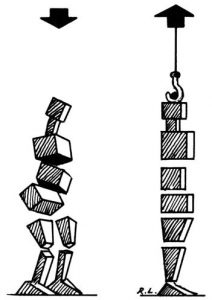
Figure 1: Dr. Rolf’s illustration of the sky-hook is apropos of what a singer feels when she is singing. It is a constant upward thrust while expanding once we transition into ‘drafting’, or sustaining the vowel, which many call ‘holding a note’. (From Rolfing by Ida P. Rolf, PhD. Published by Healing Arts Press, a division of Inner Traditions International, 1989. All rights reserved. www.Innertraditions.com. Reprinted with permission of publisher.)
The Foundation of Singing Is Speech
When I speak naturally, I do not consciously prepare to speak; I just begin speaking. I do not have to consciously inhale. I simply finish the previous word, relax, and my intrinsic muscles produce a vacuum and this involuntary, instinctive action fills the lungs without me ‘consciously’ having to do it (nature abhors a vacuum). Singing is a similar physiological process. Before you take that common singer’s gasp of breath, there is enough air in your lungs to take the next phrase quite far, much farther than imagined. Physical injury or emotional reasons lead to the loss of this capability. When you are performing live for an hour or two, inhaling through your mouth will dry out the throat, and we need wet mucosa to sing well.
Singing and speaking utilize the intrinsic muscles of the core. Few of us have developed these muscles well from the inside out. They have mostly been over-powered by over-involvement of the big, armoring muscles (called the extrinsic musculature) that dominate physical behavior and aesthetics in western culture. At best, the big muscles only extend the movement in space; the small survival-oriented ones initiate all action. When you are in a fearful situation, like performing live, the small ones will go into flexion if you have not trained them to do otherwise.
Let me make my assertion clear: singing is a similar process to speaking. And there is experience that is needed in order to make the transition from speak-singing to sustaining a tone, at the moment when the singer ‘holds the note’. This is more accurately said ‘sustaining a vibration’, and this always happens most effectively on a vowel to maximize resonance. Riddleberger’s lineage/system calls it ‘drafting’. The key is knowing how and where to place, as well as shape the vowel, because vowels allow continuous and uninterrupted airflow and generate a vibrational force field that moves through matter. This is key. The transition to sustaining the vowel is what most singers do not do well, if at all.
Each singer brings something unique that cannot be taught. It is hers. However, this transition has to be taught to most singers. They have to learn to generate this state change (e.g., gel to sol is a state change). In non-linear physics terminology, this is also known as an ascending phase shift, which is a higher, more efficient use of energy. It can be learned. It will make all the difference between acceptable singing and being able to penetrate an audience’s heart. It is a sonic and energetic transformation. Furthermore, the singer has to learn to generate it over and over again in a completely elastic and relaxed manner, which remains transparent to the audience.
Try This . . .
One school of voice connected to the work of Rudolf Steiner focuses the entire curriculum around producing and sustaining the sound ‘ng’. When we produce the sound ng, as in SING, notice what is happening physiologically when you sustain the ng. Notice what is needed in order to sustain that sound, as the moving column of air is being transferred through the nose (precisely, the post-nasal drip holes); feel it for yourself softly and easily.
This exercise alone will help the singer begin to develop the core musculature needed, in a unitary and comprehensive way. There is much more to say about this, but may it suffice that developing the unified intrinsic or survival musculature that supports efficient speech placement is the heart of singing voice development. You really can’t teach someone to sing from the heart; that is what comes naturally. You can, though, teach him how to get out of his own way physiologically and allow his expression system and vocal apparatus to do what they do, simply by inherent design.
The dancer spends countless hours developing his body through movement; the martial artist repeats her form to an ever-higher degree of perfection; the singer works with speech placement and acoustics. He has to if he is going to get up in front of others and transmit emotional and psychological meaning via what might best be called speak-singing. Please note that the intrusion of the microphone is another story entirely. This article is about using the natural voice in relation to its physical environment, without any enhancement.
Ephemeralization, Using Ever Less
Another principle of Marafioti’s (1981, 75) concerning voice production has to do with the “. . . full extension of the range of the voice being produced by using the minimum tension of the vocal chords, and the minimum breath required for each tone.” This establishes an effective process of voice production and an accurate use of the system’s inherent design. The laryngeal sounds (‘embryonic vibration’) must be transmitted to the mouth, free of any interference, and so he says that freedom is the fundamental pillar of voice production. This is true in my experience, and I assert Rolfers would share this value of freedom.
The Rib Cage
If you accept that singing and speaking are the same physiological process, you can observe something interesting that many people do when they begin to sing. It is not expanding and lengthening the body while simultaneously lifting and expanding the rib cage via the dorsal hinge, to keep the chest cavity from collapsing. It is virtually the opposite. The singer contracts ensuring that none of the rest is possible.
For a singer, maintaining lift and separation, especially in the first and second ribs (see Figure 2), will allow the most efficient use of the breath as it allows free flow of air through the throat into the mouth.
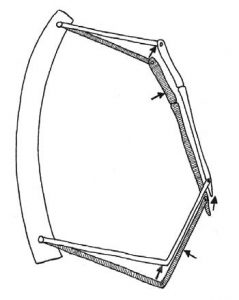
Figure 2: Having a very flexible and adaptable rib cage and working knowledge of the dorsal hinge is key to finding your resonant and natural voice. Without it, you are very limited as a singer who performs live. Studio singers don’t necessarily need this ability as the microphone magnifies their voice for them; the microphone can be a crutch, however, and vocal injuries result. Or, without being fed by the full efficiency of this method, the aging singer loses his voice over time. [Image from The Body Moveable, 6th edition (www.bodymoveable.com), used with permission.]
This involves knowing how to engage and extend the psoas complex into the respiratory diaphragm region (see Figure 3) in union with the spinal column’s extensibility and adaptability (see Figure 4). This must include knowing how to utilize the dorsal hinge, giving the full range of extensibility in the rib cage. Each of these actions also must happen while never giving up your natural speech placement nor using any force whatsoever, nor involving the throat in any way, nor letting the audience see what is happening. It is an athletic event at minimum.
Most people’s rib cages have deformed to some degree over their lifespan; some to a greater degree, as Rolfers well know. The chest is the seat of the emotional center, our heart, and the center through which we relate, communicate, and interact with those in our world. Also, the heart is paired with the aspects of the brain that process emotion. From my observation, the chest is also specifically where we carry the sadness and sorrows that we have accumulated in our life. This often causes distortion, which comes in the form of tightening and locking in the external and internal intercostals, the respiratory diaphragm, the thoracic inlet, and the rectus abdominis pairing with the psoas and the quadratus lumborum.
In many clients the connective tissue, especially in the upper two or three ribs, is very frequently nearly fibrotic. For the singer, this negative concatenation is deadly. When there is an inability to adapt the rib cage as a whole to a more horizontal orientation, it simply prevents us from accessing our full speaking and singing capability. It diminishes the uninterrupted flow of air like putting your foot on a hose.
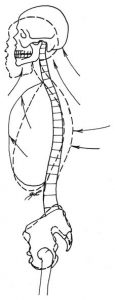
Figure 3: This drawing from Rolf’s book demonstrates how the whole body feeds the vocal apparatus and how singers need tremendous adaptability. (From Rolfing by Ida P. Rolf, PhD. Published by Healing Arts Press, a division of Inner Traditions International, 1989. All rights reserved. www.Innertraditions. com. Reprinted with permission of publisher.)
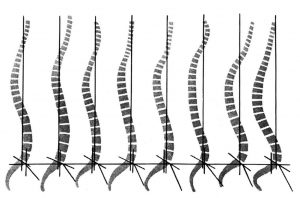
Figure 4: Rolf’s underscoring of the adaptability of the spinal column is something demonstrated by successful singers. Each singer needs to find her own range of motion for the spine and rib cage, as this can provide a vocal range that is more than three octaves without any break in it whatsoever. Learning to develop resilience and adaptability in this system is key to the process. (From Rolfing by Ida P. Rolf, PhD. Published by Healing Arts Press, a division of Inner Traditions International, 1989. All rights reserved. www. Innertraditions.com. Reprinted with permission of publisher.)
Nothing to Do with Vocal Cords
It is generally believed that the vocal folds/ cords, which are mistakenly called the voice box, produce speech. In actuality, the vocal folds only produce what Marafioti calls an ‘embryonic vibration’ that is not speech. Speech comes together in many places: the mouth – more the front of the mouth, including the teeth; also the cavities of the cranium; the facemask; and much more (Figure 5). Let me reiterate that both speech and singing are produced in the mouth (with the aid of the resonating cavities and mucosa), not the throat.
Marafioti (1981, 69) makes it clear that “Voice is speech, and is produced by the mouth, not by the vocal folds. The vocal folds produce only sounds (embryonic vibrations) that are transformed into vowels and consonants by the phonetic process taking place in the mouth.” Vowels and consonants give rise to the voice in the mouth – not in the throat.
If you manipulate your palate, tongue, or vocal folds, you are most likely not on your instrument, and what I call a ‘pseudo-singing system’ becomes your default, without you even knowing it. The voice is not a mechanical process: it is more a physiological and psychospiritual event. When you do not trust that speech and singing are the same event, what happens is that your teeth will not be used for what they do superbly, which is vibration (note: these are the most vibratory bones in the body). The front of the mouth is where speech/singing originates. One has to develop the intrinsic musculature to sustain this caliber of placement. Otherwise, the speech production center drops into the rear of the mouth and into the throat. Thus is lost the direct acoustic benefits of the cranium with its cavities, sinuses, and liquids, which are ideal for producing power, color, and resonance. In other words, you lose that potential for magic.
My Own Discovery: Physiological Center for Singing
In the martial arts, the knowledge of the tan t’ien (Chinese: center of gravity or moving center) has been fully established for a few millennia. This area of the abdomen is found three finger widths below the navel, within the abdominal cavity, about one third of the way from the surface moving posteriorly. It is the basis of Oriental medicine, where all vital energy (Chinese: chi, Japanese: ki) is circulated throughout the organism to maintain health. This center of gravity is central to the voice work that I have developed and now teach. (Riddleberger did not teach this. She was many things, but not a martial artist.)
In T’ai Chi, the non-aggressive martial art (which I‘ve studied since 1985), the tan t’ien is the initiator of all movement and also unifies all movement and energy. The basis of yet another article entirely would be the exploration of its relationship to the enteric nervous system, which, while part of the central nervous system, can also function independently in moments of crisis that threaten survival. The tan t’ien, too, can be trained to take over in survival moments where thinking about how the past relates to this moment would only get in the way: like facing a ravening wolf or when you are in front of an audience.
In combination with the tan t’ien, I address the line. Rolf’s ‘Line’ is similar to the internal line of yoga and the pivot line of the non-aggressive martial arts. This line is the other key to relaxed and powerful singing. Without the innate awareness of both this center and this line, it is difficult to repeat what is necessary in singing. It is necessary to return to this center and initiate the placement/lift/drafting process again and again, at the beginning of each phrase, after you have sustained a vowel (Figure 6). When you learn what the vocal apparatus is and how tone is actually initiated and sustained, you realize that it is very simple and efficient indeed. But we have mostly overshot it and our panic, self-criticism, and nervousness in communication has prevented us from remaining relaxed and natural in the speech event we call singing (speak-singing). At http://singingvoicetraining. com/listentodavidsing/ you can hear a selection of my singing using the principles and training I discuss. This recording of Stephen Sondheim’s “No One Is Alone” is from my one-man show, Love, Desire, and Growing Pains, recorded in an intimate theatre in NYC. It is best to listen with earbuds or headphones to get the nuance of what is meant by speak-singing.
In Closing
I have spent the better part of forty-five years obsessed by all this. I have focused on principles and descriptions in this article rather than strategies for two reasons. The first is that any competent and experienced Rolfer can be of service to a singer, even when that singer uses a compressional approach, as opposed to an expansive one. In your work with a singer, a few of the key focuses will be:
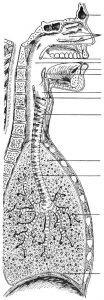
Figure 5: Marafioti’s drawing of the anatomy of the vocal apparatus demonstrating: 1) the power aspect – your lungs; 2) the vibrator aspect – the vocal folds in throat; and 3) the resonator aspect – nose, mouth, and sinuses – comprising our one unified voice. From Marafioti’s 1922 edition of Caruso’s Method of Voice Production: The Scientific Culture of the Voice [New York: D. Appleton and Company; a reprint of the book is currenlty available from Dover Publications (New York, 1981)].
The second reason that I have focused on principles and descriptions rather than strategies is that to go further and really train a singer in the expansive dynamism of authentic speak-singing, hands-on, one-on-one training and workshops are required. This is the only assured way for this knowledge to be shared with singers and bodyworkers. It is profoundly experiential. Words won’t suffice.
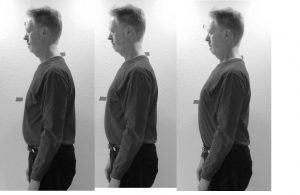
Figure 6: In these photos of me in three stages of uprightness, to the full open cavity, you can see how the larger, lateral fullness of the rib cage would permit better ‘drafting’. When we sing, since speaking and singing are similar events, we do so in a relaxed manner. This three-stage posture shows the range where this occurs. (A) Here, I am in the posture of natural speaking. (B) This intermediary posture happens at the moment I transition from speak-singing to sustaining the vowel. (C) This ultimate posture is where I need to be in order to sustain the vowel, where I can put power, resonance, and color into the vibration. Again, some call this phase ‘holding the note’. This system calls it ‘drafting’.
David G. Delaney has thirty-two years in somatic work; he was certified as a Rolfer in 1985 and as an Advanced Rolfer in 1993. He has a master’s degree in counseling and is an LPC (Licensed Professional Counselor) specializing in the nervous system, trauma, and optimal performance. He works with performers and singers both. He’d relish hearing from any Rolfer interested in further exploring this way of working with singers. Contact him at David@ DavidDelaney-Rolfing.com.
Bibliography
Marafioti, P.M. 1981. Caruso’s Method of Voice Production: The Scientific Culture of the Voice. New York: Dover Publications. (Republication of the 1922 original.)The Physiology of Singing[:]