
Introduction by Heather Corwin:
I met theatre director Monica Payne when studying Viewpoint work (actor training) with Alexandra Billings; both Monica and Alex teach classes for Steppenwolf Theatre Company in Chicago and in California. Since we all have history in Chicago, Monica and I easily became friends, sharing our experiences of Chicago and our acclimation to living in Los Angeles, where we both reside presently. In a class that Monica dropped in to watch, a fellow student was beginning the spiral of a migraine. I’m not usually one to offer hands-on work outside of my studio, but I felt compelled to ask her if she wanted me to help. She eyed me warily and said “yes.” Most of what little I did was craniosacral work to decompress her head. The classroom was small, so there was no way to get away from people, but the class quieted in support without prompting. This group of people had a special connection through the work we created together, so words were not needed often. There was a shift of energy in the room and I could tell more space was active and at ease in my friend’s head. She sighed and looked up at me. I slowly took away my hands. She had a look of disbelief on her face. “It’s gone. My migraine is . . . GONE,” she said. I smiled and said, “I’m glad,” because I truly was. Monica then asked, “What is it you do?” I said (without censoring myself – because I rarely describe myself this way), “I’m a healer.” She looked at me as if sizing me up. This was, after all, the land of fruit and nuts.
Monica teaches the Meisner acting method, which is what I learned in graduate school at Florida State University/Asolo Conservatory. She was starting up a private acting studio in LA, and at the next class she came to asked if I would be willing to join the group as sort of a leader so that her other students might benefit from my experience. I enthusiastically agreed! That was in 2007, and it was around this time that Monica started to experience discomfort in her avid yoga practice. Recalling the event in the acting class, she sought me out for Rolfing® Structural Integration (SI). After our first session she conceded, “When you told me that you’re a healer, I thought you were full of shit. I’m glad I was wrong. You really are a healer.”
Since that time, Monica and I have worked together consistently through Rolfing SI when she is in town. Through injuries, chronic pain, directing projects, teaching at UCLA, and as preventative maintenance, Rolfing SI seems to be a great fit to support her wellness. What follows is an interview I did with Monica in October 2014 to investigate her experience with Rolfing SI, the body, and how both impact performance.
Heather Corwin: Monica, can you tell me what the essence of you is as an artist?
Monica Payne: Well, I am a director in practical terms. I think as a [theatre] director, the things I care about the most are creating a production that is both visually beautiful and very emotionally connected. In order to do that, I have to be able to contact what I think is the emotional center of the play. And in order to do that, I have to be emotionally connected to myself or know what is going on inside of me so that I can figure out how to actually get in touch with the play and then transmit that or help get the actors connected to that also. And the designers, in fact, because in order to make something visually beautiful that expresses the heart of the play, the designers have to grapple with the same questions as the actors do.
I just recently heard this funny phrase. Someone said that we are “citizens of the theatre,” which I love. So I think I’m a citizen of the theatre. In my essence I’m very political. I want to be political as an artist. The act of being in a process together is part – the work is one thing when it’s with the audience, but I also believe when it’s just among the artists, it is a catalyst for something right there, before it goes to the next step and goes to the audience. In my essence I am hopefully gritty but also elegant as an artist. Someone said once that I know how to do things that seem “new agey,” Grotowski-like ritual. But also I’m not afraid to say to someone, “That does not work. No. We’re not doing that.” Someone else described me as “no bullshit” but also as a spiritual director at the same time, which I thought was a great compliment.
H CYou mentioned emotions and connecting to them. How do you think your physical life informs doing that?
MP: I guess I believe your emotions are living in your body more than they are living in your head. So if you are too stiff in the body – this goes I think for actors and directors – if you’re too stiff in your body or huge sections of your body are cut off, I don’t think you can access your emotions. When I’m directing the play, I’m often trying to feel what’s happening. I feel that literally in physical impulses. I sometimes say to actors, “I don’t know, can you do something like this?” – and then I roll around on the floor or I get on my hands and knees. Often, rather than speaking what I want, I am showing them in some kind of physicalization, and then I ask them to pick it up and make it belong to them. So I think that theatre [demands] the body be your instrument, if you’re the actor. I think [performance has] got to be highly activated physically. Through that physical activation, emotions will usually just start to pour forth. You don’t have to try get them to come up. They just come up. Once the body is fully activated and free, then everything else just begins to flow, in my experience.
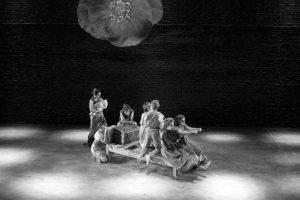
From a production of Eréndira: The Incredible and Sad Tale of Innocent Eréndira
and Her Heartless Grandmother by Gabriel García Márquez, adapted, directed and
choreographed by Monica Payne. Produced at the UCLA School of Theatre, Film, and
Television (2011).
HC: And what are some of the ways that you tend to get more physically free or lead your actors into becoming more physically free?
MP: At the beginning of every rehearsal, I [have them] do something called ‘sacred space’. So I have them lie down on the floor. I walk them through a really basic meditation at the beginning and connection with breath. It’s all meant to actually get them to be very quiet and get the body to neutral [free of emotions or distractions from life]. If you’re not in neutral first, it seems strange to go in one direction or another. I think you have to start basically at zero. You’re not at zero when you walk through the door to rehearsal. I’m not either. They’re not and I’m not, right? So I put them on the floor for a while and then I walk them through a slow series of yoga, really gentle yoga stretches like child’s pose, cat/cow, and then I start to add some chanting. They do some gentle ‘om’s and sometimes some other chants that I teach them while they’re moving. So while they do, let’s say, cat/cow, they have to release sound at the same time. So kind of slowly do that and work them up to standing. And then I have them do a few non-verbal movement exercises where they’re trying to synchronize as a group. That stuff is Viewpoints based, but it’s really gentle. We do the exact same two or three every day for six weeks. So it’s all about you have a moment to be neutral with yourself, now this is your moment to be neutral with the collective. We do that every day, rain or shine, even once we’re in performance. I work [it] out so that the call has enough time in it for this half hour [of] sacred space with the company. A couple times in tech I’ve been under pressure to get rid of it, to start. There’s a huge difference. They’re not ready. I’m not ready either. Those few times have been like the worst evenings of rehearsal ever. Because no one was focused and soft enough to respond to the task at hand.
I certainly can see sometimes – usually when I’m directing I’ve gotten rid of these people already – but when I’m teaching, I see people in sacred space who cannot move. Like, to ask them to do cat/cow, I see people whose torsos are such a solid block either of muscle or just stiffness that they don’t have any spinal flexibility. If I’m in an audition process and I see that, I usually eliminate that actor because I know [s/he is] not going to have much access to the heart or the gut because [s/he] can’t move it. Right?
To me, the body is the first place to begin. I’m often working with actors who are between eighteen and twenty-four, their body is at the prime, is at the height of life right then. So beginning there works much better than starting with psychology, because their psychology is still forming but their bodies are so strong and so flexible and so ready to go and so expressive, actually, once you teach them how to do that, that the body, to me, is the first logical point of entry. Then voice, of course, flows. An open body will allow an open voice to come out. Everyone has a deep emotional life. So if the body is open, then the emotional life just starts to pour forward. So yes, I actually work for several days nonverbally, at the very start of the rehearsal process, so we are just communicating through body to teach them also the power of nonverbal communication, to teach them how strong they are in their physical life before we go to anything else. Before we’re even really attached to the play, we just run and jump and grab each other and roll on the floor. It’s all just purely physical in the beginning.
HC: It sounds really fun.
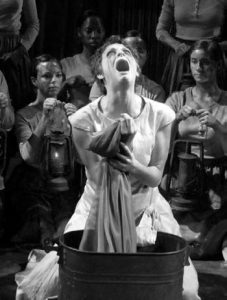
An actor portraying Elektra in Elektra by
Euripides, directed and Choreographed
by Monica Payne. Produced at the UCLA
School of Theatre, Film, and Television
(2010).
MP: Yes. It’s fun! And they’ll usually do things in that section that are quite amazing. Gestures will begin to emerge that will come from different small groups that are creating separately, but the same gesture will come back over and over again and then I know that gesture has to go into the play. Things just start to rise out of the body. Of course, the prerequisite for all that is that the body be fluid, ready to move, that the person can breathe, you know, that the body is strong but supple and ready to move in any direction it might be asked to move in.
HC: I feel like this is a good segue to talk about Rolfing [SI] and your experience with it and further, how you think Rolfing SI may have impacted you as an artist.
MP: So I, as you know, have [had Rolfing sessions] probably once every two weeks for several years. I think artists are inherently super-sensitive people. I am. I’ll speak for myself, I’m an incredibly sensitive person. The Rolfing [work] helps me, I mean it helps me physically, of course. Right? Something hurts, and I get [Rolfing SI], and my arm doesn’t hurt anymore. So there’s that piece of it. But I also think it allows for a kind of slow release of stress, emotional stress that’s building up, or things that have sort of started to bother me emotionally that I’m not even aware of. I’m getting ready to work on this play that’s about the Holocaust, basically. It’s about World War II, there’s a lot about Auschwitz in there. There’s a modern soldier who’s suffering from PTSD [post-traumatic stress disorder] because he was sent to Iraq. I was aware when I was doing a really careful read of the script two days ago to prep for some meetings, and I could feel the stress of the play enter my body. Right? It’s tough material. It’s about people making horrible choices and then it’s a terrible war. I feel like the Rolfing [work] not only helps me maybe release some excess feeling about what I‘m taking on in the work [preparation to direct], but it also helps me be more open to receiving the work in the first place. I can read about Auschwitz or I can read about Poland and Germany during the war and I don’t have to be afraid that I cannot contain the heaviness of that experience. Right? Because what has to happen is I have to take that experience in, I have to synthesize it, and then I have to give it out to the actors and eventually to the audience. My container has to be strong. I feel like Rolfing [SI] helps me do that; keeps me strong emotionally, physically, spiritually, on some level, and that if there’s something that I take on that’s too much, the Rolfing [work] gives it a release valve. Not to mention, like I said, I end up rolling on the floor with people. My literal body has to be strong. I don’t want to have a lot of aches and pains. I want to be able to spring up out of my chair and grab an actor and start to do choreography or gesture work without any problem. I just want to be able to do it.
Twyla Tharp wrote a great book about creativity. Twyla’s in her sixties, I think. She gets up at 5:15 in the morning and works out every day at the gym and then goes in with the dancers. She talks about how important it is for her – she can’t do what she could when she was twenty – [but] she talks about how important it is be able to keep up with dancers to some degree or to show them she still can demonstrate some things so that she has some credibility. I feel like I’m not Twyla Tharp, but I want that kind of credibility with the actors too. I feel like the Rolfing [SI] keeps my body more awake and alive and fluid than it would otherwise be.
HC: Have you ever suggested to an actor that he might investigate Rolfing [SI]?
MP: I talk to a few actors who have incredible injuries. They have back pain every day, all day, but they are just ignoring it and they are twenty-one years old. I have said, “My own experience with Rolfing [SI] is great. Maybe you could try it because you should not be in chronic pain when you are twenty-one, and it’s just going to get worse.” So, yes, occasionally I have recommended it either for physical ailments that actors have or sometimes when some emotional stuff seems like it’s building to an extreme, then I have talked about it as a way to release emotional baggage straight from the body rather than having to go through the psyche. I certainly would also say to actors that it’s a good idea to go to therapy. But the Rolfing [SI] to me is another modality that might accomplish the same thing depending on your body and mind and heart.
HC: Where do you think trust is on the scale when doing physical work (including Rolfing SI) and as an artist?
MP: How is trust connected to [physical work]? Well, you can’t do anything as an artist unless you trust your collaborators. Sometimes I spend the first two weeks solid of rehearsal doing nothing but trying to get the actors to trust me. Although I don’t say that’s what we’re doing, right? We may be doing all kinds of physical exercises, running around, they’re making different pieces of work, different compositions, but I am very carefully laying the groundwork for us to have a great collaborative interaction. Which involves me being very careful to be trustworthy: I’m not criticizing people, I’m not making fun of people, I’m trying to role model for the room a kind of open communication that makes room for everybody, and everyone’s contributions are valuable. I mean, if that doesn’t happen, if something goes wrong in the first week and for some reason even one member of the twenty-six doesn’t trust me at the end of the first or second week, I’m in big trouble. I actually can’t really go forward without everybody being on board. Right? So, I would say [trust] is vital. I would say trust is taken for granted. People like to say, “Well, just trust me,” and I don’t think that’s what it takes. Because then people might say, “Of course, intellectually I trust you.” But in order for it to become deeper, the only way to really trust people is through experience. That’s how I trust actors. Right? They say they’re going to do something, they say they’ll be at rehearsal at 7, and they actually show up at 7. After that happens several days in a row, then I begin to trust that they’re going to be there at 7. Right? You begin to trust through experience. It’s a foundational piece of the puzzle in terms of making art.
It’s certainly foundation in terms of someone working on you – bodywork – as well. Right? You are giving over your body to trust the practitioner and you are – I am – expecting a certain routine that we follow every time. Expecting that I can close my eyes and that nothing bad will happen, right? Trusting the practitioner is vital when you’re [receiving Rolfing work]. Certainly, [you can] even go so far as saying the audience trusts the artists when they come into the theatre and they pay $10 or $20, it’s a gesture of trust that we have made something interesting that you might want to look at. Then people get mad if their trust is broken. I get mad. If I go to the theatre thinking you’ve made something professional, and then I arrive and it doesn’t look professional, then I’m aggravated. I’m less likely to trust you the next time you send me an advertisement for a play. Right? So, yes, I think trust is at the core of interaction among people: artists, non-artists, bodyworkers, clients – trust is at the core. I also think it’s at the core of the audience/artist interaction. I know there are some artists who think that it’s good if they get the audience in there and they deeply offend them, or they shock them into anger. That’s not really my way. I feel like people are my guests and I want to be a good hostess. That doesn’t mean I’m not going to do or say something provocative inside of the piece, but it’s my job to sit in the rehearsals and to imagine myself as the first audience member. I am their proxy for many weeks. So I’m conscious of their edge as much as I can imagine it.
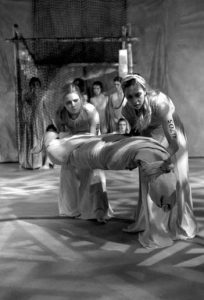
From a production of Hecuba by
Euripides, directed by Monica Payne.
Translated by Kenneth McLeish,
produced by the Pittsburgh Playhouse,
Conservatory Company (2013).
HC: Has anyone ever noticed your body change as a result of acting?
MP: That’s a good question. I certainly talk about it all the time. I talk about, especially, this bad back pain that I had for so long that you were able to fix in maybe three sessions when I had been to chiropractors, massage therapists, yoga therapists, I’d been to so many places. I don’t know if anyone’s ever commented on it. Although people often say to me that they can see that I do yoga, that I have good alignment. I think they are seeing the Rolfing [SI] too, but they just don’t know what they’re seeing, they don’t know what they’re looking at. I mean, one time I announced at a big directors’ meeting – I announced to maybe thirty directors – they said “Tell us something about you that we don’t know.” I said, “I do a lot of yoga.” They were like, “Yeah, everyone knows that.” I guess because they could sort of see it on my frame. But it was awkward. I thought, “Oh, well, okay. That’s all I have to say. That’s all I’m telling you.”
I don’t know if anyone’s ever commented outright, but I certainly get compliments that I look younger than my years. I often think, “well that is a combination of good exercise, probably genetics, eating well, and having bodywork done every few weeks.” [Bodywork] helps to increase your circulation, makes you feel better in your body, Rolfing [SI] is actually woven into that comment to me.
HC: That makes sense. How would you describe Rolfing [SI] to someone?
MP: You mean the experience or definition or both?
HC: Both.
MP: When someone asks me what [Rolfing SI] is, I say the Rolfer is working with the connective tissue in your body. So if it gets sticky or kinked or just messed up in a certain area, the Rolfer is trying to smooth it out or open it up a little bit. That’s what I say as the definition of what [Rolfing SI] is.
Sometimes I talk about that sweater analogy that you said to me once, that you’ve got a sweater that’s got bunched up on one shoulder and you’re going to, like, pull it out, but you might be pulling from a really opposite side of the body. The experience of it, I sometimes say, it’s like a cross between massage – but deep, deep, deep massage – sort of woven together with being allowed to release anything verbally. Massage they sort of insist that you stay quiet. But one of the things I like about Rolfing [SI] is that I can speak sometimes if I want to at the same time so that whatever is coming out of the body can actually have a verbal expression if it wants to. I have to say having gone back to massage a few times after being a Rolfing [client], massage feels like nothing. It really feels like they’re not hardly doing anything to the body. So I’m a convert.
I remember when you were trying to convince me to try it. I thought [how] I had heard that it was painful. That’s usually what people say to me, “I heard it’s really painful.” In fact, I just said to my roommate this morning, “It’s not painful if the practitioner is really good.” If the person who is working on you is sensitive and pay[s] attention to what is going on with your body, [s/he] can tell when it’s too much and back out. As opposed to being sort of on autopilot and just working no matter what your body is doing in response.
I would also, in a nutshell, I would say getting [Rolfing SI] is almost like getting scratched on a really deep level. Like you’re scratching an itch that’s really deep in your body and that sort of resolves it, you don’t have to worry about it anymore. It’s magic. Magic for the body.
HC: Do you have anything else you’d like to add?
MP: I do have one thing. I think it’s vital – in American actor training we’re very focused on psychology. In other countries, this isn’t as much of an issue. The French are really physically based, much more than we are. But in America, we really believe that you go through the mind or the psychology in order to release the actor. You then do a close-up where the camera is one inch from that [actor’s] nose. [We think] that is acting. I think it’s time for us to wake up to fact that the entire body is the instrument of the actor. It houses the voice, it houses the emotional life. So if the body can be really opened up and made accessible, then the other two parts of the triumvirate, which are the voice and the heart, are then easier to access. They’re more available. But the body, in my opinion, the body is the place to begin. It’s the place that you have to really convince young actors that they must work. They don’t want to. Particularly if it’s hard for them. They really don’t want to engage [the body]. They think of movement class as something to get through and then be done with it. But that’s not the case. I mean, the really versatile, world-class actors have access to all of it and have it all integrated. They have all three elements well-integrated. So, I think it’s a particular problem in American actor training, that the body has somehow been sectioned off. It needs to come back into the fold. We need to come home to the idea that the body is incredibly expressive. It can cause the audience to feel deep things and they – the [people in the] audience – they are the ones who really need to be feeling something. It’s important sometimes for actors to be emotionally connected, but the [people] who are actually supposed to be having catharsis [are in] the audience. And they will if they are seeing twenty-six actors who are fully physically engaged, they will not be able to resist coming into the world of the play to receive whatever themes or messages the play has to give. That’s what I have to say.
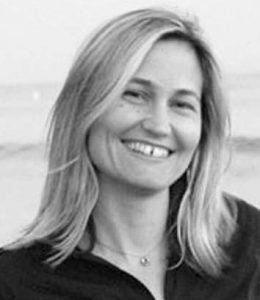
Monica Payne is an American stage director. She recently directed the Ted Hughes translation of Phedre, Hecuba, and Huck Finn for the Pittsburgh Playhouse, her own adaptation of Eréndira: The Incredible and Sad Tale of Innocent Eréndira and Her Heartless Grandmother by Gabriel Garcia Marquez, Elektra by Euripides, William Inge’s Natural Affection, and Savage Love by Sam Shepard. She also assisted on La Mirada’s award-winning production of Miss Saigon, directed by Brian Kite in 2012, which later toured to China. Formerly an actress, Payne worked for many years in Chicago with various companies, including Steppenwolf Theatre Company, the Artistic Home, the Hypocrites, the Journeymen, and Famous Door. She holds an MFA in directing from UCLA and is a member of the 2008 Lincoln Center Director’s Lab, as well as the 2012 Director’s Lab West in Los Angeles. As a professor, Payne has worked for UCLA and Carnegie Mellon, and recently served as the Director of the MFA Acting program at Point Park University in Pittsburgh, Pennsylvania. She is also a freelance Meisner instructor, and has taught for the School at Steppenwolf, the Artistic Home, and the Audition Studio, (Chicago) as well as owning her own studio in Los Angeles. She has taught in the Steppenwolf West intensives in both Monterey and Long Beach. She is the founder and Artistic Director of Theatre Lumina, a theatre company focused on cross-cultural collaboration. Upcoming projects include Death and the Ploughman by Johannes von Saaz and a Polish play called Trash Story by Magda Fertacz. Images can be found at www.monicapaynedirector.com.

Heather Corwin holds a PhD in clinical psychology with a somatic concentration from The Chicago School of Professional Psychology and an MFA in Acting from Florida State University/Asolo Conservatory. She is a Registered Movement Educator with ISMETA. Heather has been practicing bodywork since 1993 and has been a Rolfer since 2005. She was the Movement Coach/Choreographer for A Piece of Tin at the Lyric and Burial at Thebes at the Cleveland Playhouse. She teaches movement/ voice/acting at Azusa Pacific University and acting at Pasadena City College and has served as Assistant Professor of Theatre at Ashland University. Regional theater performances include: MainStreet Players, Tennessee Repertory Theater, Cleveland Playhouse, Nashville Shakespeare Festival, Mockingbird Public Theater, Banyan Theatre Company, American Stage, Nashville Children’s’ Theatre, Falcon Theatre, and Asolo Theatre. Her favorite roles as an actress were Antigone, Myra in Hayfever, Phoebe in As You Like It, Sonia in Life x 3, Dr. Purgon in The Imaginary Invalid, Katherine in Love’s Labour’s Lost, one of the witches in Macbeth, and Dierdre in I Hate Hamlet. She also co-starred on Grey’s Anatomy. Her websites are www. HeatherC.com and www.BodybyHeather.comPerforming, Creativity, and the Body[:]