
[:en]From conversations with Jim Asher
Olivia Ireland
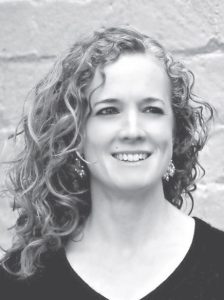
Olivia Ireland, LMP, Certified Soma® Practitioner, is in private practice in Olympia, Washington. She can be reached at [email protected].
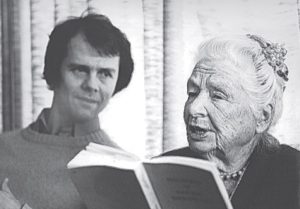
Jim Asher was one of the seven original teachers picked by Dr. Rolf, and he assisted her in basic and advanced trainings until her death. He is a senior faculty member of The Rolf Institute® and the founder of the Colorado Cranial Institute. He also trained with Philip Greenman, DO. Jim participated in The Rolf Institute’s first fascia research with Ron Thompson and Louis Schultz in 1976. He offers his unique style of bodywork in his practice and in post-10 and craniosacral continuing education classes. He can be reached at 303-325-1481 or [email protected].
“Real isn’t how you are made,” said the Skin Horse. “It’s a thing that happens to you. When a child loves you for a long, long time, not just to play with, but REALLY loves you, then you become Real.” —Margery Williams, The Velveteen Rabbit.
Jim Asher studied directly under Ida Rolf in the late 1960s and early 1970s. With his forty-one years in practice, he seemed a natural candidate to reflect on the evolution of Ida’s vision during that time period. I crafted the text of this article using not only direct quotes taken from conversations with him, but also by adding flavors and nuances of thought distilled from his honest, thoughtful sharings with me.
Parts
“The challenge now is to mix modalities, and to integrate the person … to blend modalities for the best interest of the client.” —Jim Asher
Even in Ida Rolf ’s time, the health community was beginning to fragment. Allopaths—medical doctors—were still in the forefront of American medicine, practicing traditional methods and developing cures, like sulfur drugs. Bodies were considered as machines might be: either they were working properly or they weren’t, and if they weren’t, a doctor considered what fix was needed. Treatments were performed on the body. Work done was actually work done on the disease. Or people might take medicine and passively benefit from it.
Osteopaths distinguished themselves in the medical field by using touch therapies. Of course they also developed cures, but among them were new joint manipulation techniques—they would work on something stuck, or misaligned. Their style of work might well be called a precursor to today’s physical therapy, the aim of which is to get the person moving where they currently are unable. Injuries could be treated by work done directly on the tissues.
Such techniques were new, and were propagated and developed with fervor by individual osteopaths. Osteopathic medical schools were essentially communities of practitioners sharing and learning from each other’s techniques and discoveries, independent from traditional medical schools (and not considered of high repute by traditionalists either). By positioning themselves as counter to allopathic traditions, osteopaths succeeded in creating their own faction.
Such was the battle for credibility in the medical field at the time Ida Rolf began her studies. She herself had already earned a Ph.D. in biochemistry, in addition to receiving extensive training in the osteopathic field—and so she could personally claim a deep knowledge of the systems and parts mentality. But this alone did not distinguish her from her colleagues. Her contribution to the field, structural integration, was also crafted from the understandings she took away from admittedly more mystical traditions, like yoga, tantrism, and Krishnamurti and Swedenborg’s writings, to name a few. Practitioners of these sciences espoused an appreciation of the whole as the route to truth as opposed to reckoning only the parts individually and in isolation from each other. Ida’s modality—now our modality—was designed to serve a holistic purpose: to really see the person, the client, as a whole, functional entity, not just a conglomeration of separate systems and parts.
Ida’s modality—now our modality— was designed to serve a holistic purpose:
to really see the person, the client, as a whole, functional entity, not just a conglomeration of separate systems and parts.
The world of bodywork today can be similarly described in terms of a plethora of exciting, unique, well-crafted offerings. Many continuing education credits are required to maintain state licensures, so to some extent many of us are curious and asked to dive into modalities we may not have otherwise explored. And for those things we feel more naturally drawn to, the internet has put new information at our fingertips, on demand. Multi-layered marketing and the quest for income streams in an increasingly competitive market means that workshops and study courses are often and widely available. Further, our media culture just generally values information and novelty. It is easy to imagine oneself behind the times if one is not constantly internalizing new information. All that being said, it’s conceivable that we are exposed to many techniques over the course of our professional lives. It would be an understatement to say that some extra portion of chaos has been introduced into the field of bodywork since the days when Ida Rolf was studying and working.
The idea that we, as structural integrators, can serve our clients’ best interests by our work is becoming a harder sell as the world of bodywork expands. Most clients are aware of a veritable salad bar of modalities. Of course, while they’re generally not able to professionally assess their own bodywork needs, they can absolutely be considered more worldly than the clients Ida Rolf saw. This fact alone points to an increasing need to define what we do as both unique and relevant within today’s contexts.
To not lose track of our own special role as structural integrators is a real trick.
To serve the cause of integration is to buck the trend of isolating and working parts, of specialists and factions and modalities—and serve the bigger picture: the reality and the potential presented by the clients themselves. This has always been structural integration’s raison d’ètre. It’s just a little more challenging to maintain the focus today.
Integration: Feel. Move. Repeat.
“It doesn’t do any good to work the tissue of the joint unless you get that person to consciously move through that joint.” —Jim Asher
Our modality is an amazing technology. But what exactly is it that makes it so special?
Ida Rolf really believed in the evolution of the human being—as she put it she was “interested not in [pain] relief, but in the potential of humans” (Rolf, 1988, p. 25). She realized that over the course of a lifetime human bodies do tend to break down, in other words, to literally constellate into parts over time, whether by injury or disease or misuse. Certain parts begin to call out for attention, while other areas become inaccessible, deadened. Safe to say, bodies “increase their degree of disorder and randomness” (Rolf, 1976, p. 6).
Integration is needed for bodywork to have deep meaning. This was Ida’s insight, the one that pulled our modality into focus. If a practitioner works the back, the spine or the vertebral facets, or the neck, for example, without addressing the corresponding pattern in front—then you work forever on the same client, on the same level, on the same issues. Ida maintained that more than the parts themselves being the problem, “loss of pattern is the real problem” (Rolf, 1976, p. 6). It’s not the person’s increasing sense of a disparate collection of parts, nor really the conditions of those parts individually, but in the breakdown of relationships between and among them where disease finds root. This is an important distinction she made, as such reasoning broke from the allopathic and osteopathic traditions and suggested that the way forward, the way to health and wellness, is through bringing the whole body into relationship with every part of itself.
It’s revealing that Ida began working on children first—those paragons of ontogeny—creatures designed from birth to respond and to change; to integrate myriad languages, and social, physical, and cultural realities, with absolute fluidity. The evolutionary benefits of her work must have been easy to see, given children’s pliability.
By the plasticity of adult human beings she was also much inspired. Early on, when she was working near Rockefeller Center in New York City, she would spend much of the time during her lunch breaks observing the dancers on their own breaks from their work at the Center. Watching how they moved, she learned to appreciate the exquisite attention to detail evident in the forms and mechanics of these bodies. The effect of years of constant correction was legible in even their everyday movements. It translated into a clarity and grace unmatched by most.
A person’s essential responsiveness, which was ferreted out over the course of the series, could actually be trained to a higher order of function.
She realized, not just mentally, but also in her work, that consciousness is what we bring to people— and our own first, so that they may feel theirs in due time and grow into it. It is a lovely, precise concept we bring to people: that it is possible to organize oneself around the Line. She was demanding of her clients, and insisted that they try to feel this concept, so alien to them at the beginning of the series. As structural integrators, our task is to introduce the person to an organized, more expressive whole. And in a real sense our intent is always the same: to bring every client to a higher level of feeling consciousness.
But, as well-defined as our intent is, the contexts within which we work are ever shifting. It’s not just the client’s fascial medium that changes, but the life of the individual client, popular culture, and bodywork culture—all are in a perpetual state of change. Juggling this demands utter clarity from us in our specific work: integration.
Craniosacral therapies, visceral therapies, the SI series—really any modality can integrate and be real to the client, if it is used with integrative intent by the practitioner. This requires a deeper level of sensitivity than just trying out the latest thing. An appreciation not just for forms, structure, specific movement, for particulars and details—but for the connections which that human makes to any and all of their unique experiences is something special that structural integrators, with our training in holistic assessments, can bring to the client.
To work spirit and body together, to meld consciousness to physicality—is to take out old compensations and rebuild patterns to include awareness and conscious control. One should develop a sense of the parts themselves (like the sense of an independently functioning sacrum) and at the same time a sense of the function of it in real time, in relation to other moving parts. From this develops that coveted sense of embodiment, or embodied spirit.
To do this one must learn to sense the body. Feeling is our route to proprioception—which in Jim Asher’s words is “how we feel where we are in space … how we know where we are, next to someone else … how we’re moving” (personal communications, November 2012). It forms our feedback loop with the physical world. Without it we are the walking wounded: isolated, numb. Of paramount importance to Ida was “not so much about a certain position, but the awareness piece.” Ida used a lot of feeling questions—“to force you, to obligate you” to experience what she had wrought. She “insisted that they try to feel it and then use it … it wasn’t ‘go lie on your back, let me work on you, then get up and you’re out of here.’” She would really demand of each client that they go so far as to verbalize feedback on their personal sense of the work. Ownership of the work could then rightfully pass from practitioner to client.
Sensation is informative but of no healing consequence without being able to put into practical use these messages from the whole body. Ida called what she did to address this need tracking: bringing her hands to a specific location of the body, and then bringing the client’s awareness there, with a call to movement. It’s no surprise that she was asking not for just any kind of movement, but highly organized and functionally correct movement. A person’s essential responsiveness, which was ferreted out over the course of the series, could actually be trained to a higher order of function. Perhaps it would be fair to call this newborn ability responsibility, not for its moralistic connotations, but because it suggests an unreserved ability, based in a deep sense of the felt reality, to navigate life with integrity to the self. To move consciously as a body develops connections between and among tissues and systems; to move consciously through life allows healthy connections with other humans, and with the totality of the physical world.
It is high-level communication. The synergetic effect of combining inner feeling with outward movement has been captivating people since the dawn of humanity, in dance and theater traditions. The peaks and valleys of human experience, cultural memes, the lineage of human wisdom, and essential spiritual truths are recorded in these art forms and played back through the body of the performer and, vicariously, her audience. Embodiment of sensitivity and grace truly serves to enlighten the world.
To work on the tissues is not enough; people need to be integrated at the conclusion of bodywork. To heal, a client must glean meaning from our work, and to do this demands our unwavering attention to bringing them the language of feeling and movement. Working through the final three sessions calls for lots of conscious movement on the client’s part. We are really asking them, systematically, to take on new patterns as their very own. This is fundamental to our work, and can exist completely separately from our knowledge of techniques.
Whole
“It’s about what that person is up against.”
—Jim Asher
People come to bodywork to fix things.
Of course, Ida Rolf didn’t herself believe that we were drawn to this field for its palliative effects alone. She steadfastly maintained a more lofty vision for structural integration. However, practically speaking, as a group we do have a natural tendency to serve people. That is a large part of why we are in the bodywork field. Furthermore, it is of great benefit within the context of the client-practitioner relationship to be able to address directly those particular items the client actually talks about.
Sometimes also, we want to fix the things they come in wanting to fix, or even things they aren’t as aware of but which we perceive. The experience of getting hooked by something we see in the client, but which despite our best efforts does not respond or change as much as we think it should, is common.
The media and internet culture interdigitates us with bodywork professionals at unprecedented levels. There seems to be no end of professionals out there blogging, writing, and posting videos in order to make their marks and contribute their own parts. Just as the stresses, demands, and activities of modern life debilitate body structures, so the explosion of information challenges our ability to integrate it.
It’s all too easy to lose sight of the big picture. When the capacity to integrate is challenged, individuation is challenged. This is true for individuals as well as collectives. As Ida put it though, “you are on a bigger job. You are trying to make it possible for that nervous system which distinguishes them as humans … to function more appropriately and economically. [Other animals] cannot, by conscious awareness, increase their own potential” (Rolf, 1974, p. 6). Structural integrators often talk about the importance of seeing—and indeed we are trained in a vision. It is our job to see beyond the bits and pieces, and testify in our work to those things that are fundamentally important to human life: freedom, and joy. Those are the concepts we give our clients permission to own.
What does the person in front of you need, to grow? Your own ideas, your aesthetics and agendas may be useful here. Who is to say who might benefit from one of your particular knowings, and when?
But the benefits offered are planted in fertile soil only when we serve, not just surface desires, but the deeper human need to become real.
References
Feitis, R. (1976). Interview with Ida Rolf part 1.
Bulletin of Structural Integration, 5(4).
Rolf, I.P. (1974). Ida Rolf on Rolfing. Bulletin of Structural Integration. 4(3), 5-15.
Rolf, I.P. (1976). Structural integration. Bulletin of Structural Integration, 5(3), 5-10.
Rolf, I.P. (1988). A vision for humanity. Bulletin of Structural Integration, 16(3), 25-26.
Williams, M. (1999). The velveteen rabbit (p. 13). New York, NY: Avon Books.
[:]Integration, a Practice