


Anne Hoff:
Thank you Til. I think most people in the Rolfing® Structural Integration (SI) world know who you are, through the Rolf Institute® (now the Dr. Ida Rolf Institute™) and your classes and books, but please say a little bit about your current activities.
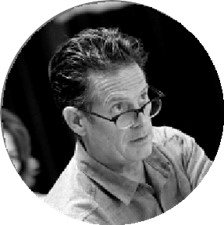
Til Luchau:
I spend a lot of my time these days writing – a regular column for Massage & Bodywork magazine, my own blogging, other publications here and there – and I teach one or two shorter workshops a month mostly in this country, sometimes in Europe or Australia. And I have a small private practice here in Boulder.
AH: Your teaching is myofascial technique; who comes to your classes?
TL: It depends on the sponsor or the country. The brand name is Advanced Myofascial Techniques. That’s a legacy from when the Rolf Institute wanted to offer myofascial workshops for other professionals, and that was the name they suggested for my workshops with them. Honestly, I don’t know if that’s the right name anymore because we’re not restricting ourselves to myofascial. In this country I’d say 80% of the workshops are sponsored by massage schools. The majority of those participants have some massage background. We always get some Rolfers, structural integration people. Tom Myers has me up to his summer program. A lot of his organizers in other countries have brought me in to work with their graduates. Every now and then, I get some chiropractors, physical therapists, in this country, as well. In Europe, it tends to be more physios and sports people, or cranial practitioners. There’s a cranial group in Switzerland that I’ve worked with for twenty years. It depends somewhat on the organizers but there’s always a mix of types of practitioners.
AH: Okay, great. Our topic today is scoliosis and how to work with scoliosis. You teach classes on this, correct?
TL: I do. Scoliosis is one of the classes in our series, and seems to be of particular interest to Rolfers; we also sell a lot of class notebooks online to them. Scoliosis is just one of the topics we teach about, as we work our way through the whole body.
AH: There’s little in-depth discussion of scoliosis in Basic Trainings, and later in Advanced Training Rolfers learn more about spinal mechanics but not necessarily in relation to working with scoliosis. Yet nearly every Rolfer in private practice has people walk in the door and say, “I have scoliosis.” Some, it’s very mild, others it’s severe. I’m curious, did you study about scoliosis first and then apply it in your work and teaching, or did clients drive you towards the study and the development of what you now teach? Or a bit of both?
TL: It was probably both. I, like you, got maybe six facts out of my basic Rolfing training that related directly to scoliosis. I listened hard because I was interested in it. I think, as Rolfers, it interests us because, on the surface, is an alignment issue. It looks like something gone wrong with whatever the different forces are that keep us aligned. Because we have this legacy of being able to help people embody dimension, otherwise known as alignment in gravity and space, we get interested in scoliosis.
My first serious scoliosis client was in a wheelchair hitchhiking around the country. She showed up at a retreat I was teaching in New Mexico, just to visit the place, and was in a lot of pain. I had been out of the Rolf Institute two years at that point. It was a puzzle. I took some of the things that I remembered and learned in my Basic Training and started working on her. At some point she just gave a big smile and relaxed and felt a lot better. We got to work together often there that summer. Later, people with scoliosis began appearing more in my practice. The biggest influence within the Rolf Institute was probably Robert Schleip, a mentor of mine, who particularly around the scoliosis puzzle has a passion of his own. His ideas had a lot of influence on the way I was thinking about scoliosis, and still do, as did Jan Sultan’s, though I’m doing it all differently than I learned it from both of them.
The other big Rolfing influence that comes to mind was Emmett Hutchins. He said, “When I’m working with scoliosis, I’m helping them move around a line, not necessarily stand around a line,” which I found interesting. It was one of those koans he would toss out, that we would have to ponder and wonder. But “moving versus standing around a line” was a real clue that started my inquiry and probably still informs the way that we’re working with scoliosis to this day.
AH: That points to something important: we’re not going to make somebody straight. If you’re lucky, there may be some change in those curvatures, but we’re not trying to get a platonic ideal of the spine.
TL: We’re trying to make the person happier, like that woman in the wheelchair. I think we’re all driven to help people.
That’s why we’re in this profession, and there’s where human compassion arises. Here are people who may or may not have pain, may or may not have restrictions in their movement; if we can support them as Emmett was indicating, in helping them in living with more ease and moving in a way that works better, they’re going to be happier and feel better.
AH: How do you go about that?
TL: One thing is, when people walk in and say, “I’ve been told I’m crooked. I want to be straight,” that asks for a reality- check conversation. There are miracle cases. There’s plenty of pictures around of people who were dramatically, visibly different after getting hands-on work. But I think most people would agree, those are the exceptions more than the rule. Most people aren’t walking out of their Rolfing session perfectly straight after coming in with scoliosis. And attempts to try to make people straight often make them less comfortable. Often people hurt more after we just try to lengthen their shorter erectors, or whatever we think will help them be straighter. Being straightened isn’t always more comfortable. Then, it’s teasing apart the context of why someone is coming to us. If it’s just to look different, there may be some reframing or alternatives to explore.
Pain is interesting, because we often assume that if someone has a funny shape, they must feel funny too. That doesn’t seem to be the case with scoliosis. People with scoliosis don’t actually have any higher incidence of back pain than the general population. That’s important: just because someone has a different shape, doesn’t mean they hurt, or will hurt. There is some evidence that says when people with scoliosis do have back pain, it tends to be worse, or more intense. But they don’t have it more often. It’s not like a crooked spine equals back pain. A crooked spine, in and of itself, is not a problem to fix from a pain perspective.
What Causes Scoliosis?
AH: So the woman in the wheelchair, was she in the chair because of mobility issues or pain or any sort of degradation of her condition that was causing pain?
TL: Which came first? I don’t know. There is a point at which spinal curves are a serious biological issue, often a compromise to organ function. Then, at some point, having a sideways spine starts to affect the nerve roots and things like that where you have pretty clear mechanical effects. The standard medical cutoff point – the point at which medical issues are more likely to happen – is somewhere around 40º, that’s where they need to take some aggressive measures to stop the progression. In most cases, 40º is an obvious and strong scoliosis. Most of our clients don’t have that much curve and are a different category of intervention, where it’s about mobility, comfort, staying proprioceptively refined, less about intervention on their shape.
AH: Let’s go bigger picture for a moment. What do you understand about potential causes of scoliosis?
TL: It’s a puzzle really. Rather than try to answer the puzzle, what I do is ask how I can help people. ‘Idiopathic’ scoliosis, which is the most common form of scoliosis, means unknown cause or without apparent cause. Honestly, anybody who says they know why it’s being caused is going in the face of the consensus view. There’s lots of pieces. There is some thought about cerebrospinal fluid flow having turbulence, that being associated with fetal development. There are bizarre little facts like there’s almost no adolescent idiopathic scoliosis in people that are deaf. Animals, quadrupeds, don’t get adolescent idiopathic scoliosis. There are some interesting puzzles there that point to bipedalism, that point to perceptual issues, that point to developmental things.
Some say it’s visceral; other say it’s a top-down phenomenon that relates to the way you’re perceiving; or, a bottom-up phenomenon, related to the way you’re supporting yourself. Those are just a few pointers toward possible causation; but causation is complex, and what really counts in the practice room is strategy. All those are probably strategic narratives that get the practitioner thinking about how to go about working with it, more than they actually explain how it got there.
Adult-onset scoliosis is a lot more common than adolescent scoliosis. By the time we’re seventy years old, about 70% of us have an observable scoliosis. It appears progressively through our lives, and it’s mostly asymptomatic, not correlated with back pain or other symptoms (although, sometimes it can result from osteoporosis or facet issues, things like that). So lot of elderly people have scoliosis, and it’s not necessarily a problem. Strategically, if there’s back pain, or if there’s a movement restriction, we work with those like we do any back pain or movement restriction. That’s a little different maybe than a strict structural integration perspective. The perspective we take in my trainings is to ask, “Are there options for movement needed?” – and those include the option of stillness and support. And, “Is there a way we can help refine proprioception, so the person can feel body sensations more accurately and in a more nuanced way?” In other words, can they have greater body awareness?”
AH: Has the way you work with scoliosis changed over time? You’ve been a Rolfer a long time.
TL: Yeah, thirty-three years. Has it changed over time? Absolutely. It began probably with that story I told you and with Emmett’s teaching, and my time assisting Robert Schleip and mentoring under him, teaching with him. His perspective is interesting and his stories were influential. For example, he realized at some point that he was doing the biomechanics exactly opposite of Fryette’s laws; but going back to those clients and working with the ‘correct’ coupling of sidebending and rotation didn’t really get much different results, maybe 10% better. So when he got the laws ‘right’, there weren’t necessarily dramatic improvements.
AH: Interesting. Perhaps even when he didn’t have Fryette’s law right in his mind, he was still working the soft tissue correctly, if not the joints.
TL: I wonder. I bet he would argue, and I would too, that ‘correctly,’ at least in terms of external measures like left/right etc., becomes less relevant. It is the act of getting worked, and the act of moving, and the act of finding movement into new places. Whether you did it as an open fixed or closed fixed direction, in either case, you can make a huge difference. From the perspective of psychobiological influences, most of the effect we have as practitioners comes from the client receiving work, as opposed to the actual strategy being employed. Increasing body awareness, increasing mobility, providing a powerful intervention in the context of movement, therapeutic ritual, all those things are valuable.
So that’s probably been the biggest change. I’m not thinking any more about things like which direction is right, or how do I want the body to be ‘corrected’. I’m thinking more about how to increase options for mobility so that the body can do what it needs to; and I’m thinking about refining proprioception, in a way that’s not noxious, because pain is unrefined, overwhelming proprioception.
AH: Please talk a bit about the therapeutic context. I’m sure much of what you do with scoliosis is going to be the same as with any client: building a safe container, dialogue, clear communication. What extra pieces might come in with scoliosis?
TL: You’re right, it is the same, though of course someone with a scoliotic pattern is going to move and perceive differently than someone with a different pattern. But the therapeutic alliance is especially important in that context, so that I understand why they want to work with me. What’s their motivator? What are their desires? What are they hoping for from our time together? For that reality check I mentioned, and also so that I can bridge what I’m seeing and doing to what’s important to them. That’s important to all of our clients, but especially with someone with scoliosis, because in the classic scenario, it’s a teenage girl sent by her parents, or doctor, to ‘fix’ her scoliosis. She may not have any direct inside-out experience of any scoliosis, she just knows what people told her, outside-in. To her, scoliosis is a long word that sounds vaguely pathological. A lot of setting ourselves up for success would be finding a way that she can have an experience of what people are talking about from the outside. It’s finding the inside-out pathway.
AH: Right. There’s the element of she’s just going about her life feeling completely normal, and suddenly people are saying there’s something wrong with her, taking her around to all sorts of different practitioners who are supposed to try to fix what’s wrong with her. That’s quite a change of worldview for a girl or young woman.
TL: Yeah. Her body and body image are still forming, and the social interactions are so important.
AH: So if it’s the mother or the father that brings in their teenager, who may or may not really know why they’re there, and who may or may not be comfortable with all these people they’re being shuttled around to, how do you build the relationship with the teenager herself?
TL: Well, first I want to find out how they think about it and feel about it. Sometimes. there is physical discomfort, or some awareness that movements are different in one direction compared to the other. Sometimes there’s no internal experience at all. If there’s no internal experience, then there is still probably is a role I can play in maintaining mobility, and meanwhile helping increase and educate their body sense. For some people, it’s via movement. If they touch their left toe and then their right toe, they might notice a difference. One girl, it was sit-ups. She was really into having a strong belly, so I had her do some sit-ups and I could show her that actually one side of her belly was higher than the other. That’s when she got interested in the work, and she could get inside of it though seeing it, and later, feel it and work with it.
AH: Yeah, it’s engaging her interest. I find that teenagers are not necessarily interested in the work, whether it’s for scoliosis or anything else. With that age group, it’s particularly important to find what’s going to hook them, to get them interested in being there.
TL: I worked both as a high-school teacher and an Outward Bound leader for teenage boys for a few years, and there were a lot of kids that didn’t want to be there. There are ways to get them interested. I would never underestimate the power of an interested adult. Just being interested in them is radical. Also, understand that, at that age, the only defense a lot of kids have is apathy.
AH: That’s huge. I never thought about it that way.
TL: Yeah. It’s a defense, really. It cracks open quickly when there’s an interested adult, who is interested in just listening, and is curious. That, for most kids, is a rare experience.
Goals
AH: Okay. Somebody comes in with scoliosis, what are your own goals and aims, and how do you work with whatever the client’s expectations are? Do people come in with realistic expectations, or do you have to downgrade their expectations?
TL: I’m always assuming that the reason that they’re coming in has an element of false promise to it. I probably don’t think about it as downgrading, but more reframing. Often, it’s an upgrade of what they imagine could be possible; often, it’s a shift of their criteria in terms of what defines success – especially scoliosis, probably more than other conditions. Often the client’s perspective is like, “Yeah, I notice in my wedding picture, my right shoulder was higher than my left. I want to fix that.” Dramatic changes can happen, but it’s complicated when that’s the primary motivator. It’s a tall order to have someone lie passively on the table for an hour, even ten times, and walk away permanently changed in their very structure. So if the person says, “In my wedding picture I noticed my right shoulder was higher than the left,” I would explore what that’s like from the inside. I might ask, “Can you tell you have a shoulder higher without looking at your wedding picture? If you can tell, what happens to you when you ‘correct’ it? Is that an expansive experience for you inside, or a diminishing experience? Where do you want to be in that continuum? How much adapting do you want to do inside to accommodate what you think you should look like from outside?”
AH: I feel the enticement of that myself, but I know there’s a lot of people who don’t want to go there. They don’t want to go in. For some people that means going into a lot of experiences that are difficult. What rate of engagement do you get with people, when you invite them in like that?
TL: 99%. Because I’m just talking about feeling your shoulder. For some people that’s a whole pathway into an inner world that’s really rich and they can’t resist exploring. For the general population, that’s not so interesting. It might even be something they’ve worked hard to stay out of. There’s culturally not a lot of encouragement or support for our interior life. “But, I was talking about feeling your shoulder, just on the level of sensation: can you tell your shoulder’s higher or lower? If you can’t, what about if I put my hands here? If you can tell, does it even matter to you? Now go ahead and let’s look into the mirror together and hold your shoulders straight. What’s that like to hold? Would you want to feel like that, or, is there a way with your breath you might find something that’s gentler, more expansive?” As you see, it’s often grounded in a language of sensation. It has lots of implications into other realms, but it’s super tangible with some people. It’s baby steps. Many more people than I expect really take off. I’m looking for whatever lights their fire, honestly. The teenage girl I was talking about – she wouldn’t even care how it felt on the inside; she wanted to see her belly differently, so that’s where we went, that’s the thread we followed, and then she was interested.
AH: Is your goal first to find what interests them?
TL: Yeah. I think I want to find the essence of what interests them. That’s at least one layer deeper than the presenting problem. There is something they want, identifying that and staying connected to that is my therapeutic goal. That’s a moment-by- moment thing, where you look to see what’s interesting to someone, where their energy goes up or goes down, how does that breath get more expansive, how can they move awareness into a part of their body that they haven’t before. Those are all types of positive feedback.
AH: Right. Our June issue was about consciousness. I’m seeing threads that relate to that, that our work is so much about consciousness, that the potential for change is so much based in an engagement of consciousness: the practitioner’s consciousness, the client’s consciousness, the therapeutic container, and how that relationship is happening. If that substrate is not there, then doing this on the physical level loses a certain essence.
TL: I am with you. Or maybe, this thing we call ‘consciousness’ is just another aspect of the same thing we call ‘body’, or what we call ‘pain’, or what we call ‘trauma’, or ‘experience’, what we call any of these things. Any of these lenses we use are just aspects of a whole that’s greater than any one of those. They all include consciousness and yet are more.
AH: When we explicitly invite or engage a certain question below the question, that next level down, it evokes something that takes us out of the model of the client being just a passive body on the table. These days, that’s how many people are oriented. I go to get a massage; I lie on the table and he does something that makes me relax. I go to the chiropractor; she adjusts my neck. The client orients as an object that the practitioner is doing something to. Once you use the type of question you describe to drop down a level, then it’s no longer a subject and object. It’s the meeting of two subjectivities in a container of ‘let’s see what happens here’. I think that opens up potential for something real and truly beneficial to happen.
TL: That’s right. We do have an advantage over massage, where many people expect a passive experience. Not all massage therapists work that way, but people expect to ‘receive’ a massage. But in a Rolfing context, we have lots of ways that we’re engaging people more actively. It’s also not just the opposite of being passive; the opposite of the client lying on the table is the client telling you everything they want you to do. Instead it is that intersubjectivity, that interaction that includes what’s important for the client, but also includes me finding a way to invite the client into a deeper or more expansive set of possibilities. That includes what I’m interested in as well.
AH: There’s a whole interesting tangent we could go on here, that we each get the clients who resonate with who we are and where we’re coming from. I think we get the clients who fit us.
TL: Or the ways they don’t fit are the ways that we grow and get more fit-able. More adaptable Structural vs Functional Scoliosis
AH: Say something about structural and functional scoliosis and different approaches based on that.
TL: Classically, structural scoliosis would be thought to be related to the bone shape, like one due to an osteoporosis that’s causing vertebrae to go wedge- shaped; something like that could sidebend the spine and cause it to rotate. Some definitions include the ligaments; they say ligamentous relationships, or articular relationships in the spine are a part of the structural components that make a spine passively stiff. The definition is if it’s passively stiff in one direction, it’s a structural issue. If the client can actively move it, then it’s functional. It’s an interesting distinction. It’s probably a false dichotomy. Ida Rolf’s big revolutionary statement is that all that is plastic. Way before neuroplasticity, she was saying there’s fascial plasticity. Giving people a sense of possibility about what could change right down to the level of what we’re made of. There’s something useful in that point of view. Even if collagen molecules turn out not to literally stretch, there’s something useful in the sense that my body is changeable.
I don’t limit myself to working just functionally or just structurally. We do tests in our treatment protocols that help me feel: does this resist me passively?
– in which case, it probably fits into the structure category. Or can it respond?
– then it’s probably more functional. We end up working with those similarly or at least we have similar goals. We want more options for movement. We want it to move in ways it doesn’t now. We want someone to be able to feel it in a less noxious or more refined way. Feel it in context to the whole body.
Homework
AH: How important is it, with working with scoliosis clients, that they are doing something on their own, either some form of movement practice or some exercises that will support the manual therapy.
TL: It would depend on their identified goals. But let’s say there’s somebody who’s getting close to that 40? curve and trying to avoid surgery. They want to do whatever they can. Then, yeah, a multidisciplinary approach is super important. It isn’t just a fascia thing. It isn’t just a visceral thing. It isn’t just a strength and conditioning thing. All those are factors. When people do strength and conditioning, they have fewer problems with their scoliosis. Scoliosis can measurably change. There are some good studies of people doing just myofascial work on scoliosis and showing a change in curves. All of these are pieces. For some people, there’s balance differences, there’s more postural sway. Especially for adult onset cases, being active physically seems to help.
AH: Do you refer people in any particular directions or it all depends on that client and what their interests are?
TL: I encourage people to be physically active in a way that they’re likely to do. Just being physically active. There’s a window of opportunity too, with kids right around puberty. There’s some pretty specific ways that physical therapists or orthopedists can tell if a kid is within that window using x-rays to stage their growth plates. For our purposes, within a couple of years of puberty, that’s a key time when there does seem to be an argument for aggressive and preventative work, even if there are no presenting problems with pain. That includes bracing or surgery, if the threat was severe enough. And in kids approaching that degree of severity, I would encourage everything I could. Some physical activities, some balance sports or balance activities, hands-on work, refined proprioception body awareness. Whatever that means for the kid. Working Symmetrically, or Not
AH: Here’s a question about working symmetrically and asymmetrically. In Rolfing sessions, we work differently on the two sides of the body according to what we find. My experience is that many trainers and yoga teachers want people to work very symmetrically. If you do this exercise or stretch, do it equally on both sides. My sense has always been that if someone has scoliosis, or any identifiable asymmetrical pattern, and they can sense that from the inside or understand it from the inside, it’s intelligent to take an asymmetrical approach into conditioning or yoga or stretching. I’m curious for your thoughts.
TL: Massage therapists are the other one. In entry-level massage they’re taught to do the same thing left and right. The intention behind that is probably good: it’s to try to keep things balanced, so to speak. You don’t want to induce some sort of difference. Again, it’s a simplistic way to stay safe and it gets translated into dogma. Probably the least dogmatic person that I can think of in that point of view was Moshe Feldenkrais, who was famous for working just one side of the body and leaving his clients asking for the other side. His answer was well, just, “No. You remember what I did right? Just think it through on the other side.” In his model it was all neurological, it was all about learning. Once you learned it, you got it. It wasn’t thinking of the stuff we’re made of, the hardware, as much as the operating system.
TL: In our trainings we’re teaching people how to work asymmetrically. But that’s not the point. The point is to leave people feeling like they have balanced options for movement. If someone comes in with an asymmetrical pattern, that means working asymmetrically. Then again, it’s not to try to make them symmetrical, but to help them do something, like Emmett was referring to, which is to be able to move in a way that feels supported, balanced.
AH: If they’re going to go out and do yoga as part of their program of being active, would you encourage them to explore being more asymmetrical in how they do it?
TL: I want to be careful about my prescriptions to them. It’s not like, “you should now do asymmetrical yoga, in order to ‘correct’ your imbalance.” My only prescription is, “What would it be like if you explored movement in both directions? Can you have as rich a sense of flexible body in this direction as in that direction? Can you expand in each direction?”
Clients with Rods and Fusions
AH: That’s a nice way to frame it. Let’s talk about scoliosis and surgery. Are Harrington rods still current?
TL: Harrington rods are still used. They are one of about five different rods that are being used now, commonly. There’s lots of exceptions. Lots of people trying experimental things too. Harrington rods were the main choice for a long time. A lot of people will come with Harrington Rods that they got years ago. Honestly, the principles are still the same: I’m still helping them find options for movement and refined proprioception. Now, I’m not trying to bend the rod, obviously. You can get a sense of movement and limited proprioception in the zone of a spine that’s been fused, either through bone infusion or a rod infusion.
The newer rods have lots of variation, and many of them flex. Many of them attach to the ribs instead of the spine and are adjustable, so they grow with the kid as she ages. Most of them now are three dimensional. Harrington rods were straight; that came from a two-dimensional view that scoliosis was an S, not a three- dimensional spiral, which probably is attributable to the fact that x-rays were the main way that they were studied – that we just perceived scoliosis as a flat situation because we were looking at flat pictures (even though some of the early people were working with scoliosis with stereoscopic x-rays – in the early twentieth century, they would take two x-rays and wear stereoscopic glasses to try to see the three dimensional curves in scoliosis). The classical view of scoliosis, the Cobb angle, is measured in two dimensions. The rod became a straight rod to try and straighten it out. They’re getting more sophisticated, the rods are now three dimensional, flexible, and adjustable. People can move even with a rod. That’s a major insider discovery for people that have a rigid rod. Even the mental concept of having a rod stiffens people up. Finding that they can actually feel breath, even bending and twisting and moving in the zones where they have a rod, can be a healing insight.
AH: It makes me think of a client in her twenties who had the Harrington rod surgery as a teenager. She was fine, completely adapted to it. She could play soccer, pretty much do whatever she wanted to do, no issues. Then she was in a car accident and that homeostasis of comfort from having adapted to and been supported by this surgery was disrupted and she was suddenly getting all sorts of radiating pain. She perhaps had less adaptability and that made it a little harder to go back to the old homeostasis or to find a new one.
TL: That sounds feasible. People with rods do have a higher statistical incidence of arthritis at the ends of the rods. In general, people with scoliosis don’t have more back pain than people without scoliosis, but people with rods have more facet joint issues at the end of the rods over time –decades later usually. That’s information we need to be careful with because it could definitely be a self-fulfilling prophecy or something that would upset someone to think about. Most of them have heard it anyways. They’re worried about it already. We can get good results by getting movement in the other facet joints, the ones that aren’t in the section where there are limits or where there’s a rod. The results come from relieving the extra movement that’s being asked at the ends of the rods that seem to be contributing to that joint problems.
AH: You teach in Europe also. Is there any different viewpoint or treatment, anything that’s useful that we might not know about in the U.S.?
TL: There’s a tremendous amount being done in Europe, especially movement in physical therapy. I think there’s seven major schools of scoliosis rehabilitation in Europe. They involve different sorts of movement and strength and conditioning physical therapy, and in some cases, manipulation. There’s a lot of really creative work being done. Schroth is one of the granddaddies – or grandmothers, in her case – schools that have given rise to different offshoots. They have different degrees of client/patient involvement too, the different schools. Some base it a lot on what the patient feels. That’s interesting to me as opposed to a prescribed set of movements.
AH: I have a client whose been doing the Schroth work as an adult and seeing a dramatic change in her curvatures.
Parts and the Whole
AH: Talk a bit about the content of your courses. How long they are and what kind of material you cover, the scoliosis courses in particular.
TL: Well, we have a series of modular
seminars and online courses. The in- person versions are typically three-day workshops. I am about to release a new DVD all about scoliosis per se. And we have a specialized workshop specifically about scoliosis, but it’s really the culmination of our five principle courses, which cover the whole body. That’s because scoliosis is a whole-body phenomenon. Even though we have two days that we dedicate to it, in practice it means pulling in perspectives and ideas for working the entire body.
AH: You’re working from the holistic perspective, obviously.
TL: Trying to all the time. We try to play that balance between really tangible, sometimes joint-specific, tests and techniques, while staying connected to the whole-body, whole-person picture.
AH: Which is something we didn’t talk much about, but obviously when we’re working with clients who have scoliosis, we’re not just looking at their thorax, their spine, we’re looking at the whole body too, and how the pattern plays out through the limbs, through the head, through the cranial system.
TL: Absolutely. The muscles of the spine aren’t strong enough to curve the spine in the way that we see in scoliosis – there are some really bizarre machines they use to test spines’ and stiffness. The idea that scoliosis is due to spinal muscular contraction doesn’t hold up, and as Schleip’s later research showed us, any force provided by fascial contractibility is very weak and slow. But conventionally, a practitioner with a tissue- based view would look at someone with a sidebend and think, “Oh, those erectors are tight on that concave side.” You’d think of the bowstring model, that you’ve got to go loosen the tight tissue and straighten it out. Well, refining awareness and getting more movement possibility in the concave side can be really useful, but it turns out that those things also help on the convex side. And there won’t usually be dramatic muscle tonus or fascial texture differences between the concave and convex sides. It’s probably not the case that the erectors or thoracolumbar fascia are ‘pulling’ the spine into a bend, and so that’s why ‘lengthening’ the erectors doesn’t usually straighten it out.
The girdles, however, are a somewhat different matter. That’s because myofascial structures crossing the girdles and going out into the limbs are bigger, stronger, and have different line of pull, so they can exert more force on the spine than the spinal muscles themselves. So just in terms of biomechanics, there are better arguments for working with the girdles and limbs than with the spine per se.
AH: What about the psoas?
TL: For a long time, the psoas was considered a key muscle in scoliosis. If you look at a lumbar scoliosis or even a lower thoracic scoliosis, it looks like the concave side has got to be short – one psoas could look like it was pulling the spine into that pattern. That led to a common surgical release where an orthopedic surgeon would actually sever the psoas tendon on the ‘short’ side, to try and correct the scoliosis and prevent it worsening. This was done up until the 1950s when a large study was done that showed that people that had psoas release surgery were no better off than the people that didn’t have the surgery.
AH: They were minus the psoas.
TL: Yeah, they were minus one of their psoas. It called into question the role – the causative role, you could say – of the psoas too. People’s scoliosis wasn’t getting better with one psoas cut. But the movement possibilities and preceptive function that myofascial structures provide seem to be important. The bowstring model probably doesn’t have a lot of basis in actual physics, and even less so in what seems to actually help; the tissue-tightness model is more conceptual than empirical.
AH: The three-dimensionality really implies that the whole biomechanical structure is going to be involved; trying to figure out one or two places to work is not going to be a model that is that helpful, ultimately.
TL: That’s right. In our trainings, we start our scoliosis protocol with the arms, legs, shoulder girdle, and pelvic girdle. We also have a lot of tools for direct work with the spine, thorax, abdomen, sacrum, and the neck. But then we finish with the limbs and girdles, back to where we started.
AH: If somebody wants to learn from you, they should move through the sequencing of your classes to get the whole worldview?
TL: Yeah. It’s a whole-body phenomenon. But people can jump into our series of short workshops at any point, and move through them in whatever order.
AH: Anything else you’d like to share?
TL: One thing – the deep pathologizing of scoliosis. People will come in having been told that they have scoliosis, and that they should do something about it. If they’re in that adolescent window, like I said, there’re good arguments for doing ambitious preventative work. But so many people have spinal curves that are asymptomatic. When we see mild curves, especially in an otherwise healthy person, it’s more helpful to reassure them and ease their concerns about having a disease that they’re afraid is going to cause them to degenerate or degrade or twist up in a funny way.
AH: That’s a good point. I can think of so many clients who’ve come in and announced that their chiropractor or another practitioner has said they have scoliosis. I look at them and feel, “You’ve been scared for no reason.”
TL: It gets complex when they’ve been scared by another practitioner. That gets into the ethical quandaries around interprofessional relationships. Often clients are relieved by an approach that’s more like, “I’m going to help you move comfortably in every direction. And I’m going to help you refine your body awareness, in every direction.” That seems to help everyone.
AH: Thank you very much, Til!
Til Luchau is a Certified Advanced Rolfer and former Coordinator of the Foundations of Rolfing Structural Integration program at the Rolf Institute, where in the early 1990s he originated Skillful Touch Bodywork. The author of the Advanced Myofascial Techniques textbook series, his regular column has been featured in Massage & Bodywork magazine since 2009, and his articles have been published in magazines and peer-reviewed technical journals in Australia, Canada, Japan, Korea, Poland, the U.K., and the U.S. Formerly a resident practitioner at the Esalen Institute, Chair of the Rolf Institute’s Teacher Training Committee, and Adjunct Faculty in Naropa University’s Somatic Psychology Department, he now directs Advanced- Trainings.com.
Anne Hoff is a Certified Advanced Rolfer in Seattle, Washington and the Editor-in- Chief of this Journal.
Resources
Til Luchau’s free online courses, as well as his books, DVDs, and course schedule are at http://Advanced-Trainings.com. Or via social media: @tilluchau on Facebook, Twitter, and Instagram.The Mystery of Scoliosis: Working from Inside Out[:]