

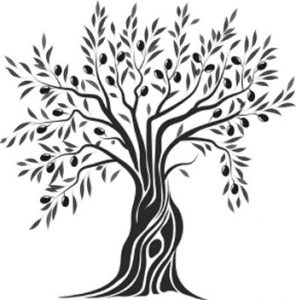
Figure 1: An olive tree.
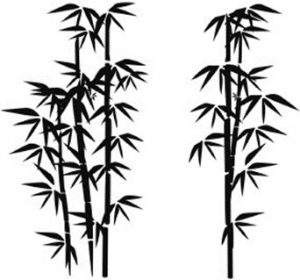
Figure 2: Bamboo.
During my years of practice as a Rolfer™, I have come to think of scoliosis as a way of growing. There are trees that grow straight toward the sky and others that twist and torque: bamboo and olives trees. Both are beautiful (see Figures 1 and 2).
People with scoliosis remind me of olive trees. With this in mind, my interventions when I work with somebody with scoliosis are intended to remind the body that there are several ways to grow up; that there are different options to grow that are less twisted, with more length. I stand at the client’s side imagining myself as a gardening tutor, planting a small tree.
What Is Scoliosis?
Searching ‘scoliosis’ on Google, this is the first definition I encounter:
“Scoliosis is a sideways curvature of the spine that occurs most often during the growth spurt just before puberty. While scoliosis can be caused by conditions such as cerebral palsy and muscular dystrophy, the cause of most scoliosis is unknown . . .
Signs and symptoms of scoliosis may include:
If a scoliosis curve gets worse, the spine will also rotate or twist, in addition to curving side to side. This causes the ribs on one side of the body to stick out farther than on the other side” (Mayo Clinic).
If I didn’t know what scoliosis is, what I would take from such a definition is that it consists of a lateral deviation of the spine due to unknown causes. But this is an overly simplified description. We will see that scoliosis is not limited to the shape of the spine.
What is interesting to me is that, in the definition above, under ‘signs and symptoms’ we find only ‘signs’: in itself, scoliosis does not create any pain. ‘Symptoms’ are generally manifestations of pain due to a disease or illness. With scoliosis, adolescents find themselves having to go see a doctor, even if they don’t feel pain, and they receive a diagnosis of something that they don’t recognize as an illness.
This discrepancy sometimes creates frictions, an obstacle in the relationship with the therapist or the Rolfer: clients are told that something is wrong, but they can’t perceive what it is. When they stand in front of a mirror, they can see that one shoulder or one hip is higher than the other, but if they close their eyes, they don’t feel any asymmetry. They feel perfectly fine, straight. Accordingly, this is an area where I place quite a bit of attention: to finding congruence between what the clients perceive from the inside and what they see from the outside.
How Do People Perceive Their Scoliosis?
In working with adults who wore a corset for scoliosis when they were young, I’ve been struck by a couple of things: first, that their torso is ‘frozen’, rigid, immobile, as if the person were still wearing the corset; second, that the corset has left signs – callouses where it pushed the client’s spine into a straighter position. Where the corset pushed on a hip or the ribs, the person often resisted the push because his/ her body schema did not recognize that something was crooked in the first place. The corset pushed on something perceived as straight; the body resisted the push. When I have asked clients if the corset was helpful, the reply almost always comes back, “The doctor said that it was helpful to stop the situation getting any worse.”
Swimming is often recommended in cases of scoliosis, and the logic behind this is very simple: with the water’s buoyancy, there is less effect on the body from gravity. But while the symmetrical activity of the limbs in swimming can balance the asymmetry, more recent research suggests that swimming helps but does not really correct scoliosis. Kinesis therapy is also recommended: it aims at lengthening the muscles on the side where they are too short, and toning the muscles on the side where they are too weak. Again, this seems logical, but it does not really work as it seems to further strengthen the side that is already too strong.
Scoliosis Has a Dynamic
A woman in her fifties came to see me because of back pain. She told me a story that touched me, and taught me a lot about scoliosis. She had a severe scoliosis, and when she was twenty years old decided to have surgery to straighten the spine. The surgeon inserted a rod that was locked with screws. A few months later, the rod broke: the thrust of her spine was stronger than the rod. She had to undergo another surgery to take the rod away.
What I understood is that a scoliosis isn’t just a shape in the spine; it’s a movement, a dynamic action that travels throughout the body. As a consequence, there needs to be an agreement with the client – spoken or unspoken – to reverse or modify the vector of growth that that person has embedded in her/his structure. Knowing that, as Dr. Rolf said, “I think there’s more than the body, but the body is all you can get your hands on,” my work as a Rolfer is not only to touch the physical structure but also to address and have in mind other structures: the structures of perception, coordination and meaning, which also includes body image and body schema.
Ways of Working
Talking with clients, it is clear that they don’t perceive their spines as twisted – in the client’s brain, his/her spine is straight. So our work needs to affect the cortical maps where the spine is located. How do we do this? What I have tried is to bring awareness to the inner motion of the breath and to the volume occupied by the breath in the thoracic cavity, and the response of the pelvis and the back to the movement of breathing into the pelvis and pelvic floor. I use my hands as a reference that clients can reach with the breath, particularly where the ribs are closer and narrow.
Having the client visualize and move the vertebrae with micromovement is also interesting. I have the client sit on the bench facing the massage table, with hands resting on the table. I touch each spinous process and ask the client to move that vertebra toward my fingers. It is often at the place where the spine changes direction that the client is confused. Asking the client to push more with one foot or/and one hand helps him/her to find that vertebra, or group of vertebrae, and at the same time to de-rotate it/them. Finally, using a mirror helps to reset the cortical map. In addition to seeing himself or herself looking straighter, the client is able to add the inner sensation of more equal volume in the thorax and can begin to integrate this new information.
Hubert Godard has stated that for people with scoliosis, the space outside the body – the kinesphere – is no longer round; it seems to have ‘holes’, as if at the side of the spinal concavity the space outside the body does not exist or is not available. Somatic Experiencing® affirms something similar: in particular circumstances, the space outside the body is perceived as if it is no longer available and not safe and the body shrinks in response. The body may lose its ability to orient, or the capacity to scan the horizon fully and freely, and this may translate, to give one example, into a sidebend of the head. Therefore, our work with people with scoliosis also involves giving back to our clients the possibility of inhabiting space inside and outside the body.
All these observations brought me to think that scoliosis is not a disease but a way of growing: it is a strategy that, for whatever reason, the biology or physiology of that particular person has adopted.
Examining Scoliosis: Assessment and Positioning for Work
Scoliosis is a movement that happens in all three planes and travels throughout the body. We often hear that one hip being higher than the other is due to a ‘shorter’ opposite leg, and it is conventionally treated with a lift of that leg. If we look more closely, we might see that this so-called ‘shorter leg’ may have a pronated foot, a valgus knee, a rotation at the femoral head (take a look at the orientation of the lesser trochanter of the ‘shorter’ leg). A precise body reading and intervention is key to normalizing the two legs and balancing the pelvis.
The sidebend and rotation of the thoracic vertebrae obviously affects the ribs. At the concave side, the ribs will be closer to each other, rotated anteriorly, and flatter. The opposite will be true at the other side. A strategy for the thorax is 1) to work the convex side, put the client in the SIMS position (Figure 3) resting on the concave side, and work the ribs of the convex side anteriorly; 2) to work the concave side, put the client in a regular sidelying position lying on the convex side, allowing you to mobilize and encourage more space between the ribs on the concave side.
Sometimes the sidebend and rotation appear in the shoulders and arms. In Figure 4 we see a schematic with contours drawn from a photo of a young person with scoliosis. We see a right rotation of the ribs on the right side; an anterior right shoulder and posterior left one; internal rotation of the right humerus, and external rotation of the left humerus; and the left forearm seeming to compensate with pronation.
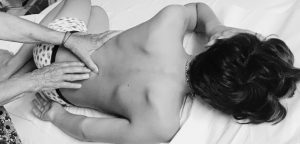
Figure 3: Working the convex side of the scoliosis with the client in the SIMS position.

Figure 4: Schematic of a young person with scoliosis.
The Visceral System
Another aspect of structural organization that appears to have a strong impact on scoliosis is the visceral contents of the thorax and abdomen. I have not yet explored in detail how to address the visceral content of the head (the tongue, eyes, and brain), but I have observed and worked with sidebends and torsions of the skull and jaw. We have more work to do to understand the visceral content of the head.
Recently I did an experiment. I have been working with a twelve-year-old girl who has a scoliosis where the right humeral head is both forward and internally rotated. Looking at the movement of her eyes, I noticed that, when I asked her to look to her left, her right eye would converge more than her left one. It seemed that the right eye was more caught, medially, by the ocular muscles. Very gently I touched her closed eyeball, with the intent to release the medial pull, and this helped the shoulder to open!
Peter Schwind has suggested that some cases of scoliosis originate in a torsional movement of the organs, particularly of the liver or stomach. There is no question that disordered structure at the level of the costovertebral and costochondral joints and ligaments is directly in dialogue with the parietal pleura attaching on the sternum and the vertebrae and creates a consequent disorder of the membranous system of the thoracic organs, and the organs themselves.
Just below the diaphragm, the liver and its ligaments, and the stomach with its sphincters and ligaments, are in close contact with each other and with the diaphragm. Work around the diaphragm is more effective when it also includes work on these membranous structures. If we think about the space in front of the spine, the psoas muscles are often asymmetrical, and the kidneys share that space. Indirectly mobilizing the kidneys by addressing the psoas can also be very effective.
The iliacus and its fascia, reaching in front of the sacroiliac joint, encases the inner surface of the pelvis. Likewise the subperitoneal organs with their lamina and ligaments spread between the pubis and the sacrum and coccyx. Thus, the pelvic floor and the overall balance of the pelvis are interrelated with the action and position of the subperitoneal organs.
Additional Considerations for Work
Working with people with scoliosis requires asymmetrical work: every session has to be tailored to that person and that moment. No two scolioses are exactly the same. Some clients have a lateral shift of the thorax, others of the pelvis; often the dorsal kyphosis is lost. Some have two, three, or more curves of the spine. Sometimes scoliosis emerges after adjustments of the teeth.
I often work the suboccipital and lumbosacral areas to free the spine. Then the table work continues, moving between the sleeve and the core, and back again: the myofascial layers, the ligamentous bed, and the visceral- membranous system. That day’s body reading provides a suggestion of where to work in each session. Often I close the session with bench work, inviting the client to negotiate how s/he deals with gravity, to recognize old and new patterns, and to find new options while I work the back, the girdles, and the spine. The use of a mirror helps to reset the client’s system, including the way that the brain has unconsciously mapped his/her physical reality.
I invite my client to do a number of things: sense position and weight on the sit bones; feel the connection of the feet to the spine; perceive the length of the spine; sense the space in front of the spine; use breath to relate the shoulder to the thorax and neck . . . All of this is the normal bench work that I use with clients in general, but when there’s a scoliosis I pay more attention to de-rotating and untwisting the spine. To achieve this, I might ask the client to use one foot more than the other, to rotate to one side and open to the space on that side, to breathe into a specific area, to shift one of his/her sit bones, and so on.

Figure 5: A corset for scoliosis.
Working with a Corset
Sometimes clients have to wear a corset for the scoliosis during the day, and they don’t like it! After a few sessions in which I aim to build rapport, confidence, and trust between us (and enhance adaptability in their structures), I ask the client to bring the corset. During bench work, I work first of all with the client in front of the mirror to untwist the spine and the torso until the client feels and sees that there is more length and less twisting. I shape the client’s shape with my hands so that the person perceives the difference between what is familiar and what is possible and is finally able to accept this change in his/her shape. I then ask the client to put on the corset, feeling the places where it holds rigidly against the ribs or pushes against the pelvis or lumbar spine. I invite the client to allow the corset’s push, to stop resisting, recalling the same sensation that s/he felt from my hands and the memory of the moment where s/he accepted a new reality, a changed shape.
Bibliography
May Clinic, ‘Scoliosis’. Available from: https://www.mayoclinic.org/diseases- conditions/scoliosis/symptoms-causes/ syc-20350716 [accessed 1 September 2018]
Pierpaola Volpones discovered Rolfing Structural Integration through bodywork and her research into well-being and somatic expression. She studied in Munich with Stacey Mills and Michael Salveson for her Basic Rolfing Training and with Michael Salveson and Jeffrey Maitland for her Advanced Rolfing Training. Her Rolf Movement Training took place in Italy with Janie French and Annie Duggan. She began Rolfing and Rolf Movement teacher training almost twenty years ago and has been teaching since 2006. She maintains a practice in Rimini, Italy and teaches for the European Rolfing® Association. Her website is www.volpones.it.
Scoliosis: A Way of Growing[:]