

Introduction
I was asked to write an article about the Ten Series. One thing I learned from studies with Dr. Rolf and her son Dick Demmerle is that the Ten Series is not ten sessions, but one session broken into ten hours. Similarly, in my mind, there is no such thing as the Ten Series separate from a bigger picture of the three phases of structural integration (SI) – Ten Series, advanced work, and ongoing work – as a lifelong process that I call the ‘three phases of SI’. I came to the distinction of the three phases after working with Dr. Rolf and working on people for many years after the first fourteen (basic plus advanced) sessions, which I will discuss below. This is one of the ways I am framing a ‘bigger context’ for the Ten Series. The other element of that bigger context is the evolutionary view that Rolf took, and that I learned through direct contact with the founder. This is where I will begin my story, but as you will see, the larger evolutionary context is intimately tied up with our work of Rolfing
SI being, ideally, a lifelong process for the individual, as well as a multigenerational endeavor through families.
Dr. Rolf viewed her work in an evolutionary context, although one has to dig through her writings to see that. Her incredible body of work landed in a culture that was not capable of thinking deeply about the relationship of structure and function in the gravitational field. While branding her work as ‘Rolfing SI’ made her philosophy more accessible to the general population, I believe that we lost the essence along the way.
The Ten Series is less a program of discrete goals and more part of a process of optimizing the human being through the bigger three-phase context of SI. Dr. Rolf always said the whole was bigger than the sum of its parts. As she noted in a late piece of writing, “The Vertical – Experiential Side to Human Potential” (Rolf 1977), “I as an individual, am not primarily interested in the relief of symptoms, either physical or mental… I am interested in human potential, and human potential per se neither includes nor excludes the palliation of symptoms
. . . ” Ultimately, she was not interested in just seeing how Rolfing SI could make people stand up straighter or feel better; she wanted to see how it could affect the behavior of a group.
She also wanted to assess the importance of demonstrating, documenting, and promoting the benefits of Rolfing SI for babies and children. Toward the end of her life, she indicated that work with babies and children was the most important direction of her work, and I have taken on that mission as my own life’s work, as I have discussed in an earlier article (Toporek 2017).
The Evolutionary Perspective
Rolf was a behaviorist and was a leader in the field of human potential giants. She saw her work in the context of how it would affect the behavior of a structure and how that translated in life. She noted that “we assume that human beings are, as a species, evolving toward verticality” (Rolf 1977) and argued that Rolfing SI was a conscious attempt at evolving one’s evolution.
I struggled with this for quite some time until I had the opportunity to do Rolfing SI with Raymond Dart, the South African physical anthropologist and paleontologist who discovered the link between humans and apes through his discoveries of fossil hominins that led to significant insights into human evolution. He observed me doing Rolfing sessions on a number of children, and we had lengthy and important discussions about the evolution of verticality. He pointed out to me that as verticality evolved, the shape of the head changed, and so did the growth and development of the brain. This evolution also reflected itself in the growth and development of humanity. I struggled with this idea, because when humans showed up on the typical chart, that was the end of the chart. I have now created a new chart that creates a future for us to think about and ponder (see Figure 1).
To quote Rolf (1977) further:
To what extent could Rolfers create a small population that is able to live within the gravity field without an everlasting war and the constant expenditure of precious human energy? If we could create such a population, what would be its characteristics? I am not interested solely in physical structure, although that is really of basic importance especially in terms of physiological well-being. What will be the psychological characteristics of the individual and of a group composed of such individuals? How would these more vertical individuals compare with the random, less conscious humans who tread the surface of the earth today?
It is perhaps too far-fetched to wonder whether one of the tap-roots of human aggression and its underlying fear may be the continuous sense of insecurity which random humans unconsciously feel with reference to their environment — the gravity field. This emotional response is called forth very early in life, probably with the first attempt at verticality and certainly with the first walking steps. Many psychological and behavioral aberrations arise from causes less basic than this.
Be that as it may, I see no means of gaining an answer to this suggestive and really important question in the abstract. The answer will come when we can create such a population and observe it through a long-term period. At this point, we are justified only in looking with satisfaction at the reports coming in from people who have experienced some approach to the integrating vertical. The appropriate integration of the bodies of man in the gravity field is a long-term evolutionary project.
Not even the first page has been turned yet. It is possible that we are seeing the first conscious attempt at evolution that any species has ever evidenced.
From this, we see again Rolf’s interest in evolution and a basis for her interest in Rolfing SI for babies and children.
My Evolving Journey
I have never studied with anyone other than Rolf and her son, Dick Demmerle. I shared my story of becoming a Rolfer in an earlier article (Toporek 2017). After my training, I apprenticed with Demmerle over three years, being supervised in ‘phase one’ (Ten Series) work, watching him work, and talking to him constantly about our work. I became Rolf’s administrative assistant and helped her promote Rolfing SI for four years. In December 1977, she asked me to implement and manage The Children’s Project. After that, I hosted and managed her final Advanced Training at my house in Philadelphia. So, for whatever it is worth, here are my two cents about Rolfing SI.
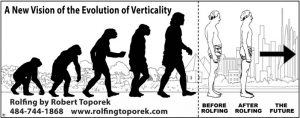
Figure 1: Thoughts on evolution.
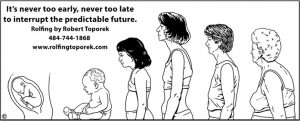
Figure 2: The author is interested in the psychological and behavioral impact of Rolfing SI from infancy and across generations.
I took Rolf’s evolutionary perspective and social experiment to heart. Since 1975, I have done Rolfing sessions for over 4,500 men, women, and children. I have photographed and/or videotaped almost everyone. In addition, I have forms that people fill out with drawings of themselves before session one and after follow-up visits. I have worked with over 300 families, from newborn babies and spanning four generations (Figure 3).
Besides Rolf, I have been influenced by Wilhelm Reich, an extraordinary man who was able to step outside of his culture and examine it with innocent eyes. In the forward to Reich’s book, Children of the Future, William Steig wrote:
Angels at birth, we become lost souls. And so it has been forever so long, as we learn from reading the ancients. How does this happen? Why do we humans, in many ways the most intelligent of all animals, fail to realize what every dog, or whale, or mouse spontaneously knows — that he is part of nature and must cooperate with it, obey its laws? Why are we estranged from life? What is wrong with us, with our way of rearing our children?
I discovered that Rolfing SI changes more than the body; it changes an individual’s relationship to his life and allows him to let go in mind and body the constraints of the past.
The Rolfing Process
Let’s begin to examine what Rolf was talking about in broad terms, looking to her article “Postural Release: An Exploration in Structural Dynamic” (Rolf 1960/2001).
Under the name of Structural Dynamics, and its implementing manipulative technique, Postural Release, a significant area of human experience is being explored. Subjectively speaking, it is a study in awareness. Objectively, its outline was delineated by Cuvier in 1821: his description, however, referred specifically to paleontology.
“Every organized being forms a whole, a unique and closed system, of which all parts mutually correspond and cooperate by reciprocal action for the same definite end. None of these parts can change without the others changing also; consequently, each of them taken separately represent and postulate all the others.” [Cuvier: Recherchessurles Ossernents Fossils] Cuvier enunciated this “correlation principal” with reference to the boney, or hard, constituents of biological organizations. The hypothesis seems to be all embracing; however, when expanded, it is found to apply quite as appropriately to the living human, functioning as a physical chemical physiological psychological whole.
Within this framework, Structural Dynamics may be defined as an objective study of such reciprocal action in the individual man; as an objective study within that very broad part of man’s consciousness of himself which he has called by abstraction “posture.”
Here we see that Rolf was already correlating “posture” or structure with broader categories of the living human experience. This takes me to my discussion of the three phases of SI, or the broader process that holds the Ten Series as but one element.
Three Phases of SI
My initial training in the Ten Series came from auditing a Basic Training with Demmerle, through training with Rolf and Demmerle, through observing Rolf’s next- to-last advanced course in New Jersey, and from hosting and participating in her final Advanced Training. I also managed The Children’s Project, which has now evolved into a bigger project called TeamChildren.org, where we take a number of babies and children through the initial Ten Series.
As best I can tell, there are three phases of Rolfing SI. The Ten Series is what I call ‘phase one’. I call it that because I don’t consider it an end. Neither did Rolf, who created a four-session Advanced Series with further goals of integration, which I consider ‘phase two’. The position I take for additional work beyond that – ‘phase three’ – is twofold: 1) if you do work on someone after the initial basic and advanced sessions, you are working on an already integrated body, so any further work goes to forward the previous sessions; and 2) there is no such thing as a perfectly integrated person.
Phase One: The Ten Series
The first phase in my schema, commonly called the Ten Series, is actually one session broken into ten parts, as I was taught by Rolf and Demmerle. The goal is to begin to integrate a person’s body around the vertical ‘Line’. Being balanced, aligned, and integrated around a vertical line in the field of gravity actually begins in the final thing we do at the end of the tenth session.
Your body shows up in your life, and your life shows up in your body. The first phase addresses the beginning steps of creating a new posture. According to Rolf (1960), “The tendency of the body to forward its own vital spontaneous rehabilitation is nowhere more evident than during the progression of a postural release. Standard procedure in this methodology calls for a series consisting of ten hours of manipulative organization. Actually, however, impressive contour changes are evident in the intervals between individual hours of processing, as well as in the more extensive changes seen as a result of the ten-hour sequence considered as a whole.”
In overview, the first seven sessions of the ten-session series free the major segments of the body. Sessions eight and nine are integrating sessions that focus on the lower and upper body. However, not until the completion of the tenth session does true integration begin. Following a lead from Joe Heller, I began relating sessions to areas of life. In each session, there is a conversation that can happen that supports the client in freeing his or her potential.
The first session relates to letting go and enjoying the ride of life. As humans, we are born into a structure where flexors have overpowered extensors. Our tendency to hold things in is far greater than our tendency to be open and free. First, I concentrate on freeing the diaphragm from the abdomen, then the shoulders from the rib cage, then lengthening the hamstrings, and a little more work on the abdomen begins to prepare it for the fifth session. I work on the neck, having the client sit up with his or her knees in, fingers laced around the knees, and I lengthen the extensor muscles on the back. Finally, a great pelvic lift.
Session two concentrates on balancing the feet and legs, while about half of the session concentrates on bench work, freeing the back more. There is more neck work, a pelvic lift, and the question of where the client is not standing up for himself or herself in his or her body and life, where he or she is not stepping up and stepping out.
Session three involves the client lying on his or her side to free the lateral line from the hips to the shoulder. There’s more neck and back work. The conversation goes like this: “By the time your tenth session happens, suppose your body and life begin to move in a new direction, what needs to change? Each human being is essentially a bigger, older version of how he or she has always been. By the time you were three, you perfected the internal conversation of ‘I’m not going to, you can’t make me.’ Letting go of that attitude makes the work so much easier.”
Session four frees the pelvis from below. The client lays on his or her side, and I start at the feet and work up to the pelvis to lengthen the inner line of the leg. People — whether aware of it or not — hold all sorts of memories in the groin region, and the last thing they want is some strange person working anywhere close to their genitals, so context is important, as well as appropriate boundaries both physical and otherwise. The way I frame the session is in a conversation about vitality. From the time most of us have entered school, our vitality has been zapped out of us. We are told not to be too loud or too happy. This session begins to give our clients a new relationship with being alive.
Session five involves the abdomen and lower back and increases power and confidence. All human beings become self-protected. We still live like lions are coming to eat us. In many cases, nasty stuff has happened to people, and they are justified in being cautious. This is the session to have a conversation about finding a new balance.
Session six works the extensor muscles. Unless I begin Rolfing work on someone at birth or within the first few weeks of life, the general pattern of flexors overpowering extensors has begun to reinforce itself both physically as well as psychologically. The conversation for this session asks, “How would you be different if you really extended yourself in your relationships, your career, and in your life?”
Session seven works with the head and neck. The world exists the way we see ourselves. This session puts the client’s head on top of his or her shoulders — often for the first time in life — and alters the way he or she sees himself or herself. As you see yourself, so you are. So, the question becomes, “What if you could invent a new view of yourself?” At the end of the session, I have the client sit on the table with his or her knees in front and fingers laced around the knees; I begin back work, having the client lengthen his or her spine from the top of the head. This balances the head on top of the shoulders, and the head and neck begin to lengthen.
During session eight, I usually work on the lower body and balance everything I have done up to that point to begin bringing it together. Rolf believed that balance in our bodies, or our bodies’ relationship with gravity, is a privilege.
Session nine works on balancing the upper body, with a further freeing of the arms and shoulders. This relates to reaching out and touching someone. Oftentimes when we have reached out and been rejected, the next time we will reach out a little less, until at some point we can barely raise our hand to ask a question or make a statement.
Session ten was repeatedly hammered into my head by both Rolf and Demmerle. Anything you miss in an earlier session will be your karma in session ten. I start at the feet and work up, legs, thighs, abdomen, chest, and shoulders. After working on the head and neck and doing a pelvic lift, I have the client stand up and walk around. Then I have him or her sit on the floor with the knees up and fingers laced around the knees and work on the back, starting just below the neck, while s/he lengthens the spine from the top of the head. In a moment, all of the work begins to come together. The distinction is, to have a new posture, one has to let go of the old one. A definition I use for ‘posture’ is the position or attitude of your mind and body about yourself or your life. I then acknowledge the joy in working with the client, find out if there is anything s/he is incomplete with, and say goodbye. This session for me is the hardest. I have established an incredible relationship, and now it’s time to let go.
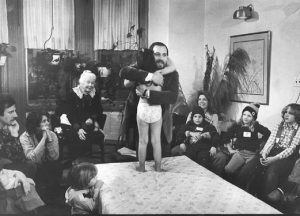
Figure 3: Robert Toporek and Ida Rolf in The Children’s Project, circa 1978.
Phase Two: The Advanced Series
The second phase of SI in my schema is Advanced Rolfing. Intheoriginal Advanced Series formulated by Rolf, it was another four sessions. Rolf recommended waiting nine months to a year before starting the advanced work, but there are always exceptions to the rule. The distinctions I learned from Rolf and Demmerle are that these four sessions, compared to the Ten Series, concentrate on a deeper level of balancing joints and impacting the nervous system. Rolf designed these four sessions to concentrate on the major joints in the body, such as ankles, knees, hips, wrists, elbows, shoulders, abdomen, lower back, the head, and neck.
Again, you think of it as one session broken into four parts, with the focus being one’s posture in the world. If you examine enough ‘before’ photos, you will see that the posture most people have in relation to the world is “Who am I to make a difference in the world?” It could be interpreted as a posture of cynicism and resignation.
Session one (session eleven total) treats the ankles, knees, and hips: your stance in the world. Session two (twelve) treats the wrists, elbows, and shoulders: reaching out in the world to make a difference. Session three (thirteen) treats the abdomen and lower back: your power in the world. Session four (fourteen) treats the head and neck: how to realize your vision.
If I have taken a client through these fourteen sessions total of phase one and phase two, I am leaving that person with a body that is well-balanced and integrated in the field of gravity. Any further work is done from this foundation, looking to see how I can take the integration to an even further level.
Phase Three: Ongoing Work
After the Ten Series and Advanced Series are completed, it is recommended that clients have a session once or twice a year or whenever they feel a need. Rolf talked about ongoing maintenance, but as I view this work as part of an overall process of lifelong SI, I have named it ‘phase three’.
Here’s a metaphor for looking at the three phases overall. The first phase, the Ten Series, is like launching a rocket. The second phase, the Advanced Series, is putting it into orbit. (People who have done the Advanced Series often take on bigger missions in life and make a bigger difference for others.) Phase three, ongoing sessions through life, is the maintenance: out in space, your vehicle runs into space debris from time to time, and if you do not maintain it, it will soon fall back to earth.
Further Considerations
Working with infants, I find that structural patterns can be dramatically altered in the first few months, especially if the parents have been through Rolfing SI. In these cases, the Advanced Series is appropriate within nine months to a year later. I am always working on a structurally integrated body. I can get more done with these kids as they age than an older client who has patterns deeply ingrained not only in his soft tissue, but in his skeletal structure as well.
Doing phase-three work on adults is another conversation. Even having benefited from Basic and Advanced work, many adults come into phase-three work facing life challenges, accidents, emotional traumas, or diseases like cancer. Nonetheless, true believers welcome the occasional session to propel them both in their bodies and in their lives. For example, a friend of mine had both his hips replaced and underwent shoulder surgery, Afterward, he was acutely aware of how imbalanced that left his body. We did an additional couple of sessions, and he is now sailing away with a balanced body once again.
Current Work
In 1978, Rolf and I held an event to recruit children to receive Rolfing work in The Children’s Project (Figure 3). In talking to the parents, Rolf noted that Rolfing SI provides children with a good foundation to stand on and grow up from, namely a balanced, supportive physical body.
This is where it all begins, and it is the genesis of my commitment to working with babies and children as well as multi- generationally with families. (I ‘walked my talk’ with my own family by working on them, both my parents and sister, and my children.) Most of my clients who do the Ten Series are familiar with the illustrations and philosophy in this article, and they have had their children or parents also receive Rolfing SI.
Right now, I am working on a woman whose parents also saw me for Rolfing SI about forty years ago. I am also doing Rolfing SI for her twenty-two-year-old son. Similarly, I am working on a man whose wife has been after him to get Rolfing SI for thirty-eight years. I am getting ready to do the phase-two series on a one-year-old baby who started his first session at two days old. His older brother started when he was six days old and has now had fifteen sessions. Their mother and father have had sessions beyond session fourteen, and their aunts, uncles, and grandparents have also received Rolfing SI. And I am doing Rolfing SI for a chiropractor and her three children (she has five-year-old twins, one of whom was severely brain injured from birth).
Additionally, I have taken this work to one of the worst ‘drug neighborhoods’ in Philadelphia over a period of years (see Toporek 2017).
From my point of view, the most important work before us is to find groups of people to work with, document the results, and find a way to follow up to further document how our work impacted the behavior of that group. When we become scientifically significant, we will be on a new path of healing the world. Rolf’s work is a gift to be given to as many people as possible as soon as possible.
Conclusion
In conclusion, here are some comments from Dr. Rolf (1979) that you may have not read:
As Rolfers, we know that through a combination of manipulation and particularly of education in the understanding use of his body and its movements, we can bring any man to a more nearly vertical stance. The structural support of a person in the collagen, the myofascial system — fascia, tendons, ligaments, bones. It is because of the unique chemical and physical properties of collagen that we are able to bring mankind toward the vertical. At this position of verticality, gravitational forces reinforce him, because at the surface of the earth, gravity acts as a set of vertical lines. Gravity no longer tears him down or pulls him apart. Then he says, “I feel good. I feel wonderful. What have you done to me?” But it is not we who have created this well-being, it is gravity.
Robert Toporek studied directly with Dr. Ida P. Rolf the last four years of her life and apprenticed with her son Richard Demmerle. He managed all of Dr. Rolf’s final classes and in January 1978 provided Dr. Rolf with the opportunity to establish the validity of Rolfing SI for babies and children by starting The Children’s Project at Rolf’s behest with the support of his housemates and friends in Philadelphia. Since that time, he has continued to expand working with babies, children, and entire families, providing and documenting Rolfing SI for over 300 families. He began Rolfing SI for his son Bryan on the first day of his life. Robert is also a decorated Vietnam veteran, the author of Hands- On Parenting: A Natural Guide to Happier, Healthier, Smarter Kids & Parents, and is a nonprofit leader blending high touch with high tech.
References
Rolf, I. 1978. “The Vertical – Experiential Side of Human Potential.” Journal of Humanistic Psychology 1978;18:37-39. Available at http://www.pedroprado.com. br/articles/the-vertical-experimental- side-to-human-potential/?lang=en.
Rolf, I.P. 1979 (Jan). “Structure – A New Factor in Understanding the Human Condition.” Bulletin of Structural
Integration 6(3):1-4. (Originally presented June 10, 1978 at the Explorers of Human Kind Conference in Los Angeles.) Available at https://novo.pedroprado.com.br/articles/ structure-a-new-factor-in-understanding- the-human-condition/?lang=en (retrieved 2/9/19).
Rolf, I. 1960/2001 (Autumn). “Postural Release: An Exploration in Structural Dynamics.” Reprinted in Structural Integration: The Journal of the Rolf Institute® 29(4):6-8. Available at http:// www.pedroprado.com.br/articles/postural- release/?lang=en (retrieved 2/9/19).
Toporek, R. 2017. Hands-On Parenting: A Natural Guide to Happier, Healthier, Smarter Kids & Parents. Audubon, Pennsylvania: TeamChildren.
Toporek, R. 2017 (Sept). “Rolfing® SI for Babies, Children, and Families: Fulfilling Dr. Rolf’s Vision.” Structural Integration: The Journal of the Rolf Institute® 45(3):7-11.