

ABSTRACT Kevin Frank and Caryn McHose, both Rolfers® and Rolf Movement® practitioners, explore the Ten Series from the perspective of normalized motor patterns and stability in both an overall discussion and a session-by-session analysis.
What Is Integration and How Does It Happen?
Caryn McHose:
Kevin, where do you see us starting in this wonderful topic of the Ten Series as steps in the evocation of normalized motor patterns and stability?
Kevin Frank:
Let’s start with some context. I think we all come to appreciate Rolf’s gift – how the ‘Recipe’ of the Ten Series supports our practice. Through our years and decades, it’s there for us; it remains a remarkably reliable, and effective, set of interventions.
The goals for the session emphasize anatomy – one learns to ‘open it up’, to differentiate layers, and use what Michael Salveson calls ‘vectorized fascial touch’ – pressing on fascia with an intention, with a direction. That’s been the main approach for Basic Trainings – and, teaching just these foundational skills, skillfully, is a challenge. Differentiation is, on its own, a profound event for many systems.
However, less defined, we might say, is the ‘integration’ part of the equation. It’s been more in the background. There are the ‘integration sessions’ of course, but what do we have to refer to on this topic? Monica Caspari’s article, “The “Functional Rationale of the Recipe” (Caspari 2005), is a window to Godard’s views, some clues about integration. Ray McCall and I wrote an article (Frank and McCall 2016) exploring, among other things, how do we define integration? And then, how do we measure it and where does it belong in the Ten Series? But the integration question persists. In this current discussion, we want to talk about integration but also about the goals of the Recipe in practical terms.
CM: I had a different way into the Recipe. I was teaching movement with other Rolfers, before I met you, and started to hear about the Recipe and see demos. In observing sessions, I was seeing the relationship to fundamental movement patterns, particularly developmental and evolutionary movement that I’d been exploring with people. Reading Ida Rolf in my twenties and liking her proposals (although not having experienced Rolfing® Structural Integration), I pursued these ideas in teaching movement, and saw people change. Becoming a Rolfer and collaborating with you, there’s a deeper appreciation of Rolf’s recipe and the change in people’s movement, change for the better.
KF: I like that you say people’s movement changes for the better. It’s part of the tradition, and everyone’s practice, to one degree or another – that people’s movement gets better. And, we want to take this idea further, to suggest a different lens through which to look at what the Recipe is about.
CM: I wonder also, what do I mean by movement getting better, what does “better” mean?
KF: Rolf posited that when people express ‘Normal’, as opposed to typical movement, that in the execution of daily tasks, movements, walking, lifting, holding, reaching – in all those things, you’d see elongation. Instead of bodies getting shorter, more contracted, bodies would express something we like looking at – it’s a quality of decompression, of becoming, as Jeff Maitland put it, ‘more spacious’. There are characteristics I think everyone can agree on as being ‘better’.
It helps to define this ‘better’ even more specifically. An element that we want to bring out in this conversation is: What are specific ways of speaking about the ‘better’? And why does it get better in terms of normalized motor patterns?
CM: Right, naming elongation – what came to me is, the mover is not doing the moving, that there is a moment-to-moment sense that the body is easy, supported, cradled in a flow of movement expression, there’s just no effort or less effort.
KF: I like that you name these qualities. Movement education asks us to embody these qualities so, as practitioners, we can show people what before and after looks like. It’s helpful for students and clients to get a visual as to what we’re up to.
CM: Then they can begin to have an experience.
KF: Right. Now, let’s back up and ask, “What do we imagine as the mechanism behind the structural integration Ten Series?” Rolf claimed the body is ‘plastic’ because the fascia is plastic in nature when you press on it; that you reshape the body because you reshape the fascia. I think we both agree that this model is now a little out of date. We aren’t the only ones who have wrestled with the mechanism question. It’s a big one.
Fortunately, evidence points to a more grounded model that serves to move the profession forward. Yes, the fascia is indisputably important, and ultimately, we’ll find out more about the physiology of its mobilization. But, we know for sure that when we mobilize fascia, we send fresh information to the body, information the body responds to quickly
– consciously and subcortically. This kind of information helps bodies make better choices; choices in coordination, in motor control.
CM: When I’m doing Rolfing sessions, I’m holding a question. It’s curiosity about what information does this body need? When I have that thought in my mind, there’s a change in my touch that isn’t about doing; rather, it’s a circulation of awareness that includes my own gravity orientation and the possibility of communication back and forth with the client. It’s the relation of the parts and the whole being; but, also, the bigger relational interval with the context, to the ground and to the space.
KF: Yes, curiosity prompts, “What information is this system asking for?” An informational model, rather than a strictly biomechanical model – whether we’re touching the fascia with a specific intention to open or differentiate, or if we’re addressing other forms of information the system might be eager for, such as having a person pause and notice things at a conscious level that the deeper brain is responsive to. We invite, for example, awareness of gravity orientation, a sense of weight, a sense of distance, the space around one, feeling the sensory experience in hands or feet or skull or tail or knee and imagining, for example, vectors of directionality. In all cases, we’re looking for what and how the client’s system might be hungry for better information, at a subcortical level, at the level at which motor control gets informed. How would this system, we ask, best find information that replaces the dominance of old habits?
CM: This approach invites some responsibility from the client to begin to develop conscious awareness for their experience and to acknowledge shifts that take place in perception and the awareness of how their own body is moving or receiving the information.
KF: Yes, good to point to the value of inviting the client to feel their own power in the process, and good to acknowledge also that not everyone is interested, or able, at first, to find words for those shifts. It might be, at first, very vague . . .
CM: . . . Yes, there are times for verbal exchange and then there are times for the nonverbal, communication that happens not with words.
KF: Yeah. Sometimes we provoke a shift in awareness with our touch or just with what we’re doing in our own body or what we’re saying in our words as we do it in our body, and not necessarily putting a verbal demand on clients who are less verbal to describe what they’re experiencing.
CM: Right. A silent potency.
KF: So, there’s one thing: the Ten Series can be reframed as a shift from a body-as- ‘stuff’ model – a biomechanical model – to an informational model, a system model. Another biggie is to look at what specific motor-pattern improvements can be associated with each step in the Recipe.
CM: Yes. Within the Series, there is guidance offered to support the building of many capacities to elongate. That’s a wonder of the Recipe.
KF: Before going further with the topic, it’s important to note some acknowledgements. We’re drawing on many people’s contributions here. This perspective didn’t occur spontaneously, out of the blue. We stand on the shoulders of Hubert Godard, certainly, but he stands on the shoulders of other folks. And, good to point out, historically, Rolf Movement instructors taught an eight-step series (without facial work). Hans Flury prompted an in-depth look at ‘Normal’ in his radical Normal Function work. And we all stand on the shoulders of many other twentieth- century movement pioneers, as well as systems theorists.
CM: Yeah, and I feel compelled to add, in terms of standing on shoulders – there’s also the different cultures through the centuries that have understood fundamental ways of supporting the body to restore normalized coordination or this ease of movement.
KF: Yes, yes. Maybe society has to kind of ‘reinvent’ this stuff over and over . . .
CM: Right, and appropriately update the words for cultural relevance for today.
KF: It’s also good to mention Mabel Todd. Rolf and Todd’s time at Columbia University overlapped. Todd taught people how to change motor patterns with perception, what became Ideokinesis. Something in the water in that part of New York maybe? You see influence. When I came to the Rolf Institute®, Todd’s The Thinking Body was at the top of the reading list. I don’t think it was accidental.
CM: Yes, it was a wonderful resource for me also, way before I knew anything about Rolfing SI. It was the first awakening to how perception changed my movement; as a dancer playing with some of these ideokinetic explorations, it was like magic, I didn’t understand how it was happening. Many decades later, there’s more understanding of how this works from a scientific perspective.
KF: It’s great to now have research that supports why when you employ ‘somatic imagination’, the body gratefully innovates its motor pattern.
The Steps of the Ten Series
KF: Let’s get to specifics and look at some ideas for how it looks when you’ve been successful with Rolf’s Ten Series, some examples of how the Recipe can be expressed to students, or clients, that rest on a notion of motor-pattern improvements for each step.
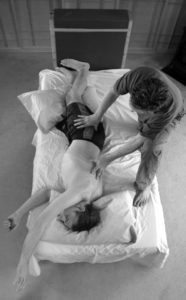
Figure 1: In session one, client toe press and reach of hand and eyes couples with posterior reach of coccyx. The practitioner supports the motion, monitors for effort, applies fascial touch as needed. G’ is supported in gaining/restoring adaptive anterior/posterior movement.
Session One
KF: For session one, what occurs to me first is orientation. It’s a good first opportunity to engage with a foundational source of plasticity for all the structures (physical, perceptual, coordinative and so on) – introducing gravity orientation as a gateway to change. Plasticity is crucial to our offer – it’s big when someone feels the potential for change. Gravity orientation, helping a client to dip into a fundamental sense of weight and the felt potency of spatial relationships, it’s so important to introduce this experience right away.
CM: Yes. I must say the First Hour is challenging from the enormity of that subject. How do you touch into that the first time, and every time? Starting that communication with the client is like taking a sip of water from an endless well.
KF: To take someone who’s just walked in off the street and to suddenly delve into, “Guess what? Your body does gravity orientation – whether you try to or not. If it didn’t, you wouldn’t be here, thinking and walking.” So, somehow, we’d like to find an appropriate introduction to this big topic and to this big bag of experience.
CM: . . . And then actually initiate and evoke experience.
KF: Initiate experience and suggest in the first session that each step is finding some element of improved coordination, of improved motor pattern. Each session offers a ‘before’ – demonstrated in the practitioner’s body, a “here’s what we see with people who come in to see us” – and then, “here’s ways coordination might look after.”
CM: What do you start with, Kevin?
KF: Just to state the obvious – we can’t, in this conversation, do the ‘catalog’
– we’ll pick some examples. For the first session, an easy choice for me is adaptive mobility / freedom to adapt in what we call G’ (G prime), the upper center of gravity, a spot near the center of the chest at T4. If we can get the body to find some buy-in, to respond in different ways with its upper center of gravity, that serves the Series and will serve normal stability and allow for new coordination.
CM: Just name a couple ways you’d facilitate that.
KF: Let’s mention first that we use a foot board (or wall) at one end of the table for almost every session of the Series, and its use starts in session one. So, in sidelying (as shown in Figure 1), I invite the client to begin to let his upper center of gravity respond to the pressure of his foot against the board, and with shifts in (eye) gaze opposite to foot press – elongation occurs in the front of the spine with a reduction or absence of effort. The exploration is supported by easy reach of the tail bone. G’ movement and breath revive; ‘Normal’ capacity restores. When the client sits up, and then stands up, he’s already rehearsed whole-body adaptive movement of G’ while on the table, so integration is more possible, more available.
CM: I do something even before that that feels so fundamental for me: when someone is first walking, I walk/move with them. I want to be with the person moving first so that I am not thinking – our bodies are speaking. And then inviting a pause for a minute and feeling or noticing where ‘down’ or the ground is . . . then to indicate or notice where is ‘up’ or out the window and towards the sky. I am fortunate – in my studio you can see ground and sky. Evoking a journey from ground to up and out, or sky back to feet and ground, is an experience in orientation. That demonstrates a lot about the front line and our goal, to elongate the body and open space for easier breath from the context of ground and space. And, second, we awaken capacity for dual attention in two directions. Of course, people may or may not understand that yet, but I like the dedication and challenge of that possibility first off. It can be a playful moment, too. It doesn’t take long. It doesn’t have to be a big deal but just . . . there’s a gesture that happens that goes from down to up. There is movement.
The client doing this gesture, from down to up and up to down, not only does it introduce the idea, but I get a reflection of where they are with that – how that gesture is expressed and where the person might need attention to that awareness as we’re going through this Series, I want to support their process of that opening to space in front of the spine and the orientation to space in general.
KF: An important point – and it shifts the emphasis from the body as ‘stuff’ to the body as a movement system, to the body as . . .
CM: . . . As an orienting being. Every moment.
KF: The orientation process, the gravity orientation process, is so woven into movement changes at a subcortical level.
CM: Yes, and we want a client to have the range of orientation capacity, not only to support them where they’re resourced, but to have added options of orientation, to innovate more of up or more down.
KF: . . . Capacity to consciously notice gravity orientation as a coordination, as a perceptual coordination, but also a fundamental coordination.
CM: A state of being.
KF: A state of being, foundational to everything that is structural integration. For a practitioner, beginning to build empathic awareness for what’s going on at that level in the client would seem to be, and we have certainly found it to be, essential in terms of supporting their process.
CM: Right, their stance. Yes.
KF: And you also describe a vital practitioner skill – to be able to read the orientation and perceptual structure of another person. It’s not something we necessarily learned in the manual therapy part of training. It’s ‘somatic movement education’ and belongs sweetly in the SI offer, but it may not always get the airtime.
CM: Starting this long journey in the First Hour and growing it through the Series is a challenge I want for myself and the client to initiate.
Session Two
KF: Let’s go on to session two. We think about support, and we think about how the system might build what we call ‘peripheral stability’. We’re making a point now, if we haven’t already, that the history of stabilizing theory and its popularized modes often emphasize building stability from the sense of ‘core’ or ‘from the center’. What we’ve discovered, and what we teach, is that if you want to develop healthy, functioning stability, you really need to do something different from focusing on the center. Rather we want to link extremities, hands and feet and head and tail, and vitalize the sense of the space around you – and link all this to the articular integrity of the spine. Session two we see as a consideration of “How do the differentiated feet and lower legs (and the hands) relate to a segmental articulation of the spine?” So, differentiation – yes – but also linking, which is part of integration.
Unpacking the notion of integration, Daniel Siegel (neuroscientist, psychiatrist, author) states, “Defined as the linkage of differentiated components of a system, integration is viewed as the core mechanism in the cultivation of well-being.” Concise, and conveniently relevant to what we do. For our work, you differentiate, you kind of blow it all up – structural integrators tend to be good at that – but then your job is to find all the ways that you can teach the system to link the differentiated elements to each other, and to engage the ‘action space’. And linking is possible pretty much in every moment.
Back to session two: You’ve to some degree liberated the movement of G’ in session one, and probably opened up the arms and hands. In two, you open the feet and lower legs. Now you have an opportunity to link the differentiated hands and feet with segmental movement of the spine in a seated situation. You begin to build an integration that becomes the basis for stability, is already an improvement in stability; even a few seconds of that type of work and we lay the basis for more complex and more deepening of stability response in later sessions.
CM: What I start off with in the Second Hour is the question: “How do you feel support now? How are you specifically supported with your feet standing, or sitting on the stool?” The person’s self- referential experience of support begins to blossom. And then working with the map of the foot and the map of the ‘feet of the pelvis’ – the rami – and beginning to get that operating and functional, and having the client start to experiment with sitting as an ‘eventing’ (feeling anatomy as an ‘event’ rather than an object); that movement on the long walk of the rami along with the activity awareness of skin of the feet and the feet and the support from the ramus on the chair builds the perception of ground within. Then adding the perception of the four legs of the chair supporting them might lead to another question, “Can I allow myself to be supported by that?”, and the way they might begin to notice, “Oh, I don’t have to work as hard sitting.”
And that can lead to the next question and project. What’s happening in the front of the body, is their spine moving? Are they tightening in the belly? And so on and so forth. So that’s a dip in, and then moving to the table to begin to work with the mobilization or the articulation in the bones of the foot.
KF: You’re mentioning the feet of the pelvis and the feet of the feet and linking those two things. And I love that you’re bringing in another key element, which is framing the work of the session in an activity at the beginning of the session. Not just having clients stand there and do some form of diagnostic for our eyes, but framing coordinative outcomes right away with simple elements that offer the client a sense of what we’re up to today, in tangible form.
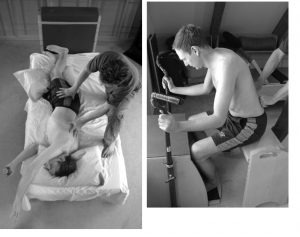
Figure 2: In session two, hands and feet support opening of the front line (A) and the back line (B).
CM: Yes. It’s both a diagnostic tool and an educational tool, that they are beginning the mapping process and they are beginning to be empowered to notice. If I ask myself how I notice my support and to begin to track those changes and the reduction of effort and where they feel the effect of that, or do feel the effect of that and where we might support them in that process.
KF: Coordination as diagnostic, coordination as education, and coordination as gaining a sense for the availability of the client, from the beginning, so we have a sense of needs to be prioritized. Also reminding him or her of the relevance of each session’s goals.
CM: And that this is an activity that they can ask themselves about every day. This is building self-care awareness of something that’s profoundly simple and profoundly linked to what the gravity response is about. That this awareness is available to tune into at any time. I can check into how I don’t have to work as hard for my support in my feet and for support of the feet of the pelvis and then begin to notice the results in my body.
KF: Yes, self-care woven in, because certainly, when you try to ‘tack on’ self- care at the end, enrollment or buy-in is going to be less than if they have iterative experiences during the session – ingredients to what they’ll receive as self- care at the end.
KF: So just to fill in the details about linking the spine and the hands and feet – peripheral stability, peripheral support – let’s mention that although we do what would be considered ‘traditional back work’ in the second session, connecting feet to spine, there’s a significant variation. Meaning – we set up the work so there’s an ergonomic support for the client’s hands in the seated position (see Figure 2). Then we might do fascial work on the back, the work one expects to see at the end of a Second Hour, but then we often do some anterior/posterior shifting of the spine using the hands and feet. We start to build that sense of, “Okay, the spine has friends at the ends.”
CM: I think it’s important to get specific about what a pre-movement is: that before we move, there’s a preparation in the body that is automatic, and we need a lot of that to survive. That preparation activity offers opportunity for us to note that preparation and consider – well, do I need all the activity that I’ve learned how to do or am I over-stabilizing? Is the voice of an intrinsic response available to me in feeling the support of the ground in this space or the periphery of my body engaging to allow that lengthening or mobilization of the spine?
That takes some practice for some people: What does it mean, hands and feet? Or what does it mean to activate at the feet? What’s that activity? Is it effort? Is it pushing? Is it engaging a lot of [fill in the blank], or is it a quiet feeling of the impression and linking one’s awareness to the context? And that’s a twofold process of slowing down impression and then allowing the sense of that engagement to be initiated in the peripheral exchange and expression with the world.
KF: Pre-movement is another ongoing, project. So much about pre-movement seems to be about slowing down to the degree that your client is available to catch the moment in which the pre- movement swerves into the habit. As Daniel Coyle points out in The Talent Code, there’s something about catching the error/the old pattern in real time, so the client gets the benefit of waking up to it. The learning process is supported by that identification of “Oops, ok, let’s try that again and let’s slow it down even more.” And then how might we support the negotiation of the moment that is turning out to be critical in the pre- movement: a little tensioning someplace, a little loss of awareness of the space, a little bit of holding the breath, whatever.
CM: Or where is the map of the feet ‘offline’ – not available or not articulated? That’s where it’s confused in terms of an opportunity for articulation. That’s a place for fascial mobilization – the process of offering guidance for the tissue to remember that it can move and re-establish that clarity of articulation.
KF: We’ve identified some of integrative and stabilizing and motor-pattern dimensions of the second hour – hinting at why and how we feel those elements fit in.
CM: Yes. And use of the footboard. The footboard is just a foot plate, a rectangular piece of wood that you can use for work when the client is lying down; especially to work with the tibiotalar joint and movement of the fibula and tibia in relation to that capacity to have the calcaneus-to- toes line be able to move and articulate as it’s used in gait.
KF: Yes. Give people ‘floor time’ before they stand up.
Session Three
KF: There are many things to consider for session three. The ‘lateral line’ is an idea Rolf grounded in terms of where and how we look and put our hands. I find, people take a while to make relationship to it. It’s a way to look at what’s happening in front and back of the lateral line – sagittal considerations – but it is also a look at a dimension of spinal movement and gait. Lateral flexion in the spine, with two contrasting phases in the upper and lower part of spine and rib cage. It’s a lot right there to think about.
For ‘before’ coordinative diagnostics at the start of session three, we can look at the flexion/extension of the hip, knee, ankle, and trunk in sit to stand and stand to sit. In that movement, is there harmonious reciprocal movement à la “When flexors flex, do extensors extend?” Is there a ‘no- one-doing-the-movement’ look with sit to stand and stand to sit? They’ve got their hands and feet. They’ve started to feel that the spine can elongate. Can we do this in sit to stand in a manner that’s ‘reversible’, in a manner that’s quietly stable?
And what’s it like to explore lateral flexion of the spine? The client, supported via two poles (see Figure 3), shifts his hips side to side; we see how the lower spine works in lateral flexion. Or we look at how the person flexes laterally, seated, arcing to the left and to the right. The point being that from a stability viewpoint and with gait in mind, lateral flexion is, if we agree with Gracovetsky, fundamental fish-body movement – it’s what drives locomotion.
CM: So, Kevin, why don’t you explain the setup that you’ve been developing for three in the sidelying position.
KF: So the process starts in session one, and it’s the classical process of articulating axial body from appendicular, but adding that now propulsion of that differentiation process comes from one foot against the footboard (see Figure 4), so that the toes help elongate the front line and the whole foot, including the heel, helps elongate the back line. When we use the whole foot and we, for example, capture the superior border of shoulder with our hands and then have the client press their foot against the board, we’re helping them feel that the shoulder girdle is with the ground, and the spine and the head elongate through the girdle, emerge through the girdle. They can feel that. They can feel their head moving on the table or the pillow, and the body ‘updates its files’ as it recognizes “Oh, the axis and the girdles are two things! They’re separate things; linked but independent.”
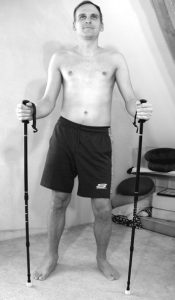
Figure 3: In session three, side-to-side hip sway is both diagnostic and self-care. The client’s bent left knee allows lateral elongation of the left lumbar region, causing the hip to shift right.
Everything being described can be done with or without the fascial mobilization.
In terms of lateral flexion, it’s definitely possible, supine on the table, to begin to do the side-to-side hip sway, with the knees bent and the feet on the table, or with the feet up on a board with the knees at a 90? angle, or just lying supine with bent knees. The feet support lateral flexion – it’s what happens when we walk.
Side-to-side hip swing shows us lateral flexion of the tail and lumbar part of the spine. Standing, holding poles or holding onto something so it’s not about balance, the knee bends as the hip shifts to the opposite side. We get to see how free the lower spine is from the pelvis, and how clear the relationship is between the feet and the lower spine.
In the sidelying work, it’s a chance to work with these relationships – the foot pressed against the board, the tailbone leading anterior and posterior with the sacrum and the lumbar spine. Can the spine move and the motor units around the pelvis take a break? It’s sagittal movement to improve coordination in lateral movement, and it works. The body makes the translation – girdle and axis de-confuse. It involves refining the pre-movement so that the sensory experience of the foot, the connecting of dots between the foot and the spine, can lead to quieting down of motor activity around the pelvis – the places where people brace, bracing being what interrupts normal stability.
At the end of session three, side-to- side hip swing gives a chance to see how the movement has evolved. How has the motor activity changed? Is there less noise, less interference from bracing around the pelvis? As with other diagnostics, simple side-to-side hip swing with poles is easy to learn and effective self-care to take home.
CM: Here’s more ways the work can be carried on. Standing with two poles gives the sense of support in the periphery, in the hands and feet, and can then allow this mapping of head-to-tail and lateral flexion or side-to-side movement in the hips. It can also differentiate the axis from the motion of the two halves of the pelvis – the axis functioning as the initiator, free to torsion and elongate. So the ‘fish body’, if you will – which translates to the volume in the head, the volume in the rib basket, the volume in the sacrum, connected via the spine and the gut tube – this whole thing begins to be noticed and experienced in the primacy of elongating, the continued offloading of extra work happening in the girdles. The client is finding connection and support from the ground through the feet, or the support of the spine, and through the work of the hands connected to the poles. Lateral flexion, felt as fish body / axial body, can also be done lying down supine on the floor or on the table – a process that begins with bidirectional elongation along one side of the body, starting with the directionality through the head and tail, and then continuing that exploration along the lateral line of the leg towards the lateral malleolus and lateral aspect of the foot.
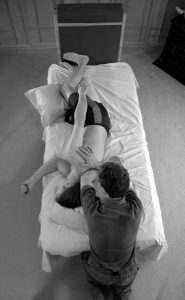
Figure 4: In session three, the client’s foot press opposite to hand/arm reach with the practitioner holding the top of the scapula helps build differentiation of the shoulder girdle from the axial body.
KF: As we said before, many dimensions to three. Lot of considerations for this central component of spinal movement, lateral flexion, which translates into torsion – rotation around the longitudinal axis – which allows us to walk around, walking around differently from other mammals.
CM: For a client to be able to take on the project of differentiating or ‘disappearing the girdles’, and feeling what we call the fish body, or the bidirectional axis in the spine, there’s no time like the beginning to start that. The girdles are there to help make a translation of support to the axis, that then can function more freely. The client then can begin to make this differentiated perception in movement and apply it when they take their practical movements out into the world, like walking.
KF: How would you describe, or translate to someone who hasn’t heard it before, the phrase, ‘disappearing the girdles’?
CM: Because of my background in dance, movement practice happened on all levels, meaning using the floor, moving on all fours, and moving dynamically through space. So, it’s second nature to me to view movement through an evolutionary lens. There was a lot of evolutionary time in which lifeforms expressed their movement just as an axis, or as a fish body, and there was even more time spent as a volumetric fluid body, floating around in the ocean. So, in three, there’s this possibility of beginning to consider the quality of volume in the gut tube, and de-evolving, if you will, to a place that life had a lot more ‘practice time’, functioning as a whole. So, ‘disappearing the girdles’ means using your imagination to begin to feel that part of yourself – the axial body – as more primary, in terms of its capacity to express movement.
KF: What does it look like?
CM: Well, it looks like the shoulders and the hips are just coming along for the ride, they’re not driving the show, and the power of the Line is expressed clearly, without interruption or noise in the system.
KF: Great. I like that description, that the girdles are just going along for the ride. I once heard Emmett Hutchins say something very similar. As we start to shift the focus from biomechanics to motor patterns and stability, it helps to add appropriate descriptors, new descriptors that do justice to what’s observed as motor-pattern change, so that students and clients can have words. At first, maybe it’s a wordless experience, and, at some point, having words connected to the actual experience helps to clarify.
CM: In the natural world, in the movements of the creatures we see around us, or that we know have been around, this quality of movement that unfolds has so much intelligence, longevity of existence. These archetypes have served me as metaphors of practice, supporting my imagination being able to join with these patterns that are a part of us.
KF: In terms of the potentialities of movement experience.
CM: Yes, and the way we’ve participated in that.
Session Four
KF: And as we go into four, we’re beginning what has traditionally been called, in our trade, the ‘core hours’. Godard brought to our attention, and we’ve had fun running with it, this idea that the core hours can be reframed as phases of gait: the Fourth Hour is about the landing/stance phase, the Fifth Hour is the swing phase, and the Sixth Hour is the push-off phase. (We have, among others, videos of the self-care/diagnostic movements associated with these three phases of gait available at https:// resourcesinmovement.com/videos/.
To begin this progression, in four we lean (literally) on a movement we call one- legged stance to embody the stance phase, and we go from emphasis on abductive lengthening of the lateral line in three to this adductive lengthening of the inner line and connecting that to supporting the spine. The one-legged stance is, to me, a potent representation of what palintonicity/eccentricity/stability looks like (see Figure 5).
The eccentralizing or decentralizing – being in the part, so to speak – has so much to do with how the extremities relate to the spine, and the segmental support, the segmental articulation from the support of the extremities, which we see in pretty much every table session when we have the foot board and things for the hands to press against or to hold. We’re teaching people peripheral stability, support for the axis in action, while on the table, so that when they stand up they’ve already been doing it.
CM: As the inherent architecture of the foot can better navigate the topography and begins to feel the impression of a surface (whether a footboard or the ground or the changing landscape) moving through phases of gait, the inner line awakens to enliven the bidirectional space, from the inner malleoli all the way up to the ramus. This is what we work with in this one- legged stance, to allow the client to have a sense of how that’s a dynamic expression, an elongation.
KF: Exactly. So, we introduce people to sensing a ramus, if not before, in the beginning of four – we have them use their fingers to trace each of their own rami, with a foot on the bench. They become familiar with each ramus, comparing it to what they see on the model, and then the feeling of the ramus and the feeling of the foot combine to do a one-legged stance at the beginning of the session. Then during the table work, we work on the one-legged stance lying down, and then we bring it back in the end of the session when standing.
CM: The rami need attention to embody, or become, a dynamic expression of directionality. So many times, clients think that they’re supposed to sit on their sit bones, and then they park there, they make it a spot that’s fixed.
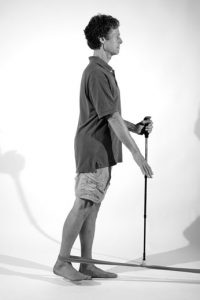
Figure 5: In session four, use a one-legged stance as both diagnostic and self-care.
KF: A spot that’s a rather posterior aspect of the ramus.
CM: Yes, and so we first of all identify where their sit bone is, and then to allow the branch to express itself towards the pubic bone.
KF: The ‘branch’ because that’s the meaning of the word ramus, yeah.
CM: Right, that’s the meaning of the word. So first of all feeling that shape of their particular rami, and what is its diagonal expression? What is its direction? Getting someone to actually be able to mirror the dimensionality in a gesture with their hands. Is it very wide? Is it very narrow? You can see bodies begin to change as they reimagine the shape of their rami. And then, to feel the ‘feet’ of the pelvis resting on the bench and maintain that dynamic spatial expression through the rami; it’s a long journey, or what I call a ‘long walk’.
KF: From the tuberosity to the pubic bone.
CM: Yes, and to begin to sustain that perception in the skin of the feet, its movement, and then to take that into the one-legged stance. There’s a lot of territory that someone can begin to really understand in making the one-legged stance, and mapping that, and refreshing that as part of a program that empowers them to then take it out into their other movement practices.
KF: And they get to clarify this every time they go from sit to stand, stand to sit, and ultimately every time they take a walk.
CM: Right, having the experience through time, of the session and the Series, clients just begin to see and notice little things about being self-aware, and the play and the practice of this that can change how they feel in their body, towards the changes that they’re making.
Session Five
KF: Session five we’re calling, among other things, the swing phase of gait, meaning the leg that’s been behind swings forward to catch the falling- forward motion of a body in motion. Historically there’s been a lot of emphasis on ‘healthy functioning of the psoas’. We propose a reframe – don’t blame the psoas. How is the body finding peripheral support, axial support, such that the psoas does what it’s supposed to do as a phasic muscle (which it is), as a set of motor units that give a quick flick of the leg forward, rather than as something that’s supposed to hold the body up. We teach Leg Raise Supine (https://resourcesinmovement.com/videos/) as a diagnostic, either with a bent knee and feet on table, or with a calf on a bench, or a straight leg (a few people can do that); two of these variations are shown in Figure 6. This is both a self-care approach and a diagnostic for session five; how is the body learning/relearning appropriate differentiation of the layers of the abdomen, again to quiet down the noise that interrupts stability?
CM: Yes, this is an optimum place, again, to feel the quieting that can happen in that passage of leg along rami to the deep front of the sacrum and the lumbar vertebra. I also feel that it’s a time to step up the sense of gut body, and give opportunity for people, standing or on all fours, to begin to experience the sense of the volume/weight of the gut hanging off the spine from the top of the palate to the tail. The bidirectional orientation of the spine allows the gut body to have its wiggle room, rather than the familiar tightening up we see in the belly or front body which diminishes the freedom of easeful motion. This brings us into the bigger realm of body story and body image. This primal place, our gut body, is woven into autonomic function. This session’s an opportunity for people to consider, first of all, that they have a gut body, and then to begin to feel what it’s like to have weight orientation in their gut body, and have it be supported by the spine, which leads to the “What does it mean to me?” part of the process. Are you holding your belly in? Is there unnecessary tension in the gut and the fascia that supports the gut? This work offers people a form of body security that involves gravity orientation, which supports and provide resource for working with psychobiological issues.
KF: It takes time to educate people on the phasic nature of the superficial abdominal muscles – how common usage patterns make impediments to spinal health and a lot of shortening in the front.
CM: Right, there is a ‘micromanaging’ that people learn, culturally, and from challenging experiences. To now begin to meet that situation in the belly wall (or what I call the ‘bellital’ surface) gently, just feeling the orientation of head to tail, or feet to head, bidirectionally, and considering being able to tune into or map their gut body is a process. It’s worth offering little moments of finding differentiation and considering what it feels like with peripheral support – that they don’t have to hold that way.
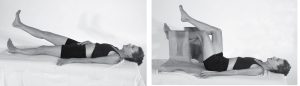
Figure 6: In session five, the Leg Raise Supine exercise is used, with two options shown here: straight leg (A) and bent knee and leg on bench (B).
Session Six
KF: Let’s move on to session six, which we’re calling, among other things, the push-off phase of gait. In the push-off phase there’s elongation first in the front line followed by the back line of the body; one illustration is the exercise we entitle Shot Put with Heel Reach (https:// resourcesinmovement.com/videos/), where we do a contralateral movement with a handle attached to a resistance band (see Figure 7). It’s reminiscent of things people have done forever: a spear throw, a ball throw, a punch, scything or raking.
For purposes of this tour of the Series in terms of shifting motor activity and evoking natural stability / normal stability, here again we’re working with, in the push-off moment, how the elongation through the back line of the leg permits the spine to be free, and permit some ease in the back of the legs and freedom of the sacrum. How does that elongation cross diagonally into the opposite side of the upper trunk and the upper extremity? How does all that activity not impede the freedom of the head? So we’ve got a movement, a diagnostic, a self-care exercise that frames for the client and the practitioner what it’s all about in session six, and we see where in that chain of events there’s opportunity for helping to color in the body map, the motor map, the sensory map, and to quiet down the girdles, but also in this case looking for a full expression of the segmental articulation of the spine and the rotation of the spine through that part of gait.
CM: This contralateral stance can be also worked simply by using the wall (see Figure 8). To have the client first clarify the map of the hand and the foot and the sensory impression to wall and floor surface. Then to notice that support and feel its effects to reduce effort in the contralateral stance with the hand against the wall. Can they feel their body taking in the information of this gesture but with less effort? It also clarifies where fascial touch will help things along.
KF: So, we’re clarifying the map, and it’s a good moment to remind the reader that we’re not throwing fascia out the window! We do teach Ten-Series courses that leave out the fascial part – it works, and for some people it’s just the right thing – but we’re not out to discourage fascia work. Fascial mobilization is powerful and we both use it in our practices. We’re just saying, let’s think of fascia work as but one of the avenues for informing the motor and autonomic systems. Other benefits to working on the fascia will get discovered, but the one that’s easiest to prove currently is that it’s an efficient organ of communication – helping the body almost instantly update the maps from which it makes motor choices.
So that’s a look at six. There’s a before- and-after diagnostic. We’re using the table (Figure 9), footboard, resistance band, bench, wall, poles. . . Some props, and a lot of opportunities.
Session Seven
KF: Let’s go on to seven. Let’s start by indicating that seven offers a chance to make more specific consideration of what’s going on with the eyes, what’s going on with all the sense organs connected to the world – ears, nose, mouth. How is the upper pole, the skull, belonging to the space around it? How is the space around it belonging to the upper pole? I hope everyone has seen the videos, of the chicken (http://bit.ly/2X8NQu9) and of the kingfisher (http://bit.ly/2Rbj9iJ), in which those birds’ heads are just unperturbed – gyroscopically located in space – while their bodies move about all over the place. Potent images for seven!
And for us humans – where are the places in the perceptual field – the perceptual structure – that prevent full expression of the axis in action? How are missing places in upper-pole orientation acting as impediments to ease with upper girdle activity? Absent a fully anchored upper pole, it’s just not possible to express clarity in the hands/arms/shoulders-to- spine relationship. The head captures it.
CM: . . . Not to forget the jaw as a limb, and the expression and the possibilities that come from easing that journey for finding openness of expression.
KF: Yes, to ground mandible as limb, and use feet (supine or sidelying) to evoke elongation of the axial body and independence of the mandible as limb. Also, supporting subtle gaze shift from the feet.
CM: The function of all the senses. The sense of being able to reach out into the world and then also to be able to receive.
KF: And self-care opportunities: ideokinesis for the atlanto-occipital joint that liberates an over-managed neck, and very slowly rolling one’s head surface on a wall, awakening head volume and spatial projection of the ‘cranio-sphere’.
CM: Being able to imagine a vector, like at the top of the head, and extending. For some people, going out far into space is a big challenge. Finding out where the comfort zone is, to actually just feel a quarter of an inch or an inch or two inches, and how that can build the sense of self into the spatial dimension as support, as belonging to.
KF: For some people, it’s a stretch that reaching out into space could mean support. So we start with what’s possible.
CM: And then find out where that strength is in someone – to initiate head movements or to begin to gesture with the top of their head, and how that changes differentiated perception through the cervical vertebrae, or through the whole spine all the way down into the bottom of the feet, combined with having that sense of a vector through the top of the head and out.
KF: It’s very helpful to be able to demonstrate these things to clients, to give them visuals for what a pattern looks like that isn’t so free, and then to show a freer possibility so they can empathize with what’s demonstrated.
CM: Right. There’s resonance – their motor neurons pick it up and give them an opportunity to have that articulation.
Integration: Sessions Eight, Nine, and Ten
KF: So that’s a nod to seven. Then in eight, we have a fondness for what has come to be known as the Wall Test (Figure 10; also illustrated and discussed in Frank and McCall 2016), which is such a step forward on the pathway to including motor-pattern diagnostics as essential to an SI series. Here we’ve got the client sitting on a bench, pressing the wall with their hands and toes while the practitioner has a hand on the clients’ back at the LDH. We get to see/feel if the spine can lengthen under the demand of pressing the wall, first with the hands, then with the feet, or vice versa. We’ve come to appreciate how this allows a practitioner to learn/feel what else one might want to focus on in eight, nine, and ten.
CM: It’s also a recapitulation for the client in all that we’ve been inviting them to practice and learn about in terms of disappearing the girdles, feeling peripheral support, feeling a fascial body or an axis that can elongate; we get information about where to work next, they get information about where they need more support. From the very beginning, I’m also teaching people the Flight of the Eagle (see http://resourcesinmovement.com/ videos/) for example, which is basically the Wall Test or the One-Legged Stance or the Shot Put with Heel Reach put into a motion sequence, to learn to embody these possibilities and begin to sense what ‘flow’ feels like.
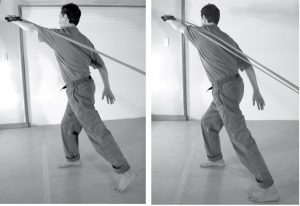
Figure 7: Shot-put exercise for session six, two variations. The variation with the heel off the ground (A) is easier; adding heel reach (B) is more challenge. A and B can be combined, as shown in the video at https://resourcesinmovement. com/videos/.
Early, starting with session one, there has been some mention of the peripheral support in the hands and feet, and so the possibility of bidirectionality in the axis. Just having the client walk, and then walk to the wall and begin to differentiate sensory impressions in the hands, and then have them begin to wiggle their spine, if you will, or move, or find their tail and find the sense of space out through the top of the head . . . that starts in session one and grows all the way through.
KF: You are not just adding techniques. It’s awakening inherent capacities. Learning certainly happens best when creativity is encouraged.
What we’re determining in the Wall Test, as explained in the article on integration that Ray and I produced (Frank and McCall 2016), is: Do you feel more elongation in the spine (and body in general) when the client presses with the hands or with the feet, and where do you feel less elongation and more ‘mastering’ – that feeling of the body trying to make sure it does a good job, which translates into efforted motor activity. As you use this diagnostic of the Wall Test, you probably want to work first, in eight, with the girdle/limb/spine relationship that feels less resourced. You test again at the end of the session, and then maybe do it again for nine, and again for a post-ten session.
CM: At this point, because of the work we’ve already done with pre-movement and self-care, we get to ask: Is the spine free to function from the support of the ground and the space?; Where are the places that need more clarification in terms of how pre-movement is functioning?; and Where might there be some additional support possible through a particular segment in the body, using fascia mobilization or going back over some of the places where self-care has shown to be helpful for the client?
KF: We might also develop or deepen a skill such as bidirectionality of the forearm (the perception that the radius and the ulna have vectors in opposite directions), or eccentricity in the spine, or support of the rami and so on.
CM: With hands and feet there is a seemingly endless need for refreshment – we live in shoes and are attached to our devices, so there is an endless dumbing down of the system. Spatial orientation and sensory receptivity to the world diminishes and with it the capacity to respond normally.
KF: With eight and nine, and ten for that matter, we’re probably going to at least do some portion of the session upright, either seated or standing, and engaging one or both of the girdles in expressive movement. And we continue with what we call AP Back Work, or anterior-posterior translation of the segments of the spine, which we touched on in session two. Here, one of the challenges is to see where one or more spinal segments don’t look as free to participate in the flow of elongation. There’s surprising benefit to teaching a client to simply move a single segment anterior, with a general lengthening of the front line, and then posterior with a general lengthening of the back line (see Figure 11). One learns to move one segment from the periphery, with hands and feet and vectors of head and tail. It’s a seated setup, on a bench with hands on handles (or on the wall or on the side of the table), hands and feet connected to the spinal- movement challenge.
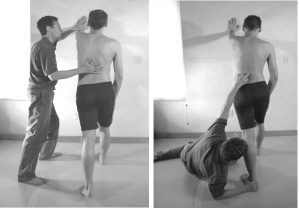
Figure 8: In session six, using a wall to open the back line from toes to hand on wall (A) and from hand on wall to whole foot on ground (B).
CM: The AP Back Work is a collaboration between practitioner and client. We could say it’s all about sensory impression gained from peripheral stability, through the hands and feet, the orientation of the axis bidirectionally. Then, when the client gets up and walks to integrate, what we often see is a sense of being able to move the spine in any direction as an opening movement; whether you’re in the back of the spine, the front of the spine, the side of the spine, finding that deep front line and allowing it to move easily, the core expressing a stable presence to adapt to all different types of movements from the connection to the peripheral.
KF: We have seen, over the years, no matter what version of AP Back Work – whether it’s on all fours, seated at a bench, or for that matter, Flight of the Eagle – is how clarification of AP movement of the spine coming through support of the extremities and orientation evokes improved torsion and counter-torsion of the spine and gait. More contralateral movement.
CM: We see little movements that a client spontaneously expresses – what their body is longing to do – in terms of integrating movement. While they’re taking their walk, they’ll start to stretch or do something. I’ve encouraged that right from the beginning so clients don’t inhibit this and instead notice and continue the exploration of how their body moves in ways that they didn’t know they could, that just in simple stretching their body is speaking to them. Some people have not been allowed to move freely, and have only learned physical education in a very disciplined way-
KF: Giving permission to explore what’s in the body, allowing that to come into expression. And this could also be about closure – whether it’s moments within a session or at the end of a session or as we reach the end of the Series. As we think about closure and the integration in eight, nine, and ten what else might we consider?
CM: Respecting that the client has been in a process, receiving a lot of information through the sessions. There needs to be empty space and time with the client in which we are holding the container for the unseen and the unknow, what might be occurring silently. Looking for how the body needs to take over the process and allowing space for what might want to emerge or just be felt.
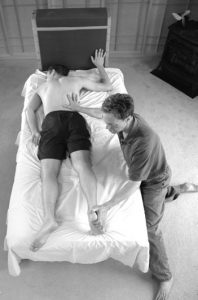
Figure 9: Another option for session six, table work using reachng of heel with toes on table combined with pushing a hand on a wall.
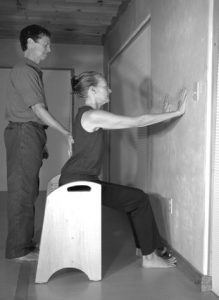
Figure 10: Wall Test for session eight.
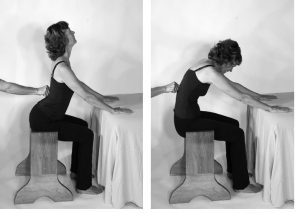
Figure 11: AP Back Work opening the front line with segments moving anterior (A) and opening the back line with segments being pressed into the practitioner’s hand with hands and feet (B).
Working with this starts for the practitioner with being comfortable with this process in the themselves. If we start to pause and spend time in ‘not doing’ we find out how much is going on – all the sensations, emotions, thoughts, impulses; we come to be able to just allow them and not act. Then you start to know when those moments for pause are there within a session and you begin to give them airtime. Then things reveal themselves in your system and the client’s experience through resonance, and clients begin to feel the support to land in their own experience.
KF: And what about the client taking the learnings that have occurred in the Series into their life?
CM: All their experiences are in their body – some conscious and some not. It’s often the silence or the pausing that allows for the body to integrate and prioritize and then go out and have it emerge in the right moments of their life.
Also on integration: I’ve noticed that there’s the integration that happens through the learning or receiving of new information, and that’s like an inhale; and then there’s the integration that happens when there’s a letting go of learning and practice, surrendering to trusting or feeling organismic intelligence, that’s like exhaling. Maybe there’s an understanding or a feeling of, “Oh yes, there’s something going on, and I don’t have to manage it anymore.” Then maybe in daily life when I return to something like going grocery shopping, or cooking, or driving, or taking a walk, there’s an emergence of, “Oh yeah, where are my hands and feet? Where’s the sky? How do I notice support?” And when I notice, I notice there’s a reduction of effort. I know integration is happening through this cycling, the body knows how to continue to change, adapt, integrate, and harvest what one wants to learn about.
KF: Digesting and witnessing?
CM: Digestion and witnessing and in some ways a conscious acknowledgement. That’s why I think closure needs to be a co-process, with the practitioner and client having that as a part of a session, naming that “We’re gonna pause here.” That’s important, having a period is important. There’s an ‘eventing’ that’s happening. I think Continuum Movement® names it ‘harvesting’ – another version of acknowledging, creating space for this eventing that’s going on in the body, and that which is around us.
Conclusion
KF: So, we’re at the end of a conversation about evoking normal stability and improved motor patterns via the Ten Series. We’ve spoken a lot about self- care, about a Ten-Series viewpoint, about motor patterns and stability. We’ve looked at different sessions, how to demonstrate before and after coordination, and how to frame each session as how bodies express integration. Any concluding remarks?
CM: An end is a good place to rest into.
KF: Is that always the mood at the end of a Series? What if you have a frisky client with a lot of enthusiasm and they’re all charged up and hungry for more? What do you do with that?
CM: I join them in that wonder, because it is wonderful, and appreciate that. It’s surrender to a bigger process – or processor of – the body, the movement brain, the organismic intelligence. So I am holding that place for that resting or that exhalation, and brightly and joyous, and pretty sure there is a next step somewhere.
KF: I think many people feel intimidated about the end if they’ve been pushing the Series along, like the Little Engine That Could, and now they’ve gotta leave the person. Instead you are building a faith that everybody has this inherent intelligence and creativity, and everyone will produce their particular Series by having airtime to express that.
CM: I’ve learned this through being a creative movement artist, I’ve learned it through honoring that process of creativity. It’s in all activities. Whether you’re a carpenter, a painter, a dancer, a designer, or programmer . . . you know there’s a dynamic activity, and part of it is the going out, and part of it is the pausing, the hibernation or incubation or harvesting.
KF: Great. Thanks for the conversation.
CM: Thank you.
Kevin Frank is a Certified Advanced Rolfer, Rolf Movement Practitioner, and Rolf Movement Instructor. He has worked with the Godard-derived Tonic Function Model since 1991 and has written on this topic from 1995 to the present. Kevin advocates for an ‘information-system’ view of SI to help bring this field into congruence with modern understanding of motor control and perceptive/coordinative processes.
Caryn McHose is a Certified Advanced Rolfer and Rolf Movement Practitioner, as well as a Somatic Experiencing® Practitioner and Certified Biodynamic Cranial Practitioner. She is the collaborator for Andrea Olsen on Bodystories: A Guide to Experiential Anatomy and The Place of Dance, and coauthor with Kevin Frank of How Life Moves: Explorations in Meaning and Body Awareness. Caryn has taught perceptual approaches to movement education for over forty-five years.
References
Caspari, M. 2005 Mar. “The Functional Rationale of the Recipe.” Structural Integration: The Journal of the Rolf Institute® 33(1):4-24.
Frank, K. and R. McCall 2016 Sept. “Inter- Faculty Perspectives: Integration – How Do We Define It? How Do We Assess It? Where Do We Place It in the Ten Series?” Structural Integration: The Journal of the Rolf Institute® 44(3):5-10.
Frank, K. and C. McHose, video resources at https://resourcesinmovement.com/videos/.