

By Heather L. Corwin, PhD, MFA, RME, Certified Rolfer™
ABSTRACT The author discusses how trust drives mutually satisfying relationships, ways to build trust when making business decisions, and explores ways it is promoted or broken in the therapeutic relationship.
Trust is at the core of every relationship we have. Though we may not think about it this way, all interactions that leave us feeling bad usually include a breach of trust. Some define trust as “the belief in the benevolence of human nature” (Yamagishi and Yamagishi 1994, 139); many others are convinced that trust is taught by caregivers (or not) early in life, also known as attachment style. Some people are raised by people who are trustworthy in some ways and not in others, which can establish unhealthy ways of engaging with others.
As Rolfers, we work with clients who may have histories of ‘trust abuse’ in varying degrees, and who themselves may not practice trustworthiness in their own relationships. We practitioners have our own experiences around trust, which further complicate interactions with our clients. The fact that touch is involved in our therapeutic relationships with clients makes our work fraught with potential challenges. Some clients have learned to mistrust the voice inside them that gives warning to a psychologically or physically dangerous situation, leaving
them vulnerable to repetition of a breach of trust. Others may perceive danger where it does not exist, and actually create a trust breach through ‘acting out’ and sabotaging relationships. In some cases, those for whom we are modeling healthy boundaries and trustworthy behavior act out because we are a safe space for them to do so. In this article, we will look at how to create and promote trust, a variety of ways that might be common for trust to be broken in our profession, and safeguards to put in place to promote safety for both practitioners and clients.
Trust is complex. Many elements can build trust or break trust. Because we are social creatures and require relationships with others to meet our needs, trust enables people to engage with each other to achieve or create an outcome. Research suggests that a personal referral or recommendation to a specific practitioner inspires more trust on the new client’s part than the absence of such a referral (Lewicki and Bunker 1995). This is also why sites that offer reviews like Yelp and Google are valuable: many people do not have firsthand knowledge of a product, and these websites are based on experiences in their area (Barrot et al. 2013, Ying et al. 2006). Notably, trust is more easily roused in people with similar backgrounds and nationalities (Glaeser et al. 2000). Additionally, Glaeser et al. point out that a person of higher social rank within their field – involving education, income, location of office, years in practice – is awarded more trust than those of lower rank.
Creating and facilitating trust can occur in many forms. As the last paragraph suggests, if you are able to make your credentials clear, people will see your experience and expertise. Another way to build trust is to have an evaluation system in place to help the client feel heard and communicate that you as an expert are taking their individual case into account to decide how to best proceed in the work. For example: your intake form; how you address the intake form and information shared during your consult/first session; any policies and/or disclaimers; ethical standards as suggested by any governing body you belong to or as outlined by the profession; and, not least, how you communicate (email, phone, text, etc.) to establish your first meeting.
I want to elaborate a bit on this last point, as our chosen mode of communication pertains to trust-building. In our present culture, we’ve come to rely on online platforms to reach out to new clients. Even with word-of-mouth referrals, connecting with new clients is crucial to building our business. Research has demonstrated that email can be an effective way to manage an existing business relationship, but other forms of communication are more effective to establish a new business relationship (Boase 2006). Ray McCall, who was my teacher in Phase III of the Rolfing® Structural Integration (SI) training, insisted that Rolfers need to return phone calls as soon as possible to build on the client’s interest and enthusiasm. Best practices suggest that a business should respond to the client in the same mode of communication with which that the client reached out – we can assume this is the way the customer prefers to connect. [despite Boase’s (2006) recommendation to avoid email to establish a business relationship]. The ‘meta’ message is that you are meeting that client where s/he is at, with a desire and ability to answer to his/her needs.
A critical element of trust is reliability: doing what you say you’re going to do. This may seem simple, but the impact of following through on promises is what establishes lifelong clients. This includes avoiding making promises regarding outcomes.
Now that we’ve looked at some research, I would like to speak to issues of trust from my own experiences as a Rolfer.
When I believe, based on prior success with others, that I can help the client, I let the person know that I feel good about the likelihood of our work succeeding and I explain why I feel this way. If your work exceeds clients’ expectations, this may inspire their loyalty; they may further regard you as an expert and be inclined to praise your name to others.
Some ways that this might play out in our practices are as follows. ‘Joe’ comes in because he has lower back pain. He heard from ‘Ken’ that you can make the pain go away. In your intake process, you learn Joe has stenosis in his low back and cervical spine, had anterior cruciate ligament surgery on his right knee years ago, and he ruptured his left Achilles tendon last year. Could you minimize the pain? Very likely. Will it go away completely with the work you do together? Suggesting that you would be able to eradicate the pain would be unwise; the combination of these injuries makes a pain-free existence unlikely. Do you want Joe’s Rolfing SI experience to be great? Yes, we want him to feel great because of the work done together and because his quality of life will be better.
The other side of our work in trust-building requires acknowledging limitations. None of us can predict how a client will respond to this type of work. Under-promising and over-producing is a great guideline when deciding on how to work with people and facilitate expectations. Some people respond to Rolfing SI as if they’ve found
the one thing for which they’ve been waiting their whole lives; others find the work intense and uncomfortable, yet feel the benefits outweigh the cost; some recognize this type of work is not for them at this time in their lives. It must be said that, regardless of your skill as a Rolfer, some people will trust you but reject the work. Most important is the integrity with which you convey information and follow through with your end of the client-Rolfer contract.
In the service of trust, it is necessary to proceed cautiously, adapting to and accommodating clients who are anxious about any aspect of the work we do together. I’m currently working with a client who I’ll call ‘Candice’. Candice has somaticized tension in her anterior neck and throat likely caused by several factors. This neck tension is extreme and has caused insomnia, anxiety, difficulty breathing, nerve impingement, and difficulty traveling, and any stress compounds the tension. Candice and I have been working together for weeks. I’m not her only wellness practitioner, I’m one of a team including a psychologist, an acupuncturist, a craniosacral therapist, and a psychiatrist.
When she and I spoke at our first session, the very idea of anyone touching her neck caused her to become agitated. I noticed this and asked if my observation was accurate. She relaxed a bit as she acknowledged she was nervous about the work we were going to do, mostly because she did not want me to touch her neck. I told her that I was not going to work on her neck that day and would check in with her when the time came that I did want to work on her neck directly. We were able to significantly create support and ease in her body without any direct work on her neck.
At the time of this writing, we are about to embark on session seven of the Ten Series, and it is planned that I will – for the first time – work on her anterior neck. I will suggest that she have her hands on mine in order to empower and give her agency. I’ve also taken photos on her phone before the Ten Series and after every session so that she can see her progress and doesn’t have to take my word for it (a clear way to create a visual evolution for the client and avoid any problems with handling of photos). These interactions build trust that has allowed us to work together towards her goals. (An update: during the process of publishing this article: Candice has completed her Ten Series and now has built up the trust to allow me to touch her neck whenever I feel the work would be helpful. In the spirit of the trust we’ve created, I always ask permission.)
Trust does have many barriers, and a big one is fear. Fear can be a strong motivator and inhibitor to our work – for both client and practitioner – and can foil trust. According to the Anxiety and Depression Association of America, one in four people in the United States has an anxiety disorder. (Anxiety can be defined as fear of something occurring in the future.) Some anxiety is normal for all people. Management of high or diagnosable anxiety can include medication, exercise, ‘talk therapy’, and manual therapy like Rolfing SI to facilitate ease in the body.
With an anxiety disorder, the nervous system is on high alert at all times; this requires the practitioner to move at a pace that the client can tolerate and that allows integration of the work. When medications are inhibiting the nervous system, it is necessary to tune into your own body/ nervous system to sense whether the client’s sympathetic nervous system has been triggered. Called ‘scaffolding’, this is an approach to helping your client using your own nervous system to regulate your client’s. If the client’s intake form notes medications that are prescribed for anxiety or depression, this will alert you to the fact that this client requires continual and sensitive monitoring because his/ her body is charged for fight/flight/freeze. If you’re not sure what a medication is for, always ask. As prescriptions are sometimes given to address an atypical diagnosis, asking the client about medications is imperative, even if you think you know what a medication is for. Simply being cognizant of this information as a practitioner can help you support your client in growing resources and awareness through your work together. Though fear can be challenging, letting clients know that some anxiety disorders require a slower pace of work acknowledges that you are listening and adjusting your approach for the individual.
Honesty is critical. If you, as practitioner, are aware of something happening in the room but avoid talking about it, this is a red flag. Perhaps you feel unconfident, or the interaction has triggered a memory that you want to avoid (countertransference), or something stirs embarrassment or shame within you, or perhaps you are wary of causing embarrassment or shame in your client. Self-awareness is essential for dealing with such moments. “To err is human,” but to take responsibility for our mistakes requires courage and integrity.
As a newer practitioner, each time I tried to avoid a sticky situation with a client, it backfired. One example: I had scheduled a Rolfing session with ‘Pam’ at 9:00 a.m. on a day that I usually began work at 11:00 a.m. Because of a setting in my booking system, Pam’s appointment didn’t show up on my personal calendar, even though she was booked to see me. I was in another part of town when she called asking if I was in the studio. A moment of panic set in. This type of situation is rare in my practice, but Pam wouldn’t have known that, and this was only her second session with me. I took a deep breath and told her the truth. Then I gave her options, which included a free session another day, or half price if she waited the less-than-twenty minutes it would take me to get to the studio. Pam chose to wait, and we worked that day. Since I was recommended to her by another healthcare professional, she had confidence that my claim that these situations were not usual for me was neither exaggeration nor a sloughing of responsibility.
A stickier situation occurred when I was still earning my PhD in clinical psychology with a somatic concentration. I was playing with the idea of incorporating ‘somatic psychology coaching’ with Rolfing clients – without supervision. My justification was my education; I felt I had a robust intake process that would help identify only high-functioning clients. One of my first and only clients who participated in this type of work was ‘Justin’ who had a history of severe physical trauma and sexual abuse. As we were working, he had a cathartic moment that easily could have retraumatized him. I had too little experience around managing such a moment.
With my regular Rolfing clients I would have made decisions that allowed more titration within a regulated state (Pat Ogden’s ‘window of tolerance’), but I was eager to move my client into ‘health’ without letting his pace be the leader. As you can imagine, the big emotions began. With as much grace as I could muster, I focused on calming my nervous system for him to attune to. I began naming everything that I felt was happening in the room to help him stay present and check in with his experience, knowing he
would likely dissociate. When he began to dissociate, the prompts did work to bring him back. Once we were able to regulate his system, we took some time to just ‘be’. I felt like I had avoided a car crash. In this instance, letting my client know about my error in judgement would not have been helpful or fostered trust. I did, however, admit that the session we shared was filled with things to unpack with his therapist (yes, he did have one). After he left and went into the world regulated, I sat with myself. I had no business trying to help people in ways I was not fully equipped. I removed ‘somatic psychology coaching’ from my menu. Knowing personal limits and abiding by your own policies can and does foster trust.
Empathy is a clear way to build trust. When you’re able to recognize and internally feel the emotions of others, you can connect with the person on more than a superficial level. This connection reverberates in both people to help understanding of the other grow. Connecting empathetically lets the other person know his/her feelings are okay, and validates the right to have those feelings. This is critical when we work with clients. People innately know when they are engaged with a person who is authentic and present (the hallmarks of a caring therapist). When we ignore or try to stifle the feelings we have because of shame or fear (or whatever), we are stopping the flow of who we are.
This stifling of emotions over time can manifest in the body, somatically. ‘Candice’, mentioned above, is an example of this; to oversimplify, her somaticized anterior neck pain resulted from stifling feelings. She came into our therapeutic relationship fully aware that she was somaticizing her feelings in her neck. She was ready and willing to address the patterns and pain, which allowed her to make great strides in our work together, including outcomes like lateral shoulders and a plumb head, which she wasn’t sure could happen. Allowing our clients to fully express who they are is another element of how we can support our clients through the Rolfing evolution into a healthier physical way of being, which is mirrored in the spirit. This expression builds trust.
Healthy relationships have clear boundaries that clarify the consequences of intolerable behavior. Honoring these boundaries helps to foster trust. The #MeToo movement is one that brings to light the gradations of violations and abuse of trust most often through power inequity.
In our Rolfing studios, we have the power. Among other reasons, we are clothed, while we (usually) ask that our clients be in their underwear. This element alone can be a trigger. (A ‘trigger’ is a term used in psychology and best defined as a visceral reaction that alerts the nervous system of a threat. It can often be accompanied by a disproportionate emotional reaction. Some triggers are smaller and are simply actions that irritate the client.)
In service of fostering trust (and avoiding potential triggers), we can give our clients options for clothing. I’ve met some male Rolfers who only work with people fully clothed. They recognize that some women feel uncomfortable being partially undressed with a male practitioner. I have a client who does not feel safe without sufficient clothes on. She wears clothes that I can easily work through, and she no longer has a high level of anxiety when she enters my studio because she knows what to expect. Regardless of the client’s state of dress, if you are going to touch or move any clothing, asking the client is imperative. I also ask permission to work on areas of the body that are close to the genitals and the anus. Several clients have told me that they felt me working in areas that I was not, which I attribute to a strong
referral sensation. These sensations, if not talked about, can be problematic and misleading. It is best to be explicit regarding the territory to be worked. Explaining the session’s goals can help the client understand why I work in a certain area. In truth, I tend to do this for most areas of the body because the client can then visualize the goal as we work, which helps the work we do together be more effective. Being exact with your clients about where, why, and how you work helps avoid misunderstandings.
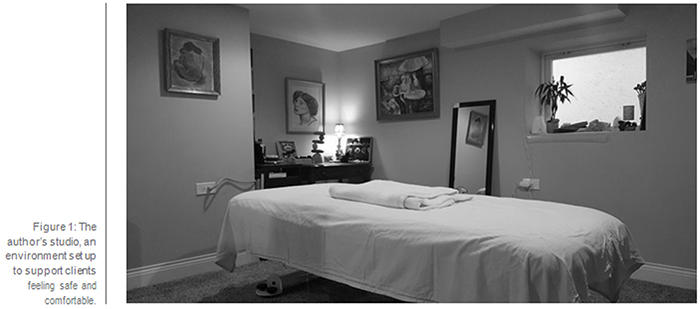
Looking to another practice element related to trust, your studio location and atmosphere communicates something about you as a practitioner (see Figure 1). Some of us have studios in our homes, some nestled in another practice (chiropractor, health club, etc.), and some have a storefront or office. Though this could be expanded into an article in itself, the essence of my point is that your space helps others understand what’s important to you in your business. I’ve been practicing bodywork since 1993. During that time I’ve worked in many environments – sometimes simultaneously. My personal preference is to have a studio at home. When in California, I was lucky enough to be able to renovate my garage into a studio with a private bathroom, separate from my house. In my present location, I have a built-in studio in the basement of my home with a separate entrance and bath. Because a home studio can conjure images of messiness, dogs and cats running around, and kids screaming around the treatment area, my website home page (www.bodybyheather.com) has a video of my treatment area, how to enter, and what to expect. Many clients have commented that this helped them understand what to expect; it helped them to imagine a tranquil and dedicated space for their Rolfing sessions. Others, clients and practitioners, prefer the clear boundaries of an office that is not inside a home. Regardless of the environment, cleanliness and a warm, welcome vibe lets clients know that you are going to take care of them.
In conclusion, someone once said, “Trust takes years to build, seconds to break, and forever to repair.” In our line of work, we help people evolve into who they want to become. Collaboration with our clients requires courage, stamina, and constant vigilance to practice integrity. None of us succeeds with everyone, and those instances that don’t work well present na opportunity to learn more about ourselves. Relationships require adapting and reconfiguring. As Rolfing practitioners, we can foster trust with our clients at every step of the relationship: how we advertise, conduct our intakes, contract with our clients, communicate empathy, set boundaries, assume responsibility, ask permission, configure our office space, and orient clients to our practices. If you have a successful practice, you likely already consider many of these things. Being conscious of all the elements that build trust can grow your business, and – more importantly – grow your satisfaction when working with people who will surely appreciate your efforts.
Heather L. Corwin holds a PhD in clinical psychology with a somatic concentration from The Chicago School of Professional Psychology and an MFA in acting from Florida State University/Asolo Conservatory. Currently, Heather runs her wellness studio in Oak Park, Illinois. As an actor for over twenty years and theatre arts professor at Roosevelt University, Heather’s research and work examines behavior through the lens of psychology, allowing the flaws of being human to unite us through creative expression. Heather is a Certified Rolfer, a belly laugher, married to the love of her life, a mother to an energetic eight- year-old, and a fan of historical romance. To read more publications and learn more about her, please visit BodybyHeather.com or HeatherC.com.
Bibliography
Barrot, C., J.U. Becker, and J. Meyners 2013. “Impact of Service Pricing on Referral Behaviour.” European Journal of Marketing 47(7):1052–1066.
Boase, J.A. 2006. America Online and Offline: The Relationship of Personal Networks to Email and Other Communication Media. Toronto: University of Toronto.
Glaeser, E., D. Laibson, J., Scheinkman, and C. Soutter 2000. “Measuring Trust.” The Quarterly Journal of Economics 115(3):811–846.
Lewicki, R.J. and B.B. Bunker 1995. “Trust in Relationships: A Model of Development and Decline.” In Conflict, Cooperation and Justice: Essays Inspired by the Work of Morton Deutch, B.B. Bunker and J.Z. Rubin eds. San Francisco: Jossey-Bass.
Yamagishi, T. and M. Yamagishi 1994. “Trust and Commitment in the United States and Japan.” Motivation and Emotion 18(2):129–166.
Ying, Y., F. Feinberg, and M. Wedel 2006. “Leveraging Missing Ratings to Improve Online Recommendation Systems.” Journal of Marketing Research 43(3):355–365.