Our mentoring program here on Alaska’s Kenai Peninsula has its roots in the mentoring I myself received from two wonderful Anchorage Rolfers, Barb Maier and Gwen Moerlein. From my earliest days as a Rolfer, their energy and generosity shortened my learning curve by years and inspired me to develop the program we now use. Every month for almost two years they came to my clinic to deepen my understanding of the work, help me out with my most difficult clients, or to teach me something new. Sometimes I would just bring out all my “before & after” Polaroids and they would patiently go through every photo of every client. Now, I offer the same service to every client of mine who becomes a Rolfer, and several of my colleagues do the same.
I turned sixty-one in 2010, and by the end of the year will have completed my thirteenth year as a Rolfer. In that time, I have delivered nearly 21,000 sessions. Of my own clients, twenty-four have become Rolfers, the twenty-fifth is in training now, and two more intend to enroll. Undoubtedly, the enormous demand for the work is one reason there are more Rolfers per capita in our area than in any other place in the world. I believe another reason is devotion to growing the profession.
It occurred to me early on that huge client rosters and long waiting lists (forty to fifty clients a week with a year waiting list) were no way to run a railroad. That approach was selfish and would never grow the profession. People needed ready access to the work and needed options among practitioners: old, young, male, female, weekends, evenings, etc. I was blessed when Andrew Mattson became the first of my clients to return with a B.S. degree and a Rolf Institute certification. We spent a lot of time together as I tried to share with him everything I knew. Soon, as Andrew outgrew any need for technical assistance, the two of us were left with bigger questions and broader discussions about the nature and context of our work. Today, Andrew is one of the most powerful and competent Rolfers I know, and our conversations helped shape the mentoring program. He, Jeannie Sorenson, and others are now mentoring their own clients.
My own work, as well as the mentoring program I developed, is based on the business goals of mastering the work, creating recognition for the Rolfing brand of structural integration, and weaving the work and the brand into the fabric of the community we serve. And, with the moral principle of Service Above Self (my Rotary Club motto) in mind, we try to grow the profession by attracting the best and brightest candidates to become Rolfers. But it takes more than that: when these candidates complete their training, they are not prepared to handle the size and complexity of the large practices awaiting them. To give you a sense of it, by my seventh week of practice, I had twenty clients a week; and by the end of my first year I had forty to fifty – a level I maintained for several years.
To address this need for further preparation, the mentoring program functions like an extended “Phase IV” of the Rolfing training in which whoever sponsored or recommended the graduate provides him or her with an “internship” through supervision. In the beginning, the main challenges were to make assessment more straightforward; to improve session strategizing; to manage expectations; and to nurture authenticity and confidence. The content includes any of several components, depending on the particular graduate’s needs based on age, background, and focus:
One of the biggest challenges has been meeting the needs of new Rolfers who are also young – 75%-85% of those I have sponsored. There was a time when one had to have attained a certain age and apparent maturity to be admitted to training. At that time, most Rolfers were like me: middle-aged career changers, settled financially. Today, the Rolf Institute doesn’t even require a four-year college degree and the minimum age is only eighteen, but these younger Rolfers tend to be bright, quick thinkers and quick learners, with seemingly endless energy. Though you can’t judge the quality of a new practitioner by age, age does shift the focus of mentoring. With the younger practitioner, we pay a lot of attention to burnout, practitioner injury, confidence, and therapeutic relationship issues. In addition, we strongly encourage each of them to get a four-year bachelor’s degree in a related field, and all but one has.
<img src=’https://novo.pedroprado.com.br/imgs/2010/1137-1.jpg’>
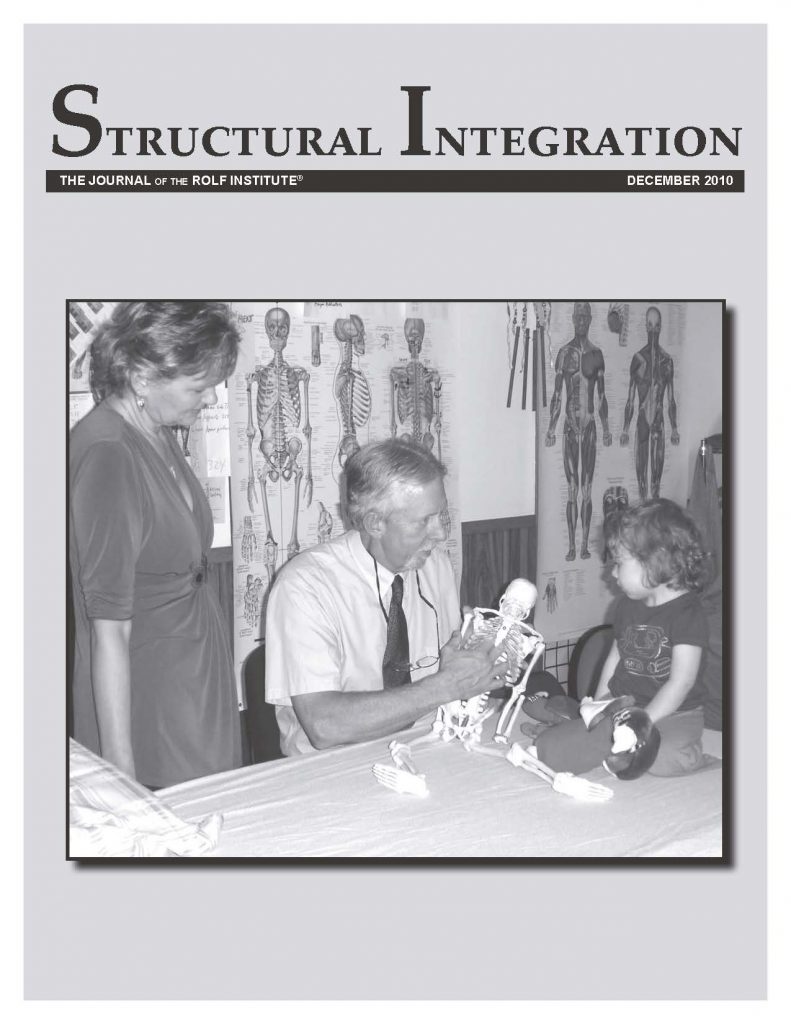
Jeanne Sorenson and Mark Hutton working with a three-year-old.
Here on the Kenai Peninsula, Rolfing has gained such high visibility that we participate in high school career days and senior career counseling, school district in-service programs, business shadow programs, hospital grand rounds lectures, and surgery observation. Rolfing is so integrated into the culture that generally when one person here tells another about going to a Rolfer, the response is, “Who are you going to?” – not “What’s that?” or “I heard it hurts!” Our work is covered by two insurance programs within the Kenai Peninsula Borough, through which ten visits per year are paid for without the need of a physician referral or prescription. We are also known for our services given free-of-charge to children under ten and to military veterans. The children, some of whom come through physicians’ referrals, are seen for conditions from torticollis to indigestion to minor structural injuries. All veterans of World War II and the Korean War are scheduled free of charge, and Vietnam and Gulf War veterans are included as space is available. Most Rolfers offer these services during the regular course of a working day. As all Rolfers know, this is some of our most rewarding work.
Along with the name-brand recognition we enjoy comes the responsibility to maintain a high standard of competence and professionalism among entrepreneurial practitioners without licensing or proactive institutional oversight. This makes our mentoring program all the more important. It is difficult for me to assess how good a job we are doing, but our intent to help is clear and we work very hard. The need is real.
In closing, I feel confident that our program is not unique and that ones like it exist in many communities. I do, however, want to encourage each Rolfer to make a more concerted effort to grow our profession. Our work has the potential to help humankind profoundly, yet its potential will not be realized until we have more Rolfers. We are a profession of service, and placing service above self includes seeking opportunities to mentor others.The Kenai Peninsula Mentoring Program[:]
To have full access to the content of this article you need to be registered on the site. Sign up or Register.