
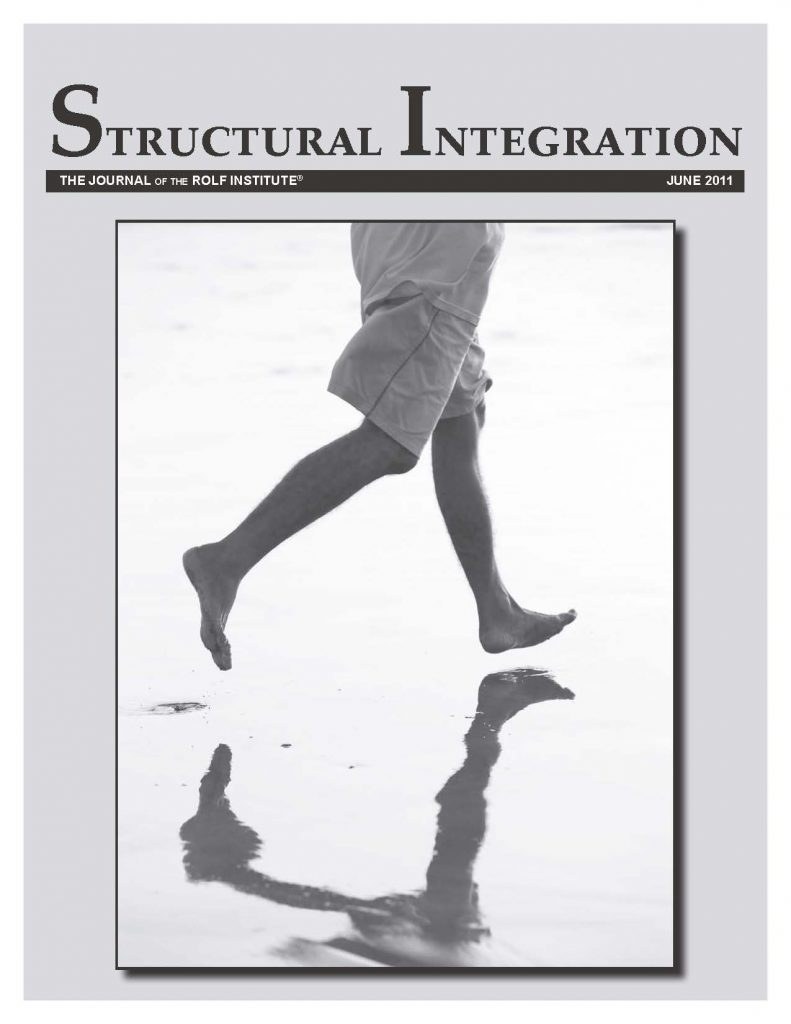
The advantages of barefoot walking can teach us how to choose footwear that follows the body’s biomechanics. A detailed look at foot biomechanics guides the recommendations for minimalistic footwear.
The foot has twenty-six bones, and each of these bones should move separately when you walk. For a hands-on experiment, twist your foot to see how much motion is possible. Now turn your shoe upside down and twist it. Grab it at the heel with one hand, and just two inches toward the toe with the other hand, then twist. You are checking for torsional rigidity, a trend in shoes that limits the ability of the tarsal bones to move naturally. Shoes need to be flexible to allow your foot and ankle to adapt to the ground. Most shoes that are flexible will also be lightweight, which allows natural hip and leg motion.
As you walk, your brain seeks proprioceptive information from the ground. When footwear is too cushioned or supportive, those sensations will be dulled and you will subconsciously strike the ground harder. This causes damaging weight load in the knee, increasing the risk for osteoarthritis. A scientific study (see references) shows increased joint shock when wearing oversupportive sneakers or stiff clogs but significantly less when barefoot or in flipflops. When walking barefoot, these heavy steps are punishing, so you quickly adjust your gait. For this reason, it’s essential to feel the ground through your shoes.
There is a second reason why this is important. Sensory feedback from your feet is essential for the correct firing of motor nerves. The nervous system demands quite a bit of sensory data to guide its motor commands: the neural bandwidth for sensory data is about five times more than for motor data. Your brain wants to sense your environment before deciding how to move, so it can make adjustments accordingly. One example of this is the tibialis posterior muscle, which does the job of lifting the arch of the foot, but will tend to be lazy if there is a lack of appropriate sensory information. When the tibialis posterior is doing a poor job of raising the arch, it is often further weakened by wearing shoes with too much arch support. The arch is meant to be supported by the foot’s bone structure, ligaments, and muscles (tibialis posterior and flexors hallucis and digitorum longus). When the arch of the foot is not undermined by artificial arch support, it will be stronger and more capable. A stiff arch support interferes with the natural pronation stage of walking, when the medial arch of the foot spreads and flattens. The peroneal muscles will still attempt to pronate the foot against this obstacle, which can cause peroneal tendinitis and even IT band strain. Your foot will be allowed to regulate its own arch support when you choose shoes with minimal arch support.
The next step in following foot biomechanics is to seek a shoe with a completely neutral heel. Most athletic shoes, sports sandals, and even “flat” dress shoes have a half-inch heel. (Look at Figure 1a to see examples of nonminimal shoes, and Figure 1b to see examples of minimal shoes.) Even a small heel contributes to tight calves and hamstrings and increased heel strike. A “negative heel” is also not neutral, and I have not heard a scientificallybased argument for why it would be an improvement over nature’s design for the heel. Exercising in an athletic shoe causes the calf to be strengthened in a limited range of motion. Outside the gym, muscles shorten if your daily footwear has a raised heel. When the calf is short, the Achilles tendon is vulnerable to tears instead of being strong and resilient. Shortened calves limit ankle freedom, and also impact the rest of the body. Since there is a continuous line of fascia from the bottom of the foot up the back of the body to the forehead, it makes sense that short calves could contribute to many problems. Tight hamstrings and lower back trouble are obvious consequences, and perhaps this pull from the calves could even cause neck tension and headaches.
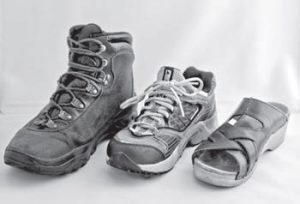
Figure 1a: Nonminimal shoe choices.
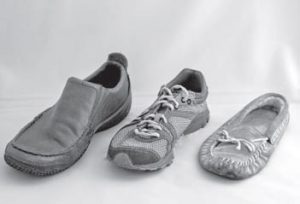
Figure 1b: Minimal shoe choices.
Athletic shoes can set runners up for plantar fascia pain. In one case, an athlete had run many marathons and even a 100-mile race, and wore athletic shoes daily with no problem. However, spending just one day barefoot at a water park triggered severe, lasting plantar fascia pain. The tissue had been overstretched by normal motion after being held short for so long. The typical podiatric recommendation is to avoid being barefoot, but that answer is only a makeshift solution. A better healing plan would be to calm and free the tibial/plantar nerve (between the gastrocnemius heads and along the inner ankle), to lengthen the calf muscles and fascia, and to transition to neutral footwear to support full calf length.
As athletes transition to reduced heels and then neutral heels, proper stretching is necessary to avoid injury. Stretching should occur after calf exercise that fully warms the muscle tissue. Stretch the calf by dropping the heel off the edge of a curb. Start slowly, feeling for the first place of resistance, and pause for ten to twenty seconds to let that resistance ease. Sink deeper and look for the next resistance. Once in the full stretch, hold the position for sixty seconds or more. This measured approach to stretching will prevent injury and support the calf in adjusting to shoes with a neutral sole.
A neutral sole will also be flat through the toes. In the past decade, athletic shoes commonly feature a 15 degree upward slant, called toespring. Toespring was added to facilitate the rolling action of the foot, but our legs naturally perform this motion without changing shoe shape. If the shoe is flexible, toespring can be reversed by bending the shoe in the other direction for a half hour. Toespring may contribute to deformed toes because it holds the toes in a lifted position. Toespring also limits the ability of the flexors and extensors of the toes to work properly. Your toes will enjoy having a foot-shaped toe box, which means the toe box needs to be wide at the end of the toes. Narrow toe boxes cause bunions, neuromas, and distorted toes. Watch out for a toe box that narrows too quickly. Athletic shoes are commonly wide at the ball of the toes but narrow at the tips of the toes. If you remove the insole and stand on it, check whether your toes go over the edges of the insole. Avoid sandal straps that cross the toes and pull the toes inward. Narrow toe boxes are a sneaky contributor to overpronation. If the big toe is pushed toward the other toes, the foot is more likely to overpronate. Try it by holding your big toe in toward your other toes, and then out away from your toes, and attempt to collapse into your medial arch. In the natural position, the big toe helps limit pronation to an appropriate level.
Poor-fitting sandals or flip-flops can also contribute to deformed toes. Footwear needs to stay on your feet without having to use your toes. Common culprits can include flip-flops, clogs, Crocs®, and Birkenstock© shoes. Over the years, gripping or lifting your toes will contribute to hammertoes, claw toes, and squished-together toes. Choose a version with a heel strap, or with a design that stays on easily as you walk. Examples would be a Birkenstock or a Croc with a strap behind the ankle, or Mary Jane style dress shoes.
Indigenous peoples who have been barefoot since childhood show us how to walk and run correctly. Allow your foot to stay on the ground longer, rolling through the toes, then swing your leg forward only to the point where it is just a little in front of your body. (Contrast this to reaching the foot far in front of the body, striking the heel, and pulling the rest of the body forward.) This new stride will be shorter but with a faster cadence. Each step will feel lighter, minimizing both impact and effort. Keep the feet fairly close to your midline, in line with your center of gravity. This prevents side-to-side rocking, for reduced impact and improved balance.
Say you’ve found shoes that are wide at the end of the toes, but when you take out the insole and stand on it, your big toe or little toe still extends past the edge. Your toebox needs a little more room. You can re-lace the shoe, skipping the first pair of eyelets, to allow more room at the toes. You can try to stretch the leather in specific places, using a tool such as the blunt end of a pen.
If the toebox is spacious but your toes are still inactive, you can wake them up by wearing toe socks, which have a separate pocket for each toe, like a glove. This stimulation will increase sensory information coming from your toes and help you learn to use them. Injini® brand (www.injinji.com) has longer toes, neutral colors, and wicking fibers appropriate for sports. Sock Dreams (www.sockdreams.com) has many styles for women, with shorter toes and fun colors. Of their products, Feelmax anklets have an excellent fit for average-sized women. Toe shoes by Vibram Five Fingers® are available online and at REI. The original four models (Classic, Sprint, KSO, and Flow) are built with extra-long toes, while the newer models fit people with average toe length.
Men’s and women’s designations simply indicate a slight difference in width. New shoe purchases need not be expensive. Just keep these principles in mind as you shop, and you will find many minimalistic shoes for $80 or less. Look first for shoes that have a reasonable toe box and a neutral heel. Pick up each of these shoes, turn them over, and twist specifically at the tarsalbone area to check for flexibility. If they pass the twist test, pull out the insole (if not glued in), which allows you to see how the shoe is constructed and whether it can be worn without the insole for increased sensory feedback and toebox room. (Doing these tests, you are spared trying on shoes that may seem initially comfortable but work against your biomechanics.) Then, try on final candidates for fit and comfort. You don’t need to throw away any of your shoes, just put some of them in the back of your closet, and be reasonable about when you wear them. If you have healthy feet, you may wish to use non-minimalistic shoes for specific activities. Examples include: tall heels for tango, salsa, or flamenco; hiking boots for extreme mountaineering, especially using crampons for ice; work boots for climbing ladders, using a shovel, or other dangerous tasks; rock climbing shoes, which pinch the toes; and ski boots, which closely resemble an ankle cast. For people who love these activities, it is even more important that the rest of your shoe wardrobe is minimalistic.
Bring a lightweight shoe to change into immediately after the activity, or go barefoot if possible. Spread your toes and stretch your calves to restore full motion to your legs and feet.
Please contact me at 503-230-0087, or see my website www.portlandrolfer.com for more information, including a link to a thirteen-page list of recommended shoe brands and styles with photos, as well as links to scientific studies on feet and shoes.
References
Lieberman, Daniel, et. al., “Foot Strike Patterns and Collision Forces in Habitually Barefoot Versus Shod Runners.” Nature, November 2009.
Shakoor, Najia and Joel Block, “Walking Barefoot Decreases Loading on Lower Extremity Joints in Knee Osteoarthritis.” Arthritis & Rheumatism, Sept 2006.
<B>Bringing This to Our Practices
I use this information in my Rolfing® Structural Integration practice to educate clients about their shoe choices. Feel free to pass out this article to your clients (or use the short client-friendly two-page version entitled “Healthy Shoe Choices” on my website www.portlandrolfer.com/index_Workshops.html) so they can make educated decisions when purchasing shoes. Besides working with individual clients, I also teach a ninety-minute class on healthy footwear that I call a “Shoe Clinic.” This is a hands-on lesson in evaluating shoes and even modifying them to optimize foot health. I ask people to bring an assortment of their shoes (one shoe per pair is fine). The shoes are a great visual aid as we go through the various points in this article. People leave the clinic motivated and clear on how to improve their foot health through their daily shoe choices. My target audience for this class is young people with healthy feet who want to stay active their entire lives.
Then, for clients making the transition to minimal shoes, I find the following Rolfing work very helpful.
- Freeing the calves – including gentle work to free the tibial nerve deep between the heads of the gastrocnemius and at the inner ankle – will help the calves be able to operate at their full length, instead of the shortened position when wearing athletic shoes with a raised heel. The result should be improved talar glide, easier hip extension, and less effort in walking.
- Sculpt the metatarsals into their natural transverse-arch shape. Some Rolfers do this using both hands, the fingers creating the shape by pushing into the bottom of the foot. I find it easier to put the knee up, foot flat on the table with a racquetball ball under the transverse arch. Then both of my hands are free, and I can even use my elbow if needed.
- Awaken the toes with detailed work to help each toe find its own role. Simply having the sensory input from your work will help the toes operate independently.
Look closely at clients’ shoes and socks. Perform “fascial release” on the toe seam of tight socks, and teach clients to do it. Encourage them to cut, stretch, and otherwise modify their shoes to fit their feet and optimize their foot function.
Barefoot Walking Inspires Healthier Shoe Choices[:]