

Contact Improvisation is a dance of improvising and partnering based on the physics of touch, balance, weight, momentum, flow and resistance. . . . Sometimes quiet and meditative, sometimes wild and athletic, it is a form open to all bodies and enquiring minds and is suitable for all with a love of playful physicality. . . (it is) a shared, non-orchestrated, non-choreographed dance.
Robert Anderson1
Contact Improvisation (CI) is an improvised conversational dance between the gravity centers of two dancers. Rolfing Structural Integration (SI) at its best is the same, only in a slightly different context. Many of the physical elements are identical: an appropriate depth of touch, a deft commitment in the application of physical force, a sure sense of the vector of my force, a deep sensing of the other, a feeling for, a waiting for, an expectation of the response. There is a huge crossover in the skill set required in CI and Rolfing SI; there is the same kind of mutuality.
I have played with the art of CI for several years and it has deepened the structural aspects of my Rolfing practice and expanded my vocabulary of movement, making me a much more assured movement practitioner. Through this practice I have developed a greater range of ‘end-feel’ connections in my clients; I can listen more deeply to their response to all my interventions, both the myofascial and the educational. I have come into a more direct understanding of the physical forces I employ, and a feeling for the qualities of movement I would wish to evoke in my clients. As a movement practitioner, I am always interested in finding new ways of pacifying habitual patterns in my clients (as well as in myself). The very nature of improvisation is that of constantly playing that edge between the habitual and the novel – the same field of enquiry as Rolf Movement Integration.
A Journey into the Joy of Movement
In my journey as a Rolfing practitioner, there have been many times when the work has lost its interest to me. The unfailing remedy during these dry spells has always been to seek out, then explore, new means of deepening the work. Once, when I felt I was becoming a ‘serial meat processor,’ I undertook an exploration of cranial work, and though deeply skeptical of the rationale given for this work, I found it greatly extended and deepened my listening touch and gave me impressive results. Then I had a long and deep romance with the work of Dr. Hans Flury, which challenged me conceptually and led me to explore just what it means when we Rolfers speak of ‘structure’ and what we are doing when we attempt to ‘integrate’ this structure. Then I discovered the brilliant work of Hubert Godard, whose broad erudition in movement studies inspired me to explore other ways (beyond structural) of bringing lift to my clients. Before this, expressions from movement teachers such as “Allow your femur to lengthen towards the knee” would drive me to distraction! My perverse, sarcastic, left- brained inner dialogue would go something like “No, the femur being bone is not likely to lengthen merely because I allow it!” I was yet to realize that there are many vocabulary sets around movement, and that the language of dance and the language of anatomy do not intersect perfectly. Godard’s work has allowed me to drop this over-analytical thinking and realize that expressions like “allow the femur to lengthen” are entirely valid in a movement context despite their anatomical improbability; expressions such as these work wonderfully well as ideokinetic suggestions that can have real effects on tonus. The next big discovery to deepen my Rolfing work was the practice of CI.
Part of my journey into the joy of movement was a visit to Kevin Frank and Caryn McHose at their beautiful Holderness retreat. There I did a workshop that explored Godard’s work of sensorial and perceptual awakening and how this can be applied to the work of SI. At the end of the workshop Caryn, a deep explorer of the somatic realm, gave me a very significant ‘debriefing’ which changed the course of my work and life. She said that, from her observation of my process, I had gone very deeply into the interior space (the space explored so profoundly in Continuum and Feldenkrais®) and that I was attracted to (she could almost have said ‘addicted to’) that luscious, deeply internal exploration of movement. In this interoceptive enquiry, the basic impulse is towards finding an internal sense of self; it is a deep exploration of our inner space, the space Godard has called ‘the territoriality of the flesh.’3 What I needed next, according to Caryn, was to bring a sense of the other into my movement work, a referent outside of myself; this required an attention to and exploration of vectorial space – an exploration of my kinesphere and all objects within that range. This was salutary advice as I was already sensing that there can be something quite self-indulgent in the exploration of ‘the territoriality of the flesh’ – after all it is all about me, me, me! Caryn recommended two practices to explore – Authentic Movement and CI; Authentic Movement because it entails an external witness, CI because the process requires constant interaction with one or more fellow practitioners (if not with a partner, then with the floor, one’s ever-present partner). Deeply delving into both practices has enriched my Rolfing practice in extraordinary ways.
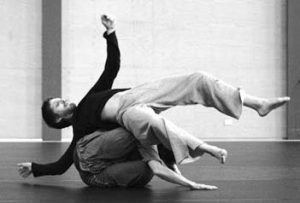
Wild and athletic. (All photos courtesy of Alejandro Rolandi.2)

The floor as the constant partner.
Contact Improvisation
Arriving back in Sydney, I found a thriving CI community in Newtown, an older and rather bohemian suburb. The group had a regular practice in a dance studio within an old industrial space that had once been a flour mill. Like many places where there has been a lot of concentrated meaningful activity and focused attention, this room had that special feeling of a sacred space; it calmed you as soon as you entered. The teacher, Alejandro Rolandi, guided us through a profound somatic warm up, and I began to sense that this work contained a somatic intelligence of a very high order. As a Feldenkrais practitioner I had done a lot of somatic work and thought I understood the scope of this form of enquiry, but here I was to discover that this little dance community had completely assimilated the work of Feldenkrais, Body-Mind Centering®, capoeira, parkour, Aikido, 5Rhythms®, yoga, Laban/Bartenieff – and any other discipline they could lay their hands on! – and had embodied and owned them.
In the first session, we were taken through a process of grounding, of orienting to space and to others within that space, of expanding the peripheral vision, of activating the proprioception of the feet, and of work with balance – all the kind of suggestions you would expect from movement practitioners familiar with the work of Godard. There was even the recognition of Godard’s ‘up’ or ‘down’ types – dancers with a preference to sky or earth. Later I realized that these prolonged and detailed ‘somatic warm ups’ were the main reason why injuries in CI are so rare; they prepare the body but quicken the perception as well.
It soon became apparent that CI has all the elements I required for my own continuing health – work on stamina, flexibility, core coordination, balance, expanded spatial awareness, improved timing, aesthetic appreciation, and great fun. And people attracted to the form are generally very decent people – improvisational forms tend to attract people who have no problem with dropping an agenda!

A rolling point of contact.
What is CI?
CI is a postmodern dance form in which there are shared, shifting points of physical contact between the practitioners. This contact initiates a mutual exploration of movement that transforms into an improvised dance. Dancers maintain this sensed, living point of contact with their partners; all are engaged in listening to or following this point of contact without holding an agenda as to how the trajectory of the dance should unfold.
CI began in the United States as an exploration of all the physical forces that can be experienced by the body – momentum, torque, impulses of falling, rolling, spiraling, lifting and flying, giving and receiving weight, catching, moving with gravity and through it. It calls for the giving and receiving weight from your partner and maintaining a balanced relationship – or if unbalanced, allowing yourself to fall freely and to follow the new and unexpected trajectory. Like other forms of improvisation, it will lead to completely unexpected places. There is a yin-yang aspect to this kind of improvised partner work – who leads and who follows? Do I initiate/lead or do I respond/follow? Can I do both? Can I do neither? Mysteriously, a third element arises in which neither partner assumes the role of leader or follower; instead, both lead/follow and traverse the unknown path where the rolling point of contact will lead – which means that this form is inherently unpredictable.
CI is said to have originated from a highly dynamic dance piece called Magnesium (1972), which was performed by Steve Paxton and dance students at Oberlin College in Ohio. Later he was joined by dancer Nancy Stark Smith, who became a co-developer of this form. I heard an apocryphal story that Paxton, who was both a gifted dancer and an Aikido master, had the idea of reframing the essence of Aikido in order to create a new approach to dance. The essence of Aikido is to use your opponents’ own momentum to unbalance them; why not instead create a dance form in which you constantly try to balance your partner? A fascinating documentary, Fall After Newton4. documents the rise of this dance form. In it, Paxton narrates:
When an apple fell on his head, Isaac Newton was inspired to describe his three laws of motion. . . . Being essentially objective, Newton ignored what it feels like to be the apple. When we get our mass in motion, we rise above the constant call of gravity, towards the swinging, circling invitation of centrifugal force. Dancers ride and play these forces.
CI is typically practiced at meetings call ‘jams.’ Usually there is a long somatic warm-up often followed by some work around a particular skill. Learning a skill may seem at odds with the concept of improvisation, but skills in CI are viewed as pathways of exploration, rather than highly choreographed movements to be practiced and mastered in a precise way, as in classical ballet. Then comes the jam, the actual dancing with one or more partners, sometimes accompanied by music, sometimes without. Newcomers are usually informed of the unwritten rules of CI:
The Underscore – A Somatic Treasure Chest
Since the inception of this dance form, Nancy Stark Smith has formulated a profound practice called ‘the underscore.’5 This arose from her many years of observing people’s process and it formally outlines aspects of individual and group process during a jam. It is a monumental achievement that encapsulates an enormous amount of somatic intelligence. The practice has almost a liturgical feel. It contains sub-practices such as ‘the small dance’ – a seemingly simple standing meditation in which participants listen to the ‘reflexive dance of the bones,’ the constant activity of the tonic musculature involved in balancing us in gravity. There are periods of orienting to the space and people around you – to the space of the room, to the floor, to the ‘skinesphere’ (one’s own surface), to the kinesphere. Then there are moments of ‘grazing,’ of having mini-contacts and mini-dances with the other dancers, followed by lengthier partner dances. And like a good Rolfing session, there is time for an appropriate denouement, a winding down, a sense of when to stop, gather and share.
CI and Rolfing SI
My practice of CI has deepened my Rolfing practice in a number of ways. It has helped me to:
What is the simple aim of Rolfing SI? – To help our clients function well. And in order to do this, we help them deal with the long-term and short-term results of harmful patterns. We help our clients to:
Rolfers are given many structural and educational tools to assist in this process. I would like to suggest that improvisational techniques and approaches, including CI, could certainly be added to this toolbox: these practices have enormous potency in helping us escape the tyranny of habit. Improvisation of any kind is never pure, never unrelated to its context, never without some form of constraint; otherwise, there would be simply too much choice – and too much choice is another way of describing chaos. Recognizing this fact, many improvisers are drawn to consciously selecting their constraints as a means of limiting the scope of the improvisation. But even within these constraints it is possible to be highly creative and innovative. In CI and other forms of movement improvisation, these chosen constraints are called ‘scores.’ Such scores channel the trajectory of the improvisation without removing the element of the unknown. Thus, even following a score, it is impossible to predict where the improvisation will lead. There is obviously great potential for using cleverly constructed scores in movement practices of all kinds, finding new ways of challenging our clients to discover new options within themselves. Feldenkrais was a master in calling for such constraints – to oblige the client to find another way.
We Have Two Bodies
Godard, with one of his extraordinarily potent simplifications, says that we have two bodies: (1) the body of vectorial space (Pilates, Rolfing SI, etc.), in which there is an outward reach both of one’s attention and the physical forces emanating from us; and (2) the body of ‘the territoriality of the flesh’ (Continuum, cranial and visceral work, etc.), in which the flow of attention is more inwardly directed.6
This is a wonderful image and helps differentiate movement practices according to where the center of gravity of the practitioner’s attention is placed – inwardly focused as in Continuum, or externally as in Pilates. With this shift in the vector of attention comes the reshaping of one’s kinesphere, and by reshaping the kinesphere we deeply affect tonic function, usually in ways that will increase movement efficiency by reducing parasitic muscular activity. This is the goal for our clients, yet as practitioners we need to understand this in our own bodies. As practitioners, we need to understand our own habits of attention, including where attention is habitually drawn (inside or outside) and how we selectively shape our own kinesphere. We also need to see the attentional habits of our clients, as this can be a big factor in deciding how to work with them. Ultimately we need both ‘bodies’ (depending on the environmental context), and to be really efficient in the world, one needs to be able to shift quickly between these modes of attention and even perhaps to have both at once. This dexterity of attention has come as the great gift from my study of CI and is possibly the most potent factor in influencing my SI work.

A moment of poise between earth and sky

Quiet and meditative.
I would encourage anyone in the bodywork field to explore this art form as a way of expanding their understanding of human function and indeed expanding their own potential for action.
The author can be contacted at johnsmithrolfer @gmail.com.
Endnotes
Contact Improvisation and Rolfing® SI[:]