
This article shares an approach to helping clients develop healthy stabilization through the shoulder girdle. While Rolfers systematically release upper shoulder-girdle tension, the release may be unsustainable unless the client acquires a new and better habit for shoulder and arm coordination. I have found, over several decades of practicing Rolfing® Structural Integration (SI), that a client’s momentary (or even week-long) somatic epiphany about her shoulder tension does not guarantee sustainable functional change.
What follows presumes that the client has already developed some capacity to yield to gravity and to experience spatial support. She has also experienced the whole-body decompression that accompanies simultaneously accessing the dual perceptual support systems. She has a sense of her central line, and reasonably well-functioning lower extremities.
Anatomy Tour
I often begin by instructing my client in basic anatomy relevant to the issue being addressed. Many people cannot internalize the three-dimensionality of the pelvis, for example, or do not know that each lower leg is composed of two bones. They may have taken an anatomy course long ago, but never associated what they studied to their own bodies. Understanding that the coracoid process is a projection from the front of the scapula, and finding it on oneself, can initiate a journey of shoulder-girdle transformation.
In our sedentary, forward-head culture, it’s common for people to stabilize their shoulder girdles from the levator scapula and pectoralis minor muscles. Rolfers commonly find the fascia in these areas to be tight, short, and fibrotic. While posterior shoulder stabilizers (lower trapezius, serratus anterior, latissimus dorsi) may be made strong through weight-bearing yoga poses or gym workouts, strength does not insure they will properly connect the arm to the spine during ordinary tasks. Further, strengthening the shoulders does not guarantee that the core of the shoulders1 is active, or that it will be engaged in supporting the shoulder girdle in the postures and locomotion of daily living.
I approach this issue with a brief tour of shoulder anatomy. I have a shoulder girdle model that includes the upper humerus, clavicle, and scapula, and also a spine with rib cage. People are interested to see how the shoulder girdle fits onto the thorax, and how the scapula and clavicle adjust to support arm movements. I could pull up a video of all this, but clients seem to like my hands-on approach. They can touch and examine the model, and then palpate the same bony features on themselves. With one hand on the clavicle at the manubrium, I have the client move the other arm around and notice how the clavicle adjusts.
Sensing the Core of the Shoulder Girdle
Next I have my client sit or stand facing a wall and place her hands on the wall with the heels of the hands at armpit level (see Figure 1). I instruct her to keep her hands “glued” to the wall while at the same time sliding them down towards the floor. The hands don’t move, but the resulting traction activates the sensation of latissimus dorsi. Then I ask her to roll the upper arms just enough to aim the crease of the elbow toward the ceiling. This minute adjustment engages lower trapezius and challenges a shortened pectoralis minor. Then, pressing the hands into the wall as if pushing it away activates the feeling of serratus anterior. (To do this last action without moving the trunk back is the key to success.) The client is now aware of a broad, sturdy feeling across the upper back. With my fingers on the inferior angles of the scapulae, I invite the client to move in and out of this configuration, noticing how serratus anterior activation flattens the scapulae against the back of the rib cage.
Once a client can sense lower shoulder-girdle engagement on her own, I ask her to keep the feeling as she lowers her arms and steps back from the wall. And then to describe what she feels. Finding her own descriptive words helps her anchor the feeling. Because many people are interested only in changing a shape-oriented notion of posture, it can take some convincing to get them to value what they feel. Information about brain re-mapping is useful because people tend to respect the brain’s needs and limitations, if not the body’s.
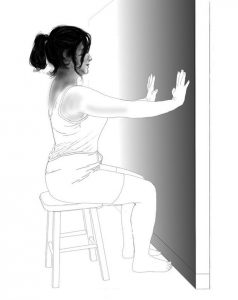
Figure 1: Hands-on-wall position.
Clients need to believe that our brains map new habits only through sensory experience, and that mindless practice quickly degenerates into habitual patterns. To that end, I emphasize the sensations that the client experiences, not the coordination, and not the body shape, even though those may be hoped-for results.
A first such mini-lesson might take ten minutes. It concludes with the client finding the serratus-anterior sensation and then purposefully losing it again, in order to practice the transition from the familiar sensory habit to the new one. A follow-up session could incorporate the new sensation into some everyday activity. After rehearsing that, it becomes homework.
When the client can reliably find the sensation of “serratus support” (serratus anterior is not the only muscle that needs to be engaged, but because the sensation of engaging it is usually unfamiliar to people, it makes a good nickname), I ask her to feed this feeling into her exercise routines, or feel it while driving, folding laundry, or doing dishes. With some clients it is necessary to coach them through such activities with a car, sheets, and real dishes.
For yoga practitioners, it’s important to step them through some of the arm weight-bearing poses. To their chagrin, some clients discover that their plank and chaturanga lack full serratus-anterior participation – that their scapulae tend to “wing” when weight-bearing is challenged. The re-learning process might look like this: starting in four-point kneeling (see Figure 2), with the heels of her hands directly below the armpits (and knees below the groin), I help the client find the sensations of a broad upper back and lower shoulder-girdle stability we have already developed in non-weight-bearing positions. Initially I may keep my fingers lightly touching the inferior angles of her scapulae for feedback about their stability. By reminding the client of her “earth and sky” perceptions in this position, she initiates abdominal core support. Vectors reach into opposite directions from clavicles and sit bones; hands and shins/ ankles press into the ground. Sustaining the sensations of shoulder support, along with ongoing perceptual renewal of weight and spaciousness, she steps each foot carefully into plank position (now with oppositional vectoring between clavicles and heels). For many, using their underactive deeper shoulder stabilizers makes this surprisingly difficult. It may be quite some time before chaturanga can be accomplished without losing the new shoulder support.
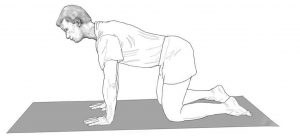
Figure 2: Four-point kneeling.
A Shoulder Shortcut
There’s a video blog on my website that demonstrates a mini-lesson about the coracoid processes (www.healyourposture. com/2013/01/secrets-of-your-shoulders/). Once clients can palpate their own coracoid processes, they can identify the sensation of the pectoralis minor pulling the whole shoulder forward and down, and drawing the neck along with it. They can reverse this trend by imagining those points as lights shining forward into the world (more imaginary vectors). Such imagery provides a shortcut to the serratus support they experienced earlier. (It may not be a bad idea to use this imagery yourself as you practice Rolfing SI: if you’re not blessed with a naturally broad-backed structure, the practice of SI can severely compress the shoulder girdle.)
The process of bringing spaciousness to the clavicle/coracoid area (and of course the thoracic outlet) relates to the topic of “heart opening.” Many people believe they can open the heart area by lifting the sternum and retracting the shoulder blades. The resultant narrowing of the back thrusts the humeral heads forward in the sockets (destabilizing them), de-activates serratus anterior, and compresses the inferior back lung area (among other potential accommodations). Simple information about how the lungs work can provide incentive for a client to revise a belief that thrusting the chest forward contributes to good or “open” posture. Just knowing there is more lung tissue in back than in front can help dismantle that belief. What contributes more to the desired openness is broadening of the upper back, widening of the clavicles, and freeing of the coracoid processes as described here. In that way the humeral heads are seated into their sockets and are thus better supported for heartfelt gestures, defensive actions, and daily tasks.
Bridging to the Real World
I nearly always end my sessions with the client’s walking self-assessment. After shoulder-girdle awareness work as described above, it would be common for the client to notice her arms swinging more from the back (instead of from the humeral heads) and for the neck to feel elongated, the head more erect. Or she might notice a new rhythm to her gait. And you never know, she might have a clearer sense of the ground under her feet. What’s important is for her to find her own words for her sensations.
Once the new shoulder awareness is on its way to becoming a new habit (usually several sessions along), we are ready to approach the essential thing for the client to notice: her perception of the world. How does her new sense of shoulder organization affect her experience of relationships with people? I sometimes invite a client to walk across the room toward me as if I were an unknown person, while she tries on different versions of shoulder support. She may notice that her perception of me shifts depending on the sensation in her shoulders. Her homework is to look for similar perceptual shifts during what I think of as “neutral relationships” – chatting with the grocery checker, greeting the bank teller, standing in line at the theater.
There are more things to observe and consider than I can cover in this short article. Because scapulae are often habituated in opposite tilts, the felt sense for each side will be distinctive.
It’s good for clients to notice this. It can be an outcome of handedness, or a response to torque in the pelvis. As we all know, the genesis of a “shoulder issue” can be traced to imbalanced and unsupportive feet. This is why our work never “gets old” for us.
Openness and curiosity are attributes that well serve both client and practitioner in the endeavor to revise a habit. Sometimes building a new habit takes longer than our busy selves would like. Consider this: how one uses the arms and shoulder girdle expresses the satisfying of needs and protecting of oneself from a very early age. If that self-expression is deeply embedded, it will take time to unravel. In approaching our shoulders – or any postural habit – a quest for self-understanding serves us far better than a drive to perfect ourselves. It’s best to approach this quest sincerely, kindly, and over the long haul.
Endnotes
Replacing Shoulder Tension with Shoulder Support