
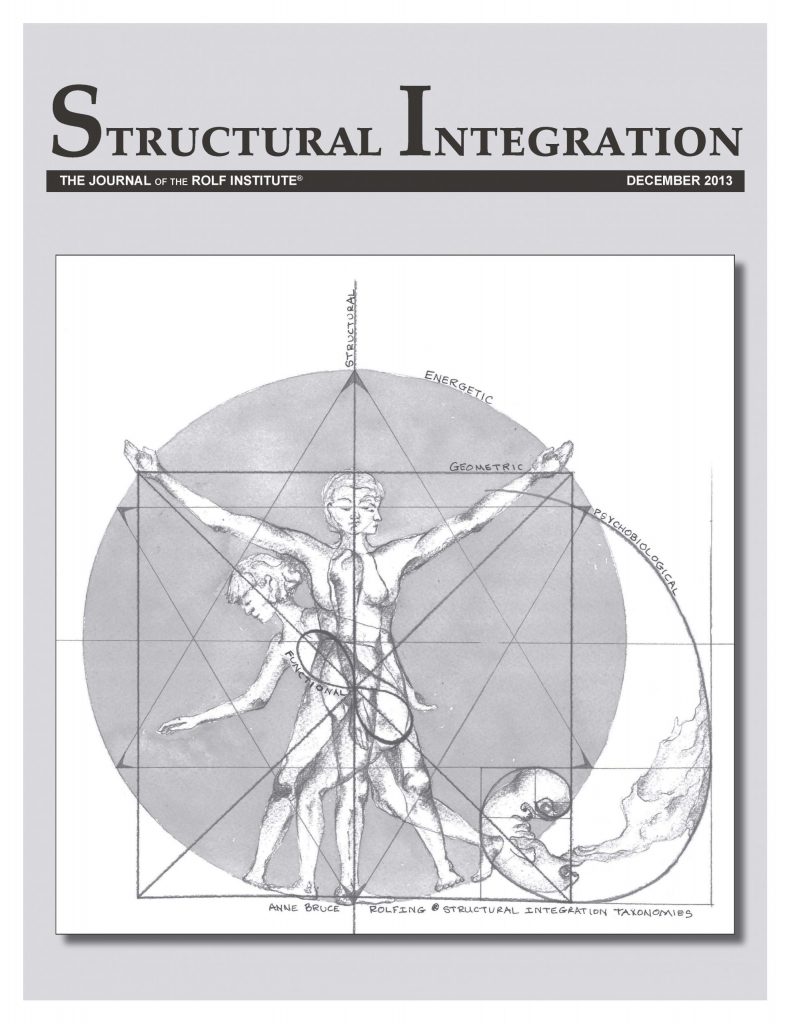
Imagine for a moment having access to a Hubble-like telescope. Not only can it block distortions from Earth’s atmosphere, but also it is able to record a deep view into space and time with laser precision. In addition, it captures the energetic blueprint of structure prior to coalescing into form. What might you see? Is there an iterative pattern shaping nature that can be identified throughout the animal and plant kingdoms? Perhaps, through the exquisite eye of this lens, we are witnessing the fundamental vibration underlying form. Perhaps, beneath the perceived solidity of structure, there is an active process moving, shaping, and vivifying all organic matter.
This article is an inquiry into what is called the geometric taxonomy1 in Rolfing Structural Integration (SI), the blueprint in biodynamic craniosacral circles and embryology, the underlying shakti in kundalini yoga, and the central channel in osteopathy. Whatever the name, there appears to be a vibratory resonance beneath perceivable and observable structures that arises prior to their formation. The Rolfing “Line,” the primitive streak and notochord of embryology, the central channel, and the shakti of kundalini rising are metaphors for this expression.
This resonance is more than a movement toward verticality. This organizing and orienting vibration is prior to the Rolfing Line or the imagined skyhook. The movement into upright does begin and end at the feet and the vertex of the cranium. Integration and alignment of the human body in gravity invites an orientation and immersion in this resonance that we can call “the field.” If we look closely, this energetic scaffolding reveals itself throughout the natural world in the swirling and spiraling patterns of leaves, shells, ferns, and flowers; the slowly rising and phototropic reaching of trees and limbs and geotropic descent of roots; the twisting turns of rivers; and the currents of wind patterns. We can follow its imprint in the lines of flow forming bone, the looping fibers forming the heart, and the embryonic process of development. It is more than a line of orientation and more dimensional than a spiral drawn on a piece of paper. What is this metaforce that shapes and sustains?
D’Arcy Thompson, Buckminster Fuller, Arthur M. Young, David Bohm, Jill Purce, Rupert Sheldrake and others have written about aspects of this resonance according to their particular and impassioned orientations.
Thompson was one of the first to integrate the mathematics of geometry with morphology. In On Growth and Form, he writes of the use and beauty of mathematics in the study of material things. From Thompson’s perspective, “number, order, and position is [sic] the threefold clue to exact knowledge” (Thompson 1961, 326). And these three things in a mathematician’s hand form the initial sketch of the universe.
Fuller took inspiration from the shapes of cells to create the design of his geodesic domes. He applied mathematics and an understanding of the fundamental architecture of life to inspire the functional design of his dwellings.
During my basic Rolfing training in 1981, Emmett Hutchins introduced the class to the work of Young and his book The Reflexive Universe. Young saw the universe as uninterrupted movement, turning into itself and unfolding out again in seamless motion. Physicists call the shape created by this movement a hypersphere and describe it with the mathematical formula for the volume of a torus. (A torus is shaped like a bagel with an infinitely smaller hole in the middle.) Young (1999) postulated that this hypersphere was an organizing field and likened this organizing principle in human beings to the awakened kundalini concept of the yogis.
These visionary writers have broadened my exploration and understanding of the geometric taxonomy as the template beneath the structures we perceive. Although the block model of Rolfing SI serves to educate the public (a picture is worth a thousand words), there are deeper implications held within this design. Locked within the linear midline of the Little Boy Logo is a cosmic order reaching beyond a cursory understanding of alignment. Could this vibratory resonance prior to form be revealing an intelligence or consciousness ordering chaos? In my private practice, I discovered that when I immerse myself in the potential of this vibratory expression, the work within a session seems to enrich contact, deepen experience, and sustain itself over time.
Embryologist Johannes Rohan expands on this idea that the organizing principle is more than a simple midline relationship. In Functional Morphology: The Dynamic Wholeness of the Human Organism, he describes the lemniscate as the most rhythmic of all geometric forms. Think of the lemniscate as a figure eight or an infinity sign, perhaps lying on its side, sometimes with one loop larger than the other. According to Rohan (2007, 17), the rhythmic quality of the lemniscate is manifest as structured oscillations that occur in cycles of sleeping and waking, catabolism and anabolism, inhalation and exhalation, and systole and diastole.
In the skeletal body, the lemniscate appears again and again. Take for example the hip joint: you can trace a lemniscate around the iliac fossa through the acetabulum to the ischium, as seen in Figure 1. At the acetabulum lies the center of the lemniscate, where the three pelvic bones join. Further understanding of the lemniscate challenges our senses, which often relegate it to a solid form. The secret of the lemniscate is that it is in fact a moving form that combines and transcends the polarities of a sphere – the circle and its radius.
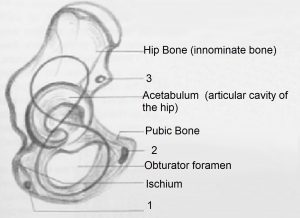
Figure 1:The lemniscate appears in the innominate bone. Reprinted with permissionfrom Adonis Press (Functional Morphology: The Dynamic Wholeness of the Human
Organism by Johannes Rohan; Fig. 56, pg. 95). The numbers 1, 2, and 3 indicate origins of the chief muscle groups: 1) flexors, 2) adductors, and 3) exte nsors.
When drawing a lemniscate, there is the beginning of a circle with a central point (A). Yet as the circle begins to come to completion, there is an “attractor” (A’) that pulls it away from completion. This becomes another center as it attracts the line moving through point B (the central point) and bends the direction into a circular movement. The movement around centers A and A’ continues, around and around and through the central fulcrum of B. Following this movement you might sense the lemniscate as a breathing figure (Van der Bie 2003, 114-115).
Energy medicine practitioner Donna Eden speaks of the lemniscate as representing the energetic threads of the connective-tissue system. The weaving pattern of its movement through the body manifests as continuity and connectivity. The movement of expansion and contraction reaches directly into the cells and the spiraling form of DNA, according to Eden.
Somatic Inquiry: Exploring the Lemniscate
The Torus: A Moving Constellation
Now let’s explore other representations of the vibratory resonance that underlies form by returning to the torus – the donut-shaped form described by Young that folds into itself endlessly. Embryologist Brian Freeman, PhD speaks of the torus as the shape organizing the formation of the fossa of the hip joint-leg relationship. He writes:
Detailed anatomical investigations, based in part on total-reconstructions of a developmental series of human embryos, have demonstrated the following positional changes in the embryo’s lower limb from the time it first appears as a torus in the inferior part of the ectodermal ring. Initially, as the limb anlage grows in volume, it growth-adducts toward the umbilical cord folding across the embryo’s genito-femoral fossa, then it growth-flexes, the bend being the anlage of the knee. Subsequent embryonic events in the development of the lower limb include growth-extension of the knee, growth-flexion in a region which then becomes the ankle, and growth-eversion of the foot. These changes of limb position occur over defined periods of time and therefore represent the primordial movements of the human lower limb. In other words, the very growth of the embryonic lower limb is an early stepping, the so-called ‘growth-kicking’. This is well-portrayed by reproducing the form and position of the lower limb of human embryos at successive stages, at the same magnification. (Freeman 1988, 127-128)
Following this movement as Freeman describes, you can feel the circular trajectory of a torus as its path shapes the fossa. You might imagine the torus as a three-dimensional weaving of gossamer threads traversing in multidimensional paths, yet sharing a common crossover space at the simultaneously dynamic and still central core. Each thread feeds into and out of a central fulcrum and then returns back again In an early workshop, Tom Shaver, DO introduced a technique that followed a torus-like pathway releasing tensions at the hip joint and lower back. I call the technique “pretzeling the leg” and describe it below.
Somatic Inquiry: Exploring the Moving Form of a Torus
Flowing Wholeness: The Vortex Ring
By integrating the motile resonances of the lemniscate and torus as they feed through the dynamic central channel, you will likely not only imagine the form of a vortex ring (see Figure 2) but also sense it through your body and hands. The vibratory resonance that you will sense is the golden nugget beneath perceivable form and gives rise to the familiar models of geometric taxonomy – lines, planes, blocks, and cylinders.
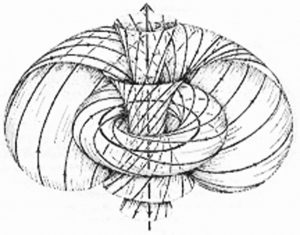
Figure 2: The vortex ring. (Image retrieved from http://go.webassistant.com/wa/upload/users/u1000057/pages/3007- 4984720478c6uGHH0uTt/free energy and free thinking.htm.)
Quantum physicist Bohm theorized that the universe must be fundamentally indivisible and called it a “flowing wholeness” in which the observer cannot be essentially separated from what is being observed. He theorized that “parts” – particles or waves – are forms of abstraction from this flowing wholeness (Briggs and Peat 1989, 29). In his treatise Wholeness and the Implicate Order, Bohm (1980) suggests that it is the enfolding and unfolding of the universe whose primal vibratory resonance appears both physical and perceivable. We are both particle and wave. At one moment we might sense ourselves as particle through focused attention on our specific anatomy, muscular development, efforts, or bracings. At another moment we might experience a flow through our tissues that generates a sense of continuity and connectivity as we move and breathe. Could the vortex ring be the first primordial touchstone, the space between unfolding and enfolding, like the pause between an inhalation and an exhalation?
What we observe as material bodies and forces are nothing but shapes and the variations in the structure of space. (Erwin Schrodinger quoted in Lazlo 2008, 93)
According to Young, the vibratory movement of the vortex ring is multidimensional and reflexive. In other words, it is both feeding into formation and dissolving that formation simultaneously. In Sanskrit, this is called spanda and translates as “throb” or “pulsation.”
In his most recent book, Science Set Free, Sheldrake investigates the phenomena of morphic resonance and presents an understanding of an informing field resonating through time. A resonance is a quality of reverberation through space and time. It has “no-matter” yet transmits vibratory patterns informing all self-organizing systems. Morphic resonance underlies habits of protein folding and crystallization as well as the inheritance of habits observed as instinctive behavior and the transfer of learning (Sheldrake 2012, 199). Taking a leap into the iterative geometry of formation, perhaps the moving elements of the vortex ring function as the primal dynamic that fuels the organization of structure through its vibratory resonance.
Purce writes of the appearance of evolutionary spiral flows, forms, and symbols depicted throughout all cultures over the eons. From Egypt to Glastonbury to the tattoo markings on Polynesian shamans, a three-dimensional spiral imprints art, pottery, earth formations, and temples. This dynamic shape has imprinted the human psyche throughout centuries, across space and time.
Once flowing this energy may bring enlightenment and a state of wholeness: the balance is the still center of the spiral. From the (universe) macrocosm to man as microcosm, in the center of any spiral is the calm core through which man passes to eternity. (Purce 1974, 127)
Somatic Inquiry: Flowing Wholeness
The flow between one’s external and internal world is essentially seamless. It is the breath moving between inhalation and exhalation. It is the movement between impression and expression, between being and doing. It is an inquiry into the common unity. It is a willingness to cultivate both an understanding and perception of the wholeness that lies beneath the surface of the illusion of separate, individual parts. Whether we are speaking of a central core and midline or the spiraling flows of the torus resonating through the vastness, our moving, sensing, breathing bodies are informed and imprinted by the iterative patterns of vibratory intelligence that manifest through the geometric taxonomy.
Carol Ann Agneessens, MS, RCST®, is a Rolfing Instructor and Rolf Movement Instructor. She has been a member of the Rolf Institute® faculty since 1994. For additional writings visit www.holographictouch.com.
Endnotes
Bibliography
Bohm, D. 1980. Wholeness and the Implicate Order. London: Routledge & Kegan.
Briggs, J. and F.D. Peat 1989. Turbulent Mirror. New York, NY: Harper and Row.
Freeman, B. 1988. “Newborn Stepping and Embryonic Growth-Stepping.” Developmental Medicine and Child Neurology 30(1):127-128.
Lazlo, E. 2008. Quantum Shift in the Global Brain. Rochester, VT: Inner Traditions.
Purce, J. 1974/1980. The Mystic Spiral. New York, NY: Thames and Hudson.
Rohan, J. 2007. Functional Morphology: The Dynamic Wholeness of the Human Organism. New York, NY: Adonis Press.
Sheldrake, R. 2012. Science Set Free: 10 Paths to New Discovery. New York: Deepak Chopra Books/Crown Publishing Group.
Thompson, D. 1961. On Growth and Form. Cambridge, England: Cambridge University Press.
Van der Bie, G. and M. Huber, eds. 2003. Foundations of Anthroposophical Medicine. Edinburgh, Scotland: Floris Books.
Young, A.M. 1999. The Reflexive Universe. Cambria, CA: Anodos Foundation.Flowing Wholeness[:]