

Just this month, a client of mine in his fifties was able to handily trounce a fast, talented twenty-eight-year-old in a tennis match. He had the stamina. He had the strength. He had the agility. And he had the drive to make sure he had all the preceding. During this match, he felt like he was moving in a way that he hadn’t in decades.
My client’s performance was not a result of extra genetic gifts. It wasn’t from having been an athletic freak who had been working out nonstop for decades. It was not even from a spectacular new myofascial technique I learned or developed. When he came in to see me two months before the match, he could not put weight into his right knee (due to an old injury and the ensuing surgery), squat low in a ready stance, use his right arm at full force or at certain angles, or play tennis for any prolonged period without severe elbow and shoulder discomfort. He felt like an old man and, rightfully, had no desire to continue feeling that way.
After about two months of physical training that focused on his weaknesses, some spot myofascial work, and some dedicated attention to relearning proper movement and exercise mechanics, his body improved drastically. His “bad knee” stopped hurting just by learning how to activate the hip muscles that had gone dormant for years. His right shoulder massively improved in range of motion and comfort with myofascial work, and his balance and explosiveness improved just from practice in a controlled environment.
What Is Aging?
Aging is the bogeyman, scapegoat, and patsy for what ails us. It allegedly causes us to get slow, decrepit, and creaky. It allegedly makes it hard to do what we used to do. It allegedly makes us want to just sit down and take another nap. While there are kernels of truth in all these notions, aging does not deserve all the blame we heap on it.
What are the real negative effects of aging? Reduced flexibility? Hampered mobility? Slowness? Lack of endurance? I grant you that those are common issues that occur as you age, but that high correlation does not make them effects. In fact, examples abound of people who are ‘older’ but who manage to defy the classical idea of getting older. An entire generation is seeking ways to ‘cheat’ aging and is finding it surprisingly doable.
The masters division of triathlons ? the division reserved for those considered ‘older’ ? is incredibly competitive. These are individuals who by all normal standards of aging should be entering a slow decline that leaves them tired and decrepit. And yet their endurance levels can rival those of their younger fellow masochists because of their training.
A decline in flexibility, stamina, and strength is not a linear effect of aging. It often appears that way simply because we tend to see so many people become less fit as they age, but this is a false inference. There are some physiological changes that make some small declines highly likely and progressively unavoidable, but the speed at which these small declines happen can be hugely influenced if looked at the right way.
A loss of fitness is actually a series of moment-by-moment choices. One is not always aware that a choice is being made, but it is constantly happening. Sit in a chair for eighteen hours a day and get only three hours of sleep every night for one year. How do you think your body will feel? How mobile will your shoulders and hips be? How happy do you think you’ll be? Do that for thirty years, call it a “career,” and where do you think your mobility levels will be?
Exercise intelligently one to four hours every day, testing and improving your body’s flexibility, stamina, and strength in various ways and at varying intensities for thirty years. Will you end up with the same corporeal complaints as the chair sitter? Certainly not. This is the old “use it or lose it” principle. Once clients understand this, they are more apt to make changes that will truly enhance their lives in the long term.
What Can Be Done?
One of the most important positive changes clients can make, whether twenty-two or ninety-two, is to properly activate and stimulate the hip musculature. Dr. Rolf referred to the hips as “the seat of the soul,” and I think all would do well to seriously examine this idea.
As bodyworkers, we tend to think that this “seat of the soul” concept means we need to physically manipulate the hips, but over the years I’ve found this is often not the case, particularly for folks with stubborn hip issues that seem to be “age-related” or who have come across hip problems after years of yoga and meditation. Think of how many clients you’ve seen with hip, knee, foot, and back issues that just didn’t improve at all, despite your best efforts at mashing, squashing, coaxing, guiding, working indirectly and directly, and cueing. But except for cueing and some movement work, most of the tools in a Rolfer’s toolbox are attempts to do something for a client that simply cannot be done. These are passive interventions, meaning the Rolfer is trying to fix or repair something, and the client is largely passive (while perhaps being asked to move a leg or twist a certain way).
Cueing someone with a novel method of movement may make some difference but is often simply not enough to create a lasting change. Cueing and constant thinking about proper movement patterns is an intensely cerebral activity and is often simply not sustainable for longer than a few minutes at a time. To make lasting change, something else has to happen: strength and coordination must be rebuilt.
It’s Often About Weakness
Imagine client George comes to you and says, “I am unable to push anything heavier than forty pounds overhead, see?” He proceeds to take a forty-pound dumbbell (which he had in his bag) and pushes it up overhead. He then takes a forty-five-pound dumbbell and fails. “Can Rolfing® Structural Integration (SI) help with this?”
“George,” you say, “Rolfing SI might be able to help.” You proceed to do your best myofascial work through the thoracic spine, around the scapula, and along the pectorals to allow for better upward rotation and reduced drag near the coracoid process. “Pick up that forty-five pounder!”
And George fails yet again.
So you do a little more work. You do five sessions of work, and you say, “George! Pick up that forty-five pounder!”
And he fails again.
Will more myofascial work improve this situation? Will a Ten Series and then a Five Series increase his pressing strength? Probably not. Why? Because that’s simply not how you build strength for that movement.
Aging clients (and young computer-bound clients) show this same issue with movements of the hip joint. The difference is that the movements they are weak in are less obvious, and they themselves rarely have the self-knowledge and/or the knowledge of kinesiology to be able to report these weaknesses to you.
If I complained about elbow problems, and I had zero biceps and triceps muscle development, would you be surprised that I was unable to articulate the elbow joint properly? If I had no mass in my quadriceps and no ability to contract those muscles, would you be surprised if I had knee trouble? If a client is missing the gluteus maximus and the gluteus medius, should you be surprised when he says the hip joint feels loose, sloppy, or even overly tight in the inner thigh? Should you be surprised that he doesn’t feel stable when walking, running, jumping, bending over, or squatting? Should you be surprised that he doesn’t feel able to change directions or balance on one leg?
The answer is no: you shouldn’t be! These are all things that go hand-in-hand with weakness in the hip musculature. These are things that happen when you sit for long periods (and definitely after a thirty-year career in a seat). No amount of loosening up of tightness (perceived or actual) is going to make a positive difference for very long. In the best-case scenario, you may provide some amount of pain relief with myofascial hip work, but the longer term issue will remain ? your client’s hips are just too weak/ too poorly connected to the brain to do their jobs properly.
Testing for Hip Weakness
There are many different positions and exercises you can use to test a client’s strength in the hips. I’m going to share two with you.
Palpation Test
One of the easiest methods to get a preliminary idea of hip strength is simply to palpate. With your client standing facing you, put your palms on the greater trochanters, and then work your way posteriorly around the greater trochanters with your fingers. You should quickly run into the gluteus maximus and posterior fibers of gluteus medius with your fingers. These muscles should extend laterally so that they are almost flush with the outermost projection of the greater trochanter. This means that as you work back with your fingers, they do not move in medially (toward each other) much. The muscle tissue should provide resistance to being able to go medial.
You will find that clients with hip issues will never have muscle here. Your fingers will be able to make contact all around the greater trochanter(s) and will obviously be going medial. The tissue here will often be flat, flabby, and feel like nothing but skin. At best, a client will have a slightly developed gluteus maximus, but that too will often be quite flabby and flat.
A self-assessment version is available in a video here: http://youtube/EN0sYBsHpvo.
Movement Test
Now for the movement assessment. Have the client lie on his side with hips and knees flexed 90?, then have him straighten the top knee and pull the toes back (see Figure 1). Now ask him to lift that leg up toward the ceiling and lower it back down ten times. The client should feel this in the posterior fibers of the gluteus medius (right where you were feeling for musculature in the palpation test). Many clients with hip issues will not even be able to raise the foot more than a few inches. Some clients will have interesting neuromuscular compensations that activate the incorrect muscles. Very, very, very rarely does someone with hip and/ or knee issues perform this movement well.
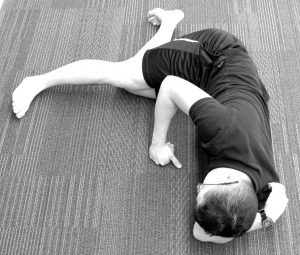
Figure 1: The client prepares to lift the leg toward the ceiling to activate the gluteus medius.
Now What?
Once you’ve confirmed that the hips are weak, your job then depends on your skill set. You should let your client know what you’ve found and what you can do about it. If you are good at exercise selection and progressive training and know how to help your client active the appropriate muscles, by all means do so! Help your client train to be stronger and more coordinated. A client who can move better will always be happier, even if you can’t do anything about his ‘age’.
If you don’t know how to help your client retrain the strength and coordination he needs, refer him to someone who can. You may have to search high and low for someone who knows how to select and adapt exercises for the hips properly, but once you find this person, hold on to him.
If you send a client with weak hips to a trainer, and the client comes back talking about circus-like acrobatics and extremely challenging balance exercises within the first week, you’ve found the wrong person. If your client comes back feeling like his hips are a little sore and a bit tighter (i.e., getting stronger), then you’re on the right track.
Hips are slow to rebuild and can be difficult to reprogram once atrophy and the associated faulty patterns have set in. But with focus and discipline, your clients can make that hip and back discomfort go away, even if they are ‘old’. Remember, ‘aging’ hips are often extremely weak. Make them stronger, and your clients will no longer feel so old.
Matt Hsu is a Certified Rolfer and personal trainer specializing in his PACT System™ (Posture, Alignment, and Coordination Training). He has helped countless clients with hip pain and weakness since fighting his way out of serious hip issues in his twenties. His eBook Healthy Hips I: Restoring Fundamental Mobility and Strength is available online at www.uprighthealth.com.