

Introduction
‘Yielding’ technique (Agneesens and Tahata 2012) is particularly beneficial for use with clients who are sensitive to pressure, as described in an earlier case studies article in this journal (Tahata 2012). In the same vein, this approach can be applied safety with clients who may have reduced bone density.
It is common for medical doctors to recommend exercise/physical activity to elderly people to prevent osteoporosis and thus reduce the risk of fracture from falls. However, if their patients have numbness or pain in their extremities and/or joints, it is natural that they do not feel inclined toward physical activity. This leads them into a negative feedback loop of lack of enthusiasm for exercise g decreased activity g loss of bone density g injuries like fracture from falls g back to an increased reluctance to exercise with the cycle continuing. Key to breaking this feedback loop is remembering the joy of movement that can come from getting back to a state of comfort in the body. This is where somatic practitioners can play a huge role in supporting the elderly.
In this article, I will present two case studies of octogenarians from my practice. Despite their advanced age, both clients’ bodies had sufficient responsiveness to garner structural change both during and after the Ten Series process. Work with these two clients was strictly Rolf Movement (based in the Principles of Rolfing® Structural Integration and following the functional regional goals of the Ten Series) that incorporated yielding. As photos were taken before and after each session, it was easy to track how the body changed immediately from the work, as well as in the interval until the next session.
Case One
This male visited my office in 2011 at the age of eighty. He was active, often going hiking and skiing. His motivation to work with me was to continue to enjoy his favorite activities. He also hoped to fix his sciatica, left knee pain, and numbness in his right foot. In terms of posture, he was aware of the tendency to throw his chest forward and believed that might be patterned by his earlier involvement in social dancing.
Interventions and Results
The client came in with a typical G’ preference in terms of movement, with his body oriented upward before starting the Rolfing series. One of the ways his body responded to the work was that it became increasingly balanced in the one-to two-week intervals between sessions, showing change beyond what was seen in the immediate post-session look, as seen in Figure 1. For example, in the Sixth Hour my intention was spinal continuity and perception of the space above the head. The photo shows more palintonic harmony front/back and top/bottom two weeks after that session than it did at the end of the session itself. Overall we see the pattern of a protruding belly correcting, and his upper arm falling into place during the week after the seventh session. More can be seen in Figure 2.


After finishing the Ten Series, the client felt 95% improvement in the numbness in his right foot and his chronic right sciatica was completely gone. Other chronic pains in his right shoulder and left thigh also disappeared.
The client came back for a post-ten session after twenty months. We see in Figure 3a that his lumbar and cervical curves seem more compressed than just after he finished the Ten Series. However, when compared with the photo before the first session, the orientation of the pelvis has held the effects of the series, with core space around the G center and still orienting to the ground. With just one post-ten session (session eleven in the photos), he regained horizontality in his head (Figure 3A).


On the other hand, Figure 3B, the back view, shows at twenty months more balance side to side, with two-cylinder support, than just after the ten sessions, and no return of the right sidebending of the sacrum that was worked out in the course of the Ten Series. The client later reported to me that after session eleven he began to go trail hiking three times a month, walking for five to six hours each time. He felt his walking was improved, and he also had the initiative to go hiking by himself, whereas before the eleventh session he would only go at a friend’s invitation.
Case Two
This eighty-four-year-old year female visited my office in 2013 at the behest of her daughter, one of my clients, who gifted her with a Ten Series. Since fracturing her left lower ribs twenty years earlier, she had felt unbalanced and started gradually bending forward, which we could call a G preference. She needed to use a rolling walker to walk.
Interventions and Results
From our sessions, this client gained upward lift and core stability. We see how this process played out through our work in Figure 4, with a general tendency of change to a more upright expression. There was a place where she instead showed a strong pattern of bending forward (in the two weeks after the seventh session), before more integration to a sky orientation was seen after the ninth session. In the ninth session, I had focused on continuity from toes to the psoas. The client also reported that her digestion/elimination greatly improved, and that she no longer had chronic constipation or difficulty with elimination.

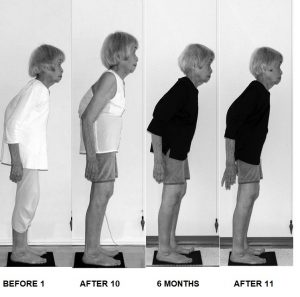

Looking at Figures 5A and 5B, we can see that in the six months following her Ten Series, before any post-ten work, her body again bent forward slightly, but that she maintained core space around her G center. From the front view, it seems her body is more stable with support from both cylinders.
The work through session eleven has eliminated the chronic pain the client had experienced in her right knee, and what had been a large area of numbness from both ankles through her toes has narrowed to just the toes. Before coming to my office, this elderly woman had little incentive to go outside because of the difficulty of engaging in daily activities. Now, through this work, she is motivated to go out and is able to walk for a distance without her rolling walker, although she uses it when she needs to carry something. Mysteriously, her hearing in her weaker left ear also improved, by 30%.
With her mobility significantly improved, the client and her daughter were able to visit two distant Shinto shrines in 2013. Such a trip had been inconceivable before, and held deep meaning for both mother and daughter who had been more distant before this and were living apart.
The year 2013 was a special year in Shinto, the animistic religion of Japan. Two major shrines, Ise Shrine (in Ise City, Mie Prefecture) and Izumo Taisha (in Izumo City, Shimane Prefecture) both held sengu, which is the transferring of the ‘body’ of a god to another shrine while an old shrine is being repaired or a new one is being built. Ise Shrine holds sengu every twenty years and Izumo Taisha every sixty years, and 2013 was the first time in sixty years there has been a dual sengu at these major sacred sites. For members of my elderly client’s generation, there is often a heartfelt wish to be able visit Ise Shrine during one’s lifetime. (For readers who are curious, the website for Ise Shrine is www.isejingu.or.jp/ english/index.htm).
Thus, both mother and daughter were thankful for the Rolfing process, which allowed them to make these pilgrimages in such a special year. We can speculate on the impact of the work from the psychobiological aspect, both in how increased mobility allowed meaningful travel as well as how it may have benefitted the mother-daughter relationship to have unexpected time together while traveling.
Discussion
There are a few more points I would like to note. I did not coach either client in how to stand for the photos. Nevertheless, we see that both clients naturally adopted a slightly wider stance, suggesting that two-cylinder support is more operational for standing and walking. This is illustrated in Figure 6, and contrasted with a posture where the legs function together as a single, less supportive, cylinder. Alignment and function through two cylinders is clearly more functional for both standing and walking. In both Case 1 and Case 2, we observed that the way the body is supported in standing spontaneously shifted from a single cylinder to dual cylinders as the process advanced.

Figure 6: Standing that aligns through one
and two cylinders. Dual-cylinders suggest
more stable support as well as reduced
load on joints.
Figure 7 presents the photo data from Figure 2 in an illustrative form. After getting more support in session two, the sacrum was horizontalized. After the seventh session, we see a decompression that begins to resolve the right sidebend in the client’s spine and lower extremities. This tendency toward a right sidebend appeared around the seventh session and might have been related to the client’s chronic sciatic pain. The expression of this deeper level of pattern may have been necessary in the process of integration.
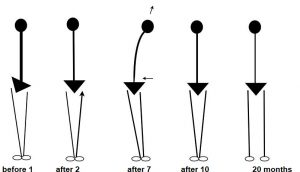
Figure 7: Depiction of the structural process in Case 1, representing the
phenomenology of the body pattern.
Thoughts on Aging
Conventional thinking holds that with increasing age, there is less and less possibility for change. As people experience symptoms like numbness and arthralgia in their extremities, they may attribute it to aging and believe they cannot improve. While aging is a natural process, that process simply means the passage of time and does not necessarily mean deterioration. In the example of these two clients, we saw a reduction the area of numbness in their feet (both cases) and reduced arthralgia in the sacroiliac joint (Case 1) and knee (Case 2).
Age is also often associated with attitude, as expressed in the adage “You are only as old as you feel.” It is thus meaningful that both clients developed a more positive attitude toward movement after their Rolfing processes. Such improvement in attitude may help move people out of the negative loop described above (where reduced enthusiasm for movement leads to decreased activity, etc.) and into a positive orientation of: positive feelings about movement g increased daily activity g improved quality of life.
These two cases show us the broad holistic impact of Rolfing work on structure, function, and well-being and encourage an aspiration that perhaps we humans can change when we want to, with the right input, no matter how old we are.
Hiroyoshi Tahata has a Rolfing and Rolf Movement practice in Tokyo, Japan. He joined the Rolf Movement faculty in 2009. He will be offering the workshop “Yield: An Alternative Perspective for Effecting Functional and Structural Change” in Soquel, California in April 2015; for more information, visit http:// rolfinger.com/yield.html.
References
Agneessens, C. and H. Tahata 2012 (Jun). “Yielding.” Structural Integration: The Journal of the Rolf Institute®, 40(1):10-16.
Tahata, H. 2012 (Jun). “Case Studies with Yielding.” Structural Integration: The Journal of the Rolf Institute®, 40(1): 31-33.Case Studies with Yielding, Part 2[:]