
Author’s Note: In my personal exploration of this process I feel particularly fortunate to have been aided by many teachers and guides. I am frequently reminded of a quote by Isaac Newton, “If I have seen further, it is by standing on the shoulders of giants.” The teachers to whom I am humbly grateful are Jeffrey Burch; Bob Schrei, Donna Thomson, and the entire team at SourcePoint Therapy®; Tias Little; and Drupon Rinchen Dorjee Rinpoche.
Learning to condition our nervous system and our mind to become focused in the present unveils new layers of information about how we interact with ourselves, our perceptual environment, and our clients. The more we allow our minds to become still, the more we will be able to notice increasingly subtler nuances of how our habitual mental choices shape our perception. By making small shifts in how we direct our attention, we can use the neurological skills we have cultivated in our structural integration (SI) practice to deepen our personal work of mindfulness and our intuitive perception in the session space with our clients.
Using subtle points of contrast in our expanding perceptual awareness will develop our ability to intuitively discern mental, emotional, and physical choices that are of greater benefit to the overall well-being of ourselves and those around us. This discernment will also enhance our ability to dialog with a body system to glean greater detail about the most beneficial approach to take with a client at any given time in the course of a session.
In exploring this dialogue process we will be conceptualizing the body more as a field of information than simply as a physical structure. By interacting with this field, we will notice how our own felt relationship to this field, along with our client’s, changes when varying forms of information arise and when questioning primers are placed within it. By noticing these subtle variations, we can initiate simple binary (yes/no) questioning that can help us refine greater layers of detail about the most beneficial treatment approach.
The range of this detail can include, but is not limited to:
We will be learning to validate the variations that do present with the other assessment methods in our skill set. The intent is not to abandon the skills we have integrated into our practice, but to access different combinations than we might use habitually. Opening up to a wider field of possibility will increase the opportunity for our own personal transformation, both in and beyond the session space, while honoring the inherent capacity of the body system to move into a more balanced, functional, vibrant expression of being that is inherent in both the client and ourselves.
Getting Still
The practice of SI involves the development of many skills to facilitate change in the systems of the clients we work with. As we learn and deepen in our practice, the richness and subtle nuances of the work continue to unfold. Finding the most efficient means of deepening perception has the potential to transform the work from simple anatomical mechanics into inspiring art. On occasion, the opportunity arises when we are invited to step beyond the comfort of the known into the mystery of transformation.
Many of us have observed various levels of this transformative phenomenon in our own personal experience and perhaps even in the session space. Frequently these insights and physical changes can be quite significant in their impact. How can we learn to effectively facilitate this additional layer of information to better inform how we engage with clients and ourselves? To answer this question we have to look more closely at moments when the act becomes art.
When learning a new skill, focus is required to monitor the activity while we are neurologically integrating this new form of input. Over time these neurological patterns become more familiar and easier to access. Eventually we are able to activate these patterns with significantly less mental effort. This familiarity allows the practitioner to be more present and to observe what is occurring in greater detail, without having to cognitively think about it. My observation is that SI encourages new practitioners to listen to and feel the layers of the system far more effectively than many other forms of manual therapy. From looking at the client’s body as an entire interrelated system of connective tissue to monitoring the tissue response in their own bodies, SI practitioners set up the neurological parameters to increase the amount of information they gather and process. The more they practice, the more adept they become.
Having trained competitive athletes for over twenty years, my observation has been that automaticity of action is due to a significant number of hours of proprioceptive awareness training. Often high-level performers such as athletes and musicians have an ability to transcend their activity and become aware of more that is happening than just where they are and what they are doing. Often this experience is also coupled with a significant reduction of any perceived conscious effort in performing the specific task in question. For athletes this is frequently referred to as the zone. Jazz musicians might call it swing. In yoga it might be called flow. The word used is less important than the sense of the experience itself. For the participant, it typically involves a state of awareness of being very present and still in the moment while also being tremendously expansive in perception. For anyone witnessing one of these expressions of life, it feels captivating, even for an observer or spectator.
How does this relate to SI and serving clients? If we can learn how to automatically tap into this greater proprioceptive potential, these perceptual skills can be applied in more detailed information gathering and perception refinement. This will allow a deeper, more profound transformation than any we could have cognitively engineered even with decades of purely intellectual study and rigor. To do this we have to conduct an honest assessment of how effectively we have been cultivating the capacity to listen to the body system, and then begin to refine our skills.
We first have to establish a very calm neurological baseline with which to observe the relationship between the speed and direction of the stream of mental thoughts and the physiological state of the body as a whole. In the course of our own healing journey, many of us have experienced forms of this still state, which can be very profound. How do we learn to put ourselves into a neurological space where these forms of profundity are able to arise with greater frequency?
Part of the answer lies in the physicality of form. As our bodies move into a more structurally balanced and physiologically functional state, the movement of breath occurs with greater ease and involves the movement of more physical tissue structures in the body cavity. As the diaphragm is able to move inferiorly on inhalation in a more three-dimensionally uniform manner, the nervous system, and consequently the activation of the mind, is able to slow down. As the speed of mental chatter and distractions decelerates, we can notice other layers of perceptual information that were present, but inaccessible due to the distractions of our mind-stream.
I often describe this experience for my Chicago clients as the point of contrast between a familiar area of the city at rush hour versus 4:00 a.m. on a Sunday. What one is able to perceive about one’s surroundings during the clamor of an urban rush hour is distinctly different from what one is able to perceive at a less active time. Most likely those quiet murmurings in the background were there during the active hours, but were drowned out by all the clamor of the city’s hustle and bustle. Ultimately it will be that very subtle perception of contrast that will allow us to explore the depths of our own mind-stream more effectively and, from there, the nature of our mental experience.
Many of my colleagues reading this will already have various forms of personal practices for calming and centering the body system as a whole. For the sake of this article, I will take a beginner’s approach towards this process of allowing the nervous system and, through that, the mind, to achieve a very calm state of being.
Initially in the exploration of the nature of mind, the physical orientation of the body will present increasing potential distractions the longer one attempts to maintain any relatively stationary position. The longer one attempts to stay relatively still, the more the structural alignment of the body and any inefficiency it has in relationship to gravity will come into play. One of the greatest obstacles I find with individuals who begin to explore some form of seated contemplative mindfulness exercise is that their structural orientation is compromised, restricting the efficient flow of breath enough to hinder any decrease in mental activation. That, coupled with the increased likelihood that this inefficient structural positioning will also accelerate muscular fatigue, ensures that physical distractions will increase with time; and therefore, there is even less chance of a calm mental state arising. To compound all this, these well-intentioned individuals are venturing into relatively uncharted neurological territory and have few perceptual reference points to use in marking progress.
Due to these challenges, I have found it much more efficient initially to set up an environment in which the physical structure is in a greater state of ease than it would be while orientated vertically. A relatively easy point of entry is to start with the body in a comfortable supine position that offers limited stabilization requirements for the structure while also providing ample tactile contact points on the support surface to track any contrast during the course of the breath practice. In a yogic system this would be referred to as savasana, corpse posture (see Figure 1).
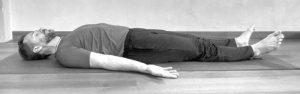
Figure 1: Savasana (Corpse Posture).
Initially with this practice, the simple intent is to check in with the contact of the body on the surface, head to toe, left to right, front to back. Notice any points of contrast in terms of the amount of contact or weight/pressure in different areas of the body. From there we can add an awareness of the orientation of the body, one limb to the other, and even within the torso. Once this relatively quick layer of information has been gathered, mental awareness can sense the movement of breath in the body. If we are astute in our observation, we may be able to gather where the movement is occurring initially and what the cycle of inhalation and exhalation is like in terms of duration, effort, etc. Typically this will begin to change very soon after we begin to bring our awareness to it.
Once we have gathered this initial information, we begin to allow the initial movement of inhalation to gently descend into the abdomen. As this begins to deepen, we allow ourselves to notice if the movement is expanding evenly into the three-dimensional space of the abdomen or if there is more movement along certain vectors of direction than others. The key is to begin to build a more detailed three-dimensional proprioceptive awareness of movement in the body. We are interested in simply observing the experience and allowing the information to come to us rather than actively going out and seeking it. The softer and deeper the breath becomes, the calmer our neurological activation, and with that, our mind.
As the volume and speed of mental chatter begins to decrease, we may begin to notice new pieces of information that were not initially apparent when we began the process. This point of contrast allows us to cognitively track our progression in this exploration. Initially, we may be intellectually inclined to think about the contrast we have become aware of, and typically in doing so, this will turn up the speed and volume of mental activation along with distracting chatter. With practice, however, we will be able to notice the contrast of even this choice and simply let it go to return to the experience of simply feeling our body and allowing the breath to flow through it.
The flip side of this experience might be that we get so neurologically slow that we lose our point of mental focus in experiencing movement in the body, and simply lose consciousness altogether, falling asleep. If we find this occurring frequently, then it would be beneficial to examine our mental fatigue in general. Are we budgeting sufficient sleep time for ourselves? If not, then perhaps allocating time to explore this mindfulness exercise when we are more physically and mentally alert in our day would be beneficial. We are seeking to learn how to evolve from a mental activation switch of on or off to more of a dial. The greater the flexibility of mental activation, the more settings on the dial. To borrow from the movie This is Spinal Tap, we would like ours to go to eleven.
Deepening Our Listening
With small regular (i.e., daily) bits of practice, we begin, through the process of neuroplasticity, to rewire the way in which our brains function. In doing so we train the mind to stay clear and present at a much slower level of neural activation in the body field. Initially even five minutes is sufficient to slow the respiratory neural activation rate, and typically fifteen to twenty minutes is adequate to allow for physiological shifts large enough to track consciously. As with any skill, the regularity of the input is integral to neurological integration of effortless functioning. I use various forms of this neurological and mental conditioning with clients on a regular basis to help them to learn how to better regulate and track their daily physical and mental experience.
Once we have achieved stability in developing a mental dial of activation, there are further refinements that are required to cultivate greater stability of information flow, insight, and the ability to interact with this information. With repeated neurological conditioning, our ability to drop into a slow calm state increases in speed and decreases in effort. At this point of mental flexibility, exploration of this practice from a traditional seated crossed-leg position is generally much more productive, assuming level stability of the pelvis above the knees, adequate range of motion of the knees and ankles, plus maintenance of gentle three-dimensional movement of breath through the body. For more specifics on structural details of this efficient alignment, see a description of the seven-points meditation posture available at www.gaiamtv.com/article/seven-points-meditation-posture.
From either of these orientations we would like to plumb the depths of the nature of mind and body further. To do this it is helpful to place a primer or intention into the system. This primer can be conceptualized as a mental construct with which to compare or contrast the experiences of mind that do arise, using the established awareness of the body field as the physical barometer affected by that contrast.
This construct centers on an intention of an ideal state of being. What would be an ideal state of health – physical, emotional, mental, spiritual? What are we moving towards in this exploration of the interaction of mental awareness and the nature of the physicality of form in space? This could be conceptualized as the Lline, a blueprint of health, divine love, Buddha nature, universal flow, etc. The key intention is that there is some dynamic, constant reference point of potential to move towards in the process of becoming that interacts with the physicality of awareness, but is not exclusively limited to it.
From a calm state, we place a question into the body field: “What would an ideal state of health feel like in the present moment?” As we do this we remain open to the first flash of insight that arises. We allow this insight to come into greater focus by experiencing it in our body. What presents to us has the potential to change each time we get still. Each time we do this, new information may appear.
We now have the option of getting still and checking in with this reference point as we do our own inner healing and evolutionary work. As we engage in this exploration, mental or physical obstacles will become apparent that inhibit our ability to effectively feel this state of calm in our mind-stream and body field. This will typically show up most clearly as a disruption in the subtle physical movement of breath in the body. This contrast point of neurological experience can be a frequent stumbling point for many people because it is interpreted as a regression or loss of the previous calm, relatively positive experience. This development is actually a good sign, however, as we now have new layers of our experience to be softly present with as we gently train the mind to simply return to a place of allowing, being aware of the body field and the subtle movement of breath therein. As we work through these perceived obstacles, we learn greater compassion for ourselves in our own personal life experience and, through that, how those experiences parallel many of the experiences that challenge the clients in our practice.
The more we are able to feel a sense of this ideal potential in our own inner practice, the more we are able to see this in others as we interact with them. In the context of a session space, we are able feel and empathize with the pains and fears of our clients while still holding the space for change in the direction of that ideal health. As our own relationship to this still point of health increases, we will be able to feel it in our body more regularly, even in the session space if we choose.
Benefiting Ourselves and Others
Once we make the choice to allow this layer of information into the session space, our intuitive exploration can really begin to take off. If we conceptualize this potential of health as a relationship that both we and the client have individually, then as we connect and interact with the client, we have set up a structural-mental construct that has three points: ourselves, the client, and the potential for health (see Figures 2 and 3). While we maintain an awareness of this relationship dynamic, we can then track how this greater sphere of information vacillates as we proceed with our normal approach to the treatment session.
If we encounter a question or unexpected puzzle about the course of the treatment or action to take, we have an opportunity to check in with this structural-mental relationship to see what it feels like as we consider the most beneficial direction to proceed. What we will begin to discover is that if we have cognitively distilled our options down to two or three choices, one or two of those choices will feel more beneficial than the other: a point of contrast. This contrast brings a new layer of information into our standard evaluation. Through this new layer the capacity arises to consider options that we would not have been open to us consciously. By opening to this information, we allow it to present to us rather than consciously seeking options with our minds.
This subtle shift in allowing information to flow to us rather than going out and getting it has the potential to completely shift our approach to SI and to our life as a whole.
This does not imply that we simply shift to a passive state, but that we allow ourselves to become more aware of the balance between the active and the receptive. We allow information that is not strictly physical to begin to inform how we relate to our environment by learning to feel in a much more sensitive, refined manner. In doing this we discover new paths of reduced resistance to ferry us from where we perceive we are to where we would like to be. An increased sense of ease in accessing information allows us to feel a greater sense of compassion and understanding as we recognize the similarities between ourselves and our clients in physical form and in emotional reactions.
The deeper we delve, the less the work feels like work. Instead it feels like an enriching experience of living, in which we are fortunate to have the opportunity to truly be of service to others. These others are precious teachers who shine a bright, sometimes painful, light on the areas of ourselves that create the foundation of dis-ease within our own experience. We grow through our mental responses to their stimuli. By conditioning the mind to habitually respond to these stimuli differently, we develop the skills to allow us to fundamentally change how we relate to others, to ourselves, and to our world.
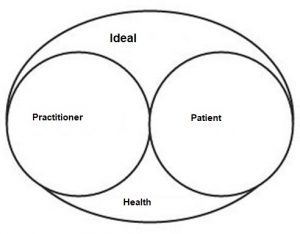
Figure 2: Field of ideal heath. (Image credit: Matthew Berean.)
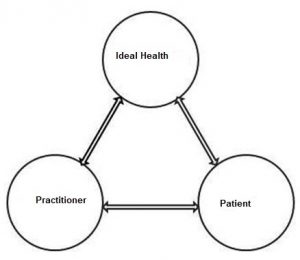
Figure 3: The healing dynamic. (Image credit: Matthew Berean.)
Matthew Berean is a Certified Rolfer, SourcePoint Therapy® Energy Medicine Practitioner, and yoga teacher in Chicago, Illinois. Matthew has also completed training in visceral, vascular, neural, and cranial manipulation. He has coached novice to elite rowers for twenty years and has been a student of yoga and meditative practice for more than twenty years.Cultivating Insight[:]