


Marsha Presnell-Jennette, Certified Advanced RolferTM and Rolf MovementC®MPractitioner, trained at the Rolf Institute® in 1988. She is a Board Certified Structural Integrator and serves on the IASI Law and Legislative Committee. Marsha published an article on her innovative approach to using therapy balls in her SI sessions in the IASI 2007 Yearbook of Structural Integration. Her current interest is in addressing structural changes through movement re-education.
Abstract
Sharing a life-changing experience often is cathartic for the teller and conveys interesting or useful information for the reader. My long journey started with mysterious sensations and changes in my right arm and stretched out over 13 years. !is article shares some of what I’ve learned from my shoulder problems. In sharing my experience I hope to heighten other practitioners’ awareness of the complexity of shoulders and offer insights and ideas to help structural integrators better serve their clients.
My Shoulder Injury
he numerous workshops and trainings I attended over the years didn’t teach me as much as my journey that included two frozen shoulders, shoulder impingement syndrome, torn rotator cuff tendons, bone spurs, and two surgeries. This experience taught me extraordinary lessons about shoulders, the pain associated with their injuries, and the healing process.
The first indication that something was not right began with carrying multiple jugs, two at a time, up a flight of stairs. I felt strong and sturdy. The two full jugs, one in each hand, were not beyond my capacity. At the time I had been a RolferTM for eleven years and my clients often commented that I was very strong for my size. I worked previously as a gardener in my city’s parks. I operated rototillers, pushed wheelbarrows loaded with rocks, lifted heavy equipment on and off of trucks, and performed many other demanding tasks that prepared me for the physical demands of my career as a structural integrator. While carrying the jugs I noticed my right arm felt strangely weak and there were unusual sensations. Within months I could not sustain legible writing; my arm would get very fatigued even when writing a short note. While driving, the vibration from the road made my arm feel strange so I relied on my left arm and hand when possible. The loss of fine motor function for writing was a concern, but I don’t recall any loss of function for gross motor movement in the early months of what became a long journey.
Over time there was noticeable muscle loss along the flexor carpi ulnaris of my right arm. When I talked to my physician about it he could not see the difference arm to arm and referred me to a neurologist for an evaluation. There were the usual nerve and muscle conduction tests, and MRIs of my cervical vertebrae and brain. Thankfully, there were no signs of MS or Parkinson’s. A neurologist said: “No doubt something is not right, but we can’t figure out what it is right now. It will have to get worse before we can help you.” I decided to rely on fellow SI practitioners, acupuncture, Continuum Movement, and my own body’s wisdom. The odd sensations remained but I had no significant pain. Assured I didn’t have a neurological disease, I didn’t worry about the odd sensations for several months.
Eventually the odd sensations became pain. I didn’t notice loss of movement in ordinary activity. The muscle loss was becoming more apparent. I began seeing a highly respected physical therapist (PT) who told me I had “weak ligaments” (a term I’d never heard before) and that I should do more push-ups and lift weights. I resumed sessions with a personal trainer who echoed the PT’s assessment and urged me to do more push-ups and use more weights. I complied with their directive and in between seeing clients I did push-ups. At home I used weights and stretch bands to strengthen my “weak ligaments.” This went on for a few months; I watched my non-dominant arm get stronger and larger and my right arm smaller and weaker. The pain worsened and began to extend to my upper arm. I found this scary, but neither the trainer nor the PT was concerned. SI colleagues could see this difference and were curious about the change. I was curious that both the PT and trainer were dismissive and uninterested in my muscle loss.
Eventually I went to my physician and begged for an MRI of my arm as the pain was now constant.
He referred me to the shoulder orthopedist who quickly offered insights and answers. During the first visit the doctor placed his hands on my shoulder, requested two movements, and pronounced: “That is a noisy shoulder. Shoulders don’t sound like that unless there is a tear. You have one or multiple rotator cuff tears. An MRI will tell us which ones and if there are other problems.”
Assessment
I was fortunate to have been referred to a leading shoulder specialist and orthopedic surgeon. He maintains a fascination and enthusiasm for solving shoulder problems. During the years I was in need of his services he was receptive to my questions and observations. I learned a great deal from our conversations and the community education lectures he offered (Duke Health, 2012), which focused on shoulder function and injuries related to the shoulder joint.
The shoulder joint is the most complex joint in the human body. Not only is it engineered for heavy lifting – chopping wood and carrying water – it also allows for refined movement and a wide range of motion. The nerves that provide fine motor movements to our hands pass over the glenohumeral joint. Determining the source of pain is difficult because of the complexity of the nerves. Often, shoulder injuries present as pain in the lower arm, hand, or even the neck, making it hard for an SI practitioner to determine the best intervention for a client who complains of arm or shoulder problems. There are numerous syndromes, congenital deformities or variables, and injuries that SI practitioners could encounter. This article only represents those within my personal and clinical experience.
Be a Detective – Observe and Ask Questions
The art of interviewing a client is a useful skill for SI practitioners. Ask questions about the pain pattern, get a complete history of all injuries, and determine how range of movement is compromised. Observe how the arms hang while the client is walking and note the differences. Often a client with an injured shoulder will display an arm that does not have responsive movement in walking.
Take the client through a range of movements and compare the motions of both arms, taking note of the function of each joint in the arm and shoulder. Listen carefully to the client’s feedback. This will support observations or lead to more questions. An SI practitioner is like a detective looking for clues to solve a mystery.
Dr. Rolf encouraged practitioners to work in a space large enough to accommodate movement assessment and the accompanying energetic changes a client can go through. Working in a small space can limit a practitioner’s ability to assess the client’s gait and structural alignment in motion. Consider finding a larger space (perhaps outdoors or a corridor in an office building) to observe the client’s movement patterns. It is surprising how much SI practitioners can learn about a client when there is adequate space to study her structure in motion.
Examples of Damage to Soft Tissue, Bone, and Cartilage
Younger clients’ shoulder injuries are often the result of a sudden incident, for example, a sports-related injury such as a baseball or tennis player’s torn rotator cuff. Or they can be the result of a sudden impact as when bracing for a fall from a skate board, snow board, or bicycle.
Children’s tissues are more flexible than those of adults. Adult shoulder problems can develop slowly and silently. An older client complaining of shoulder pain may have a rotator cuff tear that developed slowly and is not the result of a fall or other trauma.
If a client has fallen and landed on his shoulder, there is the possibility that he has a tiny bone fragment that has chipped off within the joint, creating irritation and pain, as well as other injuries such as a shoulder separation. The client or practitioner would not know the source of irritation without the benefit of an x-ray or MRI.
Clients with well-developed deltoid and trapezius muscles who experience shoulder pain are often unaware that their efforts to build strong shoulder girdles did not insure them against rotator cuff tears. SI practitioners can also underestimate the possibility of a rotator cuff tear in clients who present as physically fit and healthy with no history of injury to the shoulder. However, common exercises target superficial muscles such as the deltoids, biceps brachii, pectoralis major, and latissimus dorsi and can easily ignore strengthening the rotator cuff muscles. Figure 1 shows the anterior view of the rotator cuff and Figure 2 shows the posterior view.

Figure 1. Shoulder girdle and rotator cuff, anterior view.

Figure 2. Shoulder girdle and rotator cuff, posterior view.
Rotator cuff tears are one of the most common injuries to shoulder girdles. SI training does not teach enough about the changes that occur in tendons as people age. Tendons deteriorate and tear, cartilages soften and tear, and muscles weaken.
Studies have shown that by age 70 most people have a tendon tear which can cause bursitis (Tempelhof, Rupp & Seil, 1999). For clients over 50, or younger clients with poor health such as diabetes, a rotator cuff tendon tear may be the source of their pain, even though the client knows of no specific activity that would cause a tear. Tears can occur slowly, over time without a specific injury. Repetitive activities such as sanding or painting can slowly tear a tendon.
Labrum tears are also sources of great pain. The labrum is the fibocartilaginous tissue structure that provides a secure fit for the humerus into the glenoid cavity. Though it is thick tissue, it can tear if the shoulder is injured. I recall one client who suffered with a labrum tear for months. Her fitness trainer had encouraged her to use more weights and increase her repetitions. When her shoulder pain began the trainer was convinced it was a sure sign she was getting stronger and she should continue. During her scheduled Rolfing® sessions she complained of shoulder pain and repeated her trainer’s assertions that it was a sign she was getting stronger. I had not encountered shoulder tears at the time and never considered that the client could be injured. After a few weeks of sessions with no improvement I encouraged her to see a doctor. Later I learned she had a significant tear and needed arthroscopic surgery. This incident was an important point on my learning curve about shoulder injuries. I learned that there were various ways they can occur without a known incident.
Changes related to aging occur differently in each person and we can’t know for certain what is happening on the wet side of the skin. It is useful to remember that tissues degenerate, cartilage and tendons soften and may tear or fray without a specific incident. For many individuals the tear does not produce pain, for others even a partial tear can be very painful. The fact that no two people are alike keeps structural integration practitioners curious to understand the “what is here now?” with each client and in each session.
Pain Referral Complicates Assessment Range of motion can be compromised due to the tear. However, that is not always true. Avoiding movement in a specific direction can keep pain at bay for a while. The body’s capacity to adapt to a tear varies from person to person. If and when pain increases, an assessment by a knowledgeable orthopedic doctor would provide the client and the practitioner with useful information concerning the best methods for helping the client. My orthopedic surgeon maintains that when his patients experience severe pain that interferes with their sleep, it is time to have a complete assessment. The loss of sleep has a ripple effect in all areas of a person’s overall well-being.
It is not unusual for clients to assume they have arthritis in their shoulders. I learned that of all the joints in the human body, the glenohumeral joint is not a joint that commonly develops arthritis, unlike our weight-bearing hips. However, aging shoulder joints can develop bone spurs. These are most commonly found at the acromioclavicular joint and at the coracoid process, noted A and B in Figure 3.

Figure 3. Bone spurs commonly develop at the acromioclavicular joint (A) and the coracoid process (B).
A bone spur, also called an osteophyte, is a sharp edge on the bone which can irritate surrounding tissues and cause inflammation. As people age, bone spurs can occur throughout the body and sometimes they are very painful. If a bone spur irritates a bursa there will be pain, as bursa tissue is very reactive. A bone spur can rub on tendons creating fraying or tears. In the shoulder, bone spurs grow in small clusters like blackberries, a tendency that is characteristic only in the shoulder. A bone spur can slowly tear away at the tendons creating great pain. The pain pattern can radiate down the arm. This radiating pain convinces the client that the exact location of the pain is the source, which is not necessarily so. The location of the bone spur may be the source of pain somewhere and yet not hurt at the specific location of the bone spur. This is due to the neural network around the joint which can refer pain down to the fingertips while the source of pain may originate at the clavicle.
Frozen Shoulder and Shoulder Impingement
Frozen shoulder, also called adhesive capsulitis, and shoulder impingement syndrome are both very painful and limit mobility. With frozen shoulder, the capsule and soft tissues of the joint become inflamed and stiff. The ability to abduct the arm is the first movement to show restriction. Eventually all movement can become locked. I find it fascinating that there are many reports of this condition resolving without intervention within 18 to 36 months. That wasn’t the case for me. There is not a single treatment that can be applied to everyone with frozen shoulder.
Shoulder impingement has similar symptoms, pain, and loss of movement, but this condition is more serious, and appropriate medical diagnosis is important. It does not resolve like frozen shoulder can. With shoulder impingement the subacromional space between the top of the humerus and the acromion is narrowed, which causes inflammation of the supraspinatus tendon. Inflammation in the tendon limits the arm from moving above the head.
The pain radiates but does not usually extend beyond the elbow. This problem is usually addressed through arthroscopic shoulder surgery.
Arthroscopic surgery is a terrific milestone in medical technology. Three small holes were made in my shoulder for the instruments to enter. A very small tool polished off the bone spurs and removed the fibers from the tendon tears. The primary diagnosis for my right shoulder was impingement, with frozen shoulder a secondary condition. I had a tear in my supraspinatus tendon and an acromial spur. Five and a half years later, arthroscopic surgery was done on my left shoulder for severe frozen shoulder with a large acromial spur (growing into the joint), a partial tear of the infraspinatus, and a degenerative condition of the biceps tendon.
My surgeon has developed protocols for reducing pain after shoulder surgery and prescribed a Polar Care Unit to reduce swelling and pain. The Polar Care Unit is a small ice chest with tubes that circulate chilled ice-water through a cuff which is placed on top of and around the shoulder joint.
I have had conversations with colleagues who think undergoing shoulder surgery is a mistake. Having lived with severe shoulder pain for so long, I felt that removing the irritants of the bone spurs and frayed tendons was a welcomed option for me.
Recovering from shoulder surgery is hard work, and most of the people I know who have had it recovered much faster than I did. The severity of my condition made my recovery much longer than that of most shoulder-surgery patients.
Fascial Restriction Patterns
The physical therapists I worked with after surgery were knowledgeable about frozen shoulders, but their thinking was narrowly focused on the joint. My experience has taught me that a frozen shoulder affects tissues well beyond the shoulder joint. The fascial restrictions due to frozen shoulder and shoulder impingement spanned from my finger tips to the iliac crest and into my cranium and face. There were times when I couldn’t tell what hurt more: my shoulder or my neck. Physical therapists would do well to think more broadly than the shoulder joint in tracking fascial restrictions. Indeed, this is where structural integrators can be an important part of the recovery team for those with shoulder problems. We are trained to find and follow the tracks of restriction throughout the body. During my recovery, fellow SI colleagues worked on me. We discussed where I could feel the restrictions. While I was in the side- lying position, one colleague worked along the iliac crest and the length of the latissimus dorsi, which eased fascial restrictions. Each practitioner had a different style of working the tissue, and with each of them I felt their work was more effective and the work lasted longer when they were thinking of fascial planes rather than focusing intently on the shoulder joint itself. This offered important insights for each of us.
A client may feel intense pain in her shoulder and arm and not realize her neck, cranium, and face are also responding to the restrictions. Connective tissue is a broad matrix; think broadly when you feel into the expansiveness of the tissue and don’t get too focused on a small area. When working with a client with frozen shoulder, the SI practitioner’s sensitive and well-informed touch can observe the differences in the right and left sides of the torso, the skull and face, and feel the fascial restriction differences as they related to the affected shoulder. This will enable a practitioner to uncover the specific patterns unique to the client.
Since manual therapy is a structural integrator’s expertise, it can be tempting to try to override the lock-down that occurs with a shoulder injury by using force on the tissues around the joint. Should the problem be shoulder impingement syndrome, the added force to the joint will be harmful. If the problem is frozen shoulder, forcing won’t do any good even though clients with frozen shoulder are desperate for immediate relief and change.
Prior to my own experience I would not have been able to determine the beginning of frozen shoulder in two long-time clients. Both cases were confirmed as frozen shoulder by doctors. These clients had resolution within a year, and they both maintained some mobility in their arm throughout their episodes, which were the benefits of early intervention. In addition to hands-on sessions, spaced two weeks to a month apart, and teaching both clients a variety of movements to do frequently during the day, these women were able to maintain their daily lives with minimal disruption. One client often said: “I have something you didn’t have. I have you and what you’ve been through is benefitting me.”
Innovative Movement Interventions There are clients for whom movement education is more beneficial than hands-on manual therapy.

Figure 4. Arm hangs easily from the joints. Practitioner helps provide support to move the arm very gently. The client is passive; SI practitioner moves arm to the edge of the shoulder restriction.

Figure 5. Client swings arm to the edge of the restrictions. The momentum of the movement and the responsiveness of the ball help mimic normal motion.
In the cases mentioned above, the clients used five- to seven-inch soft therapy balls in a variety of movements (Presnell-Jennette, 2004), some of which I will now describe. Ask the client to stand with a ball between a smooth wall and the lateral side of the upper arm on the affected shoulder; direct the client to relax her arm. The practitioner can then gently move the arm just to the end-range (Figure 4). Another option is to ask the client to swing her arm from the shoulder joint, to the best of her ability (Figure 5). The range of movement may be very limited. The ball’s response will amplify the sensation of movement and this mimics normal arm swing. (One source for therapy balls is www.optp.com)
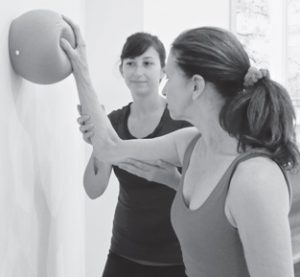
Figure 6. Practitioner slowly guides client’s arm and hand movement to the edge of restrictions. Client rests hand on the ball; gripping should not be necessary. The goal is to create various micro- movements.

Figure 7. Hand rests comfortably on the ball as it is rolled gently across the wall to the edge of available movement. Vary the relationship of the body to the wall; shift angles, and engage the entire body with movements that shimmy and undulate. Find the edge of the movement and pause as is comfortable for the injured shoulder. Allow the stiff and sore tissues to stretch or rest, as needed.
A typical physical therapy exercise for frozen shoulder is to creep fingers up the wall, but I like using the ball for more responsive feedback into the body’s fascial system. This invites gravity to be the therapist. A technique that I use successfully is to place the palm of the client’s hand of the affected arm on the ball, which is against a wall (Figure 6), and have the client very slowly roll the ball in various non-linear directions to the limits of mobility (Figure 7). Then ask the client to bend the knees and allow the span of tissue to respond from torso to finger tips and extend without the strain of reaching (Figure 8). This accomplishes the same good result as creeping the fingers up the wall but without the bad effects of reaching. Reaching is limited by the frozen joint and can be counter-productive.

Figure 8. To expand the stretch from the shoulder, slowly bend the knees keeping the hand on the ball, which will have responsive movement. Allow the passive stretch to help encourage movement at the glenohumeral joint. Movement variations from the feet to finger tips remind the entire body that movement is desirable and delicious To engage the torso and hips, the client explores micro-movements of the spine, hips, and feet.
This exercise can become a pleasurable moving meditation, especially if done slowly and the client can be helped to observe where she feels most restricted and where she feels ease. Eventually mobility will increase without the client incurring undue pain. The movements my physical therapists taught me were all painful. Offering your client some gentle techniques to do at home will be appreciated.
Through Continuum Movement, I’ve learned the value of using sound and breath to speak to the tissues and to use movements that are non-linear and fluid. When teaching movements, I share these breaths and sounds with clients and also encourage subtle, random micro-movements (as mentioned above) that wiggle and shimmy tissue. I use varying sizes of therapy balls against walls, on a table top, or on the floor to provide support, encourage innovative movement, and sensorial feedback to the system.
Using imagination and sensing movement beyond what is physically possible also nurtures the body’s fluid systems to restore more cellular responsiveness and encourages the regenerative capacities of the frozen joint.
Being a Compassionate Healer
After several sessions, one physical therapist who I also saw for acupuncture commented in a critical, accusing tone that my shoulder was still not moving at all—implying that I was lazy and not doing anything on my own to facilitate increased movement. This was a reflection of how uninformed she was about the process of frozen shoulder. I share this to encourage you to be supportive and patient with your clients as the condition is very painful and discouragingly slow to resolve.
In that exchange I realized how wounding practitioners’ words and tone can be to a client in pain. A practitioner’s words have the power to be part of a healing process or to cause further frustration, doubt, and wounding. When you find yourself becoming frustrated with a client’s progress, it is time to consider your resources. Perhaps it is appropriate to get more information from a medical doctor or medical imaging.
Your sincere interest in being of service to your client’s health and well-being speaks volumes to them about your commitment to them, to your professional growth, and to the profession of structural integration. Sometimes this interest means making a well-informed referral. There are some situations that are beyond the scope of our profession or are beyond the scope of the practitioner’s skills.
Acknowledging this is honorable and a sign of a caring healer.
The conditions mentioned in this article do not encompass all of the various problems with shoulders. When an SI practitioner is feeling frustrated at not solving the client’s shoulder complaints and the sense of frustration begins to interfere with client interactions, it is time to get help or perhaps make a referral in order to get more information. SI practitioners are not trained to diagnose, and often medical imaging is necessary for shoulder problems.
Talking with a trusted teacher or more experienced colleague can help in determining a course of action. Reaching out to a physician or physical therapist who may have expertise with shoulder problems could provide some advice or guidance. I have had many clients who expected me to understand the right course of treatment for all of their pains and problems. I know this is a dilemma SI practitioners can face. Giving the client reassurance and encouragement to get an appropriate diagnosis is the ethical thing to do. Providing the name of someone known to be experienced and skillful in the medical field offers the client support to get answers they need. This information may be useful for the practitioner in determining if SI is appropriate at this time or if adapting the approach or expectations is necessary.
Tendons deteriorate and tear, cartilages soften and tear, and muscles weaken. Studies have shown that by age 70 most people have a tendon tear which can cause bursitis.
There may come a time for honest self-reflection on the dynamics of the client-practitioner relationship. Complex clients or difficult issues can sometimes trigger a practitioner’s insecurities— or a blind certainty. Either attitude may interfere with providing appropriate support and service for a client. This important aspect of SI professional dynamics is often not explored in depth during structural integration trainings. Working with a reputable psychotherapist can help SI practitioners develop more awareness of their role in the therapeutic relationship as well as their own interpersonal patterns. Caring for oneself and one’s clients with integrity and compassion will help insure that a practitioner is engaged in a continual growth process that supports a long and satisfying career.
Protecting Your Own Shoulders as You
Practice
Structural integration practitioners with small shoulder girdles should be aware of how the compression and loading of our arms for hours every day, week after week, can undermine the integrity of our shoulder girdles. Being responsible for one’s own structural integrity while being engaged in promoting better structural order in our clients is a topic not discussed often enough during trainings. Prior to my own shoulder injuries and subsequent surgeries I was unaware of the various shoulder problems a person could develop over time without ever suffering a single traumatic event. Looking back over my occupational choices and exercise preferences, and being objective about my small shoulder girdle, I wish I had realized how vulnerable my shoulder structure was.
I encourage SI practitioners with small shoulder girdles to consider the demands that working with much larger clients places on their structures. Creating a schedule that allows two days in a row for resting arms and shoulder joints is beneficial.
Our fast-paced culture doesn’t always recognize the importance of rest for rejuvenation. Biological intelligence (Mother Nature) tells us that slowing down is a wise practice. I have found the practice of Continuum Movement to be very helpful for slowing down and reducing the shoulder and arm compression required of SI practitioners.
The Big Thaw-Reflections on My Experience
Frozen shoulder has its own time frame. With each of my shoulder sagas it was a full 18 months before the thaw stage began. Thaw is a medical term for the gradual process of the hardened tissues releasing. For practitioners working with clients with frozen shoulders, it is highly frustrating to not be able to observe more change from week to week.
Be aware that the client is also frustrated and in a great deal of pain. A practitioner’s compassion and encouragement will be appreciated.
From my experience, I offer these thoughts:
Having a great network of fellow structural integration practitioners who are also close friends helped me heal. We learned things together when they worked on me. Some of my SI colleagues generously helped support my practice by coming to my office to work on some of my clients. I am immensely grateful for my dear colleagues who are so supportive and generous in their healing touch and loving friendship.
I was a highly motivated and creative patient. In addition to following all of the recommendations from the physical therapist, I invented numerous methods of coaxing movement into my frozen shoulder. I was fortunate to have had multiple practitioners working with me: fellow structural integration practitioners, acupuncturists, and two physical therapists who worked in the orthopedic doctor’s clinic. Structural integration taught me about successful adaptation in both human structure and psyche. I adapted to life with one arm and simply had to trust that eventually the other arm would function again, even as it hung uselessly by my side for months. I gained perspective in evaluating things in two-month increments; healing and thawing of frozen shoulder moves at the glacial speed of past eras.
Frozen shoulder is an inflammatory process, and I found Dr. Barry Sears’ book titled: The Anti Inflammation Zone (2005) to be very helpful. To help reduce inflammation I changed my diet and stopped eating gluten products. This reduced my shoulder pain. I recommend Dr. Sears’ book for clients dealing with arthritis pain or other inflammatory problems.
Hypnotherapy was very helpful in teaching me to control the pain. I was amazed at how beneficial hypnotherapy was. It immediately reduced my pain and I used it often for many months.
Disability insurance proved to have been a good investment.
I began water fitness as a way to regain function in my right arm and I continue to do my own water fitness work-out in a deep pool. The resistance of the water offers a challenge. I enjoy varying the movements in the water. This offers more creative engagement than the fixed movement patterns associated with gym equipment. I recommend water workouts for clients dealing with shoulder problems.
These days I offer structural integration movement and somatic education sessions to individuals and through small classes.
Photo Credits
Photographer: Marsha Presnell-Jennette Practitioner: Megan Craig, Certified Rolfer® Model: Cilla Golas
References
Presnell-Jennette, M. (2007). Therapy balls and Rolfing® in M. Beech, & P. Kemper (Eds.), IASI 2007 yearbook of structural integration. Missoula, MT: International Association of Structural Integrators.
Sears, B. (2005). !e anti-inflammation zone: Reversing the silent epidemic that’s destroying our health. Harper Collins.
Southwick, M. (2012). My aching shoulder: Shoulder pain causes and treatments [Duke Health Library, Health Articles]. Retrieved from: http://www.dukehealth.org/health_library/health_articles/ shoulder_pain_causes_and_treatments
Tempelhof, S., Rupp, S., & Seil, R. (1999). Age-related prevalence of rotator cuff tears in asymptomatic shoulders. Journal of Shoulder and Elbow Surgery, 8(4), 296-299.
[:]My Shoulders, My Teachers: What Shoulders Taught Me