

Jan Sultan doing a demo at the Advanced Training in Venice, California,
October 2015
Introduction
In 1974, Dr. Rolf gathered her students in Big Sur, California for the first advanced training (AT) in Rolfing Structural Integration (SI). As I remember, the roll call was: Peter Melchior, Emmett Hutchins, Al Drucker, George Kasselbaum, Don Setty, Judith Aston, Giovanna DeAngelo, Will Schutz, Dub Leigh, Chet Wilson, John Lodge, Jim Asher, Michael Salveson, me (Jan Sultan), and maybe a couple of others. I had been practicing just four years, but full time.
Rolf presented us with her formulistic Advanced Four Series, as a way to go beyond the basic Ten Series. That four-session series had elements of both geometry and working positions. What was evident was that Rolf had decided to go with another universal template, a formula, rather than take the path of deconstructing the Ten Series to get deeper understanding of its application. With that first class, the AT took the form that we all learned, and taught, until her death. At that point, her first three advanced teachers added another session to the formula, and that format continued until the split that divided our house some ten years later, with some of our faculty leaving to form the Guild for Structural Integration (GSI).
The essential bone of contention that emerged with Rolf?s death (no one was going to challenge this while she lived) was whether the advanced work would continue to be a formula, like the Ten Series, or an opening into a more client-centered approach to post-ten work.
Rolf always conceived of the AT as the completion of the basic training (BT) of a Rolfer?. It was designed to build on our BT, the initial continuing education, and the Rolfer?s practical clinical experience. The AT at that point assumed the development of perception and manual skills necessary to go to the next levels of the work.
The Early, Formulistic, AT
It was not unusual in the formative days, before Rolf introduced her advanced work, to take a client through the Ten Series more than once, or to do post-ten work in a manner that mirrored the closing sessions of the Ten Series. That would look like a session each on the shoulder girdle and the pelvic girdle, and then an ?integrative? session that organized the girdles around the pelvis, rib cage, and head.
Rolf’s original advanced work went beyond that simple repetition to a series that put the client in a sequence of (sometimes stressful) positions designed to challenge restrictions and evoke geometrical organization. This was an extension of her premise that gravity organization promoted higher levels of function. Rolf insisted, from the beginning, that any work beyond the Ten Series had to reach ?higher levels of specificity? in order to serve the clients development.
That first iteration of the Advanced Four Series started with the Z position (Figure 1), in which the client was seated on the table with both legs folded to one side, first right then left. This position was more or less difficult depending on the inherent flexibility of the client. The Rolfer would do work like a Fourth Hour of the basic series on the thigh and lower inner legs, and around the ramii of the pelvis, while the client tried to rise up through his spine and the top of his head while simultaneously grounding through his pelvis.
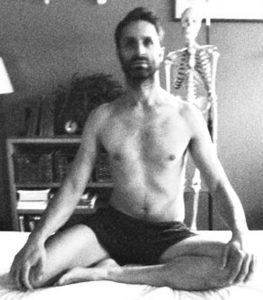
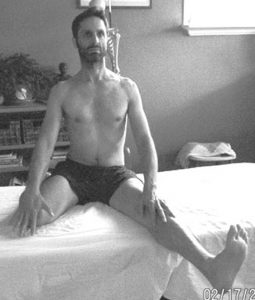
Figure 1: Two variations on the Z position, “closed Z” and “open Z”
The next session in Rolf ?s Advanced Series was the C position (Figure 2), in which the sidelying client would tuck into an embryonic C forward bend and the Rolfer would work on the back, from top to bottom. The key element was for the client to work from the inside of his spine to meet the work on the outside of the back. The objective was to restore the pre-gravity order of the spine, especially at the thoracolumbar and the lumbosacral junctions, so that when the client stood up the secondary curves would be better organized.
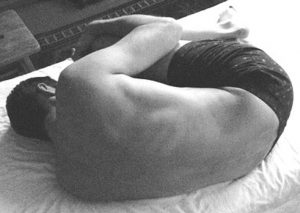
The C position.
The third session of the series was called the L (Figure 3) and it focused on establishing right angles in the function of the joints. It was also the first time that arm work appeared directly. In the basic Ten Series, the arms were worked incidentally throughout the series. Here, in the L position, the arms were addressed thoroughly, from wrist to shoulder, to establish in them the lateral (coronal) line with the elbow working as a true hinge. This put the arm on the lateral line of the body, and the shoulder girdle resting in easy neutral.
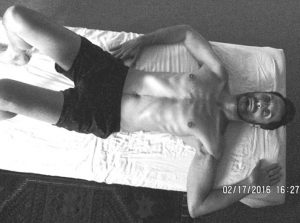
Figure 3: The L position
The last session of this Four Series started with a reiteration of the Seventh Hour from the basic series, but then went on to work in both sitting and standing positions, essentially setting up a flow from supine, to organized sitting, to standing and walking. While, in concept, this had the elements of a closure, the deep work in the cranium, that included nose and mouth work, predicted that closure here was potentially problematic.
For my part, I refused to have that last session done on me in the class. There was no way I was going to get in my car and go home to New Mexico, where there was no Rolfer for a thousand miles in any direction. I was feeling pretty good from the first three sessions, and did not want to risk it. A couple of others in the class also declined to end the series with head work, and the first cracks in our seamless unity were born there, in that first AT in Big Sur.
Rolf went on to teach her next generation of teachers through a format of combined Basic and Advanced Trainings. She would hold a class with the whole group of basic students and more seasoned Rolfers meeting in the morning for her lecture and a demonstration. After lunch, the basic and advanced groups would split into their respective clinical training. Rolf would take the advanced group for the afternoon, and her trainee the basic group. This format allowed Rolf to both solidify the BT (Ten Series) and to train her next generation of AT teachers. In this way Rolf trained Melchior, Hutchins, Salveson, Asher, and myself (Sultan) to carry on both the AT and the development of the BT faculty in her wake.
The Evolution of the AT
As I noted earlier, the question that emerged after Rolf?s death was whether the advanced work would continue to be a formula or would open into a more client-centered approach to post-ten work. It was not until the split between the Rolf Institute® and GSI that this difference in the way advanced work was to be held fully emerged. At the Guild, the decision was made to stay with the basic and advanced work exactly as Rolf had left it. At the Rolf Institute, the development of the advanced work went into a deeper study of the nature of structure and a client-centered approach that did not pre-determine what was to be done. It became systematic rather than formulistic.
The old AT was twenty-four classroom days, and the non-formulistic AT still is this length, which can happen across several different formats. Nineteen of those days are dedicated to skill development in managing local and trans-segmental relationships. This includes individual client pattern recognition, refinement of touch and perception skills, deepening of anatomy studies, and session planning based on the needs of the client. The other five of the twenty-four days can be used to season the class with the individual instructor?s personal interests in the work. Throughout, the advanced work is not taught as a pre-determined approach, or a set number of sessions, but is rather a reflection of the deepening specificity of the work. </i>
In part, what changed the Rolf Institute?s AT to its present form is that the culture changed, and the amount of information available went through a revolution. In Rolf?s wake, the transmission of information went from textbooks and from teacher to student to a digital world in which data was accessible instantaneously. Yes, there are still books to read, and anatomy to study, but knowledge is no longer contained in the way it had been over the centuries since Gutenberg invented the printing press. That opening in the field of information led us, at the Rolf Institute, to consider the ?nature of structure? in a brighter light. That opening of the informational field let us study how other professions viewed the body, and how they went about their work. It led us to be able to understand Rolf?s work with the body more profoundly.
Rolf made observations about structure and function, and theorized about the means whereby those events came to pass. The information revolution allowed us to see more deeply into the body, and to divine the underlying principles that made Rolf?s work ?work?. What emerged was the structural taxonomy of the axial complex, the shoulder girdle, the pelvic girdle, the sleeve, and the core (or visceral space). Note that the structural taxonomy came first, and later we added the functional taxonomy (to include movement and education), the geometric taxonomy (to imply gravity?s influence), the energetic taxonomy (with a nod to extra-somatic events), and the psychobiological taxonomy (with respect to behavior and expression). Within each of these categories, we were able to study and understand biomechanics, muscle actions, and relations across joints, the nerve and blood supplies, and the larger trans-segmental patterns of action. Out of the understanding that arose, the orders of intervention emerged as discrete procedural rules, based on a host of diagnostic criteria.
These changes have allowed us to teach a training where the understanding of structure and human nature determine the amount and quality of our intervention. We believe that to the extent we understand these elements, we will design the work to be relevant to the client, rather than asking the client to become congruent with the work.
Rolf predicted holism forty years before it emerged as a cultural icon, but here too our understanding has deepened. As the Rolfing view of holism has developed, we now include consideration of the client?s habitual energetic locus, the matrix of ancestral heritage he carries, and the form taken by the current intersection of these elements in his life. In the abstract, these constitute a consideration of state, trait, and shape as elements of the holistic whole the client presents. Rolf?s view implicitly approached this psychobiological holism, as did the cultural gestalt of the 1960s where physical work like Rolfing SI was often done in tandem with other modalities addressing psyche and energy, but early Rolfing SI did not have an explicit conceptualization of the forces we were engaging as we entered the client?s soma.
Conclusion
The information revolution, and our integration of the information available to us today, is reflected in how the AT is conceived and taught at the Rolf Institute today. In the entry-level training, we teach Rolf?s Ten Series and respect the genius of its universal application. Yet we are also informed, in our teaching of the Ten Series, by our further explorations and by findings now available in the larger field of information. Rolf imagined the body as segments organized around a line of gravity?s influence. We take that foundation and now bring relativity and movement into the work. In its simplest form, ?relativity? means that gravity is a function of mass, and that space-time is a continuum. There is no field of gravity per se, and gravity occurs where we are. Space-time and mass interact in a reciprocal way, expressing the laws of gravity. Our inquiry honors the creative drive of our founder, and strives to make Rolfing SI more relevant, more anatomically accurate, and more refined in its current form. Had Rolf lived longer, she would have been at the forefront of these changes, as her creativity was not static, and her exploration was a work in progress, not a fixed and final thing.