

María Cristina Jiménez: Tell us about your journey into Rolfing Structural Integration (SI).
Jan Sultan: I have been [practicing] Rolfing SI for forty-six years. I started training in 1969 and finished Basic Training in the spring of 1970. I first [received Rolfing sessions] from Dr. Rolf when I was about twenty-six years old. I had my first eight sessions with Ida and my last two with Peter Melchior. What a difference that was. Initially I didn’t like Rolfing SI or Rolf! But the results after the first ten sessions (which took about a year to complete) were astounding: I grew an inch in height, my feet went up from size ten to size eleven and a half, and I began to look more like my maternal grandfather. I could tell that this was my adult body showing up. It was quite profound.
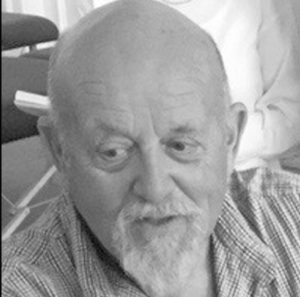
Jan Sultan
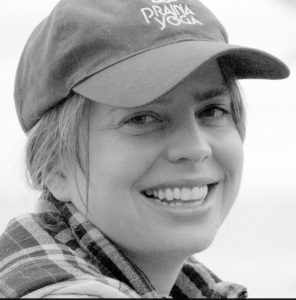
María Cristina Jiménez
MCJ: What was your background and how did that lead you to Dr. Rolf?
JS: When I graduated high school I wanted to get into the world. I could not imagine spending any more time sitting in classrooms. I was too wild to even think of sitting still in a classroom for six to eight years of college. The world was calling. Now I realize I am afflicted with attention deficit disorder, and I can’t sit still to this day. In any case, I worked the building trades, and was a working sailor in the US Merchant Marine, a member of the Sailors Union of the Pacific. I had a cabin in Big Sur, in proximity to Esalen. In between trips to sea, I worked a landscape business. After complaining of knee and back pain to my then girlfriend, she suggested I get [Rolfing sessions].
I had never had a massage or been touched therapeutically at that point. I saw Ida one day at the dining room at Esalen and went up to her: “Hey, I have heard about you. I have back pain. My knees hurt a lot and I do physical labor part of the time.” Ida looked at me up and down and said, “Of course your knees hurt, look at your pelvis!” I was embarrassed. I didn’t know what that meant, but we made an appointment and I went. I actually didn’t like it or her. It hurt.
I got my first session at the Esalen hot springs bathhouse. It was a little bit like she was carving a roast; like a she-bear on a deer carcass. A few days after the [session] I was working on something and stood up and my lungs opened with a crackle – like Velcro. I took three or four big breaths and got dizzy and I realized, “Oh it’s the Rolfing [work]. Shit! I have to go back.”
The effect was so transformative that after a few visits over about three months – ‘cause she would come and go – I began to mature in a very particular way, almost as if I got to finish growing. I didn’t have any conceptual framework for this – I just knew I was changing. Years later when I had enough information to reflect, I came up with a deeper understanding of Rolfing [SI] as ‘a highly organized stressor that would bring latent traits online’. The pattern of growth I had experienced was in me, but it hadn’t shown up because there was no pressure to make it happen.
It follows that if you throw away Ida Rolf’s technique of systematic differentiation of fascia in favor of techniques that deal more with imagery, or energy-based techniques, the opportunity is missed to apply Rolf’s highly organized systematic pressure, and organization in the gravity field, that creates space for the body to grow.
MCJ: What happened next?
JS: As I said, I started Rolfing training in 1969 and finished Basic Training in the spring of 1970. In the fall of 1971, I left Big Sur and moved to Northern New Mexico. I was based there, and worked with students at Prescott College in Arizona, at a growth center in Houston, Texas, and also traveled to Denver to work. I was like a circuit preacher, spreading the gospel of Rolf. In 1974 Rolf had her first Advanced Training (AT). I went back to Big Sur. Peter and Emmett [Hutchins] were there in 1974, Judith Aston too, in sum probably fourteen to fifteen of us. We were her original students.
A couple of years later in 1976, Dr. Rolf called me to assist her in a Basic Training in Los Angeles. I did the Ten Series with Tom Myers, who was an instructor model in that class. She again asked me to assist in the AT for two years running.
She practically dragged us there and said, “I am going to train you to teach.” Peter and Emmett were the first two and I was the third to be ‘knighted’. The three of us later went on to teach the AT for fifteen years. In addition to IPR, I looked to Peter and Emmett as my primary mentors, as models for what it was to be a teacher. In my whole education to that point, I only had one good teacher, a high school biology teacher. I also remember that I had one mentor as a sailor, an old salt who looked out for me, taught me the ropes, and how to show up and work.
MCJ: What other mentors did you have?
JS: Another well-developed teacher and physician was [John] Upledger. He came to the Rolf Institute® in 1983 and taught a five-day training for the Rolfing faculty. All of us showed up for that except Emmett, who claimed he just did not want to learn “that stuff.” Upledger opened up my perception about osteopathy and indirect technique. He demonstrated that he was able to have fun with teaching. Rolf was too driven to have fun. Fun wasn’t a highly valued quality for her. She was a serious person. Most of us were intimidated by her. In turn, she had a soft spot for medical doctors and PhD-level people. She was not pandering but was solicitous of them. She wanted her work recognized by the doctors. This was a paradox that struck me from the very beginning: that IPR never used the word ‘cure’ or ‘heal’, but insisted that her work was education. Still, she sought the approval of the elite class of healers in the medical profession.
MCJ: Talk more about IPR’s teaching and how close you feel to her teachings.
JS: I am constantly amazed by Ida’s genius and how she spun this work out of diverse threads (i.e., yoga, physics, osteopathy, biochemistry), and that she came to different conclusions than the people around her. Also, there are some anecdotes that she had some sort of leap of inspiration or insight that this work might have been used as part of the initiation of temple acolytes in ancient Egypt. She often alluded to Egypt. But she wanted the work to be acceptable and she thought that if we let the metaphysical cat out of the bag too much, that we would be relegated to a less credible place in the culture.
Among the early group, I was the structure guy from early on. While the ‘Recipe’ was our law and guideline, I wanted to know the nature of structure, the medium that we worked in: How did it behave? What is it made of? What made the Recipe work so well? How could a technique like Rolfing [SI] produce such pervasive and diverse changes in people? IPR did a lot of demonstrations with very disabled and affected people. I saw her deviate from her Recipe over and over. In fact, it was a source of frustration for many of us, that after one of her ‘wild’ demos, she would instruct us to go ahead and do a sixth session, as if she had shown it to us.
IPR used to say that “There is a lot more going on with the human than the body, but the body is what you can get your hands on.” In this context the inquiry about the energetics of the body, the ‘psychobiological’ part of human being, should always have the element of touch as a way in. If it is done without getting your hands on the body, you don’t evoke the kind of changes that are potential with our work. IPR used to say that if you left out gravity you weren’t [practicing] Rolfing [SI]. I take that to mean that the body is where gravity happens, and that the mass of the structure is what we affect. Energy work per se does not deal with the gravity part of the equation; the form and shape of the body.
Having said that, sometimes when I am working, it is as if a doorway opens into a causal domain, in which the preconditions that set up what I am seeing emerge as the conditions that are operating a priori. It isn’t magic but it’s definitely got a quality to it that you can smell and taste. It is as if the limbic brain is turned on and its perception rises to consciousness. I don’t go looking for this quality, but it happens often enough that I see it is part of perception. “What is that odd taste? Oh that’s anesthesia! Ah! Surgical trauma? Oh yes, there it is.” Ida was well aware of it, and in her teaching would obliquely refer to it. In my private work with her this element emerged, and she would speak to it as she went along with her hands on.
Ida had a mandate, she said, “Do it my way for five years or until you think know what you are doing.” Being a good Scout, at about the five-and-a-half-year mark I began studying outside Rolf’s teaching by reading books on osteopathy, chiropractic, and cranial work. I wanted to know how other people who worked with structure viewed the nature of the bod. I also began to study the ideas of people that Ida would refer to in her lectures, like the work of Gurdjieff and Ouspensky, Theosophy, and general semantics.
When I entered the realm of the I Ching and the Tao Te Ching, I had a smashing insight. First, I have to say that Taoism is not a religion but a science of life. The yin and yang principles of Taoism apply to everything: ordinary living, religion, warfare, and politics. The circulation patterns of the microcosmic and macrocosmic orbits, of the movement of energy between heaven and earth and the human body, define how the body is maintained. The body emerges as a material being connected to, and interpenetrated by, heaven and earth. This lawful fluctuation of energy through the system matched, and supported, what Ida valued. The ‘Line’ was the logo of that relationship. How we are related to the fields around us, connected to Earth and connected to the cosmos, was emerging for me. IPR was independently validated by this understanding. I realized that the energetic template of the macro and microcosmic orbits supported what Ida was seeing and driving for, and it was a natural fit.
She knew about the Tao. She didn’t talk about it very much. She had been to Japan and taught there. After she died, we took her library apart and saw these books on the Tao, and the I Ching. She may not have gone deep, but she knew. This connection was huge for me, because it put working on people in a different context. I would look for where the up and down flow of the ‘orbit’ was disrupted. Getting the body organized in space and on the ‘Line’ also opened the way for the rising and descending chi to move through the body better.
MCJ: How does it feel to be a lineage holder for the community?
JS: I didn’t ask for it. And I would probably be having more fun if I weren’t beholden to the lineage. I have given up trying to keep the pack in line. It draws too much resentment. I don’t have anything to prove. I am interested in teaching people who want to learn. I am not interested in convincing people that Rolf was right. I am not trying to be her successor. I just was there and I learned it from her and I studied my ass off for forty years. I don’t have any other credentials, you know, other than 80,000- 90,000 sessions that I have done. I am like an airline pilot with a lot of miles: you want to fly with me [laughs]. I am kind of an educational philosopher.
MCJ: What changes would you make to the work?
JS: If I had my way I would make the Rolf Institute® a two-year school, and I would invest a lot more in the foundational training of our practitioners. When I was faculty chair in the late 1970s (for five years), I said to my colleagues: “If we are going to do this right, we have to get rid of the traveling show and actually build a real university.” You come here and we train you. Tons of anatomy, kinesiology, better understanding of chemistry, and tons more supervised clinical time. Then I think that we can produce a graduate that is much better prepared to actually represent Rolfing [SI].
MCJ: Talk about your style as a practitioner:
JS: I think, as for any high-level journeyman, the work appears more and more simple to me. Even as it is informed by thousands of hours of experience, I do less to get my results. I am able to see into a pattern and more often do the right couple of things to mobilize it. As a practitioner gets more experience, [he is] able to see into the essence of a pattern and do the few things that make it accessible for the client to contact and move through. I am not sure I want to say what my metaphysical roots are, but I am a product of my times.
Rolf used to say that Rolfing [SI] was a holistic system, and she was also a big advocate of always grounding your abstractions. With that in mind, I kept wondering what is Rolfing SI’s holism? As she often demanded that we ground our abstract thinking, I wondered where her ‘holism’ found its ground. IPR said, “The body is a web connecting everything with everything else.” It comes to this: when your client stands before you, you have three primary elements, trait, state, and shape. Trait is your genome, as in the patterns of your grandparents, your hair color, your size, your attitudes, your tribal roots in a manner of speaking. Then there is the state [the person is] in now, and perhaps the one he habitually holds. Are you a pissed-off person, a joyous person, a fearful person? Or “God, I almost had an accident on my way over here and I am upset and activated, but generally I am more cooled out.” And then there is the shape: your literal form, and the way you occupy space. Shape, trait, and state then are the essence of our holism.
MCJ: Talk about the evolution of the Advanced Training from formulistic as Dr. Rolf had it, to non-formulistic. How did it come about and was there pushback?
JS: Yes there was. How it came about was that it was high time for Advanced Rolfing to take people to client-centered work instead of predetermined-formula work. And more to the point, Rolf said if you are going to do advanced work, you have to reach higher and higher levels of specificity. That can’t be done with a predetermined formula.
MCJ: Would you elaborate on the concept that you and Michael Salveson developed of working in the ligamentous bed?
JS: The ligament bed is the deepest myofascial layer on your way to the osseous components. In the ligament bed are concentrations of Golgi tendon organs and muscle spindle reflex arcs. In that way, working in the ligament bed follows the law that the smallest governs the largest. This is also fundamental [to] Taoism: the idea that water always goes to the lowest point, but then it rises as clouds and it rains again. In the body the lesser governs the greater, and in the ligament bed the establishment of adaptability opens the structure to receive educational input and real pattern changes.
MCJ: Can you speak about tracking?
JS: Ida didn’t identify the work that she did at the end of sessions as ‘tracking’ – it looked more like a guided movement education. At some point I noticed that she would do certain techniques at the end of certain sessions to help the client integrate the work. I decided to view that as a separate body of work. After her death, I gave it the name ‘tracking’. My motivation was to preserve this unique part of her work, and to be able to identify it as a distinct system that you could apply whenever and wherever. I don’t do it every time. I often do it when I feel people need help integrating the manual work that I’ve done. I sometime use it to get a hold of the brain and guide the limbs through space in a different way than what is habitual, in a sense to ‘burn in’ the track.
MCJ: Any last comments and/or pieces of advice for new Rolfers?
JS: As you develop as a practitioner, begin to pay attention to the space between the moves you make. Watch the body and the whole field of the intervention. Listen to your own body as you watch. Your pacing, and listening, is every bit as important as your doing.
It’s hard to get a business going – you are self-employed and the development of your business is based first and foremost on referral. So every person you touch is potentially the next five people you’re going to touch. Work more, talk less. Lead people to their own experience, not yours. Don’t tell any stories about yourself unless it’s directly related to what’s happening with the person on the table. And be prepared to wash dishes or wait tables until you get going. Don’t give up your day job!
Jan Sultan currently lives in Manhattan Beach, California, and maintains a full-time practice there. He also travels to Santa Fe, New Mexico to work with his clients there. He teaches Advanced Rolfing classes and offers continuing education for structural integrators on a regular basis. In addition to holding a direct lineage to Ida Rolf, he woks to deepen Rolfing SI as it is practiced today. Jan’s studies include various aspects of craniosacral work, visceral manipulation with Jean-Pierre Barral, and nerve mobilization in all its variations.
María Cristina Jiménez is a Certified Advanced Rolfer and a yoga teacher (ERYT 500) who has been teaching yoga since 2001. She was born and raised in San Juan, Puerto Rico. She’s worked extensively with – and is deeply influenced by – Integral Anatomy’s Gil Hedley and the great Bonnie Bainbridge Cohen and her BodyMind Centering® work. She regularly mentors with Rolfers Jan Sultan, Benjamin Shields, and Harvey Ruderian, and has also mentored with Mary Bond and Bruce Schonfeld. She is training in craniosacral therapy and visceral manipulation. She completed her Rolfing certification in 2013 and has a thriving bodywork practice. In addition to her public yoga classes, María Cristina has contributed in over thirty-five different teacher trainings and immersions all around the Los Angeles area as well as nationally. She is known for her spiritual anatomy workshops, which help make anatomy accessible, relevant, and poetic.Journeyman: An Interview with Jan Sultan[:pb]Journeyman: An Interview with Jan Sultan[:]