

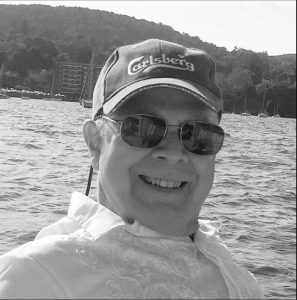
Thomas Findley

Anne Hoff
Anne Hoff: We’ve been wanting to interview you for the Journal for quite some time, so I’m thrilled this is taking place. Let’s start with your background. You became a medical doctor in 1977, got a PhD in physical medicine and rehabilition in 1983, did your basic training with the Guild for Structural Integration in 1991, and did your Advanced Training with the Rolf Institute® in 1998. Plus training in acupuncture and homeopathy during medical school. Was there an organic progression in all of this?
Tom Findley: I was exposed to Rolfing® [Structural Integration (SI)] back in college, in 1969. Sharon Wheeler was the sister of one of my college friends, Richard Wheeler – she was one of the first Rolfers. I got my ten sessions in Berkeley between college and medical school
AH: So even in medical school you knew about Rolfing SI. Did you think way back then that at some point you might want to do the training?
TF: So, in medical school I did an elective with Frank Wenger MD, the director of the department of physical medicine at the Washington Hospital Center who became my mentor, and convinced him to quit his job and become a Rolfer, and he convinced me to go into physical medicine and rehabilitation. We have always considered it a fair trade.
AH: Was fascia a big part of your training in physical medicine, or was it something you had to learn about on your own?
TF: No, so when I did my residency and got my PhD, we knew about bones and muscles and strokes, and how to rehabilitate those things. And then I got to connective tissue and – duh, we don’t know anything. You know, heat a rat tail you can stretch it, that’s all we knew. So there’s a big gap here. So that was back in, oh, 1980, I knew there was a big gap.
AH: All along were you both a clinician and a researcher?
TF: I’ve been doing research since I was three years old.
AH: What did you research when you were three years old?
TF: My mother tells me I stood next to a window where the sun was coming in in the winter, and I held up a can of honey, and I stood there for forty-five minutes. Finally she said, “Tommy, what are you doing?” And I said “I doing exerment [experiment].”
AH: Okay, so the research bug was there young, but you also knew you wanted to do some kind of clinical practice?
TF: Correct. By studying to get my PhD simultaneously with my residency, I learned to go back and forth between the clinical and the research in the middle of my residency. And I just continued to do that.
AH: That’s fairly unusual, isn’t it?
TF: Yeah, it is. Most MD/PhDs get their PhD as part of the MD, and then they go into residency and don’t do any research, and then they get out and only about 15% wind up doing research. Most MD/PhDs are just straight clinical because they never got any practice going back and forth.
AH: And then you’ve also been an educator, you were a medical school professor. So you’ve had these multiple streams of involvement . . . So you were exposed to Rolfing SI, and a certain number of years into your work you went off and trained – why?
TF: Well, I tried the training back in ’86-’87 maybe – that’s when I was research director of the Rolf Institute® – and I lasted about three days in the auditing. I [decided], “No way, I’m not sitting on my hands for eight weeks.” So I didn’t train then. But Frank Wenger had invited Ida Rolf to come work on some of his patients at Georgetown University, we also had Richard Wheeler come; they did well with Rolfing SI. It was pretty clear that Rolfing [SI] had something to play in physical medicine.
So when I was at Kessler Institute for Rehabilitation, here in New Jersey, people started listening to me when I had some pretty crazy ideas. I said, “I think this would be very useful to have here. Can we put on a training here?” I asked the Rolf Institute and they were not interested. So I asked the Guild [for Structural Integration and they were]. We found nine physical therapists (PTs) and myself, and I put down my $5,000 check and told the hospital, “I’ll pay for my own training, can you pick up the cost for the therapists?” They did, and so in 1991 the instructors flew in and we trained Thursday, Friday, Saturday, Sunday, went back to our regular jobs Monday, Tuesday, Wednesday . . . And we did that two weeks on, two weeks off.
AH: What was the result of the training?
TF: The physical therapists wound up actually doing [structural integration] at Kessler, and I went back to my full-time research job because they didn’t really want me doing anything else. And so Kessler had a [structural integrator] on staff for fifteen years.
AH: Were they doing Ten Series, nonformulistic work? And how was that working in the health-care system, in rehabilitative medicine?
TF: They were doing mixtures of Ten Series, nonformulistic stuff. Actually there’s some papers that came out of that, how our patients did. Our patients did quite well.
AH: So you’ve had opportunities, where you’ve been established and respected in the medical system, to bring in structural integration, and there’s been uptake on the medical end. But it sounds like a mixture of interest, or not, on the structural integration end.
TF: I wouldn’t call it a mixture, I’d call it not.
AH: So the Guild was willing to come out and train, but other than that there hasn’t been interest from structural integrators to come and work in the field? TF: No.
AH: I remember years ago when you were at the VA (Veterans’ Administration) you were looking for Rolfers to come work as interns in a mentorship with spinal cord injuries. So you did not get people coming out, or not many?
TF: No, I didn’t.
AH: Why do you think that is? TF: I don’t know. I think they’re independent cusses.
AH: That’s true of the Rolfing world. Was that disappointing to you?
TF: A little.
AH: Say more about working in a medical setting, this rehabilitative setting. What did you find when you brought structural integration into the mix of what you could already do as a medical doctor there. How did you know when to bring Rolfing SI into patient care? I think many Rolfers are overly eager to think our work can help with many things, but as a trained medical doctor you are probably more discriminating about that.
TF: Mostly that was in my private practice. People would come to me wanting Rolfing SI because they’d been to see a bunch of doctors. So my first question to myself was, “What did everybody else miss?,” before I even decide if I’m going to work on them. And early on I had a family with a young girl with scoliosis who wanted to [get Rolfing sessions] and I said, “No, I’m not going to do it,” and they insisted and went to somebody else. I said, “Okay, but let me monitor it.” So we did x-rays and all sorts of things. She came back after the Rolfing sessions and she looked better, and her scoliosis was worse. She was more balanced in her body but the curvature was worse. So we sent her to a surgeon who straightened her out.
AH: So the scoliosis was progressing in the way it would and the Rolfing SI was just kind of masking that on the surface.
TF: Correct.
AH: Do you think there are situations where Rolfing sessions can help with scoliosis?
TF: Of course.
AH: How would you decide when it could and when it couldn’t?
TF: It sort of depends on how fast it’s developing and how loose the tissues are. If somebody is loosey goosey in their adolescent growth spurt, it’s not going to help.
AH: But if they are tight and bound up in ways where Rolfing sessions could help facilitate fascial lengthening in some places, it could help maybe?
TF: Right.
AH: When you worked at the VA did you find anyone interested in Rolfing SI?
TF: Oh yeah, we established structural integration as a skillset, and practitioners of structural integration can be credentialed and work in the VA [hospital] where I used to work. I couldn’t do it all myself so I wanted to be able to bring in an assistant, but you can’t work on people unless you are licensed and credentialed in the hospital. So I said, “We need to be able to credential practitioners of structural integration.” I put together a packet, took it to the medical staff, and to everybody’s amazement, they approved it.
AH: What kind of credentialing was required? TF: I think that was before IASI . . . I think it just said “graduation from a school of structural integration.” AH: So somebody could come in with structural integration training, and without being a PT or a doctor, and work at the place you were at with the VA. Did this apply to other VA hospitals or centers?
TF: No, you’ve seen one VA, you’ve seen one VA.
AH: So everything is done at the micro level of each location.
TF: That’s right.
AH: I’ve wondered, with so many vets coming back from these combat zones with very severe physical damage, could Rolfing SI help them.
TF: They even agreed to pay for Rolfing SI on the outside for veterans here, and I could not find a Rolfer who was willing to do it for what the VA would pay.
AH: So they weren’t paying near what market was for Rolfers?
TF: Right, but for the experience, come on folks, these are our veterans. No one wanted to touch it.
AH: It seems there could be practitioners who would come in and work at a reduced rate if it were organized broadly, like the way we have children’s clinics.
TF: The VA has every year a meeting of all their administrators. One year my hospital director was in charge of that meeting. He wanted to demonstrate different kinds of alternative medicines that are offered in the VA. So they flew in five Rolfers to work on administrators who were attending this meeting. They were booked the whole time, they delivered all these sessions. And did anybody from the Rolf community pick up on it? No.
AH: That’s a shame.
TF: I agree.
AH: It seems like it would take the Rolf Institute or a group of structural integrators really stepping up to the plate, and somebody on the inside at the VA, to make it happen.
TF: That’s right, and I’m no longer on the inside. I’m retired. But the rehab docs at my VA are very interested in Rolfing [SI] and they would be delighted to reorganize the program.
AH: Is there any way that it could be done other places too? Maybe in New York, New Jersey, there weren’t enough Rolfers. It might be more viable in Denver.
TF: There are a lot of Rolfers in New York and New Jersey. Jason Di Filippis came out of school and came to work with me at the VA. David Wronski came forward and came to work with me at the VA, he was interested in doing the Rolfing work but I actually got him to organize the first Fascia Research Congress.
AH: It seems difficult if it has to be done by each VA rather than system-wide.
TF: True. There’s been a lot of difficulty getting acupuncturists into the VA for that reason. But once I had structural integration approved, [I said to the] people [who] had been trying to approve acupuncture for five years, “Let’s just do a text search and change ‘structural integration’ to ‘acupuncture’ [in my proposal package] and resubmit it.” And it flew right through the medical staff.
AH: If a Rolfer somewhere were interested in volunteering some time at a local VA, who would they approach?
TF: Probably the Chair of Physical Medicine and Rehabilitation. They would have to have a license in some state – any state, because the VA is federal. You could have a license in Colorado and practice in New Jersey.
AH: So you were very receptive in your role at the VA and other medical centers to alternative therapies. Is there a general receptivity or a general skepticism, or is it really a mixture depending on who the individual is?
TF: It depends. Overall there’s quite a lot of receptivity because there’s a lot of veterans who want this. There are individual physicians who are quite skeptical.
AH: Now there are a lot of Rolfers who don’t want to touch the healthcare system with a ten-foot pole. How do you feel about that?
TF: [They’re] cutting off their nose to spite their face.
AH: We Rolfers mostly love our independence, but it means there’s many people who don’t have access to our work or even know it exists.
TF: It also means you don’t get any feedback on how good you are – measurement of clinical outcomes. Maybe you’re good and maybe you’re fooling yourselves.
AH: So when you were practicing both privately and in hospitals, were you doing a lot of assessments to gauge your results?
TF: I was bringing people into my lab at the VA to measure their balance. I was measuring nerve conduction velocity in my private practice . . .
AH: So with more people doing that sort of assessment we’d have a better body of evidence of what we could and couldn’t do. What do you see as the pitfalls of Rolfers engaging more with the healthcare system.
TF: They may find out what they do is worthless. But that’s true of mammary artery transplant, of lots of different procedures that eventually turn out to be no better than placebo.
AH: So what is your impression of the effectiveness of structural integration? Do you think it’s effective?
TF: Highly.
AH: Do you think it’s only effective in certain situations?
TF: Well, you’re gonna help somebody’s posture, you may not change the disease course.
AH: Well, Ida Rolf never said Rolfing SI was aimed at that.
TF: You’ll find practitioners who are more into that. Trying to treat diseases with stuff. AH: And certainly a lot of clients today are not coming in saying, “Align my body in gravity,” they’re coming in saying, “Fix my knee.” Do you think there’s also some risk of Rolfing SI losing its identity if we get more involved in healthcare? Ida Rolf started out teaching osteopaths and chiropractors but they wanted to borrow pieces of the work rather than do Rolfing SI.
TF: There’s nothing wrong with borrowing pieces of the work.
AH: If that happened, wouldn’t the work as a whole get lost? TF: No. Ida Rolf borrowed a lot of pieces from osteopathic medicine. That’s okay.
AH: I guess the question is would Rolfing become just another type of myofascial release rather than a holistic system?
TF: Rolfing [SI] is already a variant of myofascial release and I think it’s lost the opportunity to be in the forefront.
AH: Do you see that changing at all with the interest coming about in fascia research, do you see the Institute trying to step into the role we might be missing?
TF: Well research is a highly structured speciality, if you are not trained in it you can’t do it. People seem to think research is easy and it’s not.
AH: So you came out of a lot of training to do research, and then there’s Rolfer Robert Schleip who did an incredible amount of training to be able to do research. There’s also people like Rolfer Karen Price who participated in a research study at Stanford, or Russell Stolzoff up in Bellingham helped a researcher with a project with soccer players. Do you think that’s a way to get more research done on Rolfing SI, short of us having to go out and become researchers ourselves?
TF: I think that’s the only way. That even if you get a PhD you still have to do collaborative research.
AH: Does that need more Rolfers again stepping forward and finding researchers and saying “I’d like to help,” or do we wait for researchers to come to us?
TF: You need to find the researchers and be willing to work for research wages.
AH: How would you recommend finding researchers who would be interested in engaging in a study?
TF: Contact the key speakers from the Fascia Research Congress. Like Fred Grinnell had been seeing a Rolfer for thirty years and he never knew that Rolfing SI related to his work. He didn’t put the two together. He showed the business card of his Rolfer at his talk in 2007 – how many Rolfers followed up on that? Nobody. AH: We get ensconced in our offices just doing our work. It’s easy to have a busy and full life doing that without considering what else we could be doing.
TF: Really, it’s going to be the new graduates. That’s true everywhere. You take the new graduates and give them a post-doctoral fellowship and work their knuckles to the bone and they come out doing things better.
AH: Are you still involved with the Research Committee at the Rolf Institute, or with the Ida P. Rolf Research Foundation, or are you completely retired now?
TF: I’m still involved with the Foundation to the extent that I can, but I’m out on disability. My efforts are limited.
AH: But you’ve been doing a whole lot these past few years, with the Fascia Research Congresses, and as one of the editors of Fascia: The Tensional Network of the Human Body. Is that the book that you consider “the first textbook on fascia”?
TF: Yeah. And I’m still actively researching how exercise affects the spread of cancer.
AH: I was reading a bit about that – how the tension within the fascia may have something to do with tumor metastasis. Typically Rolfers have been told to be cautious in work with cancer patients, the theory I remember when I was in school was that working fascia might facilitate the spread of cancer.
TF: That depends on the cancer.
AH: How would one know whether to work with a cancer patient or not?
TF: There are almost no metastases in muscle or in fascia. The chances of your fingers running across a metastasis are pretty small.
AH: So is the idea that if you are getting the environment softer and more organized you are supporting the body’s ability to fight the cancer, or is there something more specific going on?
TF: More specific than that. Stiffening of fascia around the tumor is associated with worse outcome for breast cancer. Whether loosening has a healthy outcome, we don’t know that.
AH: What about your research into exercise and cancer?
TF: There’s a certain kind of exercise that seems to loosen tissues: you don’t become muscle-bound, you become more flexible as well as stronger. It’s loading the muscle when it’s very short. Most exercises are done mid-range. In this alternative style you load it so that at the end of the range it has the maximum load. So instead of doing a biceps curl where at the end of the range you don’t work very hard, [here you do]; at the end of the range when the muscle is the shortest the gravity is pulling the most. You do like a triceps kickback instead of an overhead press, for example. Most of the exercises in the gym are not that way, but they can all be adapted. [This was developed] in a 1948 paper by Dr. Delorme and it got forgotten. He called it Progressive Resistive Exercise. So people remembered you lift 50% of the weight ten times, then you do 75%, then you do 100%. What they missed was his earlier paper that said you do it in a way that the muscle is loaded when it’s the shortest. He didn’t repeat that in his subsequent papers. People have cited the papers hundreds of times but they missed the first point. I missed it too when I studied it. I also missed the point where he said that, to his surprise, fibrotic limbs softened, skin scars softened.
AH: So do you have any papers on this yourself?
TF: That’s my research. We are collecting data on young men lifting weights in two different ways and we are doing ultrasound measures of the muscle dimensions and calculating the forces and so on. That’s what I’m focusing on in collecting data – how is the muscle really different when you contract in different ways? The other thing is that muscle is a filter, so that cancer cells as they travel in your blood get caught in the muscles. If you contract muscles in the right way it will pop those cells open so they don’t make it out the other side of the muscle. So not only does it soften tissue, it also kills the circulating cancer cells.
AH: Is this how you are working out yourself these days?
TF: You betcha! And I have no circulating tumor cells.
AH: That’s fantastic, Tom. Back to Rolfing SI, what else have you learned about specific ways we should use our hands that we might not be widely aware of? You wrote a paper on hyaluronic acid that seemed to suggest a particular vector of touch and also an oscillation.
TF: Correct. And it’s not just what’s under your fingers but what’s next to them. When you push on the tissue you are pushing the hyaluronic acid sideways, so it’s actually going to separate the layers just to the side of your fingers. So when you are gliding your fingers down, you need to think about what’s at the edge of that glide.
AH: The lateral edge, or front and back?
TF: Both of them.
AH: What about the oscillation?
TF: These mechanical massagers are not a bad idea.
AH: Should we try oscillating our fingers as we move through the tissue as well?
TF: That’s Stecco’s technique. Antonio Stecco has his whole technique based on oscillation.
AH: Is that something Rolfers should be trying?
TF: Yeah.
AH: It seems like there should be a feedback loop where if you are coming up with these ideas through your research, Rolfers bring that back into what we do if it will make it more effective. Did you find ways you would adjust how you used your hands based on your research and get better outcomes, or easier outcomes?
TF: Yes, but not in that way. I deliberately modulate my muscles when I’m working on my clients so as to achieve modulation in their muscles. If I want a certain set of muscles in them to relax, I have to make sure those relax in me.
AH: Is this a mirror neuron thing?
TF: I don’t know how it works, but it works nicely, it speeds things up, and I feel a whole lot better at the end of a session.
AH: I was looking at another of your papers, “Three-dimensional mathematical model for deformation of human fasciae in manual therapy.” That one seems to suggest that pressure is not doing anything.
TF: It says pressure on the fascia lata and the soles of the foot is not mechanically moving the fascia. Around the nose, yes. Those intermediate tissues of course, yes. The really tough stuff, you’ve got to put all of your weight on the tip of your elbow to move them. It doesn’t mean you can’t move fluid down the layers, but you are not pushing hard enough to deform it directly. AH: So it’s an adjustment of the old idea that we are ‘melting’ fascia and it’s more a fluid process?
TF: Yes, but I think you are melting some of the fascia. Some of the older Rolfers don’t work on the fascia lata anymore, they say we can’t move it. That’s probably right.
AH: Based on your research and your clinical practice, what’s your own best understanding at this point of how structural integration works?
TF: [Long silence.] Got that? Meaning, I don’t have a clue.
AH: So are we at the same place we were forty years ago: we’re doing something, we’re pretty sure it’s doing something, but we can’t explain what we are doing? But maybe we are at least beginning to do some research that helps clarify what it’s not doing and might point to something that will explain more in the future.
AH: So what’s next for you Tom? Somebody is writing a biography of you. Is this going to be a book? What’s it going to cover? Research, clinical practice, Rolfing SI?
TF: Yes, my whole life.
AH: And then you are training a young physician who’s going to step into your clinical shoes, and he plans to study at the Rolf Institute at some point.
TF: Yes, he’s got good hands. I’ve seen him work.
AH: That must be very satisfying that you are not leaving the ship unmanned, so to speak. What else would you like to see as your legacy?
TF: Grandchildren! I put my order in but the kitchen isn’t forthcoming.
AH: And this trip to Germany you are about to leave on? ? [Editor’s note: in August 2016, after this interview.]
TF: Robert [Schleip] has his fascia research school. I’m teaching there.
AH: Thanks so much for your time today, Tom, and for all you have been doing over the years.
TF: Thank you.
Tom Findley is Professor of Physical Medicine and Rehabilitation at Rutgers University, New Jersey Medical School. He received his MD from Georgetown University and completed hisresidency training in Physical Medicine and Rehabilitation at the University of Minnesota under the guidance of F.J. Kottke, a pioneer in the field. He went on to earn a PhD at Minnesota in physical medicine, and received state-ofthe-art training in physical therapy, exercise physiology, psychology, and anthropology. He has extensive training in complementary medicine and until his retirement in 2016 was an active clinician (Certified Advanced Rolfer) as well as a researcher at the VA Medical Center East Orange New Jersey, which is a member of the Planetree Network of hospitals incorporating integrative medicine.
He is the founder of the Fascia Research Congress, and served as CEO and executive director from its inception in 2007 through 2013. As a physiatrist he treats many disorders of the musculoskeletal system. As a scientist he strives to understand their pathophysiology in order to develop focused treatments and prophylactic regimens. Fascia, part of the connective tissues that permeate the human body, may be the unifying structure and concept that is essential to elucidate the mechanisms of these dysfunctions. The links between fascia and cancer were proposed more than 100 years ago by A.T. Still, the founder of osteopathic medicine. Dr. Findley is the recipient of the prestigious 2009 Northup Award from the American Osteopathic Association for his paper “Three-Dimensional Mathematical Model for Deformation of Human Fasciae in Manual Therapy.”
Anne Hoff now has twenty years as a Rolfing practitioner. She has a private practice in Seattle and Port Orchard, Washington. She is also a teacher of the Diamond Approach® to inner work.
Selected Research
Bibliography
Chaitow, L., T. Findley, P. Huijing, and R. Schleip (Eds) 2012. Fascia: The Tensional Network of the Human Body. London: Elsevier Urban & Fischer.
Chaudhry, H., B. Bukiet, E.Z. Anderson, J. Burch, and T. Findley 2016. “Muscle strength and stiffness in resistance exercise: Force transmission in tissues.” Journal of Bodywork and Movement Therapies Aug 9, 2016.
Chaudhry, H., B. Bukiet, Z. Ji, A. Stecco, and T. Findley 2014. “The Deformations Experienced in the Human Skin, Adipose Tissue and Fascia in Manual Medicine.” The Journal of the American Osteopathic Association 114(10):780-787.
Chaudhry, H., B. Bukiet, M. Roman, A. Stecco, and T. Findley 2013. “Squeeze film lubrication for non-Newtonian fluids with application to manual medicine.” Journal of Biorheology 50(3): 191-202. Available at www.academia.edu/13883926/Squeeze_ film_lubrication_for_non-Newtonian_ fluids_with_application_to_manual_ medicine.
Chaudhry, H., M. Roman, A. Stecco, and T. Findley 2012 Apr. “Mathematical Model of Fiber Orientation in Anisotropic Fascia Layers at Large Displacements.” Journal of Bodywork and Movement Therapies 16(2):158-164.
Chaudhry, H., Z. Ji, N. Shenoy, and T. Findley 2009. “Viscoelastic Stresses on Anisotropic Annulus Fibrosus of Lumbar Disk under Compression, Rotation and Flexion in Manual Treatment.” Journal of Bodywork and Movement Therapies 13(2):182-191.Fascia Pioneer[:it]Fascia Pioneer[:]