

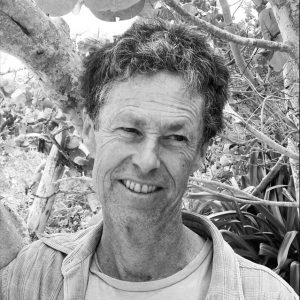
Kevin Frank
I find I’m a person of strong doubt. Doubt is an unrelenting taskmaster, but it can lead to innovation. I tend to doubt the party line about why things work, at least until I can puzzle the story out. I was, from the start, skeptical of the Rolfing® Structural Integration (SI) ‘story’ – the part that tells us that our bodies are plastic because fascia is plastic, and that once you place things in order, the body says “thank you,” and stays that way. The work itself is fantastic; it helped (and continues to help) my body in many ways. It offered me an interesting career – no doubt there. The explanations, however, those words used to sell people on what we do, and why it works, felt simplistic; akin to a mutual agreement to believe in something that hadn’t been thought through deeply enough. What happens to our clients? If they like the work, and look different after a session, how do I know it isn’t mostly due to a placebo effect?
Rolfing practice, for me, has been a continuous question about what is really going on during sessions, because how much of what I tell clients is grounded in what I directly know and feel? Each part of my work as a Rolfer and Rolf Movement Practitioner includes the questions: “How do I know this works? Can I feel the mechanism prove itself in my body?” After this, the next important questions become, “How do I access this mechanism in me? What activates it, at any time, or any place? How can I bolster my clarity and faith, and speak only from fresh experience? Why shouldn’t anybody be able to access Dr. Rolf’s understanding in simple accessible ways?”
About the time that I became a Rolfer, I started to plant and tend a small orchard of apple trees. The trees became a leitmotif for the act of observing shape and growth. Much labor was needed to sustain them, and to actually bring a crop to fruition. With time, the trees became a place to climb, and for extended times, while perched here and there in the geometry of the branches, a place to feel the shape, mass, and support.
Four years after being certified, I continued to gnaw on the questions: What makes posture and movement plastic? How does change really occur? These questions got support from study with Hubert Godard, and the work known as tonic function. The orchard and the tonic function inquiry are now an interwoven story for me. When first introduced to it, the tonic function story made sense to me, and with the better story came a way to test Dr. Rolf’s premise in many different ways, and to feel it flower in the orchard.
A central feature of Dr. Rolf’s work, and also of tonic function, is the idea that when an educated body encounters demand, it lengthens – elongating rather than shortening, and continuing to act and feel longer and more spacious as demand increases. This is counterintuitive to what seems logical. Jeffrey Maitland found an ancient Greek word for this remarkable feeling – palintonus, a feeling of length occurring in two opposite directions. Another word for it is eccentricity, which means ‘away from the center’. Whatever the name, this useful quality is associated with an accompanying improvement in stability, security, and sense of well-being. The source of this elongation and increased stability is natural and normal. At the same time, it’s also natural and normal to acquire habits of effort that interrupt being able to lengthen.
Effort tends to produce compression and loss of space, described by the term concentricity. To undo patterns of effort, we learn ways to change the preparation to move or pre-movement. Is there clarity, though, that a pre-movement that produced a useful response in the past will be able to produce the same effect today?
Each day, as practitioners, as we prepare to practice Rolfing SI or teach Rolf Movement Integration, from where does our confidence derive? What provides fresh evidence? Is it possible to test the fundamental hypothesis so that even a person with deep doubt can work with a certain degree of assurance, being reassured that there is integrity in the work?
I first tested the hypothesis with simple things; while riding my bike, I imagined a feeling of two directions in my spine and the pedaling became easier; when chainsawing a tree for firewood, feeling the contact of my hands and feet and the volume inside and outside my trunk allowed my belly to soften and the saw to feel lighter. These beginnings led to a catalog of ways to illustrate that our work is legitimate. To notice the difference between concentricity and eccentricity is a question for what happens every day – lifting groceries from a car, carrying a child, vacuuming, raking leaves, or throwing a ball; any catalog is only as helpful as it draws upon one’s life.
The apple trees got taller and gained in girth. Each year a tree needs to be pruned, to remove some of the prolific new wood, so the tree stays healthy and produces good apples. The pruning is a nice analogy to Rolfing work – both are satisfying artistries. The more potent lesson, however, occurred as I was up in the tree, setting root with feet and elbows and knees, so there was stability; then I could use one or both hands to reach out with shears, to prune and shape. Sometimes I reached farther and farther and the stability had to grow in many dimensions to support that reach. There were moments that it all became a little bit dangerous.
One wishes to sustain the reaching and climbing and chopping, aloft, for several hours, in a manner that feeds the body; confirming that bodies like to lengthen if you feed them useful information, and that a body that lengthens again and again stays happier. Tree climbing and pruning is a set of motions and actions that engage both girdles, all extremities, and all planes of motion in the spine. One immediately feels the usefulness of a robust sense of ground and space and omnidirectional awareness. The value of feeling into surfaces and textures in contact with the hands and feet becomes obvious. The activity confirms the principles of Dr. Rolf’s legacy. Confirmation gets repeated; confirmation awakens and sustains faith – faith that what we practice and teach is real. A fresh sense of ‘this is real’, in a body, communicates itself to others.
There are many self-care ‘exercises’ that allow anyone to confirm their faith in Dr. Rolf’s work. I teach them every day. It’s especially useful to find ways that her work interweaves with life activities we love, and to learn the crucial elements of perception and orientation that underlie the ability to change from effort to elongation, from frustration to satisfaction.
Just before offering a lesson to a group of students, or to a client, I find it handy to draw on a personal experience that answers the question, “Does this stuff still work today?” I probably don’t run out to the tree for prep, but use what I have learned in the tree to refresh a detail of pre-movement, some coordinative element produced in slow motion, in my office.
An apple-tree story from another person’s backyard. Atop an apple tree in lower Bavaria, I toss apples from newfound perches. To my surprise, and then delight, I experience a quiet presence that shows up to help: a mysterious movement guy below me, catching apples with one, and then both hands, each hand independent, each movement mindless and easy. One senses broad orientation to the open space – an autumn field of trees and grass and sky – an absence of focus on where the apples are – yet each one ends up in those hands.
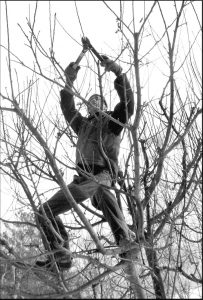 Kevin Frank is Certified Advanced Rolfer and Rolf Movement Instructor. Kevin’s teaching and private practice are informed by study with Hubert Godard, Continuum Movement with Emilie Conrad and Susan Harper, and practice in Zen and Meditative Inquiry. Kevin lives and works on land in rural New Hampshire.