
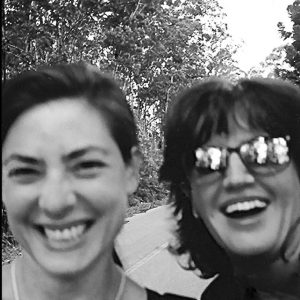
Heidi and Lena during their Rolfing training in Brazil, 1994.
Heidi Massa: Lena, you’ve been practicing Rolfing® Structural Integration (SI) for more than twenty years, right?
Maria Helena Orlando: Yes, after finishing my Basic Training in 1994, I got my Rolf Movement certification in 1998 and completed the Advanced Training in 1999. Then, in 2010 I completed a postgraduate program for Rolfers here in Brazil. Developed as a partnership between the University and the Brazilian Rolfing Association (ABR), it requires taking courses in research theory and methods at São Paulo’s Universitário UniÍtalo; designing and executing a research project using the case-study method; and publishing the results.1 The subject of my research was Rolfing SI as an agent of integration among posture, behavior, and quality of life.
HM: Besides your clinical practice in São Paulo, you’ve given years of service to the Rolfing community, both in Brazil and to the international organization.. Tell us a little about that.
MHO: I was president of the ABR, from 2003 through 2011. During that time, we met many challenges. We developed a modular format for the Basic Training; implemented a proper financial control system; created the Universitário UniÍtalo postgraduate program; and moved the organization to a headquarters well-suited to the conduct of trainings and workshops. During that time, our number grew from only about eighty Certified Rolfers to nearly 140. And, from 2006 through 2014, I served as the international representative on the Rolf Institute® Board of Directors.
HM: Is there a key insight that your years of Rolfing practice and service to the Rolfing community has brought you?
MHO: In these twenty-two years I’ve been a Rolfer, I’ve always worked toward bringing more knowledge to my practice and expanding the possibilities for assisting my clients. All of this has been an apprenticeship, both professionally and personally, that has enriched my understanding of the complexity of the human experience in all its aspects. This is fundamental: we treat the person as a whole – not just the person’s physical aspect.
HM: You’ve established a second professional practice as a music therapist. What led you to add music therapy to your professional repertoire?
MHO: Music has always been a big part of my life. I play acoustic guitar and piano, and I love to sing. In my ongoing search for greater knowledge and deeper experience of the human condition, music therapy was one way to expand my horizon.
HM: What did your training involve?
MHO: I studied the Benenzon Method, recognized internationally as one of the five most important schools of music therapy. Its approach is interdisciplinary, bringing in concepts from philosophy, science, art, and literature. The confluence of ideas yields a complex system of theory and practice for how to use the nonverbal resources of the body, the vibrations, and music to establish a therapeutic bond between practitioner and client. Certain empirically based ideas are key – for example, that every person has a unique sonorous identity. The training covers both theory and practice, but the most difficult and richest challenge is to develop the skill of therapeutic listening as the main tool for accessing the client’s concerns. Because music therapy is almost entirely nonverbal, the interaction between the therapist and client takes place through sound. So – to attend to the client’s process and establish a dialogue, I have to tune in to the client completely by listening with my own body.
 Figure 1: A set of Tibetan singing bowls
HM: Isn’t it also true in your Rolfing practice that you need to sense the client with your whole body, and that much of the communication is nonverbal?
MHO: Sure, this is a point in common: metaphorically speaking, we ‘listen’ in any therapeutic practice. But it’s not that simple. With music therapy, because communication must be established on a nonverbal level, the therapist’s presence and ability to literally listen are essential to establishing the basic understanding between the practitioner and the client. The therapist is particularly tuned in to the perception of the sounds, silences, and rhythms that appear during the interaction with the client. Something as simple as a sigh or a prolonged silence can be an important signal as the session unfolds.
HM: These days, what does your musictherapy practice consist of?
MHO: During my training, I was introduced to an approach called Sound Massage, which was developed by the German Peter Hess. It immediately touched me and made quite an impression. Sound Massage uses metal bowls, called Tibetan singing bowls (see Figure 1), that emit pure and perfectly harmonious sounds. We place the bowls on the client’s body and get them to sing by gently tapping them. The sounds of the bowls have a calming effect on the body and spirit. Their gentle vibrations spread gradually through the body to promote relaxation, comfort, and security.

The bowls are made of a combination of twelve metals, chosen for their capacity to emit perfectly harmonious sounds in frequencies that have therapeutic effects. Generally speaking, I use as many as seven different bowls during a session. Because the bowls are positioned on the prone or supine client (see Figure 2), when we tap them gently, their vibrations are transmitted to the client’s body. Each size bowl emits a particular frequency that tends to be therapeutic for a specific body area. Bowls emitting lower frequencies are used below the diaphragm, and the one emitting the highest frequency is used for the head. And the Universal Bowl, which has the broadestspectrum frequency, can be used anywhere.
Figure 2: The bowls positioned on the body
HM: So the bowls have physical effects?
MHO: They do. Vibrations are a physical reality. They propagate through fluids (Figure 3), and they’re amplified by gasses or fluids under pressure. To experience this, just hold an inflated balloon in the presence of vibration and feel the amplified waves. Now imagine how connective tissue is a fluid matrix – and how the human body is a pressure vessel – and you get the idea. The vibrations help to release soft-tissue adhesions, so using the bowls during or along with Rolfing SI can be very efficient.

Figure 3: How a bowl’s vibration affects a fluid medium.
HM: Would you give us an example of using the singing bowls and conventional Rolfing protocols together?
MHO: For example, I used the bowls with a client suffering from non-specific lumbar pain. In several sessions, I worked on the lumbar fascia by placing bowls on both the lumbar area and the sacrum. I would tap a bowl, allowing its vibration to spread throughout the lumbar region – and at the same time do some manual myofascial release. This combination produced a release of the entire area, which reduced the client’s pain. I did not make entire sessions of this protocol, but applied it within the context of the client’s Rolfing sessions.
HM: Do you ever use the bowls to help the client manifest the Rolfing ‘Line’, or to give the sense of simultaneous lift and ground?
MHO: Yes. Often at the end of a Rolfing session, when the client is supine, I’ll place a low-frequency bowl near the feet and a high-frequency one near the head. To give a sense of the axial, I’ll tap first the one near the feet, and then the one by the head. This also works with the client standing: I put a low bowl on the ground and balance a high bowl over his head. Because, the sounds of the bowls are so integrative, they’re wellsuited to this Rolfing goal.
HM: Was your experience as a Rolfer an advantage in learning the music therapy?
MHO: For both practices, the practitioner’s therapeutic attitude is fundamental to the efficacy. With my experience as a Rolfer, I was already skilled as to how to approach the client therapeutically, which helped a lot. But as far as the approach, the two are completely distinct. My personal experience with music was just as important: nobody can practice music therapy without having musical sensibility in the first place – and that’s especially true for work with the singing bowls.
HM: How do your music therapy clients find you?
MHO: Usually they are already Rolfing clients, or else they are referred by my friends or professional colleagues.
HM: What kinds of client concerns do you find best addressed through music therapy, as opposed to SI?
MHO: The clients who benefit most from music therapy and Sound Massage have difficulty with anxiety, stress, and insomnia; and behavioral issues such as aggression, hyperactivity, and attention deficit.
HM: How do you decide which of your professional skills to use in working with a particular client?
MHO: I can get a sense of which approach would be most beneficial during the client’s initial interview. And, during the course of treatment, how things play out in the sessions indicates what approach would benefit the client.
HM: In terms of your ongoing personal and professional evolution, where do you go from here? What’s next for you?
MHO: Personal evolution is what I’m usually looking for when I choose a course of study, a therapy, or even a trip – and this shows in my work. As to what’s to come, I try not to have expectations or make big plans. After all, three years ago I hadn’t even thought of studying music therapy, much less had I considered working with Tibetan singing bowls, since I hadn’t even imagined that this kind of therapeutic approach existed. Recently, to cope with a personal loss, I’ve joined a singing therapy group where everything is just now unfolding.
The start of my work as a Rolfer brought quite a bit of stress: I was a businesswoman who decided to take a massage class without having any idea where it would lead me. I feel that life invites us, over and over, to take up various journeys and challenges. When we accept them with open hearts and minds, we’re certainly on an evolutionary path.

Maria Helena Orlando practices Rolfing SI and music therapy in São Paulo, Brazil. Her academic background includes business administration, and prior to becoming a Rolfer in 1994, she operated her own business. She was President of the Brazilian Rolfing Association from 2003 through 2011 and the international representative to the Rolf Institute® Board of Directors from 2006 through 2014.
Heidi Massa, a Brazil-trained Certified Advanced Rolfer and Rolf Movement Practitioner, has been guiding the somatic adventures of the discerning, the curious, and the brave since 1994. She has served on the Rolf Institute’s Ethics and Business Practices Committee for twenty years, and been an editor for this Journal since 2000. While Chicago is home to both her Rolfing and complex business litigation practices, as well as to her architectural and interior and landscape design interests, Heidi travels frequently to Colorado, where she maintains a fine pre-War home in impeccably original style, hikes in the mountains, and dances the tango.
Maria Helena Orlando
Endnotes
1. For a description of the UniÍtalo postgraduate program, which awards participants the equivalent of a master of science degree, see Pedro Prado’s article The Case Study Method: Scientific Exploration of Rolfing® SI in the Holistic Paradigm, appearing in Vol. 39, No. 2 of this Journal (December 2011) and reprinted in the 2012 IASI Yearbook. Abstracts of the research projects of individual participants, including Maria Helena Orlando, are available at the Ida P. Rolf Library of Structural Integration (www.iprlibrary.com or www.pedroprado.com.br)