


Owen Marcus
Being an emotionally intelligent man is not an oxymoron. Being behind the emotional curve is the fate of most men. We can’t seem to connect emotionally. We try our best, but so often fail at expressing what we feel. We leave interactions feeling incomplete and unable to articulate our experience to anyone. We go off to lead lives of quiet emotional desperation. Men who could understand and appreciate our destiny we don’t speak to; women who we can confide with can’t understand why it’s such a struggle.
I fell into developing my Masculine Emotional Intelligence (MEI) because my relationships were failing. I was smart enough to realize that I was the one consistent variable, so I started working on it. My first approach was to try to heal it all by myself like I healed my dyslexia, dyspraxia, and Asperger’s Syndrome. Sure, there were some things I healed, such as my PTSD state when I spoke to women.
But the more I tried to do the guy thing, ‘fix it’, the more frustrated I became. Gradually I realized that my problem wasn’t a problem, it was a lack of modeling and teaching. Unlike my mental ‘problems’, with this challenge it was important to recognize that I had companions. I realized other men struggled with emotions and connecting, too. As men we all share not being taught what works for men. Once men begin to connect with other men, they realize that how they feel, express, and connect can be different than how woman do. A woman will appreciate a man’s unique orientation to emotions when she encounters a man who is connected to his MEI.
Twenty years ago, I went to my first men’s group, frightened that I would have to show up vulnerable. My expectation was correct, but I wasn’t alone. Every man had fear about being vulnerable and authentic.
Ten years ago, I took the traditional model of men’s groups and reinvented it. I created a format where the focus wasn’t on doing any particular technique, it was on taking men deeper into their own experience. I created a few processes that facilitate going deep; where it’s more about applying a series of skills than a formulaic technique. Quickly men learned how to be present. They learned how to ask questions that weren’t about what was going on in their heads rather than their hearts or bodies. They learned to focus on just being rather than fixing.
After watching a couple hundred men go through our free groups, having a documentary film made about us (About Men; see http://freetowin.co/men-film/), and starting a business teaching other men how to start and lead their own free groups, we figured out how to teach MEI.
Key Observations
Ever since we left the format of the tribe 10,000 years ago, how boys were trained to experience and express emotions changed. Two hundred years ago, when we left the farm for the factory, men lost male modeling and teaching. With the fathers away at work, mothers became virtual single parents raising the kids. Gradually, what it is to be a man emotionally skewed toward a feminine perspective.1
For generations, our emotional instructors were our mothers, female teachers, female counselors, and female partners. No, this is not a conspiracy. It’s women and men doing what they had to do. We never stepped back to look at the impact this has had on men. With 90% of the therapists being trained today being women, the traditional institutions are not changing the paradigm.
What We Can Do
First we need to understand that how a man experiences and expresses an emotion may be different than how a woman does it. As Alison Armstrong2 says, “A man is not a hairy woman who is misbehaving.” (For sure, we are more similar than different.) A man will shut down when asked what he is feeling. We know he’s feeling something, we suspect he’s not aware of what he is feeling – that’s probably true. How he frames that emotion may be different. When an expression is linked to weakness, even in a therapeutic situation, most men will not speak. If he is considering speaking, he’s translating it to fit the model he was taught. For example, we are taught not to raise our voices. For a man that can be like telling him not to speak. We accept a women crying; a man shouting scares us.
Without knowing it, his attempt to feel and share his emotion is like a woman’s. That is natural when women were his only models for emotional sensitivity and expression. He is certainly not going to ask a male friend for emotional guidance or support. He may ask his wife or a woman he knows.
We want our men to be emotionally present; we tell them how to behave. When they don’t behave the way we want, we correct them. Men might be emotionally illiterate under certain circumstance, but they aren’t dumb. Men will pick up that they did not perform well, if only unconsciously. With performance being important for men, our failure is another arrow in our backs. After a while, men give up.
I’m not saying women are to blame or that men are innocent victims. Again, it’s the culture we inherited. Supporting men to learn what they never got to learn is the most powerful and freeing support for all involved. When women aren’t around, and men interact more honestly with other men, they start modeling and getting cues from someone other than a woman.
Men need to express with their bodies. As Rolfers we all know too well how bound up men’s bodies are. In spite of that, men express with their bodies. We take action. Trained not to sit and emote, we become an emotional ADHD man when we try to do it the way we were taught. One way we can support men is to encourage our male clients to find ways to move their emotional energy through their bodies. We have all seen the bound-up athletes. I’m not talking about using exercise as an escape.
I’m suggesting getting the man to go for walks in nature, take a yoga class, or take up a sport that is new to him that will cause him to use his body differently. Doing his normal activity will tend to reinforce his physical-emotional pattern. Taking up a new activity that is slower and in a different setting fosters more awareness and new movement patterns.
Men run from therapy. So many men feel ganged up on by a female therapist. Even male therapists intimidate men. Men don’t like to do things that we can’t win at. Feeling handicapped emotionally, we see therapy as another loss in the emotional game. It’s a crisis that gets a man to see a therapist. If the therapist is good and the man brave, huge things can come from it. Seeing therapy as the only solution can shame and trap many men.
Framing their emotions as stress and a physiological phenomenon usually gives the man a frame he can use. Explaining to him how his body and his emotions might be having a mini-PTSD experience tells him that his mind is not screwed up. It’s his body doing what all bodies do under stress.
Traits of Masculine Emotional Intelligence
From observing men, and feeling the need to create a new model that works for men, I created the five MQ (Masculine Quotient) Traits.(3) Briefly, these are the key aspects of the five traits:
1. Emotional entrepreneur – orientation towards action
• The ability to initiate
• Willingness to take responsible risks to succeed
• Feel and express as you act
• Your actions come from your deep purpose
• Take a stand that is bigger than you
• Dance with chaos
2. Having a person’s back
• Love through the action of taking risks for another
• Taking a stand with another person or for another person
• “It’s not that others have your back, it’s that you have theirs.”
• Honor is love for a man
• Having the ‘back’ of a relationship (being willing to fight for relationship success)
3. Deep purpose
• Having a mission in life
• Living beyond self
• Allowing your unique creativity to manifest
• Serving through your purpose
• Living your own life
• Following deep desire(s) that give you deep pleasure
• Passion follows purpose
4. Holding space
• Supporting others no matter what’s occurring in your own life
• Standing for what is best for another
• Speaking and hearing the truth
• Holding space for your deepest purpose
• Providing and serving emotionally
• Keeping healthy boundaries, saying “No” and backing it up
• Creating a container for the relationship
• Fostering community and brotherhood
5. Assertive vulnerability
• Emotional expression with strength in vulnerability
• In the face of fear
• The openness of vulnerability with the strength of commitment
• Expressing while holding the space for yourself and others
• Leading with your vulnerability
• Not collapsing
• Risking with vulnerability the expression of emotions and wants for something bigger
What Men Get
We all know the biggest catalyst for men to look at changing is a relationship. We get men coming to our men’s groups and trainings because their partners sent them. In most cases, men are stepping up because they see the need to grow. We come to this scared; performing in an emotional arena was not where we exceled.
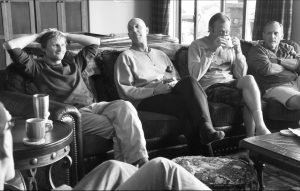
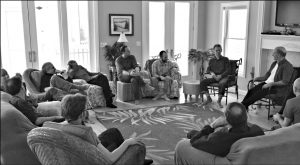
Once a man joins one of our free groups, he quickly sees an entirely new model of communication occurring with the men in the group. Men are vulnerable and real. They aren’t speaking some new age gobbledygook – they are speaking directly about what they feel. He immediately experiences the brotherhood of the group. Men are intimate in a way only men can be. It’s obvious men care for each other in a real way. They are kind, but honest. A man may get mad at another man, but he doesn’t attack the man, he simply speaks about his own feelings.
Quickly a new man realizes that a man is honored for taking emotional risk in and out of the group. A man who never expressed his anger and gets angry at a man in the group is encouraged to express. Years of repression come out. Not only is the release of that pent-up tension significant, seeing that he is not shamed for his anger is a substantial reframe.
The skills a man first sees then practices in the group rapidly transfer to his relationships. He finds himself communicating to his wife or partner in ways he never imagined. When she is upset, he listens rather than checking out or attacking. Through having a safe place to feel and express in the group, a man learns what he was never taught. He starts having deep conversations with his kids. Rather than just passing by them as he leaves the house, he sits down and asks them about their lives.
Ever since women started being the sole teachers of boys and men, women became the responsible party for emotional communication and the relationship itself. With men only being trained by women, we default to their expertise. Because this also gradually escalated over the years, women don’t feel the full impact of being the one responsible. Women I don’t know will come up to me on the street to thank me for what the group did for their partners. They speak about how they changed, how they fell back in love. These women often mention how their relationships are no longer so much work. After centuries of women getting used to a certain role, when a woman doesn’t have to do all the work, it’s like living in a new country where life is easier.
Offering Resources
When you see a man struggling, suggest he find a men’s group or start one. A good group will give him a place to release, learn, and grow that won’t strain his relationships. One of the benefits of the group is that for the most part, their relationships are in the group. They don’t sleep with or work with their fellow group members.
One of my reasons for starting a men’s group was to offer my male clients support for their Rolfing changes. I know of other health-care practitioners, including therapists, who use a men’s group to support their clients. It makes their work easier.
By providing a new model for men for their emotions, we allow men to relax into feeling and expressing their emotions, something few men would claim proficiency in doing. Supporting men to join a men’s group organically teaches men this new model while providing a place for them to practice. For us as Rolfers, a group can serve the social and emotional needs of our clients in ways we can’t in a session. For some men, relating to a female Rolfer is exactly what they need. For others, they need to develop an ability to relate to men. Like many female psychotherapists, a female Rolfer can encourage a man to participate in a men’s group (see Resources, below) to provide the masculine support he needs.
The emotional changes Rolfing SI produces go a long way to having men be emotionally literate. Breaking up the old emotional structure and models puts a man on the road to being his own man. Giving him other men to help teach him what he never was taught will escalate his progress. No longer will Masculine Emotional Intelligence be an oxymoron.
Owen Marcus, MA, founded the Sandpoint Men’s Group and the nonprofit Men Corps. He trains men around the world on how to start and lead a group through his company Free to Win. His blog www.owenmarcus.com offers free resources for men
Resources
If you or a client have any questions, please contact me. I would be glad to direct you or him towards the best resources. Below I list some you can consider.
• I am working on a free Google map at www.freetowin.co/mens-groups-2 where a man can insert his zip code to find a group near him.
• The nonprofit ManKind Project® has a network of groups: www.mkp.org.
• We started a nonprofit that gives a free set of protocols to men for starting a group: www.mencorps.org. • We also have more services available at www.freetowin.co for starting a group.
Endnotes
1. I explain this in my TEDx talk, “What 10,000 Years of Progress Cost Men” (see http://tinyurl.com/OwenMarcusTEDx).
2. See http://understandmen.com.
3. Visit www.mqtest.org for an MQ Test where you are scored on your Masculine Quotient and given a book on how to raise the score.
 Masculine Emotional Intelligence[:]