

From Michael Murphy: I first met Jim Oschman at a Rolf Institute® annual meeting in the 1970s. I met him again at several symposia on the science of Rolfing® Structural Integration (SI), held at 302 Pearl Street in Boulder, Colorado. Later, he and I collaborated to design a curriculum to introduce basic science concepts into a class that we would teach at the Rolf Institute, instead of asking prospective candidates to study that science elsewhere. By now, our relationship has developed into a friendship. In the following interview, Jim shares his perspective on the science relating to the work of Rolfing SI, and how to think about energy work in the context of Rolfing SI.
Michael Murphy: I wanted to start this interview by telling you that this issue of the Journal has the prevailing theme of energy and other subtle aspects of our work.
Jim Oschman: Good.
MM: I thought I would begin by trying to get your definition of what energy work means. What is it for those of us that are in the business of putting our hands on people’s bodies? How do you understand what we’re doing with respect to energy work?
JO: Let me give you an example; I was just thinking about this. Rolfers™ have told me stories about observations they’ve
made, and I looked to see if there was any science that fit with their stories. Some of their stories were totally astounding, but I found science that fit with them, and here’s an example.
Rolfers have told me that sometimes when they begin to work with a client, the tissue begins to move before they touch it. In the ordinary mechanistic way of thinking of things, that’s kind of ridiculous. Then I came across Toyoichi Tanaka, and his article (1981) in Scientific American on gels. Gels are a major part of connective tissue, and are probably what hardens up to make the dense places that Rolfing SI is able to melt. What Tanaka described was how gels can be at the critical point such that a tiny amount of energy, a temperature change or magnetic field, a very slight input of energy, can cause a gel to change its consistency, and go through a phase change. I thought well, maybe that’s an explanation for what’s going on. Maybe the work that had been done in the past prepared the tissue so that as a Rolfer approached it, it was at a critical stage in terms of its gel-sol relationship, and the warmth of a hand or magnetic field from a physical body took it over the edge, and it went from more solid to fluid-like.
That was interesting to me, and I talked about that years and years ago. That’s energetic; that’s energy medicine. It’s an energetic relationship. More recently, there are other factors that play into this that may be even more profound. Specifically, there’s the work of Martin Pall, a biochemist from Washington State University. He has discovered something really profound that I think is the most important discovery relating to energetics in a very long time. He has simultaneously solved two big problems. One is the problem of how a tiny amount of energy from a hand could actually affect a cell in a client’s body without physical contact. How can subtle energy therapies possibly produce effects on cells? An important source of information on this topic is an article (McCraty et al. 1998) from the HeartMath® Institute. They showed that your cardiogram entrains with your client’s brain wave even when your hand is eighteen inches away from his body.
At the same time, Pall solved another problem, which is why do some people feel awful when driving under a power line or driving past a cell phone tower; why does just being in the presence of cell phones or Wi-Fi cause some people to get sick in the presence of very tiny fields coming from our technologies? Those are two important problems, and Pall found the answer. I think he made a classic scientific statement when he said that the answer was lying in plain sight in the scientific literature, but no one had taken the time and trouble to put the pieces together. He put the pieces together and explained it by stating that all cells have what are called voltage-gated calcium channels on their surfaces. Calcium channels regulate everything that a cell does. Cells have lots of different activities they can do, and they’re switched on and off via calcium channels.
Pall’s literature search documented many examples of the effects of an extremely small electromagnetic field, a tiny, tiny, field, the kind of field you would get when you were a mile away from a cell phone tower or when your cells are six inches or a foot away from a Rolfer’s hands. Very weak fields can activate these calcium channels and the effects are almost instantaneous. He has created a model that explains very subtle energetic influences; from the energy medicine standpoint, these influences begin to take place as soon as your client enters the room, even so far as when you begin to talk to him on the phone to set up the appointment.
MM: Is he researching energy medicines of one kind or another?
JO: No, this is speaking to pure physiology and biophysics. It’s what I’ve been looking for in my investigations of energy therapies. I’m interested in all of them; in Reiki, Therapeutic Touch®, Healing Touch Program™, Polarity Therapy, and craniosacral work. I got started on this quest when I discovered that in order to understand Rolfing SI, I had to understand everything, because Dr. Rolf, in her work, produced an amalgamation of many different approaches. There was no approach to therapeutics that was off limits to her. I’ve found it to be very interesting, and the scope of my work has made my investigations of interest to virtually every branch of therapeutics. I give lectures and workshops for just about every school of complementary and alternative medicine.
MM: How did you happen to meet Ida Rolf in the first place?
JO: It was Jason Mixter who introduced me to Dr. Rolf. He did my last three Rolfing sessions in Woods Hole, Massachusetts, where we were both living at the time. My first seven sessions were with Peter Melchior. Jason was taking the Advanced Training, which was Ida’s last advanced class, conducted at Robert Toporek’s home in Philadelphia. Jason invited me to come to meet Dr. Rolf and give a talk. That’s when I met Ida, and a number of other Rolfers who have been my friends ever since. Shaking hands with Ida Rolf was such a remarkable experience that I wrote an article about it for the celebration of the hundredth anniversary of her birth in 1996 (Oschman, J.L., 1997). The Philadelphia class took place toward the end of the 1970s, maybe a year or two before she died.
MM: Had you been interested in various forms of bodywork prior to that, or did being exposed to Jason and to Ida really start your interest?
JO: It was actually being exposed to Peter Melchior that got me started. He gave me my first seven sessions of Rolfing SI, and he talked to me the whole time. I wish I had a tape recording of all the fascinating things he said. He talked about energy. The stuff that he talked about was scientific material that I had never been exposed to in twenty years of being overeducated at the university. I had never heard of Harold Saxton Burr, for example, whose work was very important. I was curious about what Western medicine thinks about energetics and why they don’t talk about it. Because physics is not taught in medical schools, energy is very confusing to most physicians, which is a huge problem. I discovered, after many years of inquiry, that Western medical science, or biomedical science, simply doesn’t think about energy. There is no opinion about energy except that it’s ‘woo-woo’, which it is not.
MM: Have you experienced isolation in the scientific community because of your interest in these topics?
JO: No, I don’t experience any isolation. I speak to the choir; I speak to people who are very interested. I don’t get any rotten vegetables thrown at me. I have given talks at medical schools. For example, I did grand rounds at a hospital in New Haven, Connecticut. I had an auditorium full of doctors, and the only feedback I got afterwards was that various doctors were mumbling, “Well, I’d like to see more research on that.” Well, of course. I would like to see more research on that, too! Until the advent of the National Center for Complementary and Alternative Medicine (NCCAM), recently re-named as the National Center for Complementary and Integrative Health, there was little financial support for research on alternative medicine. What I discovered, however, is that there is actually a lot of fundamental research that has been done on energetics in the fields of biology, physics, and biophysics. This is the research I talk about and write about in my books and articles.
The research that’s being sponsored by the National Institutes of Health (NIH) is somewhat interesting, but there is still a negative bias towards energetics. It was expressed, for example, in an article by an unnamed author, which was posted on the NCCAM web page, contrasting so-called “veritable” energy with “putative” energy. Veritable energy was described as mechanical vibrations (such as sound), and electromagnetic forces, including visible light, magnetism, monochromatic radiation, and rays from other parts of the electromagnetic spectrum. A quote: “They involve the use of specific, measurable wavelengths and frequencies to treat patients.”
“Putative” energy was described as alleged “energy fields” that human beings are supposedly infused with. A quote: “This is what practitioners of Reiki, Therapeutic Touch, yoga and others purport to be manipulating.” This statement is out of date and ridiculous. Biofields are alleged to be putative: that is simply false. Biofields have been measured around the human body since the 1970s, using sensitive magnetometers. Biofields are alive and well, and were the subject of an extensive multi-authored review (Hammerschlag et al. 2015). To say that biofields are unmeasurable is completely incorrect, misleading, and a little bit annoying, to say the least.
MM: That’s a kind of isolation; sort of an intellectual isolation or an institutional isolation. It sounds like you’ve been busy yourself.
JO: I have met physicians, for example, who give a copy of my book on energy medicine (Oschman 2000/2016) to every patient because they believe energy medicine is important and they want their clientele to know about it. There are, of course, other physicians who run to the nearest fire escape at the mere mention of energy medicine. What’s changed all of this is the popularity of Reiki. In New England, Reiki is used in hospitals and rehabilitation facilities. Hospitals are in competition for patients, so once a hospital offers Reiki and people like it, the other hospitals have to offer Reiki, as well. For example, I went to a local rehab center and there was the social worker standing behind one of the patients, holding her hands above the patient’s head, not touching, offering Reiki to a patient who had been agitated. The Reiki work calmed the person down very nicely. That kind of thing shows a shift in consciousness.
One of the doctors in the local hospital here in Dover, New Hampshire, actually asked me about Reiki. When you go for surgery, the surgeon will give you a little pamphlet offering Reiki. What this doctor noticed was when patients had Reiki before and after surgery, they needed fewer pain medications in the recovery room. The doctor was impressed, and he thought it would be interesting to do a study. Whether they actually did such a study, I don’t know, but that is a common observation. That’s energy from the hands. Sometimes touching, but not always.
My local massage therapist, Tina Michaud- Gray (www.healingnh.com), is an expert in energy medicine and has developed her own unique practice. She uses a combination of energy techniques, including grounding or Earthing, on patients before and after surgery. She calls this work The Rapid Recovery System. Patients experience far less pain and extremely rapid recovery after surgery.
MM: If Rolfers were wanting to deepen their study in this area, do you have a suggestion about ways they could proceed?
JO: First of all, they need to know that they’re already doing it, whether they know about it or not, and they can pay attention to and discuss among themselves the energetics that are going on all the time. They could read my books and articles on energy medicine that were inspired by my interactions with Rolfers over the years. Many of the articles were published in Rolf Lines and in Guild News. They could take an introductory class in any of a number of energy medicine therapies that are available all over the country, all over the world, actually. I can rattle off the names. They could take Healing Touch, Therapeutic Touch, Reiki, Polarity Therapy, or Zero Balancing®. I find BodyTalk to be very interesting. There are a lot of energy-based therapies, schools that offer introductory courses, and by the end of a day or a weekend, you’re doing it. I think that Rolfers would do very well to become familiar with this kind of work, for they would pick it up right away. It’s already in their systems; it’s already in their hands.
A valuable resource is the International Society for the Study of Subtle Energies and Energy Medicine (ISSSEEM). I joined this organization the moment I heard about it because of its goal of bridging science and spirit. For many years they have published a peer-reviewed scholarly journal, Subtle Energies and Energy Medicine, and an archive of the complete twenty-one years of publication, volumes 1-21, is available on the web for free (http://journals.sfu.ca/ seemj/index.php/seemj). This is a very rich source of information on energy medicine.
MM: I read the articles that you forwarded. I was particularly interested in that study about the shape of the human heart and speculation about how the physical shape and the fibers in it could contribute to a sense of core (Oschman and Oschman 1998 Apr; Oschman and Oschman 2015). I know Ida Rolf used this image of core and sleeve, and you were sort of hinting that that core could be aided and abetted by the physical contours of the human heart. I wonder if you have any more to say about that.
JO: My wife, Nora, and I have recently published a couple of papers on the heart. One of them is highly relevant. It describes the heart as a bi-directional scalar field antenna (Oschman and Oschman 2015). It has been very interesting to scientists; we’ve gotten a lot of good feedback. In fact, I’ve been invited to write another paper for the same journal, because of the positive comments. I have been collaborating with some cardiologists from Spain. You mentioned at the beginning of this interview about “subtle aspects of Rolfing SI” and this paper discusses scalar fields, which are the basis for the so-called ‘subtle energies’ discussed in many branches of alternative medicine.
MM: There was reference made to a Spanish cardiologist, who is now deceased.
JO: Yes. The group I am working with has continued his work; his name was Francisco Torrent-Guasp. I have an interesting story about how I connected with him. I was looking at the section on the heart in the 35th edition of Gray’s Anatomy, edited by Peter Williams and Roger Warwick, and came across a reference to a paper Dr. Torrent-Guasp had written with the title “The Electric Circulation.” This seemed highly relevant – just what I was looking for. I asked the interlibrary-loan librarian at Woods Hole if she could get a copy of that article for me. After a month, she came to me and said that the article did not exist anywhere in the U.S., and she suggested that I write to the editors of Gray’s Anatomy and ask them if they had a copy. I wrote to Professor Warwick at Guy’s Hospital Medical School, University of London, and he responded that because Dr. Torrent- Guasp came to London from time to time, they had met, and that he could vouch that Dr. Torrent-Guasp would be happy to communicate about his work. He provided the doctor’s address, which was in Denia, Alicante, Spain. Anote to Dr. Torrent-Guasp led to an enthusiastic response consisting of a collection of reprints, some in English, and some in Spanish. On the reprint of his electrical circulation article, he had written an effusive note expressing profound appreciation for interest in his work.
Dr. Torrent-Guasp also sent me a silicone- rubber model of the helical heart. This model was developed by Torrent- Guasp, Whimster, and Redmann in 1997. Dr. Torrent-Guasp had unraveled the ‘Gordian Knot’ that had been a profound mystery of heart anatomy for almost five centuries. The myocardium had traditionally been viewed as having a more or less homogenous morphology. This assumption dates to the seventeenth century, when physician William Harvey described the circulatory system. His simplistic anatomical perspective, which is widely accepted to this day, was that the heart is a single homogenous muscle. The ventricles, however, had long posed profound mysteries, and were referred to in 1864 by the well-known British professor of anatomy, James Bell Pettigrew, as a Gordian Knot, a term that is often used as a metaphor for an intractable problem (as disentangling a ‘hopelessly impossible’ knot in a rope). After some years of meticulous research, Professor Torrent-Guasp untangled the ventricular knot for the first time, discovering that the 3D configuration of the ventricles is a double helix, known as the helical ventricular myocardial band (HVMB). This, his main discovery, was revealed through a blunt dissection of the heart. A video on the Internet shows Dr. Torrent-Guasp performing the dissection and unrolling the myocardial band (http://tinyurl.com/ the-helical-heart). I have since learned that it took him fifty years of work to be able to demonstrate this simple dissection.
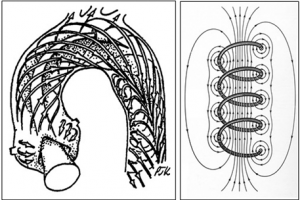
His discovery has been confirmed, and has led us (the people who continued his work and myself) to reconsider the significance of the T wave in the electrocardiogram (Ballester-Rodés et al. 2016). I got to say in that paper something I’ve always wanted to say in print. I’ve always been impressed with the evidence that the blood spirals through the aortic arch. I’ve always felt that that was very interesting and important because the heart produces electricity. That is the electricity that gives rise to the electrocardiogram. What’s interesting about the aortic arch is that the conductor of the electricity produced, which is the blood, is moving helically (Figure 1). The helix, in electric engineering terms, is a solenoid. It’s a device that greatly increases the strength of a field. A straight wire will have a magnetic field around it (this is due to a fundamental law of physics known as Ampère’s law). A coil of wire will have a much bigger field around it, especially if it has a conductive core inside.
It seemed that blood and electrical flow through the aortic arch should give rise to a large field. There are the arteries, also, which have spiral grooves in their walls (these grooves disappear on death, so we only know about them from fiber-optic examination of arterial walls in living patients). The descending aorta and the veins, e.g. the ascending vena cava, are all electrical conductors. The phenomenon of ‘core’ might have energetic, electronic, electrical aspects by virtue of the electricity going up and down, with each heartbeat, through those conductors, which are right in front of the spine. They’re in the perfect place to make a magnetic core. This fits with ancient teachings of Oriental medicine. There’s a very important energetic source, which has been seen between the kidneys, described in the ancient texts from thousands of years ago: it is called “the rising qi between the kidneys” (Oschman and Oschman 1998 Apr). What could this be? The aorta and the vena cava are positioned between the kidneys, and perhaps the core experience by Rolfers may be the same core that is referred to in Oriental medicine. Different terminology, but what we look for is the same thing, and I’m very interested in the ancient philosophies, the ancient traditions, traditional medicines, and what they have to teach us; how they link to modern biomedicine. I’m interested in anything that will teach us more about the human body.
These stories about the helical heart and the helical properties of the fabric of space were part of a thirty-year adventure with the science of spirals. I wrote up the story as a foreword for a fun little book entitled Spiral Up! 127 Energizing Options to be Your Best Right Now, by Chloe Faith Wordsworth. The adventure began when I was auditing a Rolfing class taught by Peter Melchior and Jan Sultan. One day, Jan called me over to look at one of the models in the class, who was lying on a Rolfing table. Jan drew my attention to the top of the model’s head and pointed to the spiral in his hair. What he said next was absolutely astonishing to me: “Everyone has a spiral like that on the top of their head, and it continues all the way down through their body.” This was a completely new concept for me, and I was fascinated. What could this mean? This was the beginning of a lifelong study that continues to this day, and that made me want to digest and share Chloe’s book. In the foreword for her book, I traced the steps in my adventure that began with Jan’s comment, and ended with the conclusion that the spiral has profound energetic significance because of the way it deals with the intersection of forces.
One of the steps along the way was the discovery of the importance of the vortex in the martial arts. One of the methods of Aikido is called tenkan, described as the force of the tornado or cyclone. The master is in the center of a vortex and attackers are flung around the edges of this cyclonic force. You can see a demonstration of this, and other techniques, in a rare 1935 film of the founder of Aikido, Morihei Ueshiba (‘O-Sensei’; see http://tinyurl.com/p69s2oo). During a short section near the end of the film you can see the master attacked by seven strong men. They do not appear to be able to touch the master, and all of them quickly end up on the floor of the dojo. Another video (http://tinyurl.com/lsogwy5) from some years later shows him again attacked by a group of strong fighters, and they quickly end up on the floor of the dojo. O-Sensei announces that, “Spiritually there are no strangers or borders. Everything is part of the same family. The aim of Aiki is to banish fighting, warfare and violence.”
Jason Mixter got excited when we had our natural science meeting at the Rolf Institute many years ago. Were you at that gathering?
MM: There were several and I was at several of them.
JO: One of the things that made Jason very happy was when he interviewed me and I said, “I’m not coming here to teach you about science. I’m coming to learn from you to teach science about a new way of looking at the human body.” Jason liked that. The whole story is summed up in my favorite quote from an acupuncturist in Lexington, Massachusetts, Kerry Weinstein: “There’s this method and that method and this medicine and that medicine and then there’s the way the body really is.” I’m really interested in the way the body really works. The phenomena that take place in Rolfing sessions can teach us some things that medicine, Western biomedicine, needs to know if they’re willing to listen. Biomedicine has only a rudimentary understanding of ‘human structure’. Rolfing SI has a great deal to say about structure.
MM: Another of the articles I read over the weekend talked about the phenomena of ‘lift’. I know that’s been a puzzle for Rolfers for years. We do our work and suddenly the body seems to have a rising something or energetic lift up, a physical lift, a biomechanical lift. Many of us have been trying to explain it with negative pressure gradients and this area’s lower pressure than that area. I just sort of wondered what your current take on the notion of lift is in the human organism.
JO: I have experienced that lift, so I know that it’s there. I wrote two articles about lift (Oschman and Oschman 1998 Winter; Oschman and Oschman 1998 Apr). I made a suggestion or hypothesis about it, and it arose from work that I did with a scientist at Woods Hole many years ago. His name was Ray Stevens, and he was studying what he called levity. His project was called “the Levity project.” He was interested in levitation. One of the dictionary definitions for levity is “unseemly jocularity.” I got the book Levitation by Steve Richards, which has an appendix listing “Forty Levitated Persons, Canonized or Beatified.” The list was first compiled and published by Sir William Crookes in the Quarterly Journal of Science in February 1875. Over the years many individuals have been beatified by the Catholic Church because they levitated. One of them was a little friar in a little cathedral in Italy. He would kneel down before the altar and he’d just go up. Right up off the floor. The Pope came and saw him do that. That was verification from a pretty reliable source. When a room full of people suddenly levitates and everyone starts floating around, it is hilariously funny – unseemly jocularity sets in!
What Ray Stevens had discovered, what we were working on together, was an idea about how spin can take away inertia. It is not anti-gravity. It is a phenomenon that takes away inertia. It’s not making gravity go away, but if you take away inertia, you can become very light. In those two articles of mine on gravity, lift, and inertia, I suggested that the spin of the water molecules in the blood as it’s going through the aorta and vena cava can give rise to what my friend referred to as a levity field. This has never been confirmed, never been researched any further. But it made sense in a lot of ways.
This may seem kind of ‘far out’, and I haven’t written this up, but one of the places it shows up, believe it or not, is in the phenomena of flying saucers or unidentified flying objects (UFOs), which are able to accelerate extremely rapidly. People have actually observed what they call ‘flying saucers’ and they have been recorded on radar screens near airports. There is verification that they can travel extremely fast and that they can make right-angle turns at very high speed. They are described as having some spinning component inherent to them, either inside or around the rim. What makes you go through the windshield when you slam on the brakes of your car is inertia. Any beings inside of a flying saucer would be plastered up against the leading edge of the vehicle unless inertia was cancelled. Cancelling inertia would enable the object to accelerate very rapidly, to make right- angle bends at very high speed, and it would also take away the the inertia of the occupants so they wouldn’t get plastered up against the front end of the vehicle during a sharp turn. That’s a little bit of a speculative explanation, but there it is.
MM: How do you suspect that that would apply to Rolfers and their work? Do you see a link? A levity connection? As long as we’re out here speculating, let’s go a little farther. Can you induce levity in another human being?
JO: There’s another aspect to it that I didn’t mention, which is intimately related to Rolfing SI. This is the core musculature and the ligaments associated with the spine, including the erector spinae, for example. Rolfing SI reorganizes this vertical system. It is the system that Tom Myers refers to as the spiral line. For a number of years, I taught the Comprehensive Studies course with Tom. Both of us were fascinated with spirals. Eventually, Tom wrote his famous book, Anatomy Trains, that is used as the text in anatomy classes for bodyworkers and movement therapists around the world. In it, he describes the spiral line that is a part of the head-to-foot system we are talking about. Tom acknowledges me for giving him a key article by a famous anthropologist, Raymond A. Dart MD, of the University of the Witwatersrand in Johannesburg, South Africa, where Dart was Dean of the medical school. In his DVD, Anatomy Trains Revealed, Tom said, “I thank Dart for the inspiration and Oschman for pointing his finger in the right direction, but the progressive development of the Anatomy Trains system involved a lot more perspiration, including the work of demonstrating the reality of the myofascial lines through dissection . . . .” I, in turn, must acknowledge Peter Levine as the person who originally gave the Dart article to me.
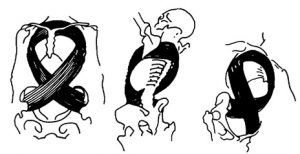
Myers (2009, 131) writes, “The spiral line loops around the body in a double helix, joining each side of the skull across the upper back to the opposite shoulder, and then around the ribs to cross in front at the level of the navel to the same hip. From the hip, the spiral line passes like a ‘jump rope’ along the anterolateral thigh and shin to the medial longitudinal arch, passing under the foot and running up the back and outside of the leg to the ischium and into the erector myofascial to end very close to where it started on the skull.”
One of the ideas is that as the spiral line becomes better organized in relation to the vertical, and more functional and connected to the psoas and so on, as that whole system becomes better organized, the core experience increases. Would you agree with that?
MM: Yes.
JO: The double-spiral arrangement described by Dart (Figure 2) is important in acupuncture theory, as is described by Yoshio Manaka (1995). For Manaka, as well as for myself, there was profound energetic significance to this system because of its analogy to a coil and a core, otherwise known as a solenoid as described above. Manaka viewed the place where the obliquus internus muscles attach to the anterior superior portions of the iliac spine as the location of the important acupuncturepointknownas Gall Bladder 29. He states that the continuous muscular band or ‘coil’ relates to the physico-electrical medium of the Yang Qiao Mia and probably the Yang Wei Mai as well. He is referring to the Extraordinary Vessel points, sometimes called ‘master points’ or ‘respectable points’ (descriptions dating to the Jin dynasty, 1115-1234 A.D.; Matsumoto and Birch 1988, 363-364).
Those erector spinae muscles run vertically, like the aorta and vena cava, and they will transmit electrical energy vertically up and down with each heartbeat. One of the ideas is that as those erectors get more functional and more oriented with the spinal cord and the cerebrospinal fluid and establish relationship with the double- spiral ventricles of the heart and blood vessels, the electrical flow through the system could increase and that could give you an experience of lift in this core system. It is conceivable that the new organization that arises from the Rolfing process enables a better energetic resonance between the double-helical heart, the double-spiral arrangement of the musculature, and the core musculature, which gives rise to the phenomenon of lift. There may also be a resonance between the double-helical heart and the double-helical DNA throughout the body.
One of the interesting things that Peter Melchior told me about was night walkers, people who go out and walk in the dark. They can’t see a thing. They are operating from their core. If there’s a rock, they step over it. If there’s a ditch, they jump over it or they avoid it. They can do this blindfolded. Even though they’re not seeing what’s in front of them, their bodies know what’s in front of them if they allow their movement to originate from their core, which senses the terrain ahead of them. The phenomenon may also be related to ‘blindsight’ as described by Weiskrantz (1986) – the ability of people who are cortically blind due to lesions in their primary visual cortex to respond to visual stimuli that they do not consciously see. Human subjects who had suffered damage to their visual cortices due to accidents or strokes can have partial or total blindness. In spite of this, when they were prompted they could ‘guess’ with above-average accuracy about the presence and details of objects, and they could even catch objects that were tossed at them. When asked how they are able to do this, the usual response is, “I guess.” These are bizarre phenomena, but they’re interesting. I look to them as possible evidence to explain things that are normally considered inexplicable.
MM: I keep hearing that the standard for scientific research has to do with repeatability. I’m suspecting you’re looking for a way to repeat those experiments; to find research projects that elucidate these rare phenomena and then repeat them.
JO: I don’t do that. There are people who do that. The gold standard for proof is the randomized controlled clinical trial. I think that is a disaster. The randomized controlled clinical trial was designed to test drugs. The phenomena that are most interesting in life are not drugs. What I’m interested in is explaining how things work. To me, a good explanation cuts through a lot of confusion. Your clients sometimes say, “Michael, how did you do that?” I want you to have a really good answer for how you did that, an answer that makes sense. I’m describing what may be going on in your work. Being able to provide a logical and understandable explanation is much more interesting and valuable to the average person than a randomized clinical trial, in my humble opinion. I find that explanations are extremely powerful. If you have insomnia, read the New England Journal of Medicine: it’ll put you right to sleep. People aren’t interested in that stuff. They don’t want to read statistical analyses of randomized clinical trials. An explanation of how something works is directly relevant to their life.
MM: I got it.
JO: I have fun. I think I have more fun than people who do randomized clinical trials. The big problem with those trials is that even with the best trials with the best statistical outcome, the information gets lost. I can give you an example. There was a very good study of homeopathy involving many, many, many patients with asthma. I think it was done in Costa Rica. It showed that the homeopathic remedies worked. The experimental design and statistics were impeccable. The study didn’t go anywhere because of the media. The media do not report things like that, or if they do, they twist the story. No matter how good your randomized clinical trial is, your work is not over until you make sure the media report it correctly, and usually they don’t. Why? The pharmaceutical industry spends a lot on advertising in newspapers and news magazines and so on. They take their news from an industry that actually has teams of people who are paid to debunk anything that comes along that doesn’t increase sales of pharmaceuticals.
MM: Oh yes.
JO: You’ve noticed that?
MM: I’ve also noticed the medical associations have professional debunkers. I’ve known a few.
JO: I’m reading a book, it’s called Arguing Science and it’s a dialogue on the future of science and spirit. It’s a dialogue between biologist Rupert Sheldrake and the skeptic Michael Shermer. Rupert Sheldrake has some extraordinary ideas about the origin of form in living things that many scientists get worked up about. They don’t like his ideas. I think they’re great ideas. The biggest unsolved mystery in biology is how Michael Murphy emerged from a single cell. It’s also highly relevant to Rolfing SI. Sheldrake’s model describes a morphogenetic field, the morphic field. This is the field that contains the information on how to make Michael Murphy. This field is present everywhere in space. Sheldrake proposes that living systems tap into information through an information field, which he calls the morphic field.
I like that idea. We do not really understand morphogenesis. Not only do I like Sheldrake’s idea, but I am also beginning to understand how space stores that information. That’s the first of the vortex articles (Oschman and Oschman 2015), describing the spiral grain of the universe. In my opinion, when there are no good explanations for a phenomenon, any idea, no matter how unusual, is better than no idea. It is a place to start.
I think that ultimate energetic healing is tapping into the morphic field to read the blueprint by which the organism was created in the first place. Rolfing SI has a great paradigm for this, of bringing forth the pattern in the body that is your birthright. That’s a beautiful statement. In a sense, that may be what all successful therapies do. What is that pattern and where does it come from? A good candidate is Rupert Sheldrake’s morphic field. It’s not DNA for sure. One quote about DNA, “The genes are not on top, they are on tap” (Strohman 1993). DNA contains information that is available to the organism as it forms, but it is not the director of the process.
MM: Is there anything else you had hoped we might talk about in this conversation that you haven’t had a chance to say yet?
JO: I’m pretty happy with the things we’ve talked about. I can certainly thank Peter Melchior and Jason Mixter and the Rolfers and Ida Rolf for giving me a career. I taught in what was called “the Pre-Training” and later became the Comprehensive Studies Program. We decided that there should be a piece to this introductory course on biophysics, which I taught for a number of years. I was trying to assemble the biophysics that seemed most relevant to Rolfing SI. It turned out that everybody who does therapy of any kind is very interested in this material. I took that material all over the world. I’ve been to twenty-five countries. I go to Europe all the time. It’s a tale that grows with the telling, as they say – that’s from The Hobbit. And I wrote books based on this information.
MM: I like it. Thank you for spending this time with me.
JO: One last thing: I was once asked by an expert on energy medicine, “What can I do to increase my compassion?” I said, “Increase the bandwidth of your heart.” I don’t know where that came from, but out it came, and he liked it and I liked it.
MM: All right. Now you have to come up with a ‘how’ – how you’re going to do that.
JO: I have a recommendation. Learn Heart Rhythm Meditation. It’s taught by Puran and Susanna Bair (2010) who founded the Institute for Applied Meditation on the Heart (iamHeart) and the IAM University of the Heart. Their book, Living from the Heart, was hailed as “one of the most important texts ever written on meditation.” People love this kind of meditation. It’s very different from Transcendental Meditation (TM). It involves paying attention to your heart and your breath. Amazing things happen. That’s a method of increasing the bandwidth of your heart radiations. There you go.
MM: There you go. Thank you very much.
James Oschman has a BS in biophysics and a PhD in biological sciences, both from the University of Pittsburgh. He is the author of numerous articles in scientific journals and the author of Energy Medicine: The Scientific Basis (2000/2016) and Energy Medicine in Therapeutics and Human Performance (2003). He lectures and teaches worldwide, is involved in the application of energy medicine to medical devices, and is the president of Nature’s Own Research Association in Dover, New Hampshire. At his website www.energyresearch.us you can find links to his books, videos, and various articles.
Michael Murphy has been practicing Rolfing SI since 1975, and has been a member of the Rolf Institute faculty since 1979. He lives in Los Altos, California with his family. His other passion is choral singing.
Bibliography
Bair, P. and S. Bair 2010. Living from the
Heart. Tucson, Arizona: Living Heart Media.
Ballester-Rodés, M., F. Carreras, J. Narula,
J.L. Oschman 2016. “A New Look at the T Wave.” Fluid Mechanics Open Access 3:128.
Hammerschlag, R. et al. 2015 Nov. “Biofield Physiology: A Framework for an Emerging Discipline.” Global Advances in Health and Medicine 2015 Nov; 4(Suppl.):35-41.
Manaka, Yoshio 1995. Chasing the Dragon’s Tail: The Theory and Practice of Acupuncture in the Work of Yoshio Manaka. Taos, New Mexico: Paradigm Publications.
Matsumoto, K. and S. Birch 1988. Hara Diagnosis: Reflections on the Sea. Taos, New Mexico: Paradigm Publications..
McCraty, R., M. Atkinson, D. Tomasino, and
Myers, Thomas 2009. Anatomy Trains. London: Churchill-Livingstone Elsevier.
Oschman, J.L. 2000/2016. Energy Medicine: The Scientific Basis. Edinburgh: Churchill Livingstone.
Oschman, J.L., 1997 Apr. “What’s in a Handshake? A Commentary on Human Energetics.” Rolf Lines 25(2):12-19.
Oschman, J.L. and N.H. Oschman, 2015. “Vortical Structure of Light and Space: Biological Implications.” Journal of Vortex Science and Technology 2(1).
Oschman, J.L. and N.H. Oschman, 2015. “The Heart as a Bi-directional Scalar Field Antenna.” Journal of Vortex Science and Technology 2(2).
Oschman, J.L. and N.H. Oschman, 1998 Winter “Gravity, Lift, and Inertia: Part 1 – What Do We Know About Gravity?” Rolf Lines 26(1):9-19.
Oschman, J.L. and N.H. Oschman, 1998 Apr “Gravity, Lift, and Inertia: Part 2 – Lift and Inertia” Rolf Lines 26(2):10-19.[:]Increasing Your Bandwidth