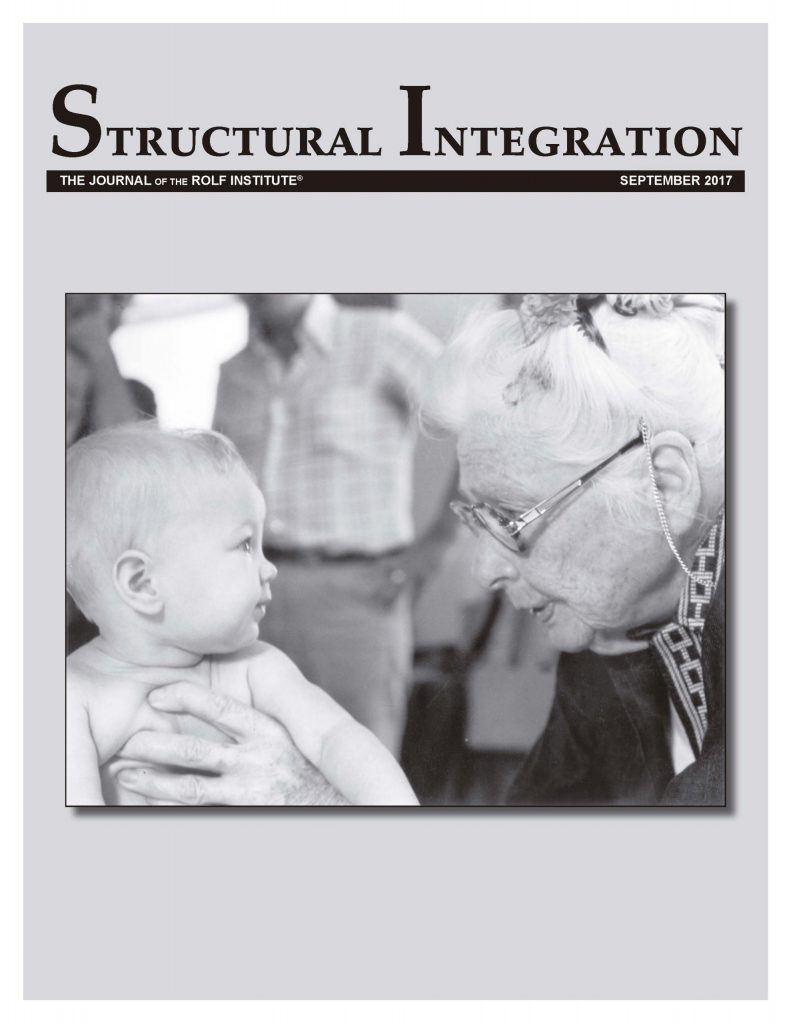
It isn’t often that a newborn person meets a pair of hands that offer Rolfing Structural Integration; yet when this meeting does happen, growth assistance that can gently guide the structural accomplishments that are actively expressing can be offered to this fresh human organism. The newborn baby is still pulsing like a singular pouch of fluid in the primary curve shape of the womb. Birth is a big structural imprint on its form, clearly palpable to the Rolfer’s hands in the first days of life. A newborn experiences the open air, and it is gravity as a force that initiates a new set of structural directives in all of the cells – a quest for length.
Some of our most treasured stories about Dr. Ida Rolf are the ones about how she was drawn to work with children. I can only infer that she must have felt in her own hands the fresh responsiveness of developing tissue. It inspires a conversation of support, a welcoming to the world, and a sense of prevention. We can offer relief from the myofascial hooks acquired during development and birth. We can support comfort to allow bonding time with caregivers. Length is a transition through the whole human lifespan. In the first days after birth, the Rolfer can facilitate the ‘breath of life’ sweeping the whole little form, inviting ease during the active structural unfolding.
The Sequence of a Session with a Newborn
Working with a newborn requires being adaptive. Consent is important. Parental consent may include a conversation about how their baby’s structure is doing in the early days of life and what help they wish us to offer. Newborns give their assent to some Rolfing touch when they settle with our contact. The treatment table is our arms and our ribcage. The first thing we offer is a gentle hold and our heart beat. If baby settles, then we may begin.
Newborns give various levels of eye contact while receiving work; the best markers may be to track facial expressions, breath rate, and body gestures. Our direct touch will be with soft sensitive finger pads – the working surface being as small as the inner loops of our fingerprints. Imagine the principles of the Ten Series in miniature. It is beautiful to give a broad whole-hand touch with only one or two fingertips actively working.
For me, I start by giving baby a hug and a hum for a hello. Then I place a whole hand on his or her back, which will cover and hold the entire spine. I listen to this fresh midline; wait for settling; and track all changes, actively supporting the dance. Babies will show us how they are feeling in their bodies.
I allow myself to be curious about the baby’s spine. I will hold the precious head in one hand; with the other hand, I slowly place two fingers on either side of the spine, often starting mid-thorax, feeling for the heart. I sink some contact into the transverse processes, offer some eye contact, and invariably the little person will give me a gesture about how that feels. I support that gesture, follow the dance, wait for settling, and come out. Then I allow intrinsic gesture to express to completion.
I will offer length where it makes sense, honoring the flexion and extension movements. It’ll look like a complex wiggle by the tiny person: a right sidebend, a left sidebend, a curl forward, a backbend, and spirals of variation. Keep in mind that space offered to this new spine will support and encourage all the organs to occupy fresh territory. This will commonly support baby to pass some gas, have a poop, take grand breaths, and make random limb movements. It does not take long for a lot of work to take place – being done in ten minutes is common.
The Physicality of In Utero Life Becoming a Newborn Life
Imagine the form of a baby two days before birth and contrast that with the same baby two days after birth. The primary curve of whole-body flexion is what this structure knows best. Embryological development can inform our hands about where to offer our directionality of support. The newborn baby has transitioned from a fluid environment to an air environment, from a confined space to open space, from supported umbilicus nutrients to independent visceral function. Every tissue line of a newborn is a vibrantly growing structure, a moving fluid form starting the long journey to uprightness.
The two days before birth is a completion moment – the embryo has completed the movement of coming into existence (van der Wal 2010). When we hold a newborn in our hands, we are feeling the forty weeks (give or take) of embryological growth that is complex beyond imagination. The first form the embryo expresses is the sphere, the single ovum fertilized. The newborn in our hands is a sphere with a center and a periphery, interacting with the outside world. We can help the baby feel its whole singular self – its periphery newly in the air.
Now, of course, that one spherical fertilized cell rather efficiently became many cells – a well-organized bubble of cells. Within the bubble of cells, two distinct sheets of cells differentiate: the ectoderm and the endoderm. After the sphere, humans develop a back body and a front body . . . a brief moment with no middle (van der Wal, 2010). Fast forward to the baby we are holding, its front and its back will have distinct qualitative differences in our hands. The embryonic ectoderm has given rise to many different types of tissue: the skin envelope around the form being one and the whole nervous system being another. The embryonic endoderm also gives rise to many different types of tissues: most notably all the organs of digestion, respiration, and circulation. We can feel that developmental division all in one hand with a person who is two days old.
The embryo quickly develops the mesoderm layer of cells, a layer that is quite important to us Rolfers because it is this tissue line that gives rise to the connective tissue wrapping all the organs and internal forms, including becoming the skeleton of the little body (van der Wal 2014). The meso cells weave lines of connective tissue across open fluid spaces like a spider weaving a web. Eventually those fibers become fabric; they make interconnected shapes, and they can be conceptualized as a mammalian-shaped matrix transmitting mechanical and fluid forces through the whole embryo. Holding a newborn takes a great softening of our working hands to make contact with the embryologic fascia. A worthwhile intervention is feeling the fascia of a newborn, connecting sensory functions with proprioception circuitry through touch.
Once the human organism has a front (endoderm), a middle (mesoderm), and a back (ectoderm), the ball of fetal cells needs nutrition from mother. The baby’s early vascular system meets the placental vascular system at the embryonic location that is the baby’s tail, the root, the pelvic base (van der Wal 2010). The maternal blood nutrition first enters caudally, establishing the next level of organization: caudal – cranial (cephalad). Later this blood supply connection moves ventral and superior to become the umbilicus connection. From the sphere, the human has a front, a back, and a middle, to the distinction of a head and a pelvis. Hold a newborn (one hand head, the other hand pelvis) and feel for breath. This embryologic morphology starts the gravitational line, but it is still all folded up.
This future verticality is further matured when the dorsal cells form a valley of cells from the tail to the head; a line of involution that will become the head and spine. This is the midline. The human midline is a symphony of complexity that pushes ectoderm into the endoderm – a long bubble of ectoderm living deep inside the endoderm, becoming the brain, the spinal cord, the peripheral nerves, and the bones that protect them. The midline has a directionality into the center of the back and pushing forwards to the front. That little newborn has a visible midline in the front (recognize that we are seeing the front of the back). We want to help gravity organize the verticality and horizontality here. If we can smooth out the midline on the second day of life, we are preventing the kinks and hooks from becoming familiar habits. If we can help the midline express its palintonicity at each segment, we create the opportunity for the form to fully express its intended majesty.
A Note About Birth
Having held a range of babies with diverse birth stories, I have felt how the method of birth impacts the structure of the newborn. When I gave birth by scheduled C-section, I saw that my little guy showed up having no length at all because he didn’t experience the squeeze of the birth canal. His body experience was being in a forward-curve form in utero, unzipped surgically; neonatal physicians worked to inspire his first breaths and he was wrapped up in a forward curve for mother’s arms. His form benefitted greatly from structural touch.
Contrast that with three weeks ago, when my close friend gave birth in a pool in her living room with four hours of labor. This new little guy had the squeeze Mother Nature has always intended, and this newborn self had a body experience of structural length imprinted into his fascia by the birth process itself. Yet that squeeze was asymmetric; the umbilical cord was caught on his shoulder; and he still had the twist of birth imprinted on his form when he was two days old.
Every birth story is unique with a high variability of trauma levels. The structure of any newborn will tell the story of how entry into the world impacted its form. Rolfers working with newborns can support the new tissue to breathe, to sidebend, to tremble, to gesture, to contract, and then to lengthen. We are helping them make room for all the bags holding all the various organs. We can help them make room for the food moving through their digestive system. We can follow their cues down the road to comfort.
Development as a Dynamic System
When we have a newborn in our hands, we are witness to a person who is in the process of dynamic growth. Developmental psychologists describe the dynamic systems perspective of growth where the child is seen as an integrated system, its mind, body, physical, and social worlds working together to acquire new skills in a constant motion of cellular development (Berk and Meyers 2015). Rolfing touch can smooth out the acquired snags from birth and the hooks that tissue has grown around in the forward flexion of the fetus. In the spirit of prevention, we offer an accelerated education about gravity in the open air.
When newborns cry, it is because they are experiencing an overwhelm of sensation of one type or another. Parents will be focused on the basic questions: Are they hungry? Are they clean? Are they safe? Yet simply feeling the world can be the point of overwhelm. The fabric on the skin might be lighting up all touch sensors on the skin in a way that is loud to their nervous system. Sounds in the environment, like the furnace or the air conditioner, might be experienced as a loud threat they can’t seem to escape. Milk passing through the digestive system for the first time has a lot of uncomfortable sensory details to it.
Sensory overwhelm gets in the way of the baby bonding with its caregivers. The human animal is ready to be received by others at the moment of birth, ready for the smell of parents, ready for the sounds of parents, and ready for the love bond. Sensory overwhelm sets off the arousal cycle, increased heart rate and breath rate. In adults, sensory overwhelm will set off the arousal cycle, too – sounds of tires screeching, for example. But as adults, we have skills to assess risk and sooth ourselves when we recognize safety – the car stopped in time and did not hit the squirrel, all are safe. Newborns do not have the neural mechanisms to relax back into the rest-and-digest paradise that is parasympathetic function. It is the bond with caregivers that soothes (Porges 2011).
Rolfing training has attuned us as touch therapists to listen to where an adult’s overwhelm (leading to chronic pain) is coming from. The same listening can draw out some information for parents of a newborn. We will notice if it is the fabric that the new little person is trying to wiggle away from; we will notice the startle when the furnace kicks on; and we will understand the lumbar shortening and face grimace associated with a kink in the small intestine. If we have clients with colicky infants, we can offer quite a bit of insight with our Rolfing lens. And we offer our touch to smooth the rough edges of physicality so the caregivers and child can get to the important business of bonding.
Work with Mother as Well as the Newborn
When I told my friend that her baby boy had inspired this article, she reminded me to write about the work I did with her in the first days after she gave birth. She had the birth story already mentioned and that all us mothers dream about: at home, in a pool, with midwives, during the day, not that long a labor, and a healthy newborn.
However, her system had distinct difficulty with the adjustment between having a lot of pregnant pressure pushing on her organs one day and the absence of this pressure the next day. Her system became momentarily disorganized; the experience was upsetting and alarming to her. She felt like she couldn’t breathe. I am so glad she reminded me that of the mom and baby pair, the first I worked with was mom.
Two days after baby was born, I was eager to meet this new little fellow in our tribe; but it was my friend’s form that was calling the most for some Rolfing work. I promptly got the table set up in her house and got to work. Her system was very clear; she was living in a pregnant body that had successfully birthed the baby. I treated her like a pregnant mom: sidelying, slow, emotional attunement as a primary focus, and interventions completely invested in settling her nervous system.
I had the benefit of knowing her pregnant form very well as we see each other every day, and I had known that her short torso had required the uterus to fill her abdomen firmly up to her diaphragm. So, I started classically: three-dimensional breath space. Her diaphragm had gotten disorganized with the pressure change of birth; her experience of breath was one of not being able to access her diaphragm. Simple holding of her diaphragm, laterally, brought awareness and comfort. At first, she could manage small, organized inhale-and-exhale cycles. Then with broad contact, we brought her breath into her upper abdominal cavity, gathering her tissue towards the midline, and inviting breath to return to the space that had been occupied by baby. And slowly, with lots of time, we invited her breath into her pelvis; the sacral movement of breath emerged, and her breath cycle deepened to a resting state that she had not experienced since giving birth. The impact of this touch support was profound; it brought ease to the difficult transition of fully formed baby inside the body to baby outside the body.
Conclusion
Holding a two-day old baby in our Rolfing hands is a weighty moment – a whole client in a small package. We help when we honor the life force that has arrived, we feel the story of the form, and we support the wiggle of growth taking place. Our training will guide the structural length the tissue is destined to find. To do a session with a newborn we can work with baby on the mom; yet personally, I find greatest effect when my skeleton is the treatment table. We hold embryological organization when we hold a newborn and we can make contact with these growth stages. We are working with the imprint of birth, and the client will teach us what the birth was like. Anewborn human is developing within a dynamic system of growth; all layers of being making daily leaps towards uprightness. Our role as structural integrators is to ease the transitions in the tissue and to smooth out the structural unfolding from the fetal life.
Lina Hack has been a Rolfer for thirteen years in Saskatoon, Saskatchewan, Canada. Along with her private practice, she also presents workshops to colleagues about the neuropsychology of stress states and structural anatomy in the context of yoga instruction. She has been integrating motherhood and professional identity for ten years; she reports it is a good life.
Bibliography
Berk, L.E. and A.B. Meyers, 2015 Infants and Children: Prenatal through Middle Childhood. New York, NY: Pearson Education.
Porges, S. 2011 The Polyvagal Theory: Neurophysiological Foundations of Emotions, Attachment, Communication, and Self- regulation. New York: W.W. Norton & Company.
Van der Wal, J. 2014 “The Fascia as the Organ of Innerness – an Holistic Approach Based upon a Phenomenological Embryology and Morphology.” (Available at http://tinyurl. com/ydeghee7. Retrieved 8/2/2017.)
Van der Wal, J. 2010. Embryo in Motion: Understanding Ourselves as Embryo. DVD of June 3-6, 2010 seminar. Portland, Oregon: The Portland Branch of the Anthroposophical Society of America (www.portlandbranch.org).
What We Have in our Hands[:]
To have full access to the content of this article you need to be registered on the site. Sign up or Register.