
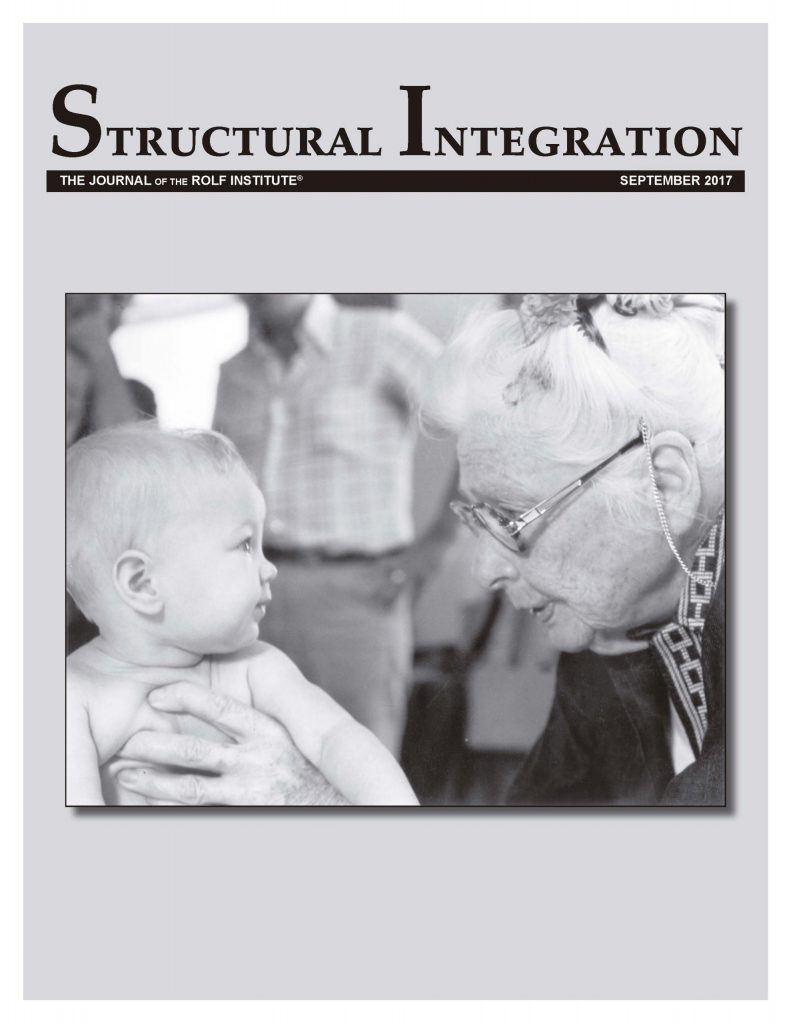
Author’s Note: Karen Price is a Certified Advanced Rolfer in Palo Alto, California. Karen has been a Rolfer for nearly forty years and has specialized in Rolfing Structural Integration (SI) for children for the duration of her practice. I had the opportunity to speak to Karen to ask her more about her experiences working with children. An earlier interview (Price and Terrill 2016) focused on Karen’s research into Rolfing SI for children with cerebral palsy.
Marie Terrill: Hi Karen, it’s good to speak with you again. I’d like to start by asking you about your practice with children. What’s the youngest client you have worked with as a Rolfer?
Karen Price: The youngest were a pair of twins that were thirty-six hours old.
MT: Tiny.
KP: I had worked with the mother all through pregnancy, and then I went to the hospital and worked on the babies. I still see them from time to time. They’re fifteen now.
MT: Wow. Karen, from your perspective, why give Rolfing sessions to children?
KP: That’s a great question, and I think one that a lot of practitioners get asked, I know that I certainly do. Even my child clients ask me that. We have this idea that children are perfect and don’t need work. They have a lot of energy, they can move around reasonably well, so why work on them? I think there are two main points: the first is understanding that we are working with a developing structure; the second is understanding that our work is to continually balance the body in the field of gravity. As we grow, there are many factors at play that affect how we develop. Focusing on the physical, there are both genetic and environmental factors. Some of the environmental factors include birth trauma, how we are handled later as infants and young children, and the falls and spills we take. And of course all this is happening as our bodies grow and change within the larger context of the gravitational field. Rolfing SI is a way to offer organized input into the structure itself as it grows and develops in gravity. This goes on to influence and improve function as well.
MT: It sounds to me like it’s a developmental issue. As children grow, they are continually incorporating new input from their changing structure as they move in the field of gravity. They’re growing into themselves, and if we, as Rolfers, can give them organized input at an early age, then their system has something to develop around that is functionally consistent within the context of gravity.
KP: Exactly. Yes. You’re going to see improvements in function in every domain. For example, physically they’re going to be better balanced; they’re going to be better coordinated; they’re going to choose more optimal use patterns rather than just choosing a random one, or rather than mimicking their parents. There are great photos in Ida’s book (Rolf 1977) of children standing exactly like their parents.
MT: Yes, I have seen that. It’s profound.
KP: If you watch children move you can see this imitation. I was watching Donald Trump walk down Pennsylvania Avenue, and his son, who’s ten years old, was walking next to him; he walked exactly like his father, that kind of lumbering gait. Children’s physical ability is often very important to parents: whether they have athletic ability, whether the parents are pushing them to be gifted, or whether the kid is uncoordinated. With Rolfing SI, you’re going to see balance, coordination, strength, athletic skills improve.
Emotionally, you’re going to see more maturity, self-control, ability to self-regulate, and ability to introspect with children of all ages. Relationally, you’re going to see interpersonally that children’s relationships improve. In the study with Stanford where I did Rolfing SI on children with cerebral palsy (Loi et al. 2015), we saw how much more relational these children became even though they were so compromised. With able-bodied kids, which is what we’re talking about in this article, their interpersonal relationships also develop very positively. They are more collaborative and cooperative rather than competitive or aggressive.
Asimple example can be of a school-age boy who is skinny, shy, and hunched over. He’s kind of nerdy, he wears glasses, and the kids tease him and bully him and he’s shrunken and afraid. After he gets Rolfing SI, he’s taller and more upright, he moves in a confident and balanced fashion. He’s still got his glasses but it doesn’t matter, and the other kids treat him more positively.

Karen Price initiating touch with a young client in 1979.
MT: This is fascinating. Could it be that Rolfing SI gives children the ability to experience the internal sensations of their own body (interoception), essentially giving their inner landscape more weight, which then balances the effects of the constant external, environmental input (exteroception)?
KP: I agree with you, and I think that’s a great way of phrasing it, and that this circular process then feeds on itself. Both the interoception and the exteroception are at constant play within the person. Another concept is introspection, which is related, but different. A lot of the emotional content or issues that can arise with Rolfing SI are not made conscious in young developing children, because the introspective ability doesn’t really come about until adolescence. Children who don’t yet have the capacity for introspection will still make very good emotional changes, in part because they can bypass the whole story about it.
MT: This makes sense.
KP: Children know they feel better. They can say, “Yes, I feel better,” or, “I feel lighter, I feel more balanced.” But I think that the circular process you described runs somewhat below consciousness.
MT: It does, yes.
KP: They just change. It’s like pruning a plant, where they grow along those lines. And by doing this when they are young, we are also preventing future problems from developing. We as SI practitioners can see the germs of future structural issues as we observe children’s structures and movement. In addition, it’s very empowering for children to know and take responsibility for their own body in this way. They’ll know when they need to get Rolfing SI and they’ll tell their parents, “I need to see Karen.”
MT: Wow.
KP: Sometimes it could be a physical thing, like, “Oh, I sprained my ankle,” but a lot of times it’s deeper than that, and they can’t articulate it, but they just know, “I have to go.”
MT: Absolutely.
KP: They know when they need a session.
MT: Right. A lot of what you’re describing are preverbal processes. Like you said, the self-reflection process does require more maturity. It requires the individual to be a little bit further along developmentally. It sounds like what Rolfing SI can do is offer children an experience that changes their visceral and internal representations that are pre-language but can certainly be felt. We all know what it feels like when we have a need or an experience that is coming from the inside and it takes a little bit of time to put it into words or figure out what it is.
KP: Exactly. Yes. There was an original work on children, The Promise of Rolfing Children (Toporek 1981), which was what Ida ended her career doing in the ‘70s. There’s a boy who sums it up by saying “Legs feel good, body feels good.” With children, since they are much more body- based – which is why Rolfing SI is so effective – when their body feels good, they’re happier. When a child is happier and eating better and sleeping better and doing his homework and chores, the whole family functions better. To sum it up, the benefits and goals of working with children really are to give them the best possible structure that you can, given whatever limits they have and that we all have as humans.
MT: Right, and whatever environmental factors are present that you can’t control, all those things.
KP: Exactly, right.
MT: Let’s talk a little about gravity, a basic tenet of Rolfing SI.
KP: Great. Having met Dr. Rolf, and listened to her speak, I’d like to include this quote from her which captures the importance of gravity in our work:
Rolfers make a life study of relating bodies and their fields to the Earth and its gravity field, and we so organize the body that the gravity field can reinforce the body’s energy field. This is our primary concept (Rolf 1978/1990, 86).
I feel that the emphasis now in Rolfing SI has become to focus on one system of the body, for example, the neural and nervous system, viscera, osteopathic work, or craniosacral work, et cetera. Those are all working with subsystems of the whole. So practitioners are only focusing on one system. That’s all fine and it’s valid and it gives symptomatic relief, but that doesn’t balance the structure in the gravitational field.
MT: So what you’re saying is that by focusing on just one system, it’s more of a palliative practice rather than an integrative one.
KP: Yes. I think the most important thing is for us to hear what Dr. Rolf said, in a different quote, “Gravity is the therapist.”

Balancing in gravity: the child experiences Rolfing SI through the context of her natural movements
We’re all in the gravitational field, but we don’t think about it. It’s like a fish in water. Gravity is either supporting you or tearing you down. When you finish a good Rolfing session, whether it’s a child or an adult, the standard response is, “I feel lighter.” That lightness is because the body is more balanced in gravity and therefore can receive more support from it. That lightness of being, if you will, also translates into what we were talking about before, the emotional balance, and maturity, and the increased fluidity in relationships.
MT: That’s beautiful.
KP: With children, this concept is important. As we are working with a developing structure – because they’re young and plastic and the fascia is much more moldable than in an adult – you can bring it to more balance easier and quicker. You can take something like a lordosis or even a scoliosis — Rolfing SI is very effective for children with scoliosis —and balance it not just intra-segmentally, each segment to itself, but within the larger field of gravity. That’s why Rolfing SI works.
MT: Tell me about your approach to the question “How do you do Rolfing sessions on children?”
KP: I meet each child where he is. I look at “What does that person present?” Generally speaking, preadolescent children will need less pressure, and you’re working more with broader sheets because they’re not as differentiated. In adolescence is when a lot of the differentiation takes place. There are some really lovely quotes from Ida Rolf in her book, Rolfing and Physical Reality (Rolf 1978/1990) about this differentiation. With younger children, the smaller they are, the lighter the touch, especially with babies. But, again, there may be times when you really do have to get in there, surprisingly enough, for their size.
MT: This makes a lot of sense. We adjust our work according to what is before us.
KP: Meeting the child where he’s at includes getting his permission to work on him. Generally speaking, when a child comes for his first appointment, it’s because the parents are bringing him. Sometimes when a parent tells the child he’s getting Rolfing SI and what it’s about, the kid will immediately say, “Oh, I need to do that. I want to do that. Please bring me in.” Sometimes children hear about it from their friends and come in, but usually it’s the parents bringing the child. This is because either they’ve had a positive experience with Rolfing SI or they know someone whose child has had Rolfing SI and their child has a similar issue, or it just sounds like something that would be good for their child. The child is often not coming of his own free will for the first time, so I very much need that child to be on board for the second time. Even if it’s a baby or a young preverbal child, getting his permission, nonverbally, to work with him.
Conversely, I’ve had times where the kids really want to come, and for whatever reason the parents don’t bring them. That’s a drag, obviously, because they can’t get there by themselves.
MT: Wow.
KP: One way to sum it up, is that children are not just little adults. They’re constantly changing. They’re constantly developing. I have followed many children from either babies or young children through to adulthood, and the needs, the sessions, the desires, everything keeps changing. As their Rolfers, we keep the ongoing movie of their lives in our minds. So as we’re working with a three-year-old, we’re projecting forward into seeing how that body is going to develop over time and space. And when they are older we remember them younger. With an older child, you see, “Oh, yes, we got those legs really lengthened out when they were three, and now they’re able to do all sorts of things at ten that, if they had not had Rolfing SI, they probably would not be doing.” It’s important that practitioners understand this development from several points of view, which we will discuss in a minute.

Spiderman participates through play. Karen meets the client through his context.
MT: And how do the parents typically respond to the changes they see in their children as a result of your work?
KP: The parents are very grateful. They know that I have their child’s best interests at heart and I’m trying to help them. Generally, the parents are easy to be around and communicate with. Even in instances where the family and I speak different languages, we manage to communicate with no problems. For example I had a four- year-old client who was translating between Mandarin and English, and another four- year-old child who translated between Spanish and English. Touch transcends a lot of barriers and divisions.
MT: I’m glad you said that. I completely agree. Karen, this is all quite profound and your experiences are valuable to the Rolfing community. Do you have plans to write a book one day? Everything that you’re talking about feels like it needs to be captured and passed on.
KP: I don’t actually have plans to write a book now, but I feel like I am now available to teach and/or to mentor. I’ve been thinking about ways to develop a training program of Rolfing SI for children. This is a vast subject, and teaching approaches for children must be considered carefully
– particularly in a classroom setting. If the instructor is teaching to a group of students and the Rolfing subject is a small child, there are important aspects to consider. If you have five or six people watching, even if they’re quiet as a mouse sitting in the corner, it really changes the energy in the room and the work itself. But I would somehow love to pass on my knowledge through teaching.
MT: Since a training program on how to do Rolfing SI for children doesn’t yet exist, and knowing how important it is for practitioners to understand the pediatric developmental process, what resources would you point Rolfers towards if they have an interest in, or already are, doing Rolfing SI for children?
KP: Great question, I’m glad you asked. First, practitioners need to be able to recognize what is normal and age- appropriate movement, structure, and function throughout the age spectrum from infant to adults. This includes being familiar with developmental milestones, such as rolling over, crawling, pulling to stand, walking, etc. And further, knowing whether, when, and how to intervene.
Understanding brain development is also important and how it relates to developmental milestones. There is a tremendous neurological pruning going on in the first five years. An excellent book to learn more about this is What’s Going On In There?: How the Brain and Mind Develop in the First Five Years of Life by Lise Eliot, PhD (1999).
Similarly, two books by Louann Brizendine, MD, The Female Brain (2007) and The Male Brain (2010), both discuss how hormones affect the brain. There are some great chapters on children and how the hormone profile our brains are bathed in affects brain development – as early as when we are in utero. Both follow development throughout the life span, so it’s interesting for adults and the aging process as well.
Then there’s the standpoint of cognitive development. Jean Piagetisoneoftheleading experts in the field surrounding discussions such as how reality is constructed within the developing mind of a child. Much of what we currently know about child psychology and the timeline and stages of progressive pediatric intelligence is due to Piaget’s work, including concepts such as pre-operational, concrete operational, and formal operational thought. Piaget’s work is particularly important for guiding our interactions and conceptual language with children to ensure we are engaging with them at an appropriate developmental level.
Lastly, Jean Gebser’s work on worldviews is important to understand. In this regard, I feel ontology does recapitulate phylogeny. Gebser’s work also gives us a common platform where we can understand how the worldview of the developing mind incrementally builds on itself, incorporating and growing from each stage. According to Gebser’s work, we all start out at the archaic stage, move through the magic stage, then into magic/mythic, mythic, and then finally incorporating rational. Gebser demonstrates the emergence of an integral consciousness where the time and space of ‘objectivity’ no longer offer an adequate description of the conceptual world or worldviews. This is incredibly relevant for clients who are children since, depending on age, they may not yet have a rational worldview built largely upon time and space.
For further reading on the concept of integral development, see the extraordinary work of Ken Wilber.
In conclusion, understanding the trajectory and many stages of child development will enable the practitioner to be more effective in meeting the child exactly where he is. For example, if a young child is in the pre-operational, magic stage, I will use very different language during the session to connect with him, compared to a school-age child who is in the concrete operational, mythic/rational stage. With the pre-operational child, I use language and concepts that pertain to magic. I might give such clients a wand and we wave wands together. They love it because it is age-appropriate, that’s their worldview, and I also get them to participate in the movement of the session.
MT: Children are definitely not just little adults. They are their own creatures traveling along a constantly changing developmental trajectory from which their unique minds and bodies arise, which are not like adult minds and bodies. Karen, thank you so much for taking the time to speak with me about Rolfing SI for children. Your contribution to the field and furthering Ida Rolf’s vision of Rolfing SI for children is an incredible achievement and benefit to the community, not to mention the immeasurable benefit to your clients and their families. We are lucky to have you.
Karen S. Price graduated with honors from Northwestern University in 1974. After receiving Rolfing SI in 1977, she began her Rolfing training in 1978 and graduated from The Rolf Institute® in 1979. She received her Advanced Rolfing certification in 1988. She is a long-term meditator, a Registered Yoga Teacher (RYT-200), and a Certified Yoga Therapist (C-IAYT). Karen has maintained a private practice in the same location in Palo Alto, California for thirty-eight years, specializing in work with women and children. For more information on Karen, please see the bio on her website rolfingchildren.com.
Marie Terrill is Certified Rolfer, Certified Structural IntegratorCM, and yoga and movement instructor in Eugene, Oregon. She incorporates aspects of body awareness and therapeutic movement when working with clients. Marie blends her work with an ongoing interest in the connections between clinical practice the scientific field. Marie studied molecular biology at The Evergreen State College and has ten years of experience in the field of functional neuroscience, with a specific focus on epilepsy and epilepsy research. She currently serves as Secretary to the Rolf Institute® Research Committee. Her website is www. mindbodyrolfing.com.
Bibliography
Brizendine, L. 2010. The Male Brain. New York: Harmony Books.
Brizendine, L. 2007. The Female Brain. New York: Harmony Books.
Eliot, L. 2010. What’s Going On In There?: How the Brain and Mind Develop in the First Five Years of Life. New York: Bantam Books.
Loi, C.E., et al, 2015 Sep 10. “Myofascial Structural Integration Therapy on Gross Motor Function and Gait of Young Children with Spastic Cerebral Palsy: ARandomized Controlled Trial.” Frontiers in Pediatrics, 2015;3:74
Price, K.S. and M. Terrill, 2016 Jun. “The Implications of Statistical Significance and Clinical Relevance.” Structural Integration: The Journal of the Rolf Institute® 44(2):29-32.
Rolf, I.P., 1978/1990. Rolfing and Physical Reality. Rosemary Feitis, ed. Rochester, Vermont: Healing Arts Press.
Rolf, I.P., 1977. Rolfing: Reestablishing the Natural Alignment and Structural Integration of the Human Body for Vitality and Well-Being. Rochester, Vermont: Healing Arts Press.
Toporek, R. 1981. The Promise of Rolfing Children. Transformation News Network.
Furthering Ida’s Vision[:]