
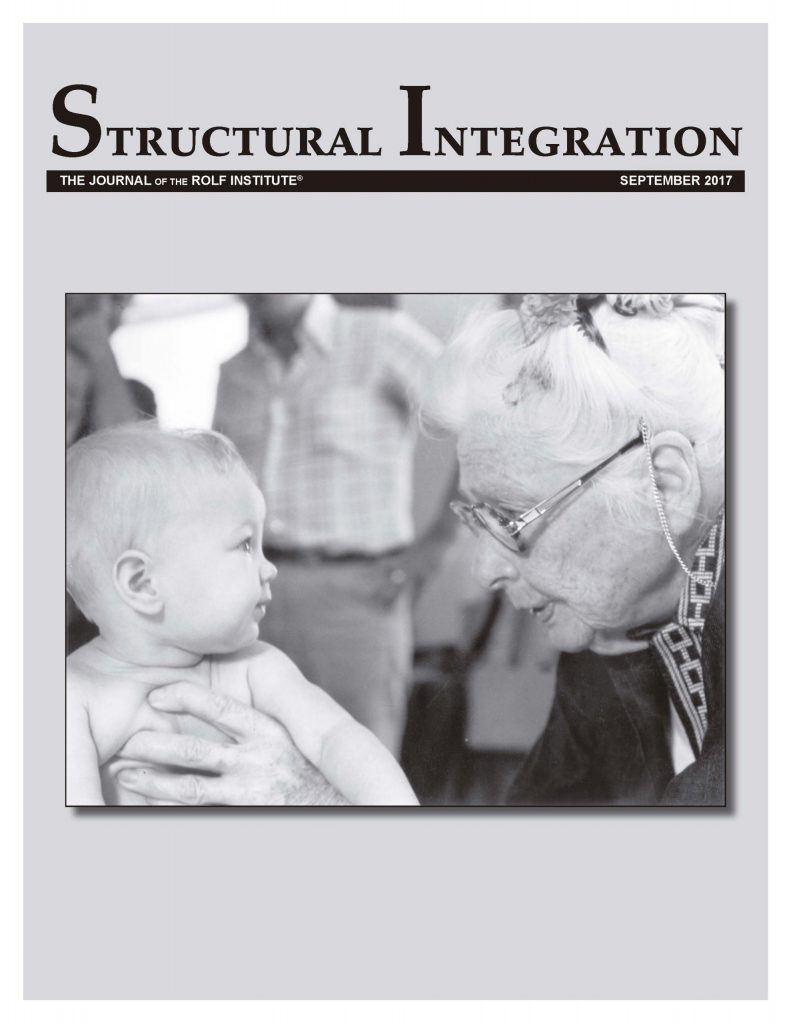
From Anne Hoff: As Editor-in-Chief of this Journal, planning a theme on Rolfing SI for infants and children, I felt it was important to include Briah Anson among the Rolfers who shared their perspectives. I was familiar with Briah’s work from her book and video on working with children (see bibliography), and knew that she had decades of experience to speak from. I was appreciative that she could take some time from her current studies to share her views. As she was so thoroughly prepared, I just began recording and let her start her ‘download’.
I’m often asked by parents and other professionals why I do Rolfing® Structural Integration (SI) with children. In a nutshell, this is why: Rolfing SI for infants and children helps their healthy development and maturation by stimulating and facilitating the integration of all body systems by working with the connective tissue. This unique approach recognizes our lifelong relationship with gravity, the need for balance within the human structure, the relationship of the body and emotions, and the importance of touch in connecting us with others.
My experiences with children, many of whom I’ve been able to track from infancy to older child or teenager, has shown me how correct Dr. Rolf was in many ways. As growing children lose noticeably awkward postures, they gain self-esteem and confidence – which really shows when they enter the teen years. The kind of touch that we are trained to offer is one that newborns and children find reassuring, and the connection between touch and nervous system development becomes obvious troublesome emotional trajectories do actually get changed. That there is a relationship between balance in the human structure and behavioral development is also obvious, and it’s so very rewarding to have the ability to correct that relationship at the very beginning of It does indeed change the path that both children and their parents can travel.
Rolf paid special attention to children throughout her lifetime. Her knowledge and understanding of the function of the connective tissue, and the body’s relationship to gravity, gave her the wisdom and incentive to work with very young infants and small children. Dr. A. Jean Ayres, an occupational therapist working with neurologically disabled children and adults for over thirty years, writes about a person’s lifetime relationship to gravity in Sensory Integration and the Child. This relationship begins by the ninth week of pregnancy with the development of sensory receptors in the inner ear called the vestibular receptors. In the ninth week, the vestibular nuclei in the brainstem that process the vestibular sensory input appear; they begin functioning by the tenth or eleventh week.
By the fifth month in utero, the entire vestibular system is well developed, and, together with the tactile and visceral systems, provides most of the sensory input to the fetal brain. Movement of the mother during pregnancy stimulates this vestibular system. Following birth, the infant is comforted and soothed by holding and rocking, which continues to stimulate the vestibular system, developing the young infant’s sense of balance and its connection with itself and others within the field of gravity.
Rolf understood the complex interactions of these systems and their relationship to gravity. “We want to get people into the place where gravity reinforces them and is a friend, a nourishing force” (quoted in Toporek 1981, 9). The vestibular system unifies all the sensory functions, forming our primary input for relating to gravity.
Rolfing SI works with this vestibular system through touch and by organizing the connective tissue. “Since both our nervous system and our skin come from the same origin, tactile stimuli have a primal point in neural organization. Touch sensations flow through the entire nervous system and influence every neural process to some extent. The interface of the neurological systems and the connective-tissue system open up the communication of the body as it moves towards greater organization, balance and healthy maturation of all systems” (Ayers 1989, 39).
I also want to mention the history of the ‘Little Boy Logo’ used by the Rolf Institute® as it has a direct bearing on our work and its importance to children. People have wanted to create a new logo, but this one has deep meaning for us as it is rooted in the principles of what Rolfing SI is all about. The logo is a reproduction of the before and after photographs of four-year-old Timmy Barrett who was diagnosed with Leggs- Perthes disease in 1959. Timmy’s body segments are shown as building blocks to clearly demonstrate the striking structural changes in his vertical alignment following Rolf’s Ten Series. Timmy’s mother made the courageous decision to choose the Rolfing process rather than following conventional medical practice.
Not only did Timmy regain his health and grow normally, but was able to participate in very strenuous and demanding physical activities. At age nine, he began to learn and enjoy surfing, eventually winning championships through high school and college, and going on to become a professional carpenter. [Editors note: Tim later took his stepfather’s surname, Law. Tim Law passed recently, and we hope to have his story in an upcoming issue.] This is what the logo represents for us – a reminder that restoring the vertical, as early as possible, opens potentials that were previously closed.
I want to go on to say that Rolf realized that a child’s posture was more than an aesthetic concern. It is a visible indicator of how the connective tissue is molding itself into its unique patterns of muscular use or disuse. She understood that emotions and muscular tone were connected. Both Ayres and Rolf understood that a person’s sense of emotional well-being and security is directly related to the relationship with gravity and to early touch experiences. Ayres (1989, 40) suggests that touch is not only necessary for neural organization, but also that, “The child needs a lot of touch sensations to develop the emotional security needed for later independence . . . Holding and touching a baby will help him develop and organize the emotional processes of his brain, so that he can function well as an independent adult.”
One of the examples in my book on Rolfing SI for children (Anson 1991, 47 and 49) is about Adrian, the infant son of a woman by the name of Lynn G. After her first trimester, I worked with Lynn through the rest of her pregnancy. Adrian was born in a posterior position face down. This caused quite a bit of stress on his head and neck. His head was rather cone-shaped and bruised for a few days. For the first three weeks after he was born, Adrian was uncomfortable and cried constantly unless he was nursing or sleeping. After three weeks Lynn brought him to me for Rolfing work because she suspected birth trauma and hoped this work would address that. During the first session, Adrian seemed to be in great pain whenever I touched his chest, neck, or head. But when I finished the session, the look on his face was incredible. He was totally relaxed and relieved. Everywhere they went that night, people commented on what a bright-eyed baby he was. He didn’t whimper or cry again, and finally fell asleep.
When he was five weeks old, they brought him in for a second session and they were amazed at his behavior. “He seemed to know Briah,” Lynn said, “and allowed her to work quietly on his body. When she came to sensitive parts, he would cry out but sigh in relief as she released the area. He loved and seemed to be relieved from pain and discomfort”.
As far as age, I don’t give people a schedule as to when to bring children in for sessions. I feel it depends on what’s going on with the child and with the parents, their knowledge of Rolfing SI, and their own sense of timing.
I have worked with day-old babies. There is this family with three children that I completed a Ten Series with, and the mother became quite an advocate. She wanted me to come the day the baby was born. I went to the hospital and did a session on day one. That child just did really well with it. I had another who did a water birth and wanted me there at the birth so I could work on her daughter right after she was born. It really depends on the parents – what their experience with Rolfing SI is, or sometimes stories they’ve heard from me about how this can help children. They decide. I think that’s really important.
Only one time in thirty-eight years have I had a baby brought for a session and it started screaming. I told the parents that I didn’t think the child was ready for this, and that maybe they needed to wait until the child grew some more. About a year later they brought the baby back and there were no problems, the baby was very receptive to receiving the work. I think we have to listen to that. I learned a lot about how to be receptive to each client from Stacey Mills who was a Rolfing teacher from Hawaii. I will always have the parents bring in a child, whatever age they are, and do a consultation session. During that session I take a life history and explain to both the parent and the child, at their level of understanding, what Rolfing SI can do. I show them before and after photographs of children from the Rolf Institute, and even do a short demonstration of my work with them.
Robert Toporek’s monograph called The Promise of Rolfing Children (1981) has some great before and after photos, and then photos from one, two, and three years later with no additional work. The Rolf Institute also published a monograph in 1970 that has some wonderful photographs. I show them all of that so they have the visual, and I do a little work on the child’s arm or wherever. I tell the parents that I will work with the child if there is agreement coming from that child. Children seem to inherently know whether they want to do this or not. As an example, I have a woman that I’m currently working with who is about three-quarters of the way through the Ten Series. She wanted her eight-year-old son to have work, so she brought home a brochure that had some pictures. The boy looked at the Little Boy Logo and said, “I want to do that. That’s exactly how I want to look.” I still had her bring him in for my usual consultation session in order to build some trust and connection. He wanted his mother in the room with him during his Rolfing sessions, which is fine. She reads and stays uninvolved in the sessions. So far, I’ve done three sessions with him. Just this week, his mother came in for her session and commented on how much more self confident he is.
Typically, up to the age of around four or five children want their mother in the room for maybe a session or two. If they’re okay without their mother it’s great, because then they really focus with me and they feel so grown up being there on their own. But if a child puts up a little bit of a stink, I make sure that the parent is there but is engaged in reading or doing something so they’re not engaged in the session – just being there. After a few sessions the parent might say, “Do you want to just go in there with Briah?” And usually the child will say, “Yes.” But again, giving children the lead, giving them the choice is really, really important. Giving them the choice whether to get work or not, to have a parent there or not, just to make it as comfortable as possible.
Typically, I work a good hour – even with an infant – very slowly and systemically. My purpose is in getting them organized, getting that stimulation in there, particularly getting the legs and the feet organized, because all of that hooks into the gut. So often all of these young infants and children have issues with digestion, particularly if their colon hasn’t fully developed. This will show up as issues with colic or spitting up. A lot of times they just need that organization and the Rolfer has to remember that its not just in the gut, you have to start right there in the feet and legs and get that organized, then work up through the whole abdomen. By the time I get up through the abdomen and diaphragm, they’re a lot more relaxed.
As for what work to do – whether to do the Ten Series or other work – the parents’ involvement is important. If the child is age four or over and they want their kid to go through the Ten Series, I’ll take them through it. If they just want to do a session or two or three, that’s fine too. There is also what the child wants. A lot of times a child says, “I want to go do that. I want to do that,” and then the parents follow through with that. Another thing I’ve experienced is that often when I’ve worked with a mother and the changes have been dramatic, she wants all her children to have this work, and the husband even comes in. I’ve ended up doing lots of families that way.
I also want to share my experience with Jovie and her younger sister, Kimberley. Jovie was referred to me by a classical homeopath at one year, three months. She was born with a condition called metatarsus adductus. Her feet were really turned in – almost clubby, thick and tight – and her legs very bowed. This is an issue that comes up a lot with children where a pediatrician wants to put them in corrective shoes or braces because they were born with really bowed or turned-in legs. Jovie’s parents wanted to try something different. At that point, her legs were very bowed – see Figure 1. I did a session every two weeks for a total of three sessions, and then I did a session every two months for a year. This is what the parents wanted to do, and it made sense to me. Now I do a session every four months.

Figure 1: Jovie Johnson at fifteen months old before Rolfing SI.
The next picture, shown in Figure 2, was taken this week, showing her laying on the Rolfing table with her legs really straight. Her mother reports that her development on all levels, physical, mental, and emotional, is more mature than a typical three-year-old, and that socially she’s able to communicate with all ages. She can now walk and run without falling, her legs are completely straight, and she seems to exhibit an excellent ability to reason, learn, and remember. Her parents attribute this to her Rolfing work and have decided to continue her Rolfing sessions throughout her childhood.

Figure 2: Jovie Johnson at three years and four months, after Rolfing SI.
A number of months ago they brought in the little sister, Kimberley, when she was eight months old. For whatever reason, she just started to cry and object. In other words, I could only do about thirty minutes of work. They brought her in at thirteen months for a second session this week. She was really happy to be there, and I was able to work a full hour. I worked pretty deeply everywhere including some mouth work, and she was very accepting of both the work and me. The mother reported that even after that half-hour session Kimberley became calmer. She walked at ten months with good balance, and that socially she’s very happy and at ease with others. The parents feel that the Rolfing sessions and homeopathy have changed the trajectory of their kids’ lives. These girls had conditions that are usually treated symptomatically and often cause a lot of discomfort with not much result, but they made the changes without pain and with major changes to their whole lives.
Another child whose history I’d like to mention is a baby named Seth (Figure 3). At age one month, he was referred to me by a classical homeopath because he was spitting up constantly and having non-stop hiccups. As a result, he cried a lot and had constipation that lasted two or three days at a time. I spent thirty minutes of that first session just organizing his legs. I almost never go to the place that’s hurting first. Instead, I ask myself where I can enter the system and get some organization and feed that into the rest of the body.

Figure 3: Seth at one month at his first Rolfing session.
The rest of the session I spent on gently freeing up his abdomen, his diaphragm, ribs, shoulders, and finished with some neck work. After that first session Seth slept through the night, his hiccups ceased, and his bowels started working normally. They brought him back a week later and I worked deeper and with more general organizing. All was well for two months, and at three months they brought him in to do one more session as less severe hiccups had returned. A week after that third session his mother reported that his legs are much stronger, he is holding his neck and head up, and he is no longer holding his hands clenched. He’s more content, grabbing things with his hands, sleeping longer, and his eyes are tracking better. He’s letting others hold him besides his mother. That’s the impact of three sessions over a period of three months (Figure 4).

Figure 4: Seth at age three months.
I think that treatment always has to be individualized, but again, holding those basic premises of our work and remembering its basic guiding philosophy that we are teachers, educators; that we’re helping a person get aligned in gravity, and know that gravity is the therapist. I work with that kind of intention, and I think the kind of intention we hold is critical.
I want to talk about another issue that’s common with young children – severe asthma. I worked with this one little boy, age four, who had severe asthma. His father was a doctor and not into holistic health, but the mother was into everything holistic. They were constantly taking him to the emergency room of the hospital with all these really bad attacks. He had a horrible sway back, stooped shoulders, concave chest . . . his neck and head also hung forward and out in front of him.
The mother felt that the asthma had postural implications that could be corrected and she was tired of watching all these adrenaline shots and their side effects. So they made changes in the environment by making the house as allergy-free as possible – no cats, diet changes, nutritional supplements, exercise programs. At age four he had the complete Rolfing Ten Series. After the last session, he was so much longer. The asthma has ceased to be a problem. She brought him back four years later and I did three sessions. With those additional three sessions he became really straight – he filled out and changed into a little mesomorphic boy. His psychological behavior shifted as well. There was a lot of conflict between the parents, and I think he was carrying and expressing a lot of that. After the Rolfing series he just became a joy to live with.
Another situation that comes up a lot is ADD and ADHD, and I want to talk about a little boy by the name of Joey. He was seven years old and had been diagnosed with ADD and ADHD. Joey was already telling his mom that he was dumber than the other kids in class, and the parents were very concerned about how the challenge in school would affect his self-esteem. He was also having difficulty in reading and was assigned to work with a reading specialist that only served to further fuel his belief that he was dumb. His mother said that he was a restless, impatient, and easily frustrated little boy.
They worked with a pediatrician who started him on medication. This allowed him to focus and complete his schoolwork, but the side effects (stomach upset) made his parents think that medication wasn’t a good long-term solution. The mother had done some reading about alternative treatments for kids evaluated for ADD, and she felt like Rolfing SI could help. She found the idea of balancing the body and the mind through neuromuscular integration an intriguing concept that seemed to make intuitive sense. The fact that it’s a holistic approach to the issue seemed like they were making a positive investment in Joey’s future.
That boy was not excited to come see me at first. They had taken him to so many different therapists, and he wasn’t feeling good about his situation, so he didn’t want to go see one more person. After the first few sessions he was expressing a lot of anger; his mother said that little things would set him off and he could be angry for much of the evening. They started seeing a real change after the third session. His resistance to the Rolfing sessions started to change. They noticed changes in his behavior: instead of becoming impatient with his friends if things didn’t go exactly his way, he started to become more tolerant and cooperative. Not only did he start to work things out more, he also started sharing more – both big issues for these ADD kids.
He eventually said that school improved dramatically for him. While the medication allows him to focus much better in school, I believe the combination with Rolfing SI has been tremendous. Everything seemed to start clicking. His reading and spelling improved dramatically – he is now spelling so well that he’s qualifying for the most difficult spelling words most of the time and he’s very proud of his accomplishment and grades. By the seventh session, although he still got angry, the anger seemed to dissipate more quickly and he seemed to process it faster on his own. He not only was more cooperative in seeing me, but he was more cooperative with everyone in the family. After we’d finished the Ten Series he was straighter and taller – his parents were amazed at the dramatic differences in him after three months. The alignment of his shoulders, legs, and overall posture was astonishing. He actually looked and acted more mature, and he’s started to fill out, making some of his slim pants become more difficult to button. He now enjoys participating in sports, he’s running track this spring, and he feels some of his fast running can be attributed to his Rolfing work.
Joey still remains a driven little boy, but there has been a shift in his personality. He’s more reasonable, cooperative, and articulate. He’s become less impatient, more tolerant, happier, and is more enjoyable to be around. His tremendous success in school has taken him from feeling dumb to having confidence in his abilities to read and write and be successful. His mother told me that, “Above all, he is very proud of his accomplishments with Briah – his straight posture, his perseverance through the Rolfing process. And then he’s most proud of the Rolfing pin that Briah gave him at his completion” (Hofstad 2004; I’ve had little brass Little Boy Logo pins made that I give to little children when they finish.) That’s an experience of one seven-year-old with ADD, ADHD – but I’ve seen a lot of that. Even kids who were suspended from multiple schools, after Rolfing sessions they just seemed to settle and not be a destructive influence around them, not be difficult to live with.
While I’ve mentioned specific conditions here, when talking to parents, I don’t focus on any condition or feed any expectation. I say that it’s been my experience that children become able to mature no matter what conditions they are diagnosed with. I say that all these different conditions also manifest as muscular tension in the body, and by just freeing them up through their connective-tissue system and organizing and balancing them with gravity, just like we’ve seen with adults, there seems to be a shift in their development and organization. Then I say that we just have to do the process and then wait and see. I always go back to those basic premises and speak to experiences that I’ve had. I also say that every child is so individual, we can’t know what’s going on completely, we just organize the system and see what happens. What I do know is that I can help them get balance and organization.
Let me speak to the issue of self-esteem. It has become clear to me that even by age three or four kids already have a sense of self-esteem based on how their bodies look. They’re already being picked on with comments like, “Hey, your butt sticks out.” An example is a girl, Ami, whose mother had a hugely anteriorly tilted pelvis. The mother realized that her little girl, who was in the third grade, had the same body, and she didn’t want her daughter to look like her and have the same problems she had – Ami’s pelvis was tipped so far forward she would soon have her mom’s pains in her back, neck, and shoulders.
Ami told me once, “When you’re young you don’t think about your body. I’m glad my mom realized the problem I had and had me [get Rolfing sessions] before I became self-conscious about my body. If I had grown up without any professional help, just look at the way my body was going. I think I would have had problems with my self-confidence and self-esteem” (Anson 1991, 91). She went through the Ten Series and her structure almost completely came up. Her legs were angling a little bit forward but her back was pretty straight. Her pelvis was still tilted a little bit. Then her mom brought her back eight years later, and I did only one session. She had continued to grow beautifully. She is a great example of the promise of Rolfing SI – if you organize the basic segments and let gravity be the therapist, people continue to unwind along the vertical axis of gravity. She just had so much poise and self-confidence it was beautiful. She grew up to be athletic with no trace of self-confidence issues.
I have a great big mirror in my office, and when the kids get off the table, the first thing they do is look in the mirror. Most adults are not good at seeing anything, but these kids notice how they look. And then the parents will see how they’re doing.
I feel strongly that self-esteem starts in the body. When you first start seeing a little zigzag, or you see a body that is clearly at war with gravity, that self-esteem is crumbling along with the structure. What we are doing as practitioners, as Rolfers, is getting these kids a matrix of support around which they can grow.
Another child I worked with, Erika, is a little girl who was diagnosed with Leggs-Perthes disease at age eleven. It’s a bone disease in both hip joints with malformation – the same condition as Timmy, the model for the Little Boy Logo. Erika loved to dance but she couldn’t do that; she was missing some school, and she also couldn’t sit cross- legged. Chiropractic didn’t help, that’s why the parents turned to Rolfing SI. She had been on crutches for about four years – that was the therapy, to put her on crutches until her bones built back up. She also had a bad limp and would get into a great deal of pain just going to the grocery store. She had a little baby face and baby body.
We did the Ten Series and it seemed like overnight she became a young woman. She lost the round belly, it became flat, and her toddler walk became graceful. The limp went away and when her face lost baby fat she just glowed. She still had pain when she walked, but only limped when she was really tired. Her crooked feet became straight and flat, and her back straightened out. It was amazing. A year later I did three advanced sessions that enabled her to get on the volleyball team, something she never thought she’d be able to do. Then she started dancing!
She used to have a lot of anger: she had been angry with her parents for getting a divorce, and angry at the bone disease that made it impossible to run and play like other kids. It made her angry at the world. I think sometimes this anger gets stored in the body, and it’s really hard to eliminate because it’s stored so deeply. Her mother called it poison in every cell. After the Ten Series, even though she couldn’t run as fast or jump as high as other kids, she could still do everything. She’s no longer an angry person, she’s lost her allergy problems, and somewhere along the line she developed all that beautiful poise.
Her doctor was really surprised that she had healed and had so much more movement, but I’ve seen that with a number of kids that were around her age and had severe joint problems. They weren’t growing right, and in every case their bodies were just like a huge zigzag with the pelvis really tipped anterior, and they just didn’t have any integrity or organization. They were tired, they were in pain, they felt ostracized at school, and going through the Rolfing work turned everything around.
Sometimes you see children who aren’t athletic turn into little marathon runners and champion skateboarders. You would have never, ever thought that was in them. It’s like Rolf said, this is about opening up your human potential, your vitality, and we don’t know what’s in there waiting to be expressed. Rolfers can be that agent of freeing it up and organizing it, and then the child’s own vital force can shine and come through.
I also want to address the issue of scoliosis. An example is Olivia, who at age eleven started developing a really bad scoliosis. I did two full Ten Series and more over the years, and the parents kept bringing her in, but I told them that I felt this was a case where no amount of chiropractic and Rolfing SI was going to help her maintain or hold that alignment. It was so clear to me that they needed to consider surgery – and it’s the only time I’ve really, clearly said that to a parent. I did a lot of research and found a surgeon here in Minneapolis who seemed to be very successful with these kids. At age twenty-five, Olivia had the surgery and was able to have very dramatic changes in her curvature. Before getting bodywork she had a 105° curvature, and after collaborative work with me and a chiropractor, and then the surgery, she had a 40° correction. The neurosurgeon said he had never seen that amount of change – the best he had hoped for with the surgery was a 20° correction.
After recovery she had almost no back pain and could live a normal, healthy life. She has matured and gained in self-confidence, which was really impacting her life. I did a little bit of Rolfing work with her when she was in recovery – just some scar tissue work. That’s the most severe case that I’ve worked with, but I’ve certainly worked with a ton of kids with scoliosis.
I want to finish with this quote from Dr. Rolf: “Our way is more basic because we understand that structure is determined by the relation of the body to the gravitational field. We are the only group that recognizes that in order for a living body to be at ease in its spatial environment on earth, gravity must be able to deal positively with it” (Rolf 1978, 35). Sometimes we hear that and think it’s a bunch of words, but it is the basic foundational premise that should guide our intention as we work – whether with babies, children, teenagers, anybody. We’ve got to hold that intention.
Briah Anson, MA, is a Certified Advanced Rolfer and Rolf Movement Practitioner with over thirty-eight years of experience. She is a pioneer in the field of Rolfing SI, and the author and publisher of Rolfing: Stories of Personal Empowerment (1991). She also produced and directed Growing Right With Rolfing (1996), a documentary featuring her work with children under the age of four. Briah has a private practice in St. Paul, Minnesota. Continuing her evolution as a healer, Briah completed her training and certification in 2001 as a practitioner of Frequencies of Brilliance – a form of quantum energetic bodywork. To date she has completed twenty- five levels of this transformative healing work. Briah is also presently pursuing a four-year program in classical homeopathy at The Northwestern Academy of Homeopathy in Minneapolis, Minnesota.
Bibliography
Anson, B. 1991 Rolfing: Stories of Personal Empowerment. 1st ed. Berkeley, CA: North Atlantic Books.
Ayers, A. J. 1989. Sensory Integration and the Child. 1st ed. Los Angeles, CA: Western Psychological Services.
Hofstad, C. 2004. Personal communication. Rolf, I.P. 1978. Ida Rolf Talks about Rolfing and
Physical Reality. R. Feitis, ed. 1st ed. New York: Harper & Row.
Toporek, R. 1981. The Promise of Rolfing Children: A Pilot Project (monograph). Philadelphia, Pennsylvania: Transformation News Network.