
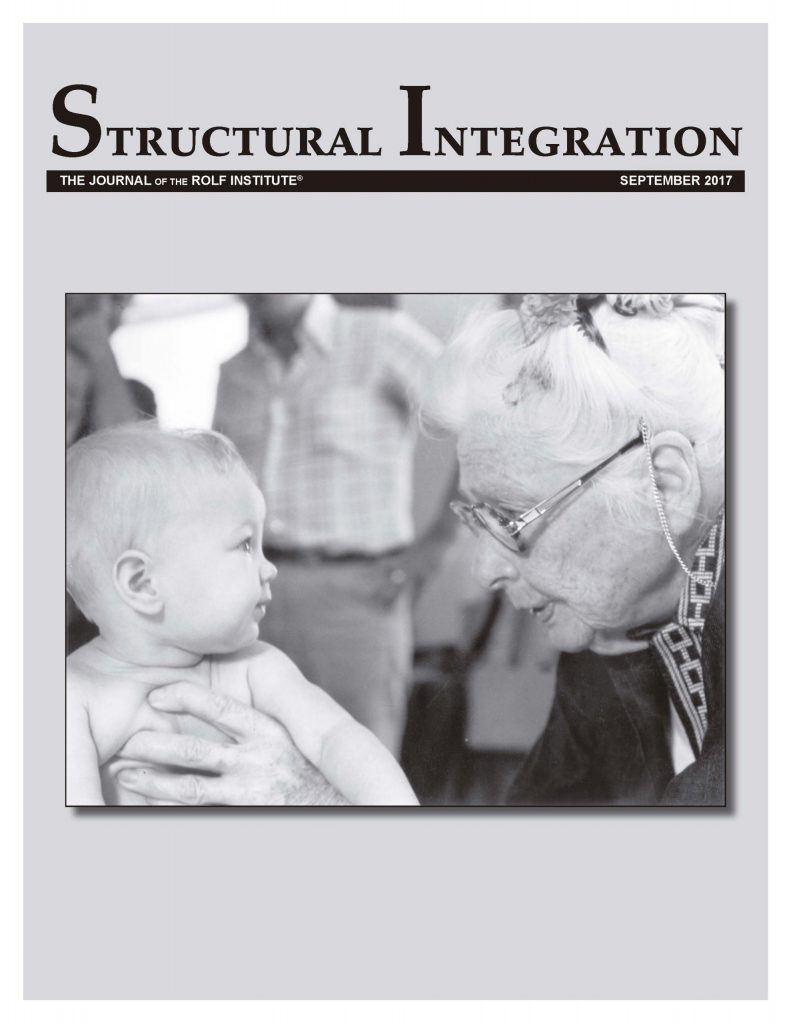

Three Stories on Rolfing® SI for Babies and Children
By Deanna Melnychuk, Certified Advanced Rolfer
I waited in vain for my very pregnant client to show up. She regularly came for Rolfing Structural Integration (SI) as it helped ease her back. I called; no answer. Eleven days later, my client comes in carrying a baby car seat with her brand-new son. He had decided to come early and so was very teeny and looked like a doll in the too large seat. He was all scrunched up and crying.
Now the mom was delighted to show me why she had missed our appointment, and I very carefully took the wee one out of his car seat and to my table. Laying him on his back, I kept my hands under his little body and so very gently – like a butterfly’s touch – I put slight pressure on either side of his spine. My middle fingers nearly reached from his head to his.
He stopped crying, he relaxed, and his body said, “Wow! That helped a lot. Thanks.” His mom said, “What did you do? He has been crying nonstop.” Well, his birth had come unexpectedly two weeks early and was very fast – he just had not recovered and had not had a chance to stretch his back. I will never know what prompted me to hold him that way. I just did. Success!
Another story. The mom was concerned that her bright, happy daughter, age eight, was ‘knock-kneed’. She told me that Carol (not her real name) could not run and play with the other children: because of her knees, she would stumble and fall, and she was very self-conscious. She would sit and play with her dolls and not join in games that involved running and quick movements.
Carol was very quiet. As I worked and we established rapport, we devised a way for her to tell me when it “hurt too much.” She would hold up fingers, one to five, and when all five fingers came up, I was to stop. I actually did the Ten Series with her, spending time each session on her legs. It was only about four sessions in when her mother reported that Carol was at the rocky beach and running with her friends. Carol’s personality also blossomed, and she begin to tease me and tell me about her activities – a completely different child from the one who initially would barely talk to me. Giving her legs gave her a whole new outlook on life.
My last story comes from when I was a new Rolfer, still living in Boulder, and the Rolf Institute® had a clinic for children on Dr. Rolf’s birthday. My first two clients were brothers – one was five and the other about two and a half. The mom told me both of the boys had backaches. When I looked at the five-year-old, his left foot splayed out, and he walked with a limp. I could not see a bony cause and proceeded to work on legs and hips. He promptly fell asleep.
I told his mom that while he slept, we would work on her other child. Amazingly, when he got up and walked, he looked exactly like his brother. When I mentioned this to their mother, she said, “Oh, the boys copy the way their father walks, and he has a severe scoliosis.” Then, ten minutes into this session, the little one fell asleep.
When we woke the five-year-old and had him walk, he walked normally. As they left, him walking and the mom carrying the little one out, I was still in shock – at how the boys had developed their dad’s pattern, and at how a few minutes of Rolfing work and the mom’s new awareness made significant changes, both in the moment and probably for the rest of their lives.
Deanna Melnychuk went from a Canadian college instructor (Algonquin College) to manager in a computer operations department (Northern Telecom) to Certified Advanced Rolfer. She has enjoyed the past twenty-three years practicing Rolfing SI on the citizens of Phoenix, Arizona. Now beginning semi- retirement by dropping to three clients a day, she is eagerly looking forward to adding new skills to her lifestyle. ‘Throwing’ pots (it looks easier than it is) and practicing chi gong are two activities she is looking forward to mastering. She can be heard to say: “Rolfing SI was the best career move . . . the most fulfilling and satisfying job I ever had.”
Working with Kids
By Patty Murphy, Certified Advanced Rolfer
I had worked with some kids before having my son, but my understanding changed once I had my own child (Figure 1).

Figure 1: Patty Murphy and her son Liam.
I worked on my son when he was an infant as he was born with a bit of torticollis (which I’m finding comes across my table a bit now that I’ve worked with him). It wasn’t overly obvious, but enough that I noticed it: a lift in his right shoulder, and he would turn his head differently from side to side and always had a preference. My son is a fidgety little guy and I could only work on him when he was nursing, but every child is different with how they respond to the work, and how long they will let you work on them. Some will lay still for you, and some are just nonstop movers, so you do it however it works. One client, who was about five weeks old, would let me work on him however I wanted. Another baby would let me work on her a little bit but would get frustrated after a couple minutes, so I’d work on her while she was nursing. Sometimes they’ll give me five minutes, sometimes they’ll give me twenty minutes.
I think prior to having a child I wouldn’t have recognized the difference between working with a practitioner who has kids and one who doesn’t. Now that I am a parent, my understanding of how to deal with kids and how to work with them has changed. It’s made a huge difference. I understand how to talk to them and how to work with them. Since having my son, I’ve had a lot more kids come to my practice, ranging in age from a couple of weeks, to teenagers. Just like any client who walks through the door, each one is unique and special in his/her own right; we need to adapt to them and meet them where they are. I think working with pregnancy, postpartum, children, or babies is no different than working with other clients, although it might be harder to meet the client where he or she is at without having firsthand experience – but that’s not to say it can’t be done.
Patty Murphy has been practicing for ten years and has recently opened her own Wellness Center in Patchogue, Long Island, New York. She practices full-time while balancing life with a three-year-old and preparing for a new arrival in February.
Brown Syndrome: A Disease or Just Dis-ease in the Body?
By Felisa Holmberg, Certified Rolfer
Brown Syndrome is a mechanical problem of the eye where a tethering of the superior oblique muscle/tendon and trochlea causes the eye to deviate. (For details on this condition, see https://aapos.org/terms/ conditions/29.) Some children are born with Brown Syndrome, while some develop it later. The birth process can cause trauma; even what’s considered a normal childbirth can leave the head out of balance. Other children fall and hit their heads, receiving head trauma; this may seem mild and not be treated. Yet as Rolfers we know that adhesions form in areas of the body that experience trauma, so why not in the head too?
A client going through the Rolfing Ten Series started talking to me about her ten-year-old son. He went from being an advanced student to doing poorly in school, becoming overly emotional, and he was getting worse over time. He even stopped playing chess and other things he once loved to do. He had been diagnosed with Brown Syndrome. I asked if he was born with it and she said no, he developed this condition around the age of two.
As the story unfolded, I learned that he had fallen out of a mobile home (the steps had been removed during a construction project) and landed on concrete, head first, resulting in a concussion. He was one year old when this happened, and he developed Brown Syndrome within a year. I asked her to bring him in to see me. As soon as I put my hands on his head, I felt a pull that I interpreted as his brain being pulled out of balance. I connected in to the fascial strain and it slowly began to release. It took a full session, but at the end of the session, I no longer felt the pull and his eyes were in normal position. His mother later reported that he was no longer having issues at school or being overly emotional. The Brown Syndrome symptoms were gone. Since then, I’ve also had the pleasure of reversing these symptoms in a six-year-old.
Brain and head injuries are among the most common injuries suffered in auto accidents. Closed-head injuries, whether a mild injury or a traumatic brain injury, can deeply affect one’s life. (I developed profound personal understanding of this after myself being ina car accident.) These injuries can include adhesions that affect how the brain is balanced and can also leave nerves and arteries compressed and unable to function optimally. Such adhesions may affect not only the eyes, causing issues like Brown Syndrome, but also the entire body. There is often no apparent physical injury, but there can be bruising and inflammation from the impact causing the brain to hit the inside of the skull, and can lead to fascial adhesions that affect how the brain is positioned. This can have a subtlety that a medical doctor might not necessarily consider, but the injury still can put micro-tears in the connective tissue, just as with an injury to any other part of the body. From this there can be a broad scale of issues and severity, including mild to severe memory issues and emotional and noise sensitivity.
Besides Rolfing SI, I’ve studied many modalities like visceral manipulation and craniosacral therapy, and it is difficult to put into words the amazing teachings I’ve received from Advanced Rolfers and osteopathic manual practitioners trained in Canada. However, even with all the wonderful teachers and training from these folks, horses have been my greatest teachers – teaching me how to listen on many levels and allow the body to ‘talk’ to me. (In my article “Horse Listener” in the June issue of this Journal, I discussed my work with horses and how they have taught me how to become a better human being.) This is part of the subtlety that has helped me with cases such as these children with Brown Syndrome.
Felisa Holmberg works and resides in Missoula, Montana and also offers services in eastern and western Washington State. Her websites are www.therolfer.com (Rolfing SI and horse work for bodyworkers) and www.horseshopeforhumanity.com (horse work for personal growth).
Children and Athletics: The Archer
By Szaja Gottlieb, Certified Advanced Rolfer
My daughter Judith, fifteen, is a serious archer who for the past year trains every day for about four hours and has gone to tournaments in Florida, Michigan, Arizona, and Nevada. Her coach is in South Korea, and she and my wife travel there twice a year for about six weeks.
I did not know anything about archery previously, but as I learned about its emphasis on form and particularly balance, I knew Rolfing Structural Integration would be a perfect accompaniment. I did a ten-session series with her last summer, taking pictures before and after to record the noticeable improvement in her postural alignment.
Archery requires tremendous strength and stability as it is unique in being a sport of immobility (see Figure 2). From my background as a Rolfer I began analyzing the sport through tensegrity principles. If the archer was not loading properly – dispersing rather than concentrating – then the local muscles of the shoulder (trapezius, rhomboid, rotator cuff, etc.) would overwork. As a Rolfer, I emphasized that an archer shoots with the lower body, the legs, as well as the shoulder girdle.

Figure 2: The archer.
Naturally, as a result of shooting hundreds of arrows, Judith’s complaints centered on the repetitive motion of elevating her right shoulder before arrow release. When she complains, I simply palpate and squeeze her shoulders from behind, which tells me just how bad it is, and also whether she is loading or shooting according to tensegrity principles, and then proceed to the table. Surprising, too, is that a fifteen-year-old neck can temporarily feel like that of a fifty- year-old. Suffice to say, the need for manual therapy is ongoing and will be throughout her career.
From experience, I believe a perfect time for an individual to get Rolfing SI is in adolescence. I should also mention that at some point in time I plan on writing an article entitled, “Artchery, Tensegrity, and Rolfing Structural Integration.”
Szaja Gottlieb first received Rolfing sessions in 1978, which resulted in him becoming a stone sculptor, which, in turn, led to his becoming a Rolfer in 2001. He lives with his wife Ko and daughter Judith in Los Osos, California and practices in San Luis Obispo.
The Story of “The Really Shitty Friend”
By Cheryl Van Der Horn, Certified Advanced Rolfer
A woman I work with at a different job had been telling me how much trouble her four-year-old daughter had been having intermittently with bowel movements. We had been trying to get it together to do a session, yet things never seemed to fall into place. Finally one night in November, our last evening in Boise, Idaho at a conference, we were all eating dinner together (mom, dad, kid, and another coworker). At some point the girl crawled into my lap and proceeded to draw things on the placemat with the crayons she had been given. I felt her abdomen and everything felt surprisingly happy. Her glutes, however, were quite a different story. I worked on her a bit while we all enjoyed some conversation. This was a close-knit group of colleagues having a last meal together before the four-month winter break ahead of us. I didn’t think much more about it.
The next day I flew back to Seattle on my way home to Alaska. When I landed there I had a text from my colleague describing the rather eventful drive they were having from Boise to Yreka, California – one that entailed quite a few unscheduled stops and running through quite a bit of toilet paper and clean undergarments, and squatting in the cold along wide open expanses of highway.
Mother, father, and daughter endured the long day, and when we reconvened the next spring it was confirmed that the girl had had very little bowel trouble over the winter, notwithstanding the varied diet while spending holidays with different branches of the family. After this incident I was lovingly called, “the really shitty friend.”
Cheryl Van Der Horn has worked seasonally with wildland fire fighting 1990-2017, and as a ski patroller 1990-2003. Rolfing SI entered her life in 1992, however she did not get around to studying it until 2005, as she was collecting those ‘years of life experience’ the Rolf Institute® wanted in lieu of the college degree. She had the great privilege and enjoyment of taking her Advanced Training in 2015 in Brazil from Lael Keen and Karen Lakritz. Cheryl’s life has been a study of nature and humans, which began as an external exploration and continues as an internal journey.
Empowering the New Bodywork Client
By Laura Barnes, Certified Advanced Rolfer
When I work with children, a parent is usually in the room (until the kids are old enough to drive Mom’s car to the session and pay with Mom’s credit card), so it’s an opportunity to explain to both that bodywork like this is a resource available to them throughout their lives, and to educate them with a framework for the therapeutic relationship. And that always includes telling them that whenever they are receiving bodywork, or other physical care, they can set their own limits. I tell them that they can always decide what’s comfortable and what’s working. If it hurts in a bad way (‘new pain going in’ rather than ‘old pain coming out’), the client can always say “No,” even if the professional says something like, “This will help, just count to ten.” Regardless, the client can always say “No.” (Well, dental appointments are a special case. It’s hard to talk about serious dental work as ‘good pain’ with a straight face.) The message to the client is: “You are always the boss of you. If you’re not sure who’s the boss, just look at which way the money is going. If you’re paying someone else for bodywork or other care, you are the boss.”
This message is important to kids getting bodywork for the first time, and I also offer this point of view to adults on the table sooner or later, even if their kids aren’t there. Practicing in south Florida for years, I worked on a lot of baby boomers, very few babies. Clients slightly older, members of ‘the greatest generation’, tend to follow directions from a professional without question, so I like to offer them the same perspective on self-determination that I would to children and teenagers. Especially if the client has a challenge like scoliosis or some other condition that might result in a need for frequent work, they need to know about their resources and their rights.
Other than that, a session with a child is a lot like a session with an adult: observe, ask questions, invite shortened fascial lines to regain functional length, observe again.
Laura Barnes has been a Rolfer since 1995. She got hooked on SI when she was a student’s model in a 1988 Practitioning class taught by Emmett Hutchins. About twenty-five weeks later, her second baby was born – nine pounds, ten ounces – in well under five hours.
A Calling
By Mélanie Holt, Certified Advanced Rolfer
When my older brother was a toddler, a doctor told my parents that he needed a lift in his shoe because he had a leg-length difference. Fortunately they knew better and brought him to an osteopath who adjusted his pelvis, and that was the end of it. This family story is the reason I always knew I wanted to work with kids. Even before I graduated from the Rolf Institute, I was thinking about organizing children’s clinics.
As a brand-new Rolfer, I decided to work on kids for free, thirty-minute sessions. I didn’t feel good enough at it to charge, and I always thought about work on kids as community service. I was always amazed at how few people took me up on it.
I will always remember one of my first babies, Max. He was born with inverted organs and his stomach outside his body. He’d had multiple surgeries obviously, and was doing a lot of physical therapy (PT). I was very nervous, his mom was an emotional wreck (for good reasons). I did what I could; I wasn’t even sure where to start. I worked on his abdomen very gently, around his scar, in his neck. He never cried. I saw him maybe three or four times. And at some point his mom said that in one session I had helped him more than all the months of PT combined, and he wasn’t even screaming! I don’t know why they stopped coming. Now a parent, I can imagine she was overwhelmed with appointments. But I thought that if I, a brand-new Rolfer with very little experience, could make so much difference to a little guy who needed it so bad, then we were onto something. I still work on kids for free, and yet I still barely see any.
Even though working on very young children is important to help in their development, and I enjoy that part of it, I actually prefer working on kids ten to thirteen years old. They can talk to you, tell you where they feel something or not, where they need the work. I like developing a relationship with them. There’s also less pressure from the parents! One of my clients’ brought her twelve-year-old son who was born with spina bifida. He was a little socially awkward, and she wasn’t sure he would let me touch him that much, but we bonded well and he looked forward to his mini sessions. He did martial arts and had been hit in the head and was getting horrible headaches. He was happy the headaches went away after a couple of sessions, but he kept coming because it made him feel better everywhere.
When I lived in Seattle I organized two children’s clinics. I have participated in several clinics here in Portland, and my goal for this fall is to organize a children’s clinic geared toward low-income families. There’s a strong racially and culturally diverse low- income population in North Portland where I live and work, and I want to reach out to the community and bring them something they otherwise can’t afford.
Mélanie Holt is a Certified Advanced Rolfer with a practice in Portland, Oregon. She grew up in France under the influence of truly holistic osteopaths. After a fun but useless BA in English literature and translation, she moved to the Alps to surrender to her love of the mountains. Life and love brought her to the U.S. in 2006, where she discovered Rolfing SI and was finally given a chance to do something meaningful. She believes in the transformational power of SI and is dedicated to helping her clients discover how they can become who they want to be.
Impressions on Working with Kids
By Steven Radiloff MA, MT, Certified Advanced Rolfer
I’ve worked with dozens and dozens of kids over the years, ranging from about one year into the teens. Many of my clients have brought their kids in for me to see and evaluate for particular or potential problems and growth issues. The work is not in the classic sense of a Ten Series, but certain, and mostly gentle, alterations in movement and function. Sometimes, with a child old enough to comprehend, I’ll make some suggestions about sitting at the computer, or their reading environment or athletic endeavors, etc. And, I have done quite a bit of direct, hands-on manipulation when necessary.
One has to be very comfortable and confident working with kids. I really enjoy it, and fortunately kids take to me easily, even if they’re initially shy or intimidated. Some have even asked their parents when they could come in and see me again – I was a little surprised by that at first but, as you know, kids are very sensitive and have strong intuition when someone is in close proximity. I don’t have a set rule and treat each child individually, but most often I won’t get into any significant work until the child is about thirteen or fourteen.
Creativity, An Open Mind, and Realistic Goals
By Heidi Massa, Certified Advanced Rolfer, Rolf Movement® Practitioner
C h i l d rn ’s c ocrs a ro f tn developmental. Their bodies haven’t had time to harden functional lesions into structural fixations — and the kids aren’tshowing up for the ‘shits & giggles’ of self-discovery. Instead, their parents often bring them in for specific perceived deficits; and addressing them requires creativity, an open mind, and modesty about what we can realistically achieve.
Sometimes the best we can do is to try to educate the parents to biological reality. A physician from India once brought me his daughter – a healthy and pleasant nine- year-old who was training to be competitive in a traditional Indian dance form. Her teacher had told the father that “something was wrong with” the girl’s back because when she bent both knees, her lumbars would hyperlordose. The father brought the girl to me to be “fixed” before she traveled to India in six months to compete against sixteen-year-olds. I advised the father, “You’re a physician. Maybe you’d like to look into how old kids are before certain nerves myelinate — and give that some thought before you ask her to compete against girls nearly twice her age.” Since I failed to “fix” the daughter, I never saw them again — thank God.
But sometimes we can indeed address the developmental issue. Afather familiar with Rolfing SI brought me his fifteen-year-old daughter who had been diagnosed by various oral experts as having an arthritic temporomandibular joint that required surgery. The father just didn’t believe it – and he was right – but something more than ordinary SI was needed. Because her symptoms were oral, I taught her a series of oral exercises I had learned from our colleague Beatriz Pacheco of São Paulo. The exercises improve basic oral reflex functions (sucking, swallowing, breathing, chewing); and when those get better, the entire structure and function get better. I taught the exercises to both the girl and her mother, who did them together. The mother, who at one point reported to me that the girl as an infant had had difficulties sucking at the breast, observed that the girl’s speech was much clearer following our work. The girl was symptom-free after an abbreviated series of five sessions.
Heidi Massa, a Brazil-trained Certified Advanced Rolfer and Rolf Movement Practitioner, has been guiding the somatic adventures of the discerning, the curious, and the brave since 1994. She has served on the Rolf Institute’s Ethics and Business Practices Committee for twenty years, and been an editor for this Journal since 2000.
A Holistic Approach to a Client with Club Foot
By Karin Edwards Wagner, Certified Advanced Rolfer
A baby with club foot (Figure 3) started coming to see me when he was two weeks old. The parents decided to do the standard orthopedic route as well, so he had a series of casts, then boots connected by a bar, and ultimately a small surgery to cut his Achilles tendon. My task was to help with the club-foot pattern as much as I could (though I couldn’t work directly on his foot when he had the casts), but also to help his little body endure the orthopedic interventions. His mom said that he got fussier during the week until it was time for his Rolfing session, which reset his mood and his sleep.

Figure 3: Karin Edward Wagner’s infant client with club foot.
Whenever I came up with a useful intervention for him, I would teach his mom how to do it at home. This included tissue work and movement retraining. She quickly learned to observe his movement patterns and create her own interventions, so the benefit of our work was greatly multiplied.
As he got a bit older he started to resist intraoral work, so I consulted with a local midwife, Carol Gray, who teaches classes on gentle bodywork for babies and moms. She suggested playing ‘the mouth game’: offer touch on his face, then lips, and so forth, only continuing until he gives any sort of a “no” response (which includes puckering up, turning away, or fussing); when that happens, the game is over for the moment, but you can play again a bit later, again only going as far as he allows. The principle is to reinforce his right to decide what happens to his body, especially his mouth. We didn’t always get intraoral work done (maybe a third of the time he would allow half a minute of work), but we accomplished something much more important. I believe that this way of interacting remapped his sensory and emotional experience of his mouth in a way that will have lifelong benefits. Potentially this may impact his relationship with both food and intimacy.
As a toddler, he had a minor Achilles tendon surgery. We used Peter Levine and Maggie Kline’s book Trauma-Proofing Your Kids to prepare him to feel confidant and secure during his medical experiences. This included using medical masks during playtime so they wouldn’t seem so strange, and spinning games to develop a positive association with the dizzy feelings that can result from anesthesia. He was too young to spin himself in circles, so I held him while I spun around until we both were dizzy. Initially he fussed but quickly realized that he liked it. It was fun to watch his eyes dart back and forth right after we stopped, as his brain tried to sort out his visual field. He ended up liking spinning so much that we would use it to take a break if he was getting fussy during sessions.
The surgeon who did the Achilles operation said that in his experience, children who receive SI along with the standard treatments have better results than kids who just do the Western medicine methods alone. This child is now almost three. He is still wearing the boots and the bar at night, but he has been sleeping better. His orthopedist said he is doing so well that he can get checked twice a year instead of the standard four times a year. He also receives Rolfing sessions two to four times a year at this point.
Karin Edwards Wagner is Certified Advanced Rolfer in Portland, Oregon, and has a black belt in Ki Aikido. She has organized more than ten annual children’s clinics with local Rolfers. She teaches short classes for the public on the nervous system and on the use of mindfulness, movement, and social connection to heal trauma
An Opportunity for the Two of Us
By Linda Loggins, Certified Advanced Rolfer, Rolf Movement Practitioner
Early in my Rolfing career, I had the opportunity to work with a two-year-old boy with mild cerebral palsy. His mother was concerned that he favored one side when crawling, and he was just beginning to ‘pull up’, which meant he would soon begin to attempt to walk. She had read about Rolfing SI, and met with me to discuss if it might improve his coordination. I told her about a study done with Rolfing SI for children with mild cerebral palsy in the 1970s, and I gave her a copy of the paper written about the results. She decided to proceed, even though I told her I was inexperienced with working with children.
Her son was initially resistant to receiving the work. He squirmed and fussed, and I soon learned that because his attention span was shorter than that of adults, I could only work for ten to fifteen minutes, and then had to let him crawl around on the floor and play. The day that he went to sleep on my table while I was working was a day to remember!
I learned that patterns in children are less entrenched, and change can happen quite quickly. This boy soon became very receptive to receiving the work, and when I let him play during a break he would shriek with happiness (being preverbal), and his mother and I both laughed. When I finished the series with him, he was much more balanced in crawling movements, using both sides equally, and could easily pull up on furniture. I had no doubt that he would have a much easier time learning how to walk.
A side note is that my husband and I were dating during this period. When asked why he became interested in me, he replied, “Because she makes children scream!”
Linda Loggins is a medical technologist certified by the American Society of Clinical Pathology (ASCP) and a Board Certified Structural Integrator. She graduated from the Rolf Institute in 1993, became a Certified Advanced Rolfer in 2002, and completed her Rolf Movement certification in 2006. She graduated with a master’s degree in public health in 2014.
It’s All About Rapport and Relationship
By Allan Kaplan, Certified Advanced Rolfer
Working with kids has always turned out to be more fun, interesting, and less of a challenge than I had ever anticipated. Being someone without kids, who has always pictured himself more comfortable as an uncle than as a father, the concept of working with kids always seemed daunting. That is, until kids actually started coming through my office. In the office, at least, they became little humans, rather than aliens, and often more pleasant to deal with than many adult clients I’ve seen. Key, in my mind, is establishing and managing the relationship with both the child and the parent.
Mostly, moms have brought in babies with curiosity about a condition that medical doctors have had no concrete answer for, and see what last-ditch magical cure a Rolfer might provide. Little babies I’ve seen mostly at free children’s clinics we local Rolfers used to do.
It’s up to me to see what I see, and see what I can do within the scope of one short intervention. What mostly stands out in my memory is a ‘session’ I did with a baby who did not kick. In this case the mom had brought her baby in “just because,” and it was up to me to find something to work on. When I pointed out that the lower girdle was quiet, while the upper girdle was quite active, the mother became intrigued. When working with any kid, it’s important to make a connection: talking, making eye- contact, and gauging timing and pressure are essential in working with any client, and especially so with a nonverbal one. Mostly, I recall working with this baby around the lumbodorsal hinge and continuing the work down into the lower girdle and a bit up the spine. After only a few minutes, the baby was kicking and waving his arms and grabbing his feet, surprising the mom who hadn’t realized that her baby hadn’t done this before!
With young kids, it’s really important to connect, and it’s sometimes very important to make the session fun or entertaining, because they can otherwise get ornery, completely disengaged, or uncooperative, making the work somewhat superfluous. Some kids are into the work, and some aren’t. I was working on an entire family, from grandma down to kids, and one of the boys just was not interested. I simply told him that he had the choice of doing it or not, and to simply tell his parents if it wasn’t something he was interested in. The relief of getting permission to stop really helped him accept the work he’d had up to that point.
The connection is important, and can really make or break the value of the work. One delightful, bright six year-old would chat with me about all sorts of things: her riding lessons, school, and what I was doing. She would tell her mom when she felt she was ready to come back. I would gratefully have many more like her than lots of adults! With her, it was great to have her mother in the office. While many parents are patient and may ‘disappear’ into a book during the session, others can be overwhelming and try to manage things. I can run out of patience with these parents, and try to get the message across that this is the kid’s session, not theirs. I have asked some rather directly to let the kids answer questions and speak for themselves, rather than having the parent butting in, and have asked others to leave the office. Usually there’s a good rapport between parent and child, and it’s not so tough to strike a balanced relationship all the way around. I prefer that a parent stay in the office, especially when I work with girls, but more times than not, once the parent sees what’s going on, he or she develops a trust and often hangs out on the waiting-area couch or drops the kid off and goes shopping.
It may be obvious to some how to engage kids, but establishing rapport can sometimes be very elusive. Yet once there’s a common ground established, walls drop, and trust is created. Many years ago, a young boy came in and it turned out his love was music, and we talked Beatles for several sessions. It’s no surprise that it’s the same with adults. I remember one client, who had had many sessions and a close relationship with a previous Rolfer. I was immediately put off by her abrasive personality and bossiness, but halfway through the session we discovered that we had both traveled to Munich, and we talked about German beer for the rest of the session. She has since become a favorite client. It’s all about rapport and relationship.
Allan Kaplan was certified in 1988 and has practiced in Seattle ever since. He did his advanced certification in 1991, and again in 1999, and assisted Basic Trainings in Boulder, Colorado in the 1990s. He studied osteopathy at the Canadian College of Osteopathy, studied with and assisted Didier Prat DO teaching visceral manipulation, and currently continues his visceral studies with Jean-Pierre Barral DO.
“Rolfing SI . . .What’s That?”
By Max Leyf Treinen, Certified Rolfer and Rolf Movement Practitioner
“Rolfing [SI] . . . What’s that? To find oneself at the ‘gunpoint’ of such a question is likely no unfamiliar experience. As tempting as it would be to have a pat answer that I could whip out of my back pocket like a bulletproof cue card, a response of this sort would fail to embody at least one of the five pillars of Rolfing SI (the Principles of Intervention). Indeed, in this case, as in so many others, the how of the answer is no less crucial than the what. For this reason, in an attempt to embody the principle of adaptability, and not merely to talk about it, I have challenged myself to resist the temptation to respond with a ready-made formulation. I flatter myself that what I forfeit in convenience, I compensate with connection. Without a prefabricated answer to a question like “What is Rolfing SI?,” I encourage myself to discover the interests and background of my inquisitor. Then, together, we can re-approach the question on his or her own familiar terms. Therefore, on a good day, an answer really belongs to both of us, and adaptability has emerged as a living experience even before any work on the table.
“What is Rolfing SI?” Without a ready-made response, this question is a pluripotent prompt. Like every child, such a question bears infinite possibilities and could unfold in innumerable directions. Indeed, in the most fundamental analogy, the child represents just such an open question. The child is a walking incarnation of the beloved principle of adaptability. In Rolfing work with children, we recognize in the most striking terms that our highest responsibility is not to fix our clients. Neither is our office to impart knowledge to, nor impose beliefs upon, them. Instead it is our sacred task to learn from them; to sit at the feet of masters and allow their bodies to convey the ambition of their souls. Then we may offer ourselves in service and become disciples of life. To quote Novalis, “Wherever children are, there is the Golden Age.”
Max Leyf Treinen is a Certified Rolfer and Rolf Movement Practitioner at The Way of the Elbow in Anchorage, Alaska. He is a writer and is working towards his PhD in the Philosophy, Cosmology, and Consciousness program at the California Institute of Integral Studies.