

Then the Lord God formed the man from the dust of the ground.
The Book of Genesis 2:7
So that is what I’m talking about, the gravity field, the earth field, the great field of the earth always wins . . . What can we do about it? We can change the field of the man, the small field, even though we cannot change the large field.
Ida Rolf (1978a)
All this metaphysics is fine, but be mighty sure you’ve got physics under the metaphysics.
Ida Rolf (1978b, 206)
Psychology has always played the doppelganger to structural integration (SI). Famed Gestalt psychologist Fritz Perls helped launch Dr. Rolf and Rolfing SI at Esalen, but even previously, in England where she hosted workshops, Rolf favored having psychological work with a client done at the same time as somatic work. The psychological effects of SI were perhaps unexpected but too obvious not to be noticed, and by the time the human potential movement in the 1960s was unfolding, Rolf delightfully accepted it.
Almost a third of the entries in Rolfing and Physical Reality (Rolf 1978b) deal with some aspect of psychological or personality development. But she was very definite that the aim of Rolfing SI was not psychological transformation. In the introduction to Rolfing SI written for the Psychology Handbook, Rolf wrote, “Rolfing [SI] is not primarily a psychotherapeutic approach to the problems of humans, but the effect it has had on the human psyche has been so noteworthy that people insist on so regarding it” (Rolf 1978b, 26; quoted in Rosemary Feitis’s introduction). Her explanation of the psychological effects, which were referred to by Feitis as “succinct and cagy,” focused on the spillover effect of the myofascial reorganization of the human body on the various other “bodies”: psychological, emotional, mental, and spiritual. A more fully balanced and integrated body allows a greater efficiency and greater energy.
When discussing the psychological effects of SI, most practitioners point to the emotional episodes that they themselves or their clients have experienced during SI sessions. David Lesondak, in his recent book Fascia: What It Is and Why It Matters, refers to these episodes as somatoemotional releases (SERs), which he describes as a change or release of mechanical tension in the body coinciding with emotional response, often in cases of PTSD (Lesondak 2017, 89). Explained from a Reichian point of view, the rationale is that once the emotional ‘body armor’ is removed, a release of heretofore restricted energies results. Significantly, Rolf cast aspersions on the importance of such emotional releases:
People think that just because they get tremendous release of emotion they’re getting help. This is so much a part of the current ideas of the culture. You’ll get people who are working with a therapist who say, “I can’t really get that scream out.” Make it clear that you are doing work to bring that person to a greater spatial integration; emotional release is like a pebble on the path. Respect it but don’t spend a lot time analyzing it (1978b, 151).
A Pebble on the Path: ‘Spatial Integration’ and Emotional Transformation

“Tower” 1991. Sandstone, wood, wire, nails (8’x2’x2’).
The relationship between psychological development and spatial relationships is well explored in twentieth century psychology, specifically in childhood development by Swiss psychologist Jean Piaget (1896-1960). He introduced the idea that developmental stages of children, particularly in early childhood, are directly connected to the physical world by sensorimotor engagement, and that thinking and feeling are not differentiated as separate functions until the later stages of childhood, usually after seven years of age, when intellectual capacities such as mathematics and language are developed (Wikipedia). Until then, thinking and feeling are not differentiated; this is sometimes thought of as a magical period where a child’s thoughts, desires, and feelings are merged, as, for example, by Joseph Chilton Pearce (1977) in his book Magical Child.
Built upon Piaget’s insight, the contemporary field of childhood psychology was born. In the 1930s psychotherapist Margaret Lowenfeld (1890-1973) developed innovative therapy techniques of play, such as sandbox games and drawing to discern a child’s emotional landscape, reminiscent of those used today in art therapy. One of Lowenfeld’s disciples, Elizabeth Burford, wrote a little-known book, published in 1998 with the intriguing title, Gravity and the Creation of Self: An Exploration of Self Representations Using Spatial Concepts. In the book, the author focuses on the emotional life of children in early development and her remarks concerning the spatial interactions in the gravity field resound, as if written by Rolf herself.
We live in a three-dimensional world, subject to the force of gravity which grounds us. This force has been one of the main determinants of our physical shape during the evolution of mankind. Spatial concepts are developed as we learn to maneuver ourselves around in the real world attempting to satisfy our basic needs. These spatial ideas, reflecting a world dominated by the energy force of gravity, are used to place objects, including ourselves, in our version of the concrete world. These positions are then used to indicate emotional states (Burford 1998, 8).
And this quote as well:
The erect living object on earth uses energy from within itself to defy the downward pull of gravity.
Gravity is a little understood source of energy which shapes the whole universe . . . From the experiential point of view it is of all-pervasive importance. Though we are barely aware of this unseen force working its effect upon us, all our experiences have the imprint of the structure that it imposes. The attainment of erect posture accrues emotional significance and comes in itself to symbolize individuality, integrity, and power (Burford 1998, 24).
Simply put, early interaction with the physical environment in childhood creates the future personality in all aspects.
Two spatial dimensions, according to Burford, are of particular importance. The first is the up/down axis as a result of the need to resist gravity, which she identifies as an assertion of self. The second dimension relates to objects outside the child, especially sources of nurturance such as parents. In her view, these two spatial conditions, when optimally met, lead to a healthy individual, independent but also integrated with the outside world.
While ‘up’ is usually a positive and ‘down’ is a negative in Burford’s cosmology, the psychotherapist points out there is one area in relation to ‘down’ that expresses a positive, and that is the feeling of being close to the earth:
But there is one spatial idea involving lowness which goes against this generalization, feeling ‘close to the earth’ is understood to be a good, satisfying experience probably associated with continuity of loving care in infancy . . . (Burford 1998, 29).
One cannot help but note that this idea is reminiscent of the ‘grounding’ concepts associated with Bioenergetic Analysis developed by Alexander Lowen in the 1930s and intended to rebalance the upper- pole orientation by reaffirming the ‘lower’ energies, especially the sexual ones.
From a mechanical point of view, the concept of support in the gravitational field is physical; our bodies hold us up. But there is also the psychological concept of support, usually related to issues of the emotions and nurturance. Traditionally, in psychoanalysis, this emotional component focuses on an individual’s relationship with the mother. The close relationship between these two concepts of support, the mechanical in terms of the earth and the psychological in terms of the mother, is borne out in our vocabulary. The origins of the words matter, mother, matrix are associated with, if not derived from, the Latin word, mater, or ‘mother’ (Online Etymology Dictionary). While it is commonly accepted that in psychoanalysis the therapeutic process focuses a great deal on the relationship of the client to the mother, the notion, however, that an emotional relationship is established with the earth similar to and related to the relationship with the mother as part of living in the gravitational field is startling and mind-bending, and, I believe, an important consideration in the SI process.
The well-known psychoanalyst, C.F. Rycroft, in discussing vertigo, for example, uses this theme in explaining the relationship between vertical alignment and neurosis. He is quoted by Burford saying:
Vertigo is a sensation which occurs when one’s sense of equilibrium is threatened. To an adult it is a sensation which is usually, though by no means always, associated with the maintenance of the erect posture, and there is, therefore, a tendency to think of giddiness exclusively in terms of such relatively mature anxieties as fear of falling over or the fear of heights and to forget that infants, long before they can stand, experience threats to their equilibrium and that some of their earliest activities such as grasping and clinging represents attempts to maintain the security of being supported by the mother. As the infant learns to crawl and later to walk, the supporting function of the mother is increasingly taken over by the ground; this must be one of the main reasons why the earth is unconsciously thought of as the mother and why neurotic disturbances of equilibrium can so frequently be traced back to conflicts about the dependence on the mother (Burford 1998, 35).
The implications here are twofold. First, psychological development of the individual from infancy through adulthood is expressed by the vibrancy and vitality of vertical alignment. Second, the correct relationship in the gravitational field to the earth or ground potentially provides a pathway to healing, wholeness, and integration on a psychological level, even if an individual has suffered “neurotic disturbance” in childhood.
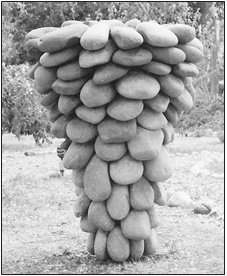
“Cone” 1994. Sandstone, wood, wires, nails (5’x3’x3’).
Though uprightness in evolution is usually associated with the animal kingdom and then humans, the response to challenges of gravity was first taken up on land by plants. A remarkable article published in 2016 by two scientists, Tabir Najrana and Juan Sanchez-Esteban, “Mechanotransduction as an Adaptation to Gravity,” describes the evolutionary process of life first appearing in the sea thirty million years ago and then moving on land four million years ago. Whereas gravity was easily neutralized in the oceans by buoyancy, once life forms moved from an aquatic to a terrestrial environment, a new set of responses needed to develop. These responses began at a cellular level as certain cells specialized and developed biochemical signals in response to changes in gravitational forces.
In spite of the more or less constant gravitational force on Earth, mechanical load of organisms on land is approximately 1,000 times larger than in water. About 4 million years ago, the first terrestrial organisms, plants appeared on the land from the sea. The terrestrial plants have adapted to and evolved on the land environment, so that they can extend their roots downward in the soil and their shoots upward against 1 x g (Najrana and Sanchez- Esteban 2016).
Being the first responders to terrestrial gravitational forces, it was plants who first engaged the problem of maintaining equilibrium in the gravitational field by using specialized cells to orient simultaneously in two directions – upwards and downwards using roots and shoots, which a Rolfer might call palintonicity. It is thus to the vegetative kingdom, rather than the animal kingdom, that we owe gratitude for our evolution to uprightness.
Though a great deal of attention has been paid to fascia by researchers in the past twenty years, Rolf’s original insight into the role of mechanical forces, specifically gravity, in shaping life aligns with the recent developments of contemporary science. The study and research of mechanotransduction – biochemical responses at a cellular level to mechanical influences – is a staple in the modern laboratory. As the title of her book Rolfing and Physical Reality indicates, Rolf understood the primacy of mechanical forces in shaping the human response to the gravitational field to create a greater efficiency. She also declared that this same restructuring of a human’s body in the gravitational field plays a vital role in psychological transformation. At the root of this declaration was her unproven assertion that psychological maturity accompanies physical maturity when there is a movement away from use of the extrinsic muscles and to intrinsic muscles for postural stability.
The business of living in extrinsics is characteristic of the very young; it is characteristic of the immature. I do not know, it may be that as long as you preeminently use extrinsic muscles you are immature. Perhaps maturity occurs as you begin to get intrinsics into the picture and bring both to a balance (Rolf 1978b, 125).
As a result of the SI process and more efficient use of intrinsic muscles, the physical transformation also has a psychological effect:
I f a Rolfer aligns a person appropriately, his behavior will be more what we label mature. That goes whether the kid is five or fifteen or twenty-five or fifty-five. At fifty- five we don’t call him immature; we call him neurotic. But it is the same problem; he’s stuck in an early place. As you align his body in accordance with the structure that is written into the tissue itself, you get evidence of more mature behavior (Rolf 1978, 100).

“Off the Wall” 1990. Sandstone, wood, wires, nails (4’x4’x18’).
Psychology and Rolf Movement® Integration
To understand more completely Rolf’s intent and the psychological import of SI, we have to turn to another Rolfer, Hubert Godard, a movement teacher and member of the Rolf Institute® faculty known for developing the Tonic Function Model, which has been elucidated by Rolfers Kevin Frank and Aline Newton. I do not know his present viewpoint, but in 1992, when interviewed by Aline Newton, psychology and Rolfing SI were for Godard integral with one another. Significantly, similar to Rolf he differentiates between the emotional and the psychological. “But to talk about the line,” commented Godard, “I need to be really open to [the] emotional around that and to use my skillfulness in psychological stuff, but the aim is not to have an emotional release” (Newton 1992, 44).
He further explained that his goal is not to deal with “neo-Reichian armor” but to work directly on the ‘Line’ so that the armor simply falls away. Once the client’s inner line is reinforced and greater access to the core is attained, often the problems psychoanalysis was intended to solve will either drop away or be more easily handled in therapy. “I have often seen people in a psychoanalytic process,” remarks Godard, “who, with Rolfing [SI] giving supporting effect in the gravity system, make a very quick end to many years of psychoanalysis” (Newton 1992, 46). This is the explanation of Rolf’s thinking when she said that emotional episodes are merely pebbles on the path. This differentiation between the psychological and the emotional is important to be noted by many practitioners who tend to identify the two as identical.
But if the up/down polarity is so endemic and a natural part of evolution as presented in “Mechanotransduction as an Adaptation to Gravity”, why do clients walk into our office misaligned and completely unaware of the gravitational field?
Spatial Bias
A relatively unexplored issue in the field of somatics is the problem of what I call spatial bias. Godard himself comments on directional spatial bias. “If you ask a person to point to the sky, you can see that there are two different ways to point to the sky: one comes from the ground and the other comes from the upper body” (Newton 1992, 48). Godard comments further, “To have the capacity for fight and flight, the two . . . if you are only ‘up’ you have no grounding. If you are a pusher, you have a tendency to be stuck in the structure, on the ground, and to change the stuff around you” (Newton 1992, 46).
This is expressed not only in our attitudes but also in our language. Individuals want to be ‘up’ and not ‘down’. We want to ‘walk on air’ and not be ‘put down’. After death we hope to go to ‘up to heaven’ rather than go ‘down to hell’. Anthropologist Edward T. Hall (1914-2009) wrote a number of books such as The Hidden Dimension (1990) exposing the differences in perception and behavior in relation to space embedded in various cultures and manifested in language.
Additionally, in our technological society with its emphasis on the cerebral and using tools such as cell phones, computers, automobiles, etc., there is also a heavy bias to the ‘upper pole’ and loss of connection to the ‘lower pole’. In 1985, Joshua Meyrowitz wrote the book No Sense of Place: The Impact of Electronic Media on Social Behavior where he explored the displacing effect of television on social space, i.e., the elimination of face-to-face conversations. He could have just as easily included a chapter on the disembodying effect of media on physical space, a theme that, if anything, has amplified since the introduction of cell phones and computers.
And then there is the simple morphological bias due to the design of our bodies, which orients to the space in front of our bodies which we can see, work with our hands, and walk toward. The overall neutrality in gravity is easily lost in deference to the many tasks that lay in front and ahead of us – simply, form adapting to function. Evolution guarantees functioning adaptive structures to the overall challenges in our environment, not necessarily the best one suited to gravity.
Thus, despite the protests about the constancy and objectivity of the gravitational field, space turns out to be anything but – our interaction with space is perceptual and this is why Godard referred to it as the symbolic. This is why SI, at its highest point of delivery, begins with understanding, insight, awareness, and sometimes even a change in consciousness. Rolf (1978b, 87) recognized the difficulty of the task when she said, “There is something about the fact that we live in the gravitational field which makes us insensitive to the recognition of that field. So we always have to keep pulling it in intellectually.”
The client who walks across the threshold of our office or studio has an opportunity to cleanse the spatial doors of perception and to rediscover himself as a singular body in relation to space as well as a singular body of space within space. The perceptual shift that SI requires then has the potential of reconnecting the person with what might be called the intrinsic self or the adamantine self. Proprioception gives us a clue to this potential. The Latin root of the word proprioception is a combination of two words, proprius, or ‘one’s own’, and capio or capere, ‘to take or grasp’ (Wikipedia). Thus, the literal meaning of proprioception is to grasp one’s self.
The Rolfing Ten Series can be viewed and presented as proprioceptive scaffolding, reorganizing not only the client’s body in relation to space but also the client’s spatial awareness. I have referred to this schematic in my previous article (Gottlieb 2017, 30): “The ten-session series thus can be presented as a series of sessions to reorganize the client’s directional awareness of space: the first session, up or north pole; the second session, down or south pole; the third session, sides; the fourth, fifth, sixth, and seventh sessions, center (lower), center, center, center (upper), respectively.”
Spatial reorganization of the body and perceptual shifts in relation to space shift the psyche and have the potential to initiate a spiritual journey. Existentialist psychologist Karlfried Graf Dürckheim in his classic The Way of Transformation: Daily Life as Spiritual Exercise explored posture as a manifestation of personality and commented on the effect of embodying this center of gravity, which in Rolfing SI we refer to as the Line:
This effort to attain the correct centre of gravity is the fundamental mental practice by means of which we are enabled to live in the world in the right way. Thus resting in the basic centre, we are relaxed and free and at the same time feel ourselves supported (Dürckheim 1971, 38).
And:
Understood in the personal sense “centre of gravity” does not refer to any specific area, but to what we call the root of personal or existential life. Nevertheless, it is possible to perceive whether or not a person is properly rooted in his physical body. When a man has found this correct centre of gravity in his body he can open himself to the forces that lie at the essential core of life and anchor himself therein (Dürckheim 1971, 67).
Psychological Transformation
If spatial relationships become a field of play cleared of bias, what Dürckheim viewed as ego attachment, the potential for meaningful healing and psychological transformation now are introduced. Interestingly and perhaps significantly, this same process takes place in art as well. Otto Rank, Freud’s disciple, modeled his therapy as a tension between neurosis and creativity with the goal of removing obstacles and restrictions to the development of the personality which might then manifest in works of art. From his point of view these works of art were a record of the artist’s transformation. Many biographies charting the voyage of the artist by analyzing his work echo this point of view.
This psychoanalytic model of neurosis, in fact, is a mirror image of the SI process and its potential for supporting transformation. Removal of restrictions and fixations is akin to reducing neurotic attachment with the aim of returning what might be referred to as flow on a somatic and psychic level. It is perhaps overly simplistic to think of body fixations and restrictions as similar to neurotic patterns that block, but it is a pleasing idea nonetheless. Hubert Godard, a Rolfer who was also accomplished as a dancer and dance teacher, demonstrates this point of view in discussing the shoulder girdle, theoretically, as a psychological point of freedom of the body that often takes on psychosomatic restrictions. “Because the arm, if free from gravity, it is full of emotion . . . The glenohumeral joint will reveal a lot about where a person is psychologically. And it makes sense, because the arm is so free, it becomes a psychological issue” (Newton 1992, 48). Removal of restrictions to the shoulder girdle thus can have a corresponding liberating effect on psychological restrictions in the individual.

“Polymonolith l” 1990. Sandstone, wood, wire, nails (10’x8’x2’).
Conclusion
To be clear, as Rolf stated, psychological transformation in and of itself was never the goal of Rolfing SI; but transformation, such as is experienced in various disciplines like yoga, meditation, and practices such as art, was. In her remarkable address, entitled “Structure: A New Factor in Understanding the Human Condition” in 1978 at the Explorers of Humankind Conference in Los Angeles, Rolf declared her truth: “structure determines behavior.”
As far as I am concerned, this is the message of structure, that structure even within human beings can be modified. And that in modifying it, you make available to the human being the energy field of the Earth which surrounds him. And that even though we be unconscious of the fact that we are working with the energy field of the Earth, that this is truly what is giving us the ability to change the situations of the man, and of his feelings, and of his abilities, and of his acceptance, and of his general behavior to the world around him. I think I am sorry to say, this is all of my message. But if you take it to heart, you’ll find you have quite something to think (Rolf 1978a).
While psychology is obviously included, my view is that the concept of ‘consciousness’ would better serve in describing behavioral changes stimulated by SI. That change in consciousness begins with an awareness of one’s body within space and in relation to the gravitational field, again the ‘embodied self’. A term in vogue, nowadays, is planetary consciousness. I would assert, in the spirit of getting the physics under the metaphysics, that the idea of planetary consciousness begins with the individual’s physical relationship with the planet as a physical entity, what Dr. Rolf might describe as aligning the smaller gravitational field that is man with the larger gravitational field that is earth. It is the Rolfer’s job to help do just that.
Author’s Note: I would like to add a note of thanks to Rolf Movement® Instructor and Certified Advanced Rolfer Kevin Frank for correspondence and conversation about Hubert Godard, saving me from entering the ‘extrinsic/ intrinsic muscle’ morass.
Szaja Gottlieb first received Rolfing sessions in 1978, which resulted in him becoming a stone sculptor, which, in turn, led to his becoming a Rolfer in 2001. He lives with his wife Ko and daughter Judith and practices in San Luis Obispo, California. He believes in the transformational potency of SI.
Bibliography
Burford, E. 1998. Gravity and the Creation of Self: An Exploration of Self Representations Using Spatial Concepts. London and Philadelphia: Jessica Kingsley Publishers.
Dürckheim, K. G. 1971 . The Way of Transformation: Daily Life as Spiritual Exercise. London: Unwin Hyman Limited.
Gottlieb, S. 2017 Mar. “The Art of Rolfing® SI and the Art of Sculpture, Part 1: Seeing, Embodiment and Space.” Structural Integration: The Journal of the Rolf Institute® 45(1):28-32.
Hall, E. 1990. The Hidden Dimension. New York: Anchor Books/Random House Inc.
Lesondak, D. 2017. Fascia: What It Is and Why It Matters. Pencaitland, Scotland: Handspring Press.
Meyrowitz, J. 1985. No Sense of Place: The Impact of Electronic Media on Social Behavior. New York and Oxford: Oxford University Press.
Najrana, T. and J. Sanchez-Esteban 2016. “Mechanotransduction as an Adaptation to Gravity” Frontiers in Pediatrics 2016(4)140. Available at www.ncbi.nlm.nih.gov/pmc/ articles/PMC5183626/ (retrieved 5/15/2018).
Newton, A. 1992 Winter. “An Interview with Hubert Godard.” Rolf Lines 20(1):42-48.
Ol ie E t y m o l o g y D i c t i oa r ywww. etymonline. com/ word/ matter (retrieved 5/15/2018).
Pearce, J.C. 1977. Magical Child. New York: Penguin Books.
Rank, O. 1935/1968. Art and the Artist: Creative Urge and Personality Development. New York: Agathon Press.
Rolf, I.P. 1978a. “Structure: A New Factor in Understanding the Human Condition.” Audiotape from the Explorers of Humankind Conference in Los Angeles.
Rolf, I.P. 1978b. Rolfing and Physical Reality.
W i k i pd i a . “ JaP i a gt , ” Wikipedia, The Free Encyclopedia , https:// en. wikipedia. org/ w/ index. php?title=Jean_Piaget&oldid=839126116 (retrieved 5/15/2018).
Wikipedia. “Proprioception,” Wikipedia, The Free Encyclopedia, https://en.wikipedia. org/w/index.php?title=Proprioception&old id=834541677 (retrieved 5/15/2018).The Earthbound Metaphysic[:]