

ABSTRACT Sterling Cassel interviews Basic and Advanced Rolfing® Instructor Sally Klemm about the Ten Series – when and how she practices it, and thoughts on teaching it. They also give particular attention to the Seventh-Hour work on the cranium as Klemm is also a teacher of craniosacral work.
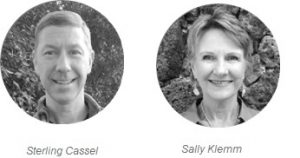
Sterling Cassel:
The Ten Series is the theme of this issue. I’m interested in talking with you about that, and particularly about your relation to the Seventh Hour as you teach craniosacral work as well as Rolfing Structural Integration (SI). So we can range far and wide.
Sally Klemm:
Sounds good Sterling: I’m game.
SC: Let’s start with you Sally. You practice Rolfing SI and teach Basic and Advanced Rolfing trainings as well as CE classes. How do you look at the Ten Series through each of those lenses?
SK: In brief I’ll say the practitioner lens differs considerably from the instructor lens. And each according to what level of client or students I’m working with.
As a Basic Rolfing instructor, the lens is focused on presenting the Series in a technically coherent and logically cogent form. The lens in intermediate (CE) training becomes more focused on developing and refining a particular aspect of the Series in greater depth and detail. In Advanced Trainings, the lens opens wide again, extending beyond the Ten Series to consideration of the multidimensional aspect of the work; strategizing nonformulistic and principle- based interventions via the various taxons according to individual client needs.
SC: How do you decide whether or not to do a Ten Series or do nonformulistic work in your practice?
SK: I generally leave it up to the client to determine.
SC: You don’t necessarily push or recommend the Ten Series?
SK: Recommend, yes; push, no. The Ten Series does provide an excellent, marketable package with a label with a recognizable brand. The curriculum and instructional model of our trainings fits well with the package. As a package it can be taught fairly formulaically and the Rolfing brand can be sold as a unit. People come for the packaged set of ten; it’s a convenient brand.
At this point in my career, I don’t need to adhere so strictly to the ten pack. When people call me and say, “I want to get the Ten Series of Rolfing; I heard about it, you’re in my neighborhood, and I want to do it,” I’m apt to reply, “Come in for a session and then we’ll take it from there”. I tend to package it in terms of a single unit; that’s my usual selling point. I don’t tell clients that they have to sign up for the entire ten sessions. More often I recommend a single session, and if they like it, they can come for two more. If they don’t; we’re done. If someone likes the three and they want a fourth, I then recommend seven to ten – the reason for that being how sessions four through seven build on each other to establish transmission through the axial complex, and eight to ten being the integration or closure piece, etc. Having said that, the Ten Series is always at the background of my thinking and strategy making – even if it’s a single first or umpteenth session.
Because I live where I do, people will often come out of curiosity when they’re visiting Hawaii. More and more people are combining their trip to the islands with a seeking out of self-care that they might not pursue in their ordinary environment. They may say, “I heard about this. I’ve taken a vacation from the stressful situation I’m in at home and work and I thought I’d try this while I’m out here.” I say, “Great!” I may see them for a single or several sessions. Other people come that have started the Ten Series with a Rolfing practitioner in another area of the world and may want to continue while they are on island. It’s kind of fun actually: it could be a post-ten, or it could be a four, a nine . . . I may see them only a few sessions. I also have clients that have only received piecemeal work. They don’t commit to a series, but they will commit to coming in when they get ‘in trouble’. That’s always fascinating because had they done a classic Ten Series their recurring issue might have been addressed earlier.
SC: Mmmm.
SK: I firmly believe that Rolfing SI is not just manipulation, but also a process of education. The education piece is now at the forefront of my work, whether I’m practicing or teaching. In one sense the instructional aspect often has a conceptual and didactic component. Students are studying the goals and the anatomical territory while learning techniques and different cognitive aspects, for example the Principles of Intervention. That’s a very different kind of knowing than the experience of participation in, say, a Seventh Hour. It’s more of an open field of inquiry. Is that too vague?
SC: I like it.
SK: In the beginning of my practice, I was constantly wanting to earn my chops, hone my anatomy and technical skills in terms of achieving the session goals, and educating my client. Now I find the actual experience of a session, particularly the Seventh, has taken on a life of its own. I’m less directive and instructional and more inclusive in terms of it being a participatory experience for myself as well as the client. This calls for both client and practitioner involvement in the realm of sensation and awareness. What does the work feel like in a sensorial fashion? The perceptions and experience are personal and unique, and vary widely from client to client, session to session.
SC: Yes.
SK: I’ll go on from here to mention that our ways of knowing and styles of learning in the West are very cause and effect. We crave a rationale for the way things are and want to understand the cause. Particularly where there’s pain and distress involved, we seek to end, undo, resolve, or fix it as soon as possible.
In terms of Rolfing’s holistic approach however, structural integration is an ongoing life process and embodiment continues on beyond the Ten Series.
Let’s take pattern recognition for instance. Pattern recognition is integral to embodiment. By means of touch and contact, with the practitioner as a guide, we can optimally gain insight into habitual patterns of posture, movement, or gesture that are unconscious. They’re not really in our cerebral cortex – or our rational mind – but more in the realm of feelings, emotions, or sensations that are actually in a different part of brain and nervous system altogether. How might we use skillful means to bring those sensations and the nervous system more into our conscious awareness? For me, it entails slowing down and being relaxed enough to attend more to the sensations and perceptions that my rational or cognitive mind isn’t so great at tracking.
Rather than asking what’s causing this issue or pain, the question becomes open-ended: How might I provide enough space and support in the system to affect a beneficial reset in the nervous system in order for the entire body to come back home to center?
How do we begin to sense our way in through the territory that is interfering with an experience of verticality and impinging on transmission through the core? Consider for a moment Jan Sultan’s five elements or components of structure
All of them converge in the neck and the cranium, which is basically the territory of the seventh session, right? This has ramifications right through to the other pole of the spine and into the feet and legs. Ideally we’ve systematically worked through the body with each progressive session so that the classic seventh- session task of putting the head on the top of the spine is a goal that’s available or achievable to us.
SC: Great.
SK: I have another point to make about using moment-to-moment experience for the duration of a session to explore the territory in an embodied and tactile way, i.e., how does the cranium relate to the rest of the body, or, let’s say, complete the ‘Line’? Rather than this moment-to- moment experiencing, the focus for our clients and students as clients in general becomes a tendency to react (rather than respond) to a particular pattern or condition or situation.
For example, I assume you’ve experienced this: you’re working in the territory that is impinging on the overall integration and the client says, “That’s it! – that’s the spot!,” and begins to react in a way that’s contractile. I’m referring to the tendency to brace somewhere to release something elsewhere, rather than patiently allowing a response to occur. That is significant for me.
SC: And do you find that people who have had a lot of work can allow a response to occur better than, say, a person completely new to Rolfing work?
SK: I do. I think one of the gifts of the Ten Series is this educational piece, the opportunity for clients to learn somatically, to accompany them in an exploration of the body’s natural responsiveness. We’re already alive, we’re already responding. We’re already breathing. I’m a big fan of optimizing respiration, the goal of the first session, but also the goal of all ten sessions – you know, Ida Rolf’s description of the Series as being ten different approaches to improving respiration certainly is conducive to allowing the nervous system to come into a more responsive and less reactive state. And that is not cognitive. It’s more limbic. It’s more in the autonomics.
SC: Yeah.
SK: If we can refine our ability to sit with, listen to, open to, and embody the inherent vitality that’s already going on – these responses are always mirrored in the breath. It gives the nervous system a chance to respond.
SC: As an instructor, which part of the Ten Series is the hardest for students to learn? And hardest to teach?
SK: Off the top of my head I’d say the integration part (or piece) – sessions eight, nine, and ten are often the most nebulous because we have a fairly clear roadmap in one through seven in terms of principles, goals, territories, and the outcomes we would like to achieve. However, having covered those seven bases, to switch from differentiation to integration is often less clear. And by the same token, more open- ended. Integration continues on beyond, far beyond, the Ten Series.
Integration is hard to convey, it’s a pretty lofty notion to look at people holistically. The tendency for new practitioners is to think it must be delivered within the ‘ten shots’ of the Series. In reality, integration is an ongoing process of embodiment rather than a goal or destination to be achieved once and for all. That process has its own timing. Does that answer your question?
SC: Yes, it does. Do you have a favorite session that you love to do, or any that you’ve found more challenging over the course of your development as a Rolfer?
SK: As both a Rolfing practitioner and an instructor, my favorite session is the session at hand. I’m trying to guide the way through the Series, but it isn’t really me that teaches Rolfing; it’s the Series that teaches them as they embark on their practice. And that’s what I love so much about what I do. I’m still infatuated with Rolfing. It’s like a long-term relationship. And to share that with others step by step, I love it.
SC: What about in a Ten Series, do you ever make modifications and switch things up where you may do something that ought to be done later earlier (in terms of the historical template of the ‘Recipe’)?
SK: Let me go back a little bit. For example, in an intermediate or advanced class we go into further consideration of some of the elements of the seventh session or some of the elements of the cranium in a different way – to get some more precision and refinement at an advanced level that most of the time, would be beyond the scope of a basic class.
So, in terms of a basic Ten Series, I consider each session is more of a lesson if I’m looking at it formulaically. You know, that one lesson leads to the next, and it may take two visits to complete a lesson, particularly the seventh session that addresses the interplay of the viscerocranium and the neurocranium. It may be that there’s a session 7A and a session 7B, where one appointment addresses tissue in the axial portion of the cranium while the next appointment might address the visceral component separately. Or even a possible separate session on the neurological component, or inherent motion – bringing a balance to that.
SC: Some people say that the Ten Series is a teaching tool. How do you frame that to students in Basic Training?
SK: For example, in a language, you learn the basic, present tense, before you start learning past tense or pluperfect. With the Ten Series, you have a lesson plan for each of the different sessions built into the ten-step protocol. There are goals and territory for each session: one through three you address length, width, and depth; in the middle four sessions you are addressing torsion and rotation and contralateral movement and how they are reflected through the central axis of the spine; then the three final sessions you are in the integration phase – whether you call it upper and lower body, G and G’, or the ‘spheres’, or different images – and hopefully these will be incorporated in a way that allows a more connected, embodied sense of oneself in the world.
SC: Let’s talk more about the seventh session. We sometimes hear that some Rolfers are no longer doing the nose work or the intraoral work that’s part of the classic Seventh Hour. How do you feel about that, and what do you think the client is missing out on, or what, perhaps, is the Rolfer misunderstanding?
SK: That’s a good question. Interesting and fascinating to me is that interface of cranial work with structural integration. The dimensionality of the cranium and how that dimensionality, that sense of palintonicity, can be enhanced through our work. And it may be different for different clients.
For example, the interface of the neurocranium with the viscerocranium in the head is a huge consideration of the seventh session. There needs to be span or a possibility for dimension from the center, for a centrifugal expansion or dimension within the cranium – particularly if it’s restricted in the anterior/ posterior depth, the interface of neuro- and viscerocranium. The nose work and the mouth work can be very effective in increasing front-to-back depth and releasing the sense of restriction or compression through the front and back of the skull.
I mean, it’s not just front and back. Behind the nasal pharynx we have the body of the sphenoid, at the top of the visceral core. It’s at that juncture where the visceral core relates to the foramen magnum and the spinal cord going down through the spinal canal for our central nervous system. With some clients, a hypertonicity or contracture through the axial compartment of the neck may be more influential in terms of that palitonicity, so perhaps a client like that doesn’t need nose work. Do I do nose and mouth work every single seventh session? No. But have I omitted that from my practice? No. So it can be client- or session-specific depending on my perception of the needs of the client.
Also, if anything, I’m more apt to do mouth work because of the influence of the mandible and in terms of different strain patterns that can be driven into the cranium via the mandible and upper shoulder. So if I would leave something out, I might leave the nasal work out. And having said that, I don’t lock myself into the seventh session only for intraoral work. I often begin the intraoral work earlier in the Series, often at five and occasionally at three. That was a good question.
SC: When, from the client’s side, might it be appropriate to not do the nose or mouth work? Say if somebody had a history of trauma there, or just specifically said they didn’t want to. Does that happen?
SK: Yes, it happens. Some clients I see on an ongoing basis are working through traumas of various sorts and cannot (yet) tolerate nasal or intraoral work. With those folks, it is possible to affect structural change externally. The practitioner’s ability to sense the inherent motion of the cranial system facilitates this significantly. If the client will allow a grip to the front teeth, for example, that hold can be used to decompress the maxillae and sense through to the vomer and ethmoid. In addition, the cartilage of the nostrils can be used to feel fascial connections through the conchae from outside the nose.
Because the mandible is one of those single structures that crosses the midline and has a paired joint with the two temporal bones, many clients present with temporomandibular issues because of asymmetry through the temporal bones. And those structures feed into the lateral line of the head. It is easier and more direct to work on the deeper layers of the masseter and the lateral pterygoids intraorally, but it is also possible to effect change in that fascia from outside the mouth. As we get more refined at feeling the various layers and perceiving where tension is held, we can work from superficial to deep without going into the mouth.
SC: How do you know when you’ve done a good Seventh Hour? What’s the hallmark?
SK: The first hallmark that comes immediately to mind is when the client reports a better connection to their feet. Another one might be the client’s sense of having relief from – most often– neck pain or headache. For me as the practitioner, I look also for a palpable sense of transmission; if I can perceive this from the foramen magnum / occiput/ atlantooccipital joint through to the lumbosacral junction, I’m happy. That’s a big hallmark because to get that sense of connection from the cranium through the neck that does not end at the mid-dorsal hinge but extends below throughout the thoracic spine into the lumbars and sacrum, with that the client often perceives and has the felt sense that the support for their cranium is at the base of the sacrum, that they are not ‘doing’ something to support it or to be upright.
SC: Is there anything else that you would like to address or expand on?
SK: Not that I think of off the top of my head.
SC: Thank you, Sally, I’m very happy with this.
SK: Thank you.
Sally Klemm is a member of the Advanced Faculty of the Dr Ida Rolf Institute® who has taught certification courses in Rolfing Structural Integration and craniosacral work internationally. She is a graduate of UC Berkeley and holds a Master’s Degree in Education. Sally’s ability to blend an organized cognitive style with intuitive understanding reflects her fascination with the interface of psyche and soma and how that informs our direct experience. Her teaching style creates a relaxed atmosphere that supports a variety of learning styles. When she is not traveling internationally to teach, Sally maintains a private practice on Oahu and Kauai in Hawaii.
Sterling Cassel graduated from the Rolf Institute® in 2005. His practice is located in Kirkland, Washington. He is currently talking the Advanced Training and will be done in June 2019.
Thoughts on Practicing and Teaching the Ten Series and the Seventh Hour