

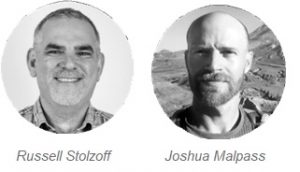
ABSTRACT Russell Stolzoff talks with Joshua Malpass, Rolfer and endurance athlete, about his sports, his Rolfing Structural Integration (SI) journey, and his practice..
Russell Stolzoff:
Thanks for taking the time to do this. To start I’d like to ask you to talk about your background and how you got into Rolfing Structural Integration.
Joshua Malpass:
I started out getting a kinesiology and exercise-science degree. I had a personal- training business and was actually training for an Ironman when one day a car ran a stop sign and hit me on my bike. A guy that saw me get hit said I flew about sixty or seventy feet before I hit the ground. When the car hit me the frame of the bicycle wrapped around my leg and broke on my leg. I ruptured several discs, got a spondylolisthesis, all types of things like that. Doctors all said if I didn’t get surgery right away, I’d be paralyzed, but none of them would agree on the surgery procedure I needed, so I tried everything else – chiropractic, acupuncture, physical therapy, massage . . . Nothing worked. And then I met Scott Pyeatt, a Rolfer down here in Orange County, and within three or four sessions I could breathe again, and I could walk again. I basically hadn’t been breathing for several months . . . just what happens when you get fifteen-millimeter ruptures in several discs at the same time. After the Ten Series with him, he told me I’d probably do really well as a Rolfer. So, I looked up the Rolf Institute® program and went into it. That was probably twelve or thirteen years ago. I never did have to get the surgery, and now I’m back to doing Ironmans and all those other types of things. I’m doing an Ironman in another three weeks.
RS: Thats’ a very powerful story. I know you mostly as a runner. I didn’t know that you are a triathlete, but I did know you do ultra-distance marathons. Tell us about your athletic endeavors.
JM: Well, I guess it starts in high school. I did swimming and water polo. Later I got really into mountain biking, and then I started doing triathlon and worked my way up to Ironman. With the running part of triathlon, I preferred running on the dirt (Figure 1). And as soon as you start trail running you meet ultrarunners. I just wanted something else challenging. So far, I’ve done several fifty-mile ultra events and several 100-mile events. Last year I did my first 200 miler – that was seventy-nine hours straight of running all up through the area where you live, in the Cascades from around Mount St. Helens all the way up to Mount Ranier. It was 209 miles and it took me seventy-nine hours.
RS: Did you sleep?
JM: Yeah, you sleep. Some people don’t but they hallucinate pretty badly. I slept about an hour and a half each night. I read something about how the average human has sleep cycles of ninety minutes, so I figured if I got one sleep cycle in each night it would keep the hallucinations down a bit. I have another one of those coming up around Lake Tahoe in September. It’s another 200 miler. It’ll be fun.
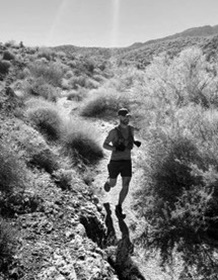
Figure 1: Josh Malpass trail running.
RS: I’m curious how you approach training. What is your typical workout like?
JM: Well, the funny thing is most people that do the kinds of events that I do run anywhere from sixty to 100 miles a week. They’re getting in several ten-mile runs during the week and then a twenty- and a thirty-mile run in on the weekend. But I don’t do anything like that. I run maybe twice a week tops, four to six miles on Monday and then again on Wednesday, then I’ll run maybe fifteen or twenty miles max on Saturday or Sunday. I actually just looked at my average for this year and it was two runs a week and thirteen miles per week. So, two six-and-a-half-mile runs per week.
The only way I can explain that it works comes from when I was in the Rolfing training. During Units 1 and 2 we talked about Rolfing SI and biomechanics and about appropriate movement patterns in the context of the Ten Series. You know the Twin Lakes right next to the Institute? Well, we had the hour-and-a-half lunch break and I didn’t need ninety minutes to eat, so I just changed really quick and I’d go out and I’d run around those lakes, and the whole time I was running I would focus on what we talked about in class that day. So, I like to say that I ran the Ten Series into me. Because of my back injuries, even though I’m pain free, I’m extremely careful with my form, and I really do believe that if you can move your body appropriately you should be able to do it without breaking it down. So far I’ve been successful at it. It’s an interesting kind of long-term experiment with my own body.
RS: It sounds like embodiment is an important part of your training. I know that when some people think about long- distance endurance athletics, they think about dissociation – how you would have to, in a sense, leave your body in order to be able to deal with the discomfort or the fatigue.
JM: People say, “What are you running away from?”, or “You’re just out there running away from your problems”, but it’s the exact opposite. When I go out for a six- or seven-hour long run by myself on the weekends, I don’t take any music, I don’t take my phone. The moment you hit the trail, your problems, all of them, are staring you right in the face, and you have to deal with every single one of them. The amount of self-reflection and intense picking apart of every decision you’ve made in your life and how you could have done it better . . . you can’t get away. You’re just out there, and it’s awesome, because you can really push away all the distractions and figure out the person that you want to be.
RS: That’s an amazing approach.
JM: It’s a celebration of life, right?
RS: Talk a bit about who your clients are and how your athleticism informs your work.
JM: I work on a lot of triathletes, cyclists, runners, CrossFit® practitioners, and a lot of people that do way too much yoga.
RS: Too much yoga?
JM: Yeah, way too much. I mean folks out there that, you know, their friends are at the yoga studio, their job is at the yoga studio, their spiritual life is at the yoga studio. They do two classes of yoga a day, six days a week, and they’re totally unstable because they’re so loose. They don’t have anything holding them together anymore. I think yoga is great once or twice [a week] at the most. I don’t claim to be right in that, but it’s just my opinion.
So, I get a lot of business from people hurting themselves doing yoga. And I meet people running. Everybody has something that hurts. It’s either their foot, or their back . . . same thing on the bike rides. Something always hurts. So I’ll talk to them and they can tell that I know what I’m talking about. It’s a small community of people that do long-distance running events and Ironman events, and your name gets around pretty quickly. I’ve been fortunate enough to work on a few people that win races, and if the guy that wins then goes out and tells everybody that I fixed his hip, and that’s why he won, then pretty quickly you get a lot of people calling you. It gives you a huge amount of credibility when somebody comes in and their injury is from some sort of exercise and they know you do the same exercise. They know they can trust you, and you’re not going to tell them, “Well, if it hurts to run, just stop running.”
RS: What is your opinion about having pain or injury and continuing to train?
JM: I’ve kind of decided, or maybe it’s something I heard at the Rolf Institute, that movement is the healer; motion is lotion. You know, we put the body in its correct range and plane of motion, and then you move it correctly. That’s what brings the healing – the blood flow, the oxygen. So, if something hurts, it’s my opinion that it’s probably being used incorrectly. When some people say, “I have an overuse injury,” I think that’s impossible. There are people out there that run 200 miles a week and they don’t have an overuse injury. So, I believe people have an incorrect-use injury.
If someone has truly injured something – torn a muscle or a tendon – then, yes, you have to stop, you have to rest. But if there’s just an ache or a tightness or some kind of chronic nerve [issue], then I ask, “What is it in your body mechanics that’s continuing to perpetuate the injury that we can change, and then through appropriate body mechanics how can we actually speed up the recovery process?” If I’m out doing a run or a bike ride or swimming and something starts to hurt, I change my body mechanics to make it feel better, rather than stopping. That’s what I try to teach the people that I work on. If something hurts, change your body mechanics to actually speed up the healing process, instead of sitting on the couch and waiting for it to get better.
RS: Do you typically begin your work with people through the Ten Series?
JM: It’s been a while since the majority of my clients were Ten-Series clients. It seems like I’ve always got at least a couple that are going through it, but it’s more often like fix-it work, or it’s first-aid work. But I still do it. In fact, I just finished up a Ten Series last week. If someone requests it, I’m happy to do it, but it’s generally not my go-to anymore.
RS: Why is that?
JM: Everyone’s in a hurry in Orange County. They want to get better now. They want to get back to working on whatever their max is in CrossFit, or back into whatever pose they can’t get into in yoga, or they’ve got a race coming up in a month. They don’t want to wait until the sixth session for me to free the sacrum. They want me to free it right now.
RS: Do you think your training as an Advanced Rolfer better enables you to work like you do?
JM: Yes. The Advanced Training definitely changed my work. It slowly changed it – it took a while to really kind of marinate and sink in, but the way that Jan [Sultan] taught that class gave me a clearer view on how to focus on specific areas and get a more global effect in the whole body.
RS: Do you also work with non-athlete clients?
JM: Yes, I’d say my typical client is a mid-fifties executive, and I work with a lot of business owners, business people, and lawyers. There are a lot of lawyers in Orange County, and they’re so stressed out. You know how it is, nine out of ten clients come in and they’re focused on the massive knots in their shoulders, so then you have to educate them on posture and how to sit. Several of my clients are in their late eighties and a couple are in their early nineties, I’ve got a handful of really young teenagers with scoliosis, and then everybody in between. I prefer athletes. I would rather work on getting somebody’s back feeling better so they can go out and crush a hundred-miler than so they could go out and crush eighteen hours at their desk, but I’m happy to work on anybody.
RS: What other types of sports are your athlete clients doing?
JM: I met a chiropractor down here several years back who works on professional athletes of all types. He referred a bunch of pro surfers to me, so I’ve been working on them. Then I got a handful of other people in that line, like pro skateboarders, pro snowboarders, some high-level golfers, things like that – a lot of varying types of athletes. It’s been a lot of fun.
RS: When you’re working with action-sports athletes, is your approach any different?
JM: Yes. They have a different purpose behind their sport and they have a different drive behind their sport, so you have to meet them from a different place. You just have to meet them where they’re at.
With people who are into endurance sports, there’s a much more emotional/ spiritual component. Like what I was talking about before: you get out there and your problems are right there staring you in the face. Basically, it’s movement meditation; even if people don’t use that language, they all understand that’s what it is.
Whereas with the action-sports guys, most of the ones I work on are doing it for a job. It’s their bread and butter, it’s their income. So they’re coming at it from a very different place of high level intensity, and they have to be able to stick this trick, and it can’t hurt when they’re out there in their heat because they don’t want to lose focus. So then I am approaching it in a very different way. It’s much more of really trying to get in and free up the tethered nerve or calm down the inflamed tendon. Whereas with the endurance-sports person, it’s a lot more of getting into the body mechanics and trying to find a way to teach them how to heal themselves better.
RS: Those are great distinctions. What role do you see Rolfing SI has in recovery for performance sports?
JM: The biggest thing I find is the educational aspect. I have a line I tell people. I tell them how silly it is that we’re trying to put people on the moon when we don’t even know how to breathe. Most people that come into my office don’t know how to breathe. They don’t know how to sit. They don’t know how to walk. They don’t know where their head is supposed to be. We’ve completely forgotten how to be humans and how to exist on this planet, but we’re trying to put 12,000 satellites into the solar system to blanket the earth and Wi-Fi right now. Why don’t we work on just teaching people how to breathe correctly again? So to get back to your question, I’m just trying to teach people how to get back into their bodies, how to move correctly, breathe correctly. I think if someone is moving correctly and eating correctly, then they can go really strong and really hard for several decades without having the degeneration and breakdown. I’m trying to teach people that so they can they can feel good and have fun for as many years in their life as they want to continue pushing for that.
RS: Do you have advice for Rolfers who want to focus on working with athletes?
JM: Yes. Make sure you do the athletics yourself. You’ve got to have some credibility with these people. Athletes look at their sport the same way that a business professional looks at their trade. They take it very seriously. If I try to talk to somebody about the mechanics of throwing a football, they’re going to know that I don’t know what I’m talking about because that’s not my thing. So you have to prove that you’re the expert by actually living it out.
RS: Is there anything else you want to touch on?
JM: There’s so much. You know, you do this a few years and you get pretty passionate about trying to teach people how to live their best life. One of the interesting things I’ve learned is that the more I focus on the finances of the practice the more my business slows down, and the more I focus on just truly trying to help people and love people through my work, the more my practice gets busier and busier.
RS: That’s a great message, Josh. I really appreciate you taking the time for this.
Joshua Malpass, Certified Advanced Rolfer, earned his BA in kinesiology and fitness at California State University, Long Beach. After operating a personal-training business for several years, a ‘fortunate’ bike accident caused him to encounter Rolfing SI. He has been in practice for twelve years. He lives with his wife and son in a small canyon town in Southern California and loves the lifestyle that his Rolfing practice provides them. A large part of his practice is working on high-level action-adventure and endurance athletes. Josh also participates in Ironman and ultramarathon events. You can learn more about Josh at http://www.ocrolfing.com.
Russell Stolzoff is a lifelong athlete whose understanding of Rolfing’s impact on embodiment and performance dates back to the dramatic improvements in balance and quickness he experienced from his first Ten Series in 1983. For the past thirty years he has devoted his professional life to elevating his skills as a practitioner and instructor. In 2010, Russell founded Stolzoff Sportworks to bring the benefits of Rolfing SI to professional athletes. He was instrumental in helping members of the NFL’s Seattle Seahawks stay in the game and perform at the highest level en route to two consecutive Super Bowl appearances and the 2013 Super Bowl NFL Championship. Russell’s diverse background includes scientific research and studies in Somatic Experiencing® trauma resolution and Bodynamic Analysis (a developmental approach to body psychotherapy). Russell is a member of the Dr. Ida Rolf Institute® (DIRI) Advanced Faculty and chairs the DIRI Education Executive Committee. He lives and practices in Bellingham, Washington.
Russell Stolzoff, the Journal’s Sports Editor, is interested in talking with you about your sports Rolfing stories. He can be reached at [email protected].