
By Michael Boblett, Certified Advanced Rolfer™ and Kevin Frank, Certified Advanced Rolfer and Rolf Movement® Instructor
ABSTRACT Michael Boblett interviews Kevin Frank on the art of reaching back into the human – and pre-human – family tree to reawaken lost patterns of movements. What sets this interview apart is a firm emphasis on the day-to-day needs of clients in a busy Rolfing® Structural Integration (SI) practice. In their dialogue, Kevin and Michael provide a very practical set of suggestions, things that work.
Michael Boblett: What are we talking about today?
Kevin Frank: Our topic is the capacity to have an active kinesphere, especially in association with certain kinds of movements that involve hanging and twisting and being in different orientations to gravity and using all four limbs.
MB: In addition to your background in movement, one of the things I appreciated when I took your class in 2006 was your ability to really go back into phylogeny, back up the family tree literally and figuratively to find stuff that we’ve forgotten – mostly in probably just the last few thousand years as we have increasingly restricted the motions that we do. So, one of the things I wanted to talk about was monkeys and Australopithecus, who spent a great deal of time in the trees, and the fact that even now, if you put homo sapiens and hunter gatherers somewhere where there are trees, they’re going to climb them. Children never got the memo that we came down from the trees. What are your thoughts about that? Specifically, how do you apply that with clients?
There’s so many things that people have weighing on them, or triggering things that get in the way of actually discovering the fun of being in a broad experience of how many dimensions there are of the space around us. We first have to encounter, or negotiate, what that first little step is that allows the body to be comfortable enough, to feel safe enough, to allow it to feel good.
KF: Well, first of all, as we approach people’s challenges, if there are limitations in the way people are using their body, we have an opportunity to introduce people to dimensions of their awareness and strategies for movement with enjoyment. We can introduce novel experience that supports a natural capacity to respond more, shall we say, creatively and ergonomically to life’s daily challenges.
MB: Nice. Now, when you work with people on hanging, how do you deal with the fact that most people’s hands are too weak to hang for more than a few seconds?
KF: Well, there are many things that all of us are introducing clients to that are perhaps initially too hard, intimidating, or off-putting. I think one of the chief roles we play as we support someone in opening up the world of his or her body is to create ‘availability’ [make something possible] and to continuously do just that, whether we’re working with someone very elderly or very limited in their experience or someone who’s recovering from injury. A huge part of what we’re doing is finding a friendly trail of breadcrumbs between here and there. So, for instance, when I work with a client who’s ninety-four and still actively Alpine skis, I’m always working to discover what’s going to feel like the appropriate amount of difficulty that makes it interesting but not intimidating. I now have him hanging from a chin up bar but with his feet on the ground, bending his knees. I’m not working with many people in very vigorous hanging situations, and I’m not necessarily introducing it as a vital ingredient unless they’re already interested in it.
I think you may have really done a great service by intentionally delving into the hanging because you like to do it. Let’s say someone is interested in hanging but she can’t really use her entire body weight. Well, then you find a way for her to not have to support the entire body weight. You work with her lowering herself down, on knees or in some other way, even on a chair. You might work with just one arm and girdle at a time. You can use a pulley system so that a person is able to really titrate the amount of weight that being sustained.
Again, I think about a ‘trail of breadcrumbs’, so a person finds that first tiny discovery that’s an authentic appreciation of what it means to allow the weight to be experienced through the chain of bones from the fingers through the carpals, through the radius and ulna, through the humerus into the scapula, into the rib cage, and registering the value of having a refreshed experience of what it means to be in a suspended format. For many people, the barrier is often the habit of protecting against feeling the weight or immediately trying to apply a strong effort to be adequate in their performance of a movement.
There’s so many things that people have weighing on them, or triggering things that get in the way of actually discovering the fun of being in a broad experience of how many dimensions there are of the space around us. We first have to encounter, or negotiate, what that first little step is that allows the body to be comfortable enough, to feel safe enough, to allow it to feel good.
MB: This is absolutely marvelous! I work in San Diego with a relatively young population for the most part. San Diego has been listed as one of the healthiest cities in the world. So, the whole issue of titration, and particularly with people who have fears about gravity and hanging, that’s something I’m not as prepared to deal with. You mentioned using a pulley system. Pulleys are something that I’ve just started getting clients to use, but I just encourage clients to use the pull-down bar at the gym, with weights. Getting to and from the gym doesn’t always happen. Are you aware of any hanging system that people can use relatively easily at home?
KF: For shoulder rehabilitation, these pulleys are pretty widespread online. You put hooks in the ceiling and attach it. It’s not very robust; you wouldn’t want to put all your weight on it, but for the practitioner to hold one of the handles while the client negotiates allowing his hand and arm to be raised slowly, we can catch the moments where a person starts to work too hard or when there’s a habitual tendency to defend in the shoulder muscles. We can slow it down and track the person’s experience and begin to create a new pathway. The least expensive thing is a small pulley at the hardware store and a piece of clothesline and then a couple of handles of some sort. You can just take a piece of dowel and wrap the cord around it, and you’ve got a simple handle. And in that way, there can be some continuity between the exploration in the office and then at home.
MB: One of the articles I’m putting together is about how to get people to the point where they can just use a simple pull-up bar over their door at home. Part of the skill with which you approach this is with different kinds of clientele. I make many assumptions because my clientele tends to be young and athletic.
KF: Let me affirm [the importance of] people beginning to learn what it’s like to use their latissimus and their lower trapezius in a manner that is friendly enough that things don’t get all bunched up, so people don’t turn on every muscle in their body. There are so many ways in which the people I see, broadly, lead lives where there isn’t so much opportunity to do that coordination of pulling down with the hands to pull the body up. And, it doesn’t have to be with the entire body weight. We’ve also put a hook in the ceiling and attached a loop of TheraBand attached to a 13⁄8”-diameter [3.5 cm] by 32” [80 cm] stick, so a person can begin to pull down like at the gym, but again in a very controlled circumstance where there isn’t a context of “this is all about building muscles, this is all about looking good.” Pulling down the stick over their head can feel fun.
Another wonderful thing, although not available everywhere, is outdoor exercise equipment where a person can pull down bars and lift their body up in the air. They have these in different parks, I’ve seen them in Brazil and in Florida. What’s wonderful is feeling the body lift up into the air; a person who could never do a pull-up is suddenly empowered in a way that’s tremendous.
MB: Ah, the pleasure principle! Ed Maupin is big on finding the joy in the movement itself. In San Diego, many of my people are driven by pleasure. They’re driven by, “I want to look good walking down the beach in La Jolla with my shirt off.” The problem is that approach to exercise actually gets in the way. I have clients who are all about a few repetitions of concentric movement done clumsily on a machine and for cosmetic reasons.
KF: I have those people too, the gym enthusiasts. I’m probably not seeing as many who are just trying to look good. But I’d say I certainly work with people who have many conceptions about what it means to be fit and what it’s going to take for them to be strong and have the kind of stability that they’re after. What I get asked a great deal of in classes that I teach is what do you do with these people who have this focus? I’d say that my go-to’s are the following. First of all, a person may come in and say things like, “My neck hurts.” If someone says that kind of thing, I ask, “Are you interested in in a counterintuitive idea? Are you willing to consider finding out that there are assumptions in what you are doing and what you’ve been taught? Well-meaning people may be teaching you things about exercise and fitness that aren’t serving you. Are you interested in that?” I think it’s polite to first give someone a chance to say, “No, I’m not interested.” But assuming a person is, I say, “So, I’m going to propose to you an idea that most strength issues are not about the hardware, it’s about the software”.
It’s about conflicted motor patterns that tend to lead to getting more compressed in joints. The tone in some of their musculature really only gets more uncomfortable because the brakes and the gas pedal are being pressed at the same time. I really take a great deal of time with this idea in the classes and with my clients, and it has to be reiterative, meaning over and over again. Then I have to show them in my body, this is me moving by letting go, this is me moving by adding more power to the agonist without releasing the antagonist.
Hans Flury with his normal function work made a big deal about how movement needs to start by letting go. Many people have. But the point has to get made over and over to our community because even though we have a legacy from Rolf saying we need to have extensors extend as flexors flex, to really flesh it out, so to speak, to really explain that and to really demonstrate it over and over again with clients, I think it’s a very worthy and appropriate part of our scope. We really have to educate people to stop beating themselves up.
MB: One of the groups of people I work with are fitness trainers. These people often have very strange ideas about training. Somehow, without saying, “You believe things that are wrong,” you can say to the client, “. . . By the way, here are some additional things that could add to your practice . . .”
KF: . . . To your repertoire of ideas and tools. I would add to that, with someone strongly committed to a particular orthodoxy of fitness philosophy, I try to give a face-saving idea, which is, “Look, I work with the people for whom what you do may not always work out delightfully. So, I have a slightly skewed perspective and I invite you to indulge me in learning about it.” I tell them it’s not “fair”: there are people who can do abdominal workouts of the conventional sort – forced flexion – their whole lives and never pay a price for it. By contrast, I see the people who, when they do those abdominal workouts, their back hurts worse, and then their neck hurts worse, and they end up really in trouble. I ask, “Would you be interested in finding out what I’ve discovered helps those people?”
MB: Very good. I’ve had trainers say that they took ideas from me – and my ideas worked! But if people take ideas from me, I must be willing to take ideas from them, which makes the conversation more agreeable. Nobody likes to feel stupid. Partly because most people really aren’t.
KF: Certainly.
MB: This is how tactless I was when I first started out. There was one client who came in, twenty-six-year-old personal trainer and fitness model. He had 173/4 inch biceps, and they did not look good. He thought I was going to gasp and tell him what an Adonis he was. I said, “You’re twenty-six. I’m sixty-two. If it came to a fight, I could probably beat you up.” This is not the way you normally talk to a client. But that kid started my program of developing more natural muscles, and he now makes more money as a model than he did before.
KF: That’s a beautiful story.
MB: Yeah, he looks like a human being now. So, I was tactless, but I knew this kid [through a friend]; I knew that I could get away with it.
KF: Sometimes you can get away with candor, which is a wonderful thing. I tend to give myself permission to be as blunt as I can be when it looks like it’s going to be okay because why beat around the bush. People can tell if you’re beating around the bush anyway.
MB: I think if the heart is in the right place, you actually have to spend less energy trying to be tactful.
KF: Very well put. I like that.
MB: So, you introduced the idea of eccentric movement for lowering down. What are your feelings about hanging yoga and some of the equipment that is used?
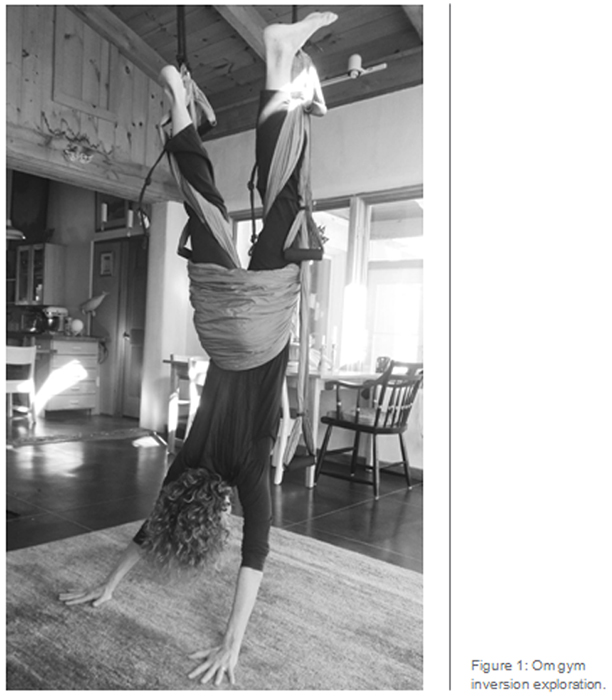
KF: Well, I think you’re more familiar with what’s current than I am. But I’d say there are specific ways we [Caryn McHose and I] use hanging; I feel like it derives a great deal from what we learned from Emily Conrad and Continuum Movement®. She did movement improvisation suspended on a device she called the ‘explore board’. We own three of those things. Every morning, I do suspended movement, and there is a great deal of elongation in that, as well as maximized varieties in planes and combinations of limbs and spine. A chief value is the capacity to relax into it. We also use an OmGym, which is a suspensory thing that you hang from a hook in the ceiling. It’s a cloth sling that you can wrap your legs around and suspend and move your body in different ways (see Figure 1). So, in all these things, I think a key feature is it can help people find a comfortable relationship to that suspended situation.
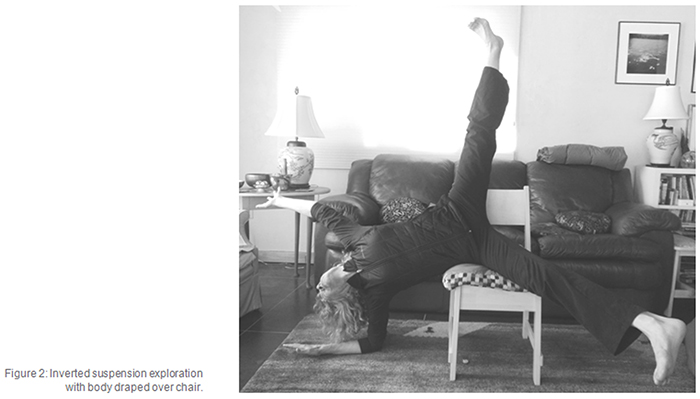
My stepdaughter had done a tremendous amount of aerial-type yoga, and it leads to a yummy body experience. I think there’s something about having the weight of the body allowed to do its work and to feel how the body has an instinctive response to that. For the people who aren’t the young whippersnappers, if it’s titrated enough, they can begin to feel this experience, even just suspending themselves over a chair, which is a very interesting thing to do. To do that, you put some padding on a chair with one hip down on the chair and one hand down on the floor, then bring your legs up in the air and your other hand up in the air, and you begin to work with an inverted posture that allows for improvisational movement (see Figure 2). So, for me, I’m less interested in specific postures than I am in people calibrating, finding their own delicious discoveries in a suspended mode.
I think when someone, as a practitioner, does this on a daily basis, inevitably, it’s going to spill over into what you suggest people do. Hanging off the table, hanging off the chair, hanging off a ladder rack, hanging off some kind of a slant board,
hanging off . . . any of these things that one might try like the OmGym, whatever. A person starts to realize, oh, there’s a tremendous amount of degrees of freedom to play with. You’ve changed the equation so that you have a different orientation to gravity and now your proprioceptive sense is going to get stimulated in ways that then can inspire. Again, if it’s supported, if a person is encouraged to find their way in it, she can start to find innovative ways to allow their joints to move, for example. That stimulates the receptors. It creates a great deal of flow of information that allows the body to begin to innovate movements when they’re in the normal orientation to gravity.
MB: This is cool. At my clinic we’re putting together an exercise and movement room. And also, there’s stuff that I can install in my own apartment that I can do.
KF: Right. We happen to live with many affordances as they’re called, affordances for innovating movement in our studio and in our house. If it’s there you use it. I think the discoveries one can make on a daily basis become the menu of choices that can be offered to clients.
MB: Well, I’ve been to your place, and I think if you saw my apartment you’d see something similar in terms of equipment. But to change track a little bit, we’ve talked a bit about eccentric movement. There’s also the issue of slow-twitch versus fast- twitch muscle. People tend to think of movement as something fairly dramatic that involves either a great deal of weight or a movement that will impress people as opposed to doing the same movement or similar movements more than once in a slower and more relaxed way, which I think wakes up the slow-twitch fibers in muscles more than the other thing. We tend to be very fast-twitch obsessed society. What are your feelings about that?
KF: I would just make the comment first that a big piece of the whole Tonic Function theory is defining motor units, muscles within the body, as being in a continuum between those associated with a great deal of fasciae, proprioceptive components, architecturally associated with efficiency for ‘set it and forget it’ operations – postural activity – those that have really good blood supply, which is a big piece of the slow-twitch group. Then the ‘move fast, briefly’ motor units are the fast-twitch group. I’d say there is a common tendency to corrupt fast-twitch muscles into being used for postural activity, static or otherwise. A piece of what we’re trying to educate about is that those strategies that people might think of as supportive, are, in fact, ‘expensive’. Fast-twitch [phasic] motor units actually don’t have the appropriate physiology for use for postural stability.
Because modern people have grocery stores [we don’t have to hunt and gather], we can afford to be metabolically wasteful. You wonder, why have economy? Why not use the pectoralis and rectus abdominis and whatever to do daily activity, metabolically expensive as it might be? We modern humans often use our bodies sometimes like we did with cars during times of cheap oil. I’d say, well, there’s no reason not to if you can, but if you’re here to see me about issues that have to do with discomfort and compression and those kinds of things, then I think it’s useful for you to know that there are ways of doing movement, ways of doing exercise, where you start to be discriminating about how you’re using different parts of your motor-unit array so that you have a less compressed body and a more pleasurable experience of movement. Moving very slowly is harder for people because they’re not used to it. But obviously when we move very slowly, we have an opportunity to change the preparation to move, which means we have an opportunity to change the coordination of ingredients to any movement. When one does that, if a person gets it, and learns some brief exploration they can do in her own time to reinforce that shift – something that changes from sit to stand, something that changes when she lifts a jug of milk, whatever it is – one gets an opportunity to change the equation in terms of whether they are using phasic/fast-twitch in unnecessary ways or in ways that are going to lead to more conflicted patterns.
Again, a big piece of enrollment, as I’m sure you’ve found out, is being able to show people what the two versions of the movement look like: Here’s the fast-twitch version, here’s the version in which you can’t even tell what I’m using because it just looks like there’s flow. Here I am doing work to lift up the jug of milk, and here, by contrast, the jug of milk looks like it’s raising itself.
MB: I think much of what we are doing is encouraging people to see their bodies as something besides either a commodity that looks good or a machine that is here to work hard. Instead, our clients can discover a body they can inhabit and enjoy, which in a puritanical culture like ours is very difficult.
KF: I think sometimes on a good day, people birth the discovery of, “Wow, this feels easier. This feels more fun. This feels like something I’d like to try on my own.” That’s a wonderful thing. Sometimes I think we have to titrate the message about pleasure and fun because we all have some pretty strong beliefs. There’s a certain stoicism and a certain sense of whatever we’ve been trained to believe about what life is about.
MB: Yeah, and the messages that we’ve gotten about the relationship between self-indulgence and health. That indulgent people are all fat, lazy,with bad skin, and the disciplined people who sit around eating raw spinach are the ones who are going to wind up looking good. So, pleasure and health as pursuing the same ends. For example, one of the things that I’m just beginning to dip my toes into is dance movements or dance-like movements that are not necessarily from the ground up, like using music to do a little hip shimmy while you’re hanging.
KF: Lovely.
MB: I do it myself and I give myself chiropractic adjustments.
KF: Precisely. Your body takes the opportunity to integrate and to unbind the fixations.
MB: How do you incorporate music?
KF: We’ve done many different things with music, not so much in sessions but in movement classes. I think oftentimes it can de-inhibit the playfulness, liberate expression. Certainly, like you’re saying in suspended inverted movement, it’s a nice companion. Sound is a form of touch. Rhythm is a deep, deep part of the ancestry of our species. So, the rhythm, the sense of touch that we feel with sound, oftentimes it’s a way to change the mood in a group. You have a chance to change the dynamic, to move from something that’s automatic, to feeling the body feedback. Being it’s slow enough, you can work with nuanced shifts first and then, after time in that mode, you’re moving on to where you’re moving, faster than you can think about it, faster than you can correct it to make it right. The two modes are both important.
That’s often a very integrative thing. Slow movement juxtaposed with a higher dynamic. Again, for many people, I think it’s that sense of feeling that the context has changed, so the permission to move has changed. But if we are working primarily with movement, then I think it’s ok to ask, “What do you think about movement?” And see where a person is at. So that, again, we’re always hopefully creating a safe container where people feel they have prerogative. Then, if you’re working with something and layered it in a kind of rehearsal way, you’ve got to say, “Okay, you feel the improvisational potential here. Would you be interested in seeing what it’s like to add this other dimension, the dimension of music or the dimension of sound? There are many different kinds of sound and see how you have a conversation with the music, how your body has a conversation with the movement.”
It introduces a triangulation. There’s you, there’s gravity, and there’s the music. There’s also you as a witness if you’re with someone while doing it. Again, getting back to one of your very early points about the sense of kinesphere, we build a sense, or we help people restore their sense, of allowing bigger spatial dimensions to their context as something friendly, through happy accidents; through moments in which the inhibition against that limited field of spatial awareness is allowed to relax. We don’t tear it open. It relaxes when there’s interest, when there’s a sense of, “this is fun.”
MB: As you were saying this, I am realizing how I still have to work on some of my own style of communication. I think a great deal of what I began to learn from you back in 2006 was how to invite people rather than be parental with them, which is something I tend to do.
KF: Well, that’s a perspective that you’re offering here, Michael, that we all have these super egos. They’re not usually kind in tone – the super egos that we listen to in our heads. There is also something about the history of structural integration, we’ll say, where the training doesn’t always emphasize client-centered curiosity. I don’t want to indict anybody or anything, but when you do manual therapy, as you listen to Rolf’s adages, or any teacher, there is a tradition that emphasizes it’s you who looks at the body and makes the choice for the places to work and you make the outcome assessment. This can occur to a greater or lesser degree of course.
That’s all fine. As we shift into the movement inquiry, I’m suggesting that we, as a profession, find it doesn’t work to prescribe how people move and just tell them to do something differently if they don’t have a feeling of their own agency in the process. How do we help support their sense of agency in the discovery process? I really do think the term ‘happy accident’ is appropriate. You don’t make a new motor pattern; your body gives birth to a new pattern. It does so with an abundance of support, curiosity, and interest.
MB: Part of it also is that these things we discover are often tools that have been in the toolbox for generations. Jan Sultan talks about shaking hands with the ancestors. We find ourselves doing things we didn’t know we could do.
KF: Isn’t that wonderful? There’s this inheritance, the opportunity to feel the potential of our inheritance for these primal types of movement that we are set up to do. Our architecture is really pretty identical for the last hundred thousand years, and yet the usage patterns may really eclipse a lot of that history.
MB: When you first became aware that we were going to have this conversation, is there anything that you thought of, like, aha, now I get to talk about spider monkeys or whatever?
KF: Well, I love watching primates move. My body loves it. There’s a wonderful resonance. They appear to ‘know’ things we don’t anymore. I think seeing other species move, in general, and then feeling that we have those capacities in our body, seeing it, feeling it, opening to the implications, certainly opening to the suspending thing, as an example, is a wonderful opportunity. We start to realize that we can have a different relationship between the hands and the feet and the spine; a different relationship with the spatial surroundings and get much more connected to that. We get many different dimensions of movement suddenly happening in the spine – the spine likes it.
You were talking about how you feel all these adjustments happening naturally. Well, yes, I think also of the endorphins that happen when we’re in that novel territory, the twists and the turns and the loading happening in the body in ways that are completely novel for people who normally stay oriented to up and down. Again, it leads to happy accidents if it’s titrated sufficiently and people get the basics. I do a great deal of climbing in trees because I prune apple trees. I wrote an article about that for this journal [see “Persistent Doubt, Perches in Apple Trees, and Putting Ground Under One’s Faith” in the March 2017 issue of Structural Integration: The Journal of the Rolf Institute® (Vol. 45, No. 1), pp.20-21]. The challenges that I experience hanging out with a pruner in one hand while being suspended by different parts of my legs and feet – I do it for a long time and it’s enjoyable. So, there’s a treasure chest of opportunities for discovery: learning from the primate, from fish movement, from the things we can do when we’re on the floor. What comes out of it as people get some support to feel, again, their inheritance, to see the possibilities, is a much repertoire of fun things to do that are healthy.
MB: I grew up in Southern California, where there were many orange trees. When I was a kid, taking an orange from somebody else’s orange grove was not stealing because there were so many of them. We had three orange trees in our yard, but there were miles of orange trees. So yeah, we would just go through and take oranges. Part of it was just the sheer joy of climbing a strange tree, a different tree.
KF: Every tree is its own personality. Yeah.
MB: Do you have any classes coming up that you want to talk about?
KF: Well, we do a course that has been retitled, but it’s similar to others we’ve done on stability. It’s called Normal Stability: Invoking Inherent Capacity to Meet Demand. It’s a course we love to do because it covers many of the issues we’ve raised about fitness. It also covers the issues of how we relate the ‘Recipe’ to stability, the places in the Ten-Series Recipe that don’t necessarily get fleshed out in the conventional basic series. We ask, “Where are the opportunities in the Recipe to address the stability issues?” There are plenty of them. So that’s the kind of thing we’re doing. We’ve started an ongoing study group on tonic function so that there’s a chance to progress into certain issues and maybe get into more about how we work in our practice in some specific ways that don’t happen in all the courses.
MB: For anybody who hasn’t been there, just going to your place in New Hampshire is a mind-altering experience. That lake is fun to play in.
KF: Yeah, the lake is a great place to boat in and swim in and look at.
MB: You’ve still got that wooden thing that you can stand on and kind of wiggle back and forth?
KF: Well, we do have the balance boards, like Darryl Sanchez created, his tuning board. We try to keep bringing in new devices that people can make for themselves that enhance what they can introduce to their clients in their movement classes.
MB: Any last words of wisdom you want to pass on?
KF: Well, I didn’t know anything that’s necessarily wisdom. But I’d say there’s a huge opportunity to give people agency in their movement. I think it’s good for us to remember those moments where learning movement was not easy and to recall what would have helped, what would have made it easier for us. Because I think we often underestimate the intimidating nature of the offer we are making.
MB: Very good. I think we will end with that. Thank you very much for agreeing to this interview.
KF: Great to talk with you, Michael. I really appreciate the conversation and all the provocative questions you asked, which I’m really enjoying thinking about. Thank you.
Michael Boblett works in San Diego, California. He has been a Certified Rolfer since 2003 and a Certified Advanced Rolfer since 2008. Michael is a retired Unitarian minister. His advanced degrees (MA, MDiv, and DMin) are from Pacific School of Religion in Berkeley, California. At seminary, he focused on the anthropology of religion, with experiential training under Michael Harner, author of The Way of the Shaman. Michael runs marathons and hikes up mountains wearing Vibram FiveFingers. His website is www.rolfer.biz.
Kevin Frank is a Certified Advanced Rolfer, Rolf Movement Practitioner, and Rolf Movement Instructor at the Dr. Ida Rolf Institute. He has worked with the Godard- derived Tonic Function Model since 1991 and has written on this topic from 1995 to the present. Kevin advocates for an ‘information system’ view of SI to help bring this field into congruence with modern understanding of motor control and perceptive/coordinative processes. His articles can be found at www.resourcesinmovement.com under article archive. Kevin is also the co- author (with Caryn McHose) of How Life Moves: Explorations of Meaning and Body Awareness (North Atlantic 2006)