
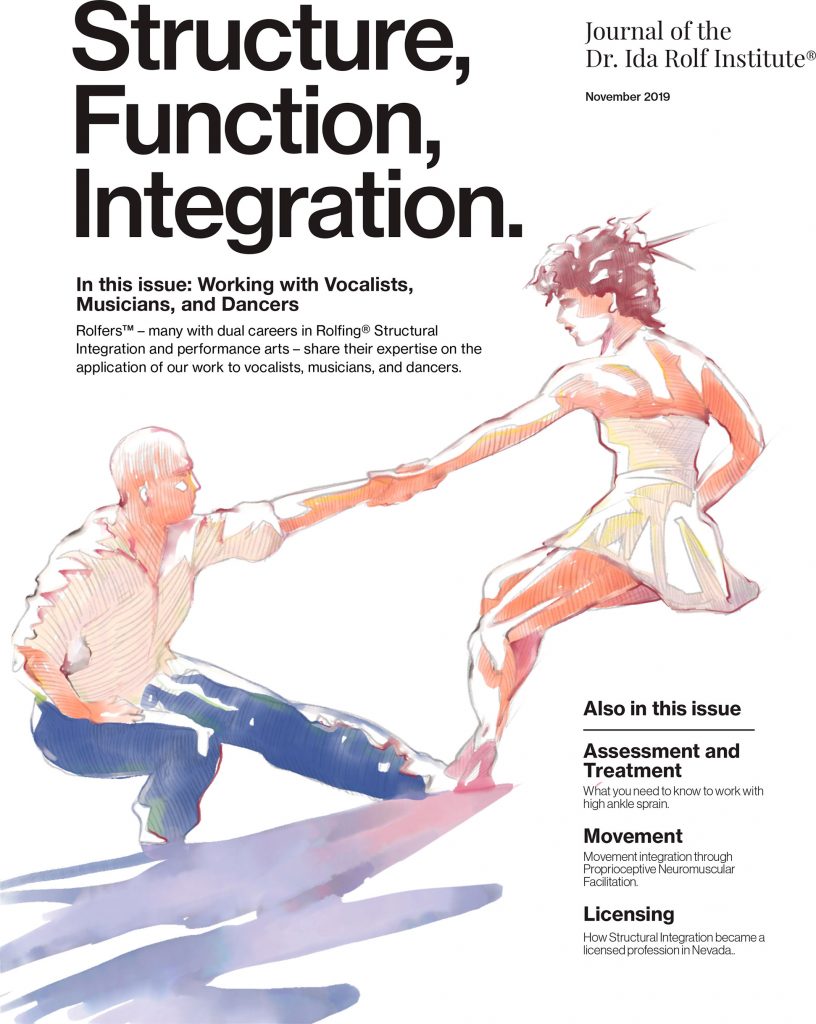
[:en] By Rebecca Carli-Mills, Rolf Movement® Instructor, Certified Advanced Rolfer™, Linda Grace, Certified Advanced Rolfer and Rolf Movement Practitioner, and Paul Roby, Violinist
ABSTRACT In this thorough interview by Rebecca Carli-Mills, we hear from musician, Rolfer, and Rolf Movement Practitioner Linda Grace and professional violinist Paul Roby. The interview delves into the Rolfer’s task when working with musicians, ideas from Hubert Godard, movement sequences Linda has developed, and the musician’s experience of the work and particular needs.
I was excited to attend a 2012 Northeast regional meeting of Rolfers in Philadelphia because Linda Grace and her professional violinist son, Paul Roby, were giving a presentation about movement and structural issues in violin playing. Linda, a longtime Certified Advanced Rolfer and Rolf Movement Practitioner, has worked with musicians for many years, drawing all types of professional musicians as well as students from the Curtis Institute of Music, which is located a few blocks from her office. Paul, a Curtis graduate, held positions with the Baltimore Symphony and National Symphony Orchestra before joining The Philadelphia Orchestra in 1991. In 2000, he was named Associate Principal Second Violin.
Linda has been working consistently with Paul since she trained in Rolfing® Structural Integration (SI) in 1983, when he was sixteen years old. I had the pleasure of giving Paul a few Rolf Movement Integration (RMI) sessions when he was a student at Curtis. His easy, supple physicality, along with coordinative intelligence and rich perceptual embodiment, was awe- inspiring, and particularly delightful because back in those days he was prone to a little rebellious behavior – such as skipping school. As with many high-level artists and athletes, I could almost feel his synapses sending nuanced signals as he was alive and present in every nook and cranny of his being, especially his hands. As a new Rolf Movement practitioner, this was meaningful education: what did it feel like to live, move, and breathe with Paul’s embodied intelligence?
So there we were, a sizable group of Northeast region Rolfers, gathered at Rebecca Lisak’s downtown Philly studio, ready and eager to experience Linda and Paul’s longtime collaboration. Always good for surprises, Linda started by asking Paul to play “Mary Had a Little Lamb.” From Mary and her lamb they progressed to more complex pieces, such as segments of the Tchaikovsky Violin Concerto in D major, Op. 35. I was
mesmerized as they worked together. Paul would play a short phrase and then Linda would suggest a seemingly simple movement cue such as “feel the floor come up to support you.” Paul would allow the cue in, and when he played the phrase again the sound would change – often dramatically.
Linda and I have been longtime students of Hubert Godard, so many of her cues originated from his teachings. Paul was open and able to kinesthetically incorporate the cue: Paul played, Linda casually suggested, Paul responded. Nothing was pre-planned; they simply responded to each other. Their dynamics were easy, flowing, and quite wonderful to experience. They, along with the physical space around them, became a cohesive, collaborative unit. I often wish we had recorded the presentation to capture specific details. My memory is composed of reflections with shades and sensations, along with a lasting curiosity.
Now, six years later, we (Linda, Paul, his violin, and I) gather in Linda’s Philly office for a conversation. We hope to gain insights about what was happening during the 2012 presentation and also open new avenues for understanding the potential of Rolfing SI and RMI with musicians.
Linda Grace: Violin playing is a 200-year- old endeavor, and the study of playing has changed over time. There are some schools that are more conducive to focusing on physicality than others. When players first come to see me, they often have a backlog of belief systems wired in coordinative and perceptual training history. Usually, they do not make an appointment to improve their sound; they come in pointing at a hurt shoulder, neck, or back. However, beyond sorting out the fascial restrictions that have developed over time, usually since childhood, solving these problems is often necessarily rooted in addressing their backlog of learned movement patterns. Some of these may be counterproductive, in conflict with each other, and create unnecessary tension. At the same time, they may also be the very patterns that allowed them to get to the level where they are; often one has to engage in a dance, of sorts, by building new supportive options without stalling out by crashing into their natural reluctance to change. When an intervention works, a skilled musician recognizes it – both in the sound and the feel. I don’t have to explain why; intrinsically they just get it. Taking on new supportive options is always a matter of choice. If they work for the performer both physically and artistically, then together we search for ways to habitualize, fascialize, and integrate the options so that they do not need to be constantly thought about. Transitional objects (easy tunes learned in childhood) are good for this intermediate step.
Early on, I realized how well Godard’s work applied to violin studies, especially for getting more flow in the whole body. Violin students typically focus on their fingering and wrist and shoulder positioning without considering how their entire body participates in creating sound – including how they are related to the ground and the space around them. Studying the violin is a lot like studying Rolfing SI, in that you progress along certain graduated chains, step-by-step. You don’t perfect anything in particular, but you go along, incorporating and integrating information, and in the end you have an artist; someone who can play the music, as it was intended, plus add some of their personality.
What you saw me doing with Paul in 2012 was focusing on strength. This is key: with skilled musicians, focus on developing strength, not relaxation. Too much relaxation and they will lose sound. They may be fine playing in a living room, but not in a 3,000-seat concert hall with a 100-piece orchestra behind them. Strength with flow is an essential characteristic in performance. By this, I mean that strength has to flow through the musician’s entire body as they connect to the music and relate appropriately to their environment. When they are connected, the unnecessary tension will take care of itself. You don’t have to go back and analyze who, how, or why they learned a particular pattern of playing – you work in present time, with the fascia, muscle, and nervous system coordinative patterns that exist (a history of what the performer has learned and done) serving as a pattern to the present time.
Rebecca Carli-Mills: So, Paul, when a movement cue is suggested, what happens inside you – what are you thinking or what is your felt experience?
Paul Roby: Well, immediately I am trying to do the physical imaginary component I was given. I try to respond to the cue. At first, I really only focus on it – the image or idea. After a time, I hear the sound that I am producing while employing the cue. If it’s better, I practice to incorporate the change. That’s the hardest thing, because if you have been doing something for fifteen, twenty years at a high level, and that’s what got you to the party, it’s difficult to change it, because to you, it feels familiar. It’s known and it sounds right. It may be the source of pain, but often you want the pain to go away without having to make a change because you are attached. You see, you have the idea of the sound in your head, which may be different from the actual sound. However,
 with home-run cues, the improvement in actual sound breaks through your idea of the sound and has such value that you can’t help but want to incorporate it.
I have a memory of Hubert working with me. He asked me to fill up the room with my bow going from wall to wall, no matter what space I was in – a big hall such as the Verizon Hall, here in Philadelphia, or a small place such as the room we were in – my bow sliding to and fro from wall to wall. Then, he said to go through the walls into the outside space surrounding the walls – still playing the tune, but imagining the bow easily touching the space around the building, the block, the city. Now, I work with my students with this cue because it dramatically changes their sound. It becomes freer, and the instrument rings better and vibrates more, so that the sound becomes more colorful, richer, maybe even louder (as in, it will project further without as much effort). It feels as if you are doing so much less, but gaining so much more. I explain this effect by saying that your physicality no longer limits or condenses the sound. If the sound is too tight and condensed, it sounds monolithic. It doesn’t sound as colorful, and the instrument doesn’t ring as well. That’s the hardest thing when you have grown up practicing one kind of way; it’s really difficult to feel that you don’t need that quality and quantity of effort to project your sound and emotions. Your chief goal is to connect with the audience and there may be thousands out there, so you feel as if you should work really hard – but it’s a zero-sum game – clearly, less is more.
LG: So many injuries come from too much effort being applied with the intention of creating sound. In Philadelphia, we kind of joke about the New York bow grip which looks like they grab on with that first finger sticking out and push down on the strings while bringing their shoulder up, so they get this gritty sound. In New York, I’m sure they have a similar joke about the Philly bow grab or some such thing. The thing is that a violinist may think that more pressure, more effort, makes for a louder sound – but it’s not particularly rich, nor does the quality of the sound project (fill the space, or have the potential to convey the emotion of the music). When you stand next to someone who can really play, there’s richness in overtones, subtlety, resonance. Once you can project by filling the space, going out to reach the upper balcony and beyond, you can then adjust to achieve gentle, quiet nuanced phrases that pull the audience in to you. A full range of control is achieved in this way. A big bonus is that the audience becomes more interested in hearing what the performer is playing: this is one of the essential traits for winning auditions and making a career in the field.
RCM: So this distinction between strength as opposed to relaxation: Are you saying that when a musician comes to you with pain, often they have an idea that the problem is that they are not relaxed enough in their playing, so they have been working with more relaxation in their playing as an idea towards a cure? Yet, once the curtain goes up, their chief priority is to project powerfully enough to reach the audience and be a viable orchestra member, so they effort more, perhaps with more pressure. So, your work with them focuses on creating the conditions such that they more powerfully project with ease, or as you said, flow – allowing, not making the movement happen.
PR: Yes, what you said in the past that was really helpful to me was: “Instead of making the movement happen, allow the movement to happen, and then you can add all the intensity that you want to your strength.” If you are allowing everything to expansively flow, it doesn’t become bound up.
LG: Allowing, yes, there has to be allowing, and there has to be full-body participation. You see, there is learning to play the violin and there is training to be a violinist. Training to be a violinist involves shaping the raw material that means that you can stand on a stage and play alone, audition and get the job, hold your own while playing with an orchestra. You can not only play technically well, but you can also inhabit the role of a violinist to convey the music – and you have to do that with ease, otherwise, you will get injured.
RCM: So, at the training level, you are talking about creating movement patterns that allow the evolution of a player through the course of their entire life. When you are working with a musician, at what point do you ask them to bring in their instrument?
LG: Most likely the first session, because I want to know what they are doing that might be hurting them. I realize that a lot of us would be concerned about fixing a specific problem, and that is critical. However, the real fix goes along with whole-body function, and so identifying those issues is key to a real resolution. That said, often I can find video of the people that come to me on YouTube, so that helps if the person is a pianist or bass player with instruments that are too large to bring in the office.
RCM: What are some common issues or injuries that walk in with musicians?
LG: Well, since we are here with Paul, let’s talk about violinists. There’s often an issue with the position of the violin resting on the shoulder. This speaks to whole- body organization. Players often hold up their instrument on their shoulder instead of allowing the support of their contact
with the floor to come up and meet their collarbone and also support the violin. If your sternum is sunk there is no way to have a good set up – your sternum has to have fluidity in its lift such that the violin can float on your collarbone. A simple exercise is one that I have adapted from Hubert: Have the client feel the floor through their feet – really feel it in terms of sensation, not just an idea, while allowing the chest to drop or soften more into collapse. Then, slowly increase pressure into/through the floor through your feet such that the impulse lifts your collarbone upwards. You would be surprised how many violin players cannot perform one aspect or another of this simple exercise. They may not be able to soften downward and drop in – they may not be able to really sense the ground through their feet – they may not be able to bring that impulse through to lift their collarbones upwards. This is especially true for seasoned players if they have been using their shoulders to hold up their violins. This doesn’t mean they can’t play well. They can. However, they are more prone to injuries, such as thoracic outlet syndrome, because of the way they are organizing their shoulder girdles.
Professional violinists often play for five to seven hours per day, between rehearsals and performances. You have to be an athlete. There has to be support through real contact with the ground coming up to meet the collarbone. This connection is primary and its absence can be the root cause of other issues.
RCM: This reminds me that our nervous system is going to triage staying upright in gravity. So the ease with which we do that has the potential to assist us playing the violin, or hinder it. It organizes the whole deal and the specific stuff follows.
PR: Yes, the specific stuff – I am thinking of the turn of the lower arm and hand.
LG: Yes, pronation and supination – usually players who are having arm troubles don’t have ease with pronation and supination. Let’s see your pronation and supination, Rebecca. It’s pretty good, but not the level at which you could play the violin – sorry – maybe the tambourine.
RCM: That’s nice to know!
LG: Playing the violin all day every day can create fascial issues in the interosseous membrane that inhibit pronation and supination. There may be a tendency toward overuse syndrome. It may start with the small bones of the wrist or hand being stuck together, so you have to be able to meticulously mobilize those. Restoring pronation and supination tends to be the first issue with a violin or viola player. I’ve never seen one come in with pain who had a decent excursion.
The thumb joints can be compromised by the small bones of the hand being stuck together in both the left and right hands, also. There are several ways of mobilizing these joints within the Rolfing work techniques. In addition, I teach a warm-up exercise for the left hand to find appropriate pressure on the strings and to equalize the fingers (including the vibrato) that came second-hand from Ruggiero Ricci. The right hand fingers can also benefit from the Galamian style of classic exercise for supple strength with the bow grip, the starter of which is called ‘strike the match’.
An important issue for bow pressure is that students are zealously taught, “Contact point!” to keep the bow going straight at the beginning. An antidote for this is to think of the bow contact point being lower, even as low as the shoe tops. This will help create the energetic idea of strength with flowing downward pressure. ‘Regular’ violin teachers have various ways to stop the contact-point gritty downward pressure of the bow, including the idea of ‘weight underside’ which is taken from the discipline of Aikido. Anything that works to get a certain flowing contact point is to be desired!
Rolfers are trained to look at flow states, and within the classic instrumental, conducting, and singing techniques there are certain places that can be stopping points for a healthy technique and style. As we Rolfers know more about various techniques down through the years and the way skills are taught, we can know more about possibilities for where ‘the bodies are buried’, so to speak. This does not mean that a Rolfer can’t help someone if they don’t know these various techniques. During their Rolfing sessions, a skilled musician can help a Rolfer learn how to help the musician within the musician’s discipline.
PR: Both shoulders can be a problem – bow arm or support arm. What about that?
LG: Yes, this speaks to the fact that violin players often do not have good rotational capacity in their thorax. They are constantly slightly rotating to one side and do not balance it out. It can get even more complicated based on their handedness and if they have scoliosis. Restoring rib-cage motion with breath, the collarbone’s ability to move, and the rotational capacity of the thorax goes a long way towards resolving issues that seem much more complicated than they are; applying the goals of a standard Rolfing series goes a long way. Sure, work on their hurt spot every session, but do not get lost in the trees; remember the whole forest – the functioning of a human being who lives and plays their violin within the earth’s field of gravity.
PR: Some players freeze when they play due to over-effort because they want to make more intensity or sound. And there is also fear and overwork. You have an audition, concert, or big recital coming up, so you practice for hours in a row.
RCM: How many years have you been with The Philadelphia Orchestra?
PR: Twenty-seven.
LG: And it’s fifty-two weeks per year.
RCM: Describe a week, how much playing, on average? What does it look like?
PR: It’s approximately four rehearsals and four concerts. The individual practice of the music is separate from that. The actual hours on the job are very focused – there is no playing games – we need to arrive prepared. When the conductor says, “Start at letter A,” we start because there’s not really a moment to waste. Rehearsals are only two and a half hours long, so we have a lot to achieve to bring the entire orchestra together, especially if we are playing music we are unfamiliar with. There is no time to ‘get ready’ – we have to be able to ‘go’.
Playing in an orchestra has certain characteristics that are different from playing as a soloist or in a chamber ensemble. A lot of injuries happen because we are trying to play with everyone; we are trying to play really soft or we are trying to play really loud because we can’t hear ourselves within the milieu, there’s so much sound. So both of those things, being too tightly controlled or being too bombastic or being just . . . there’s a lot of different ways you can hurt yourself in an orchestra.
LG: Yes, I am thinking that the group becomes a sort of organism. I imagine that when someone or something changes, there’s a whole readjustment that goes along with it.
PR: Yes, as individuals, we are trained to be very sensitive so that we play well with each other, yet we also have to be clear about whatever our role is. If you are a principal oboe player, you may have a lot of solos. At those times the rest of the orchestra follows you. Plus, we all are trying to do what the conductor shows, musically and rhythmically, so there is a lot of paying attention to the world around you and sensitivity is involved. It’s tricky, because you need to open yourself up to receive all the input, but at the same time it can be overwhelming and changes happen very quickly. It’s a balancing act – how much do you contribute and how much do you subsume into the organization of the whole.
RCM: This ability that you describe, to be simultaneously aware of interoception and exteroception, has been and continues to be studied by neuroscientists as key to healthy functioning. There is a feedback loop between the two states of awareness that creates an appropriate, balanced relationship. It’s being studied in healthy aging, rehabilitation, Parkinson’s disease, and it sounds as if it is key to longevity as a violinist in an orchestra.
PR: Yes, essential.
RCM: Linda, you described the ground- to-collarbone awareness exercise as foundational, how do you build upon that?
LG: Well, you build by using it to rise and lower continuously to and from a chair while playing the violin. It speaks to the whole body working, and to the freedom  through what we Rolfers call the midline. In order to do this without missing a note, there has to be a moving transmission of forces from bottom to top. So, Paul is going to demonstrate – this is a good chair because his hip hinge is higher than his knees. It’s a bit higher than an average chair but, in the beginning, it’s important to have this arrangement so that the musician client has immediate success.
[We’ll next hear Linda coach Paul through a sensate dialogue that builds his awareness beginning with his feet relating to the floor, with some commentary on what she is doing.]
LG: So, Paul, bring your awareness to what’s under your feet. Tell me what you feel.
PR: I feel the sock and a bit of warmness coming up from the floor.
LG: What’s underneath the warmness?
PR: Well, it’s hard, smooth, flat.
LG: Is it cement?
PR: No, not that hard or cold.
LG: It’s a third floor in a classic Philadelphia row house, so it’s probably wood, right?
PR: Yes, wood – and it has supports with spaces, joists, and nails.
LG: Hmm, when you wiggle your toes, can you feel spaces between the supports?
PR: Yes, it gives a bit more in the spaces between.
LG: So, it doesn’t matter what floor you are doing this on or the accuracy of the dialogue – we are tuning the person into their feet with sensation; any sensation- based questions and answers are valid. In the beginning I got all hung up on whether the dialogue was accurate or based on reality. Actually, it doesn’t matter, as long as the client is encouraged to stay with their sensations. Paul has done this many times before, so he arrives fairly quickly and easily, but each time it’s important to build the sensate state fresh.
Paul, with your feet actively sensing the ground, place your hands lightly on your collarbones . . . allow them to arrive and register
that . . . now, allow your chest to sink a bit.
PR: Okay.
LG: Give yourself time to soften into the experience. [Paul exhales.] Now, imagine that your feet travel through the floor until you feel that force travel through your body to raise your collarbone in the opposite direction. Yes, you go down to come up.
At first people will more likely than not grab somewhere or interrupt the flow – their effort is too hard. However, with encouragement they will find the ease. Again, every step isn’t to achieve perfection, it just has to be good enough to build to the next event. At the end, it will come together.
RCM’s obervations: She asks Paul to begin again, and this time, as he allows the force from the ground to travel upwards to meet his collarbones, she tells him to continue that direction such that he stands straight up from the chair. [This isn’t the classic hip hinge rise from a chair – Paul literally goes straight up.] As he repeats this action, she offers various cues: release his head and neck, scan the horizon, release his arms, begin by allowing his legs to release, then build the tonus by finding the ground. She is encouraging and her voice has a calm, casual, but directive quality to it. Linda is clearly leading, but she is also titrating her directions to Paul’s pace – she doesn’t let him get lost in detail or too much analysis. Linda keeps encouraging Paul to balance his inner sensations with his contact with the world around him. His movement smooths out – there is no hint of a beginning or an ending.
She directs him to lower to the chair by allowing his knees to travel forwards and his tailbone backwards. For this action he creases at his hip hinge, so his torso leans slightly forwards. The focus is on the flow of the action, not on any specific position.
RCM: An important distinction is that you didn’t tell Paul where or how to place his feet – you only guided him to the sensations of his connection with the floor as the basis for his movement. This is so important because so much movement is coached based on a set position – without inclusion of sensation, which actually organizes the appropriate action. Also, you had him touch his collarbone, which seems important in building sensation. He can identify where it is and also receive the push from the floor coming up to meet it – he doesn’t have to imagine this sensation because he can feel it with his own hands.
LG: Yes, even advanced musicians don’t know the location of their collarbone, as in owning it as part of their body. Instead, one is known as the resting place for their violin and the other disappears. I can’t emphasize enough that this coming up from the ground activates the entire front line – it can’t just be lifting the chest: it must travel all the way through, and then you have real support. Once [the musician] can get up and down from a chair with this support, then you can include anything else, such as playing the violin while going up and down. The flow through the midline maintains the smooth quality of the sound. If they grip or hesitate, you will hear it. It’s great practice.
PR: So, what about shoulders? – we haven’t addressed shoulders. You talk about the importance of the lats being able to move.
LG: Yes, that is important. However, when I first start working with a musician, I don’t talk specifically about shoulders, because the more they focus there, the more they lock them down in a position. The important thing for the musician to get initially is coming through their feet to support their thorax; the ability to lengthen and mobilize their front line. When a musician has that, the arms are free to play the instrument because their body is supporting itself through its midline. If they cannot access that, then any focus on the shoulders ends up being about holding something.
RCM: In a sense, the ground supports the violin and the space around the shoulders draws the bow.
LG: Yes!
RCM: At one point, when Paul was doing this chair exercise, you asked him to push from his feet all the way through to his collarbone, and you said, “See there, you are doing it.” What were you looking for? What would it look like if Paul wasn’t ‘doing it?’
LG: There would have been an interruption in the chain – the flow of the movement – or he wouldn’t have come up far enough. That’s quite common. If you have never come up like that, it can feel like you are too far out there. It’s kind of weird to think that a musician that plays in front of 3,000 people has this reticence about getting out there, but it is quite common, and this happens with regular people, too. There may be a lot that’s emotionally fraught in that, so it’s good to go slow and be patient. Cultivating this action creates a different player and a different relationship with their instrument.
RCM: It sounds as if there is more power, support, and fluidity available from within the person – and for some, that is a big change.
PR: Most of the time when I am playing, I know when I am coming from my feet or not – not always, but most of the time. So, during this exercise, how can you tell if the person is really coming from their feet relating to the floor or just kind of hoisting themselves up?
LG: We use comparison as a tool so that they can register the difference. If I see that they are beginning to get it, but they are still engaging too much muscular effort from their hips and legs, I might have them exaggerate that action, so that they can really feel it. I might have them slump and muscle their way up without using their feet. Then slowly we build the feet related to the ground – the slight push through the floor to feel the counter-impulse coming through to their collarbones; that might be their homework. Then they come back and we build the story again, but this time we allow the impulse to go further, raise the person up to standing. We might have to compare again, asking them for feedback about what they are sensing along the way. Gradually, they will find it and then we can move on.
You see, in these sessions, I am doing movement work and fascial work too. I might be taking them through the Ten Series, or working on these specific goals; we will try the exercise before and after a session. If we are in a Ten Series, they will most often have it by session three because by then we will have freed their thorax and breathing so that they have more fluidity. We will have built their sense of the ground through their feet, and we will have opened their peripheral awareness and a sense of their dimensionality by addressing their lateral line. These session goals allow them to perform the chair exercise. We just have to see where they are getting in their own way and help them through it.
Sometimes a musician will call me from Kalamazoo or someplace and say, “I heard you are the ‘Musician Rolfer’, so I want to come to see you.” I will tell them to see their local Rolfer for a Ten Series, have some Rolf Movement work, and then if they still need to see me, okay. There is so much that Rolfers can do for musicians without having any specific musical training. Yes, some issues are specialized, but many resolve with fascial organization and awareness about how we humans interact with gravity.
Back to the chair exercise, if you have someone who is really struggling or muscling their way up, increase the height of their chair and/or instruct them to bring one foot back towards the chair. Either of these can be an intermediary step; once they feel that flow, without inhibition or interruption, they will get better at it. You want them to be successful and practice that success to create a new coordination.
LG: Okay, now here’s the one that can cure the ‘wobble’ for the horn player or singer:
RCM: Linda, what’s a wobble? Describe that?
LG: A wobble sounds like this. [Linda sings a high-pitched note with breathy interruptions.] It sounds like a vibrato gone haywire – okay?
RCM: Got it.
LG: So, this is what cures it: coach the person through the chair exercise, and once they have the concept fairly well in hand, they will be aware of their feet and they will feel their collarbones. Most likely you will notice an inhibition at the level of their respiratory diaphragm. There will be a glitch there. Ask them now to pant while they do it – say, ten pants up and ten pants down. Or maybe you are a big dog, so you pant eight times up and down. You really pant, tongue out – pant.
RCM: What is happening? Why does this cure the wobble?
LG: Because the wobble is due to a stuck or frozen diaphragm. There is the Valsalva effect, where you hold or freeze your diaphragm. This may happen because of a mistaken interpretation of “Breathe from the diaphragm!” Or perhaps the person has employed their diaphragm as a substitute for postural stability, or they may have gotten into a fear situation. As we know, the diaphragm rises when we exhale. When there is a wobble, there is an incomplete exhale, not a full release – the diaphragm goes three-quarters of the way up, but not all the way. It’s not a smooth excursion for the diaphragm because of the holding, so they are unable to fully use their strength from the floor – they interrupt it. When you build strength from the floor and pant, you are able to release the holding in the diaphragm and the wobble goes away. The pant acts as a distraction – a reset for the habitual holding diaphragm.
RCM: So the diaphragm stops being about posture and holding oneself up in gravity or controlling one’s emotions and starts being about breathing.
LG: That’s a great way to say it. And [lack of] freedom of excursion of the diaphragm is implicated in lower back pain.
RCM: Yes, aren’t there muscle fibers within the fascia of the crura that attach as far down as L3, even L4 in some people? And the transitional nature of the LDH from the lumbar lordosis to the thoracic kyphosis seems key.
LG: Yes, how the weight is borne through the bodies of the lumbar vertebrae has a lot to do with the story of the diaphragm. When you have those lower thoracic and upper lumbar vertebrae held in flexion or extension, it becomes a problem because the vertebrae become stuck or more vulnerable. Often they are held because of the diaphragm. So even regular people – not musicians – teach them the panting chair exercise. If they truly practice it, your hands-on work with them will go more easily and they will find long-term resolution. Often a sacrum that keeps getting stuck will resolve. You can work with anyone with the panting chair exercise. With violinists, after they have the hang of the chair exercise, with or without the pant, I will have them play while they are rising and lowering from the chair.
PR: Yes, speaking of a challenge!
LG: Yes, you ask them to play something simple first – a scale or an easy piece they choose. They will really be able to hear when they have lost their connection with the ground.
RCM: It sounds like a fantastic tool – there is auditory feedback.
LG: Yes. It’s a way to reinforce whole- body participation and give them a tool that they can perform most anywhere. Another useful tool is the tuning board. I have musicians play while standing on the tuning board, so, it’s important to have the tuning board that is designed for the person’s weight.
RCM: Darrell Sanchez created a wonderful tool for our Rolfing community when he designed these tuning boards. They allow one to really sense in a nuanced way their relationship with gravity. Where do they grab to stay upright, and what happens when they release? After coming off, standing feels like a different experience, without bracing or propping oneself up; interaction with the ground as support for the whole body becomes more real.
LG: At first, I begin with the person coming onto the tuning board without their violin, as Paul is demonstrating.
PR: Oh, right, tuning boards wobble.
LG: Yes, but this is a beneficial wobble. Where do you feel the weight on your feet?
PR: I feel a little more weighted in my heels
. . . even though I’m pretty well balanced
. . . Well, maybe I’m not . . . maybe I just don’t want to feel it on the front.
LG: That could be, but just tell us what is.
PR: Okay, so now it feels pretty even. I mean I’d like to feel the weight in the back so I know that I’m not leaning forwards, which I do sometimes.
LG: This speaks to his upper-lower conundrum.
PR: I kind of want to sink on the one side.
LG: Left or right side?
PR: It feels easier to sink on the left side, but not so much on the right side.
LG: This is a common problem for violin players who are taught to put their weight on their left foot. There’s a school that teaches that, because if you are going low, you can sweep down to the right, and then swing back to the left. It tends to be restrictive artistically after a while. I think it’s important to have more flow, so that you don’t have to force-feed it.
RCM: Yes, it seems as if there is a more natural way to do that without it being pre-choreographed. I imagine that there is a natural sense of shifting weight that goes along with the feeling of the movement that happens with the bow, with the natural rotational movement as a response, with the emotion of the music. If the central channel is open, without inhibition, there is an organic flow of movement, appropriate to the action, intention, direction, specificity, and so on.
LG: So, Paul, where are you now feeling your weight in your feet?
PR: It is now feeling pretty centered – whole foot, both sides. It just took some time – I feel some movement from the tuning board, but I feel okay, easy with it.
LG: So, I like to see the weight fall slightly in front of the lateral malleolus, through the Chopart joint and spread out. You can see this easily when you look from the side, especially when someone is standing on a tuning board. Okay, Paul, now bend your knees; just go down as your knees go forward. This is good, he is not tucking under. He is allowing a real hip crease – no holding in the back of his pelvic floor.
RCM: Do musicians tend to tuck under, like dancers of my generation? We were taught to do that.
LG: I think that the whole population thinks that tucking under is a good thing to do.
RCM: Yes, right. I just thought that there was a specific reason that musicians might do it – long hours of play, fatigue, training . . .
LG: Yes, all of those. Also, they have been taught to not lock their knees. If you start playing when you are four or five, you may not have enough muscular development, so you hang on to your ligaments, thus tightening your back line and slinging your pelvis under for stability. So, I ask them to go ahead and lock their knees and then slightly relax them from there
– the key is slightly – this is not a bent- knee position. It’s important that they find ‘home’: balanced, yet responsive weight over their feet, centered, but not stagnant, over Chopart. Okay, Paul, now play a tune.
[Paul plays]
LG: How is that for you?
PR: Difficult. I am grabbing. The shifts of the violin challenge my balance, so I grab the arch of my left foot.
LG: Okay, so notice that and sense the board; the texture; the temperature; allow yourself to arrive. Okay, good. Now, from there, play again. This tune is probably a grade two, maybe three tops. It has some variations in bow strokes, so it is good for practice. It works as a transitional phrase to practice when you are experimenting with a new suggestion.
PR: Violin teachers often teach students to push and pull the bow, but that’s not what you teach, right?
RCM: What’s the difference?
LG: Well, push in the upper body often creates a struggle – more effort. It often works in the lower body to find strength and support through the legs and feet, but in the upper body pushing seems to create a struggle. So, I tell them to pull both ways. Violinists are taught to push the bow so it goes straight – direct. And then we pull back, so there can be a back and forth quality. I’m sure you have heard it.
RCM: Yes.
LG: Also, when you push and pull, you lose your sound – it can get stuck in that back and forth dichotomy. Whereas if you imagine that something is pulling your bow out and something is pulling your bow the other way, you stay expansive; you extend the vectors into the space on both sides, so the sound stays rich, you have more nuanced control, there is less effort with better sound. You are free to adapt to change the color or tone. You can do this with fast staccato pieces, too. It just takes practice and sort of picking the notes out with flexible fingers. Try this and you will not feel so much time pressure. It also works for push-ups.
RCM: Okay, I am going to try that – maybe I will finally do one!
LG: I got validation for this concept of pull-pull and extension into space with vectors during the 1990 Hubert workshop. I kept studying the videos and applying it to working with musicians. The bow and violin are included within the violinist’s body schema, so it is essential that they find ease in the gravity center that includes themselves with the weight of the violin and bow, and also find ease in the inclusion of and extension of the space around them.
RCM: Yes, it seems that the action space for the violinist increases dramatically when they begin working with their feet reaching into the ground and the space pulling their bow. Given that our body is created by the actions that we do, I imagine that playing the violin this way creates a different body and a different sense of oneself. One of the things I reflect on is how those early workshops with Hubert really opened my perception and how I consider gravity and human movement, this fundamental principle of Dr. Rolf’s work.
LG: Yes, the clarification of G and G′ organized my thinking about gravity and human movement. [G is the gravity center for the whole body, located in the space anterior to L3-S1; and G′ is the gravity center for the upper body and arms, located in the space anterior to T4.] It is especially important for violin players to be able to locate home with G over their base of support (BOS), so that they can find the strength from the ground to support a fluid and flexible G′ to express the music. If one of these centers is chronically fixed in place, such as G falling behind the BOS, or G′ fixed anterior to G, there will be problems that will eventually result in pain or injury. This will affect the sound and the player will be less adaptable. This seems logical in our world, but not so easy for the violin world to grasp. Often it takes until they come in injured and unable to play; then they are usually available for these ideas because they desperately want to get better.
PR: What about the head and neck? They are often issues for violin players. It can be so easy to grip the violin with your jaw. Playing with your head turned one way for hours is a major challenge, too.
LG: Yes, there has to be as little tension in the head and neck as possible. I also think about a center of gravity for the head – let’s say G′′. It’s a space in one’s head, behind the bridge of your nose, between your ears. This gravity center relates to the others, so if G′ is chronically behind G, then the head G′′ will counterbalance by coming forward.
RCM: Is there also the idea of the violin coming to you instead of going to get the violin as you place it between your chin and shoulder?
LG: Yes, that’s a good one, and also not going out to get your music with your foveal vision, but rather allowing the score to come to you. That will release the neck and throat so that the upper body can participate better. Yes, and it makes a better sound.
RCM: This feels expansive to me because while our world is becoming increasingly visual in perception, Paul is consistently auditory in nature. I think that auditory perception has the ability to sort of transcend us to a different state. There is so much engaged listening in what you do all day. For people who are mainly visual perceivers, tuning into their auditory sense can assist in shifting their movement patterns, certainly help them carry their head more on top, and change behavior. A really simple example is when you are cleaning your house; if you put on your favorite music, the cleaning goes a different way – you move differently, the activity feels different. It’s fascinating to think about someone who lives mainly in an auditory world and has such a keen sense of that. I feel that hanging out with you guys offers me huge ears!
LG: This reminds me of training. For a young child, how their teachers and parents approached their study is very influential. There is an entrainment that happens – almost hypnosis. Often they carry these states with them.
RCM: So, what I hear you saying is that how someone comes to music – not just the lessons or method, but the whole emotional and social environment, the whole context – stays with them throughout the course of their career as a musician.
LG: Yes, you can see this in their approach. Of course, there are the more extreme stories, such as a child having to practice in her slip so she wouldn’t get her dress dirty – and she was beaten if she made a mistake. More often they are much less severe, but still there. Are they afraid of making a mistake? Do they anticipate criticism or disinterest? Are they concerned about seeming too showy or ‘out there’? Are they attached to perfection?
So, it’s a balancing act. Too much and the child may rebel or never be able to own it themselves, too little and the child will feel that the art is unimportant or that they don’t matter. It’s helpful if we have an educated, enlightened parent, but that is not always the case. But if you are investing the time and money, you want to make sure that you give your child the wherewithal so that when they really decide they want to play, they can. You don’t say, “Oh, you want to change to piano this week?,” or “Oh, you want to play soccer this week instead?” No, you say, “You said that you wanted to play the violin, so we are just going to stick with it until the end of the year, and then we’ll see what happens.” Parents think that it’s wrong to practice with their children because their children should have autonomy. There is nothing wrong with sitting with your child for a half hour. This can build the basis for them to take themselves and the art seriously. Studying any musical instrument is not easy, and it’s not always a joy ride. It’s easy to understand why a child might want to quit and try something else. So, it’s a judgment call.
RCM: Paul, are your kids musicians?
PR: They all play, but they’re not on the musician track at all. I let them know that I would be even more thrilled if they would keep playing so that we could play music together. My daughter and I played double violin for a couple of community orchestras and that was great.
RCM: Can you describe the relationship between a musician and their instrument?
PR: Ah, a lot of it depends on the quality of the instrument. It’s definitely love/hate. At times we are angry and feel betrayed by the instrument – perhaps we are having trouble achieving a challenging phrase. We do learn to not take our anger out on our instrument, especially because they are often antique and extremely valuable.
RCM: How old is your current violin?
PR: 320 years old.
RCM: Wow!
PR: Yes, it’s a wonderful instrument with deep history and understanding. Musicians are taught to express our emotions through our instruments, and there is sometimes anger and even fury in the pieces we play; all sorts of human emotions – anger, sadness, joy, everything – all the shades of the tune. The instrument allows us to express those. If you have an instrument that is not as good as the one I have now, or as easy to play, or that doesn’t respond well, that’s its own set of struggles, and those come out physically because you’re not producing the sound that you want or it’s not as easy to play and you start to try to make it happen – you effort.
LG: Yes, the instrument has to go with your body – it has to fit. Sometimes I get asked to go with a player to try different instruments to see which goes well with their body.
PR: Yes, just a millimeter or two in size or thickness makes a big difference.
RCM: I can imagine that a small amount of change could really matter given the intimate relationship that a violinist has with their instrument. The violin and bow are not objects that they manipulate, but tactile sensory aspects of their own body representation – in a sense, together they are a whole musical unit.
LG: One of the first things that I ask when musicians come in with pain is: “Have you changed your instrument?”, and, “How did that go for you?” Sometimes there is a real problem with fit, and sometimes there is a problem with change and adaptability. It’s important to remember that musicians have pedestrian lives, too. I remember the harp player who couldn’t raise her arms because she was in such pain. We had a first session of Rolfing fascial work during which I included her head and neck balance; then I went over to her place and soon learned that she had recently changed to sleeping on a hard futon on the floor because she heard it was good for her back. So, we changed that, and the problem went away. It’s important to remember that the pain or problem may not always be with the instrument or the playing. We can all be unconscious about what we are doing in our lives.
RCM: What about self-care? What do you do?
PR: Hmmm – well, I try to walk, instead of drive, and that feels a lot better. I do the arm rotations. Sessions are great. And when I practice at home, I look for how I might achieve the desired sound with more ease – less is more. I know that may sound simplistic, but you would be surprised at how many musicians practice without that in mind.
RCM: Sounds good to me! So, Paul, is there a felt sense of when you’re playing exceptionally well? Like, how do you know? What does it feel like?
PR: A simplistic way would be to say I am ‘in the zone’. A lot of people feel that in whatever field they are in. For me, this means the removal of the negative. If all the notes are sounding the right way without squeaking or some extraneous scratch, or when something is really well in tune, then the success builds upon itself and the state flows. When you are thinking and feeling how the music flows, you are also projecting that emotion in the phrase; everything is great. But if you play something that’s off, then suddenly you may be pulled into thinking more about that than about the music and nothing’s flowing mentally. Or you may have a memory problem and you just don’t remember where you are going. That’s hard for me, too. So when everything is flowing well, and I’m not concentrating on the negatives or how to fix something, that’s the best state to be in.
As we said earlier, the orchestra is like an organism. It can begin to contract because something went wrong, or maybe the conductor forgot where they were and then everyone is thinking, “Okay, what’s going to happen now?”
– we are on tiptoes. I don’t know if you will notice that, but we have a collective mood. Sometimes it’s going really well and we all know it, or if something’s not, it’s more on edge and we are all struggling to make sure everything works out alright.
RCM: It’s fascinating to hear about the internal process of a musician and the process of an orchestra as a whole. As a listener, with an orchestra of the caliber of The Philadelphia Orchestra, I always think you sound great. Sure, at times i am more moved, or I like certain pieces better than others – but they always sound good to me. Next time, I’ll try to sense more carefully for the collective mood.
PR: Yes, luckily, in an orchestra, unlike a soloist, you have a lot of great colleagues to pick you up if you are having a bad day. It’s true that individually we have our good nights and our bad. Sometimes I’ll walk offstage and say, “I thought that was a great concert, wasn’t it?”, and somebody will say, “No, I didn’t think we did so well.” And I’ll be surprised to hear that because I thought it was great. Who knows what the reality was?
RCM: Yes, reality is in the perception of those perceiving, right?
LG: Right, many different concerts all played at the same time.
PR: Yes, the goal is to play in the best concert.
LG: It took me a while to stop analyzing all the small stuff when I attend a concert, but now I allow the music to flow through me. I can feel the vibrations – even if it’s not a great concert hall, I can feel the vibrations of the music. When I work with individual musicians, though I want to hear what they tell me with words, I can tell how they are bowing or their contact point, their state of flow, even their painful back or creaky shoulder, by feeling the vibration of their playing. I can do it without even looking because of the vibrational quality of the music. That is the kinesthetic basis from which I intervene. Whether you like amplifiers or not for certain music is a personal choice, but they certainly change and lessen the hearing/feeling of the natural vibrational quality of the music. That’s really essential to me – that felt sense of the natural vibration of the music is important to cultivate.
RCM: It seems like when you are working with musicians, you are listening with your whole body.
LG: Yes, let’s try that. Paul, what would you like to play?
Rebecca Carli-Mills became interested in somatic movement studies while pursuing BA and MFA degrees in dance performance and choreography. She earned certification in Rolf Movement Integration in 1987 with Janie French and Annie Duggan. She became a Certified Rolfer in 1989 and a Certified Advanced Rolfer in 1992. In 1994, Rebecca graduated from the Pennsylvania Gestalt Center for Psychotherapy and Training and joined the DIRI Rolf Movement faculty.Rebecca is a past chairperson of the Rolf Movement faculty and ISMETA board member. Currently, Rebecca lives in Chevy Chase, Maryland, where she maintains an active practice.
Linda L. Grace began her working life with a performing and scholarly concentration in performance practices of instrumental music in the Renaissance, Baroque, and Modern classical music periods. Rolf Movement studies have been with Louis Schultz, Rebecca Carli-Mills, and Hubert Godard, and she holds two advanced Rolfing certifications from the Dr. Ida Rolf Institute (DIRI), as well as movement certification. She is an approved mentor from DIRI in movement and structural work. A short list of musicians acknowledging their generous collaborations with Linda includes Michael and Yoko Takebe Gilbert, Will Haapaniemi, Mary Crowder Hess, and Paul Roby.
Paul Roby is Associate Principal Second Violin with The Philadelphia Orchestra, Sandra and David Marshall Chair. Immediately after graduation from the Curtis Institute of Music, Paul won a position with the Baltimore Symphony under David Zinman, and soon after became a member of the National Symphony Orchestra under Mstislav Rostropovich. In 1991 Paul became a member of The Philadelphia Orchestra under Riccardo Muti, and in November 2000 was named associate principal second violin. Paul made his solo debut at age twelve with the Boston Pops Esplanade Orchestra and has since won such prizes as the best performance of a Wieniawski Polonaise Prize at the Wieniawski-Lipinski Competition in Lublin, Poland, and the Davidoff Prize for Outstanding Artistry at the 1989 Schleswig-Holstein Festival. As a founding member of the Salzau Quartet, Paul played a command performance for German President Weizacker at his official residence. He is still active in chamber music and as a soloist and clinician. As a Rolfing client, Paul has worked with Rebecca Carli- Mills, Hubert Godard, and Linda Grace.
Fascia, Movement, and Sound[:]
 by
by