

By Bob Alonzi, Certified Advanced Rolfer™
ABSTRACT The author asserts that dance requires the Rolfer to learn to see a dynamic ‘Line’ (rather than rely on the classic, static ‘Line’ used in Rolfing® Structural Integration) as a marker to assess structural balance. Moreover, a dynamic ‘Line’ looks at more than structural alignment, taking into consideration balance, power, strength, transmission, symmetry and asymmetry, and the art and culture of the dance.
The fluid-like grace and the geometric patterns formed in dance of all types are an expression of so many aspects of the complexity of humanity. Dance can tell us how we think. It can be a statement of a philosophy. It may be insightful and give us greater understanding and knowing. The geometry formed in dance gives life to symbols, dreams, and an interpretation of life’s events. Dance takes us beyond movement and makes evident that human structure embodies patterns, which reflect the inner self, the formed and evolving human condition.
I did not want to be a tree, a flower or a wave. In a dancer’s body, we as audience must see ourselves, not the imitated behavior of everyday actions, not the phenomenon of nature, not exotic creatures from another planet, but something of the miracle that is a human being.
Martha Graham
What we see in the dancer is the passion for living in physical form – a deep connection to the subtle and powerful awareness of the body in motion. It is in the state of refined kinesthetic awareness that the dancer can expose both the limitation and the potential for human action. And in action we can watch how structure adapts to unique and ordinary movement patterns and positions.
As Rolfers we utilize the concept of the ‘Line’ to measure viewable repositioning in a client’s structure. Mostly, we see the ‘Line’ as a static marker by which structural organization takes place. It is how we view alignment and balance, as well as the client’s potential for change and adaptability. When we add a dancer in motion to a static line, the measure of the static line is lost. With the introduction of movement, the static means of measure becomes limited and only a partial resource for the Rolfer as well as the client. The dancer in motion requires us to see the ′Line′ in a dynamic form – one in which alignment, balance, and position are closely associated with the geometry and physics of the art and action being expressed by the dancer.
Adjusting our vision to see the ′Line′ in movement asks us to see the asymmetries created in the geometric shapes created by the dancer. In addition, we must understand the physics determining engagement and movement and its influence on geometry. The dancer’s intent may be to create symmetry but engagement may create an asymmetrical form. Through the use of a dynamic ′Line′ we can help advance both form and engagement of the dancer with more refined interventions.
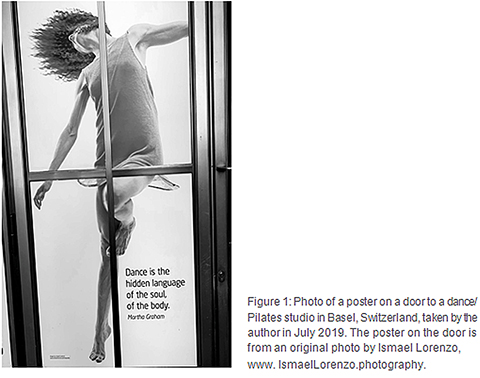
A dynamic Line asks us to take into account more than the positioning of skeletal alignment. The function of a dynamic Line asks us to account for variables such as balance, power, strength, transmission lines of engagement and movement, symmetry and asymmetry, and the art and culture of the dance. In order to optimize the dancer’s performance, having a broader understanding of these variables enhances how we go about designing sessions to achieve optimal function.
In the action of movement, the dancer is displaying each of the variables that will compose a step, a shape, a transition, and the culture of the dance. What determines the action taken is the choreography, the skill of the dancer, and the art of the dance. And the movement created requires power, strength, and the kinesthetic awareness of a flawless sequence of precise movements.
When we use a static-line measurement, we may see the asymmetry in the dancer’s structure, along with anomalies that influence balance and form. We recognize that optimizing balance and form will enhance the dancer’s performance. What we may not recognize from a fixed- position assessment are the limitations and influences that occur in structure during dynamic movement. For the dancer, it is in movement that we can see the ′Line′ express itself in form, geometry, and physics.
A dynamic ′Line′ helps us see points of balance by which the body is positioned along an axis that changes as the dancer moves and, in turn, creates varying geometric patterns, positions, and actions. Along these axis lines, stacking occurs to achieve balance, geometry, and movement. It is here, in these varying positions and shapes, we now see where limitation and influences restrict the dancer’s potential. And it is here where interventions and corrections can more fully optimize the dancer’s performance.
Laura Maguire wrote in Dance as a Way of Knowing, “Dance can be an expression of emotion or aesthetic impulses, or it can be more like a scientific investigation into the physics of moving bodies.” Do we understand the context in which movement is engaged, shaped, and communicated, to fully allow the dancer to express the aesthetics of her dance? What then of the necessity of being true to the art and culture of the dance? It is here that structural refinement and art asks us to know more, and to see beyond structure to fully comprehend how the application of change has the potential to vary art and movement. By having a greater awareness of a particular type of dance, our intention then can guide us towards optimization that then provides the dancer with a greater range of choice in the expression and performance of the dance.
When a body moves, it’s the most revealing thing. Dance for me a minute, and I’ll tell you who you are.
Mikhail Baryshnikov
Dance shines a bright light on the range of adaptability the human structure can attain. At times it is mystical and symbolic, and other times it is an expression of sweet innocence. In all cases it is about knowing there is something magical in movement that speaks to our humanity and reveals the inner world of the dancer to those fortunate enough to witness the dance.
Bob Alonzi is a Certified Advance Rolfer in Los Angeles. He is the author of I Stretch & Strengthen released by Green Tara Press in 2018.Dance as the Teacher[:]