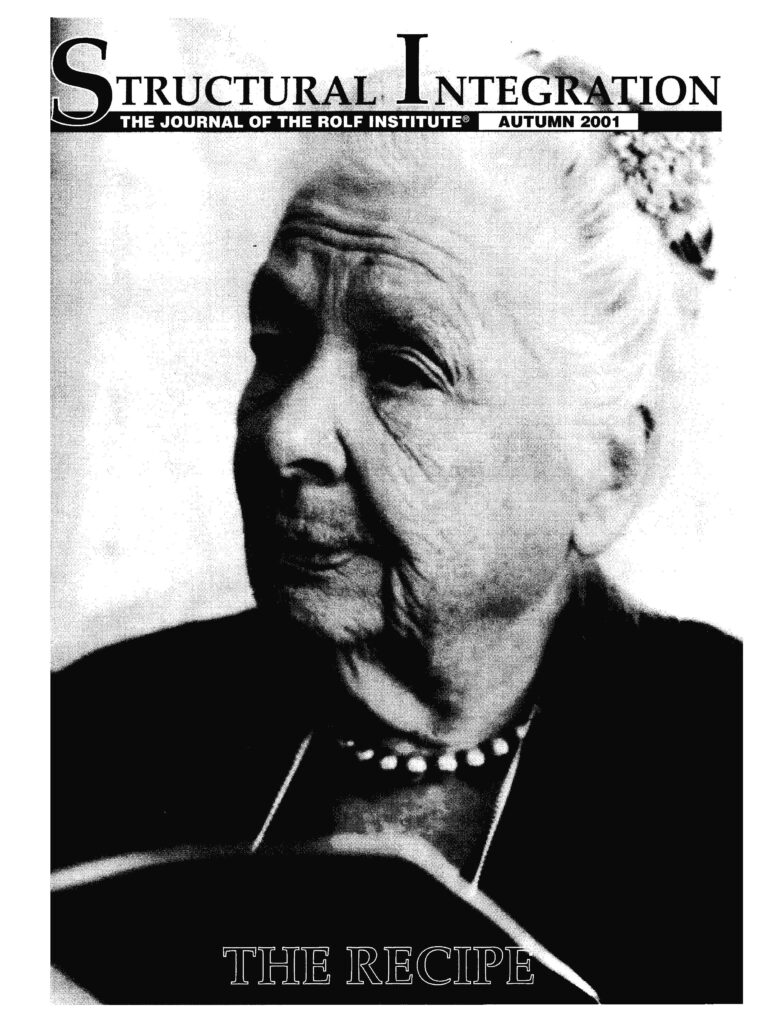
During her basic practitioner’s class in Boulder, 1972, Dr. Rolf called the class over to look carefully at her Third hour model’s left side. The longer we looked, the more structural details we saw. Students began noticing that the model’s ribs were not evenly distributed and that some were deeper than others. They commented that during the model’s breathing, ribs moved at different rates and timings. Dr. Rolf then proceeded to deliver her third hour. She placed her hands on both sides of the model’s lateral line and began working each contact evenly away from center. When she was done, she invited the class to observe the results. I was astonished to see that all of the previous structural observations had been corrected. My amazement was that she had accomplished correction of many structural problems by directly addressing none of them! As this lesson has matured within me over the years, I have come to realize that the specifics of anatomical structure are not as important as what is done with it.
THE TYRANNY OF COMPLEXITY
Any given structural situation is complicated by the observer’s perceptions. The more time and in-depth effort one invests in seeing, the more detail and complexity one sees. The sharper one’s perceptions become, the more problems are observed. One problem with this is that any perceived misalignment may be interpreted as the “cause of the problem”, and, based on this, a treatment modality designed for its “correction”. For example, symptom-oriented Chiropractors love finding that an L4 is anterior on the right. Their allopathically inspired reasoning leads to a simple “fix” of pushing L4’s left side forward to correct the alignment. However, limitations of available treatment time dictate that practitioners cannot apply this reasoning to all the body’s 206 bones.
And what about the relationships among all the body’s 206 bones? Structure is relationship, after all. When we look beyond each bone’s immediate neighbors, the number of relationships in the whole osseous body is 206 bones factorial (mathematically written 206!; 206 factorial is 206 x 205 x 204 x 203 … x 4 x 3 x 2 x1). 206! is a HUGE number, well beyond the human mind’s conceptual capabilities. An all-encompassing structural treatment strategy is therefore patently impossible, because the same logic, and the same tyranny of complexity, applies to the body’s myofascial tissues at any and all levels of dissection or detail.
How did Dr. Rolf normalize all those structural problems without specifically addressing each one? Did an essentially unteachable miracle happen or was a different dynamic invoked?
A SIMPLE MODEL
Let’s model the spine as a stack of plates (vertebral centrums) and marbles (disks). In our readily observable Newtonian, everyday “real” world, a stack of plates and marbles can never be perfectly aligned. There will always be small differences in plate alignment or marble placement. Therefore, even pressure applied to the top of the stack will exaggerate subtle misalignments until a near-perfect alignment disintegrates into off-center marbles and diagonalized plates. Now imagine the reverse process: evenly applied decompression forces will pull everything back towards center, eventually enabling gravity to better support the stack.
Dr. Rolf treated both sides of the body evenly and the misalignments, movement and/or contour problems corrected themselves. She also commented that improved Structural Integration could be accomplished with minimal anatomical study, just by paying attention to the body’s overall geometry, shape and function. Given that we do not need a detailed knowledge of anatomy to change a person’s physical shape, motion dynamics, and posture, it becomes sufficient to know that:
1) If one decompresses it, it will expand to fill all available space.
2) If one melts or softens solidified, work hardened tissue, it will expand like a re hydrating kitchen sponge (pressurized water is always present).
The shape and span normalizes, whether from decompression or re hydration. Like an inflating dirigible or balloon sculpture, body contours will normalize and assume their genetically predetermined shapes when the forces on all the interconnecting lines and struts are equilibrated.
THE GEOMETRIC APPROACH
I have concluded that structure, as dissectible, analyzable shape, is an intellectual red herring. What is important is what one does with it. This is why a geometry based, N-step recipe or model works well as a simple context for framing and teaching a whole-system treatment approach. If we arbitrarily choose the number of sessions to be given as ten, Dr. Rolf’s original recipe for a sequence of treatments becomes quite reasonable:
Session Release and/or Relate
1,2: Front to Back (coronal plane)
3,4: Side to Side (sagittal plane)
5,6,7: Top to Bottom (transverse plane)
8,9: Girdles to Core (internal/external)
10: Establish Horizontals and/or Verticals
A few guidelines apply. Any of the above numbered steps can be sub-divided or repeated as much as is appropriate. The order may also change as long as the integrity of the approach is observed. If you wish to transform the whole structure and if you have the luxury of being systematic, be sure you distribute your efforts everywhere, at all depths, sooner or later.
Work back and forth from the gross levels of structure to the finer details. Given that the system is relentlessly aging, growing or being stressed, repetition of treatment and strategies can be very appropriate, and, as usual, the Ultimate Caveat applies: “…when performed on normal, healthy bodies under ordinary circumstances”.
A geometrical context gives us the freedom to work with the body in any shapes or positions (sitting, standing, lying and any yoga-inspired poses or levels of rest), and in motion or stillness (breathing and motion dynamics, joint and segment tracking, at all reach-envelope limits and with any choreography).
Another advantage of this generalized approach is that we are no longer limited in our thinking to purely Euclidean spaces. Recent advances in Geometry, pioneered by the mathematician Benoit Mandelbrot (The Fractal Geometry of Nature, 1982), have profoundly altered our ability to understand and computationally model organic form and complex structures.
I suggest that if we can understand and relate to the fractal nature of organic structures, we will find new ways of applying our working knowledge in our quest of helping human anatomy to more appropriately fill and use space. From a fractal perspective, the body’s functional sub-units and their dynamic interrelationships look very different from the classical, dissection oriented anatomist’s viewpoint.
WHAT CREATES INTEGRATION?
Pressure creates both disintegration and reintegration. In randomly organized bodies, gravitationally-induced pressures will cause asymmetries, misalignments and functional problems to settle and solidify. Direct manual application of pressure can cause all of the body’s inherently soft, squishy parts and tissues to adjust their interfacing contours and fit together differently. The systematic application of pressure to change a shape – or create a morphological transformation – is a concept easily understood by anyone who has ever sculpted clay or kneaded bread dough.
Dr. Rolf’s hypothesis, that collagen gel chemistry is the mechanism underlying the body’s inherent and observed plasticity, could prove to be too complex. Simple re hydration, analogous to the act of squeezing and releasing a kitchen sponge to promote water absorbtion, may be a more accurate description of the physical nature of the events involved.
DIRECTIONS FOR FURTHER THOUGHT AND STUDY
If structure is relationship, and if relationships can be changed, then shouldn’t we be studying changes that we have made, and asking questions about what changes we might be able to make? Perhaps we should focus on observed changes and not be concerned about symptomatic status or idiosyncratic shapes. I offer three ideas:
1) Maybe we don’t create structural change as much as proportional variation. How much can human proportions be changed through manipulation? During his famous study of human shape (published in An Atlas of Men), Sheldon’s obsolete but descriptive terminology (“mesomorph, ectomorph, endomorph”) was so subjective that he was the only person who could reliably sort people into his categories. Modern image analysis and contour mapping software should allow objective re-creation of Sheldoris work -a new “Atlas of Humans” by using three-dimensional data and automated computation to sort humans into morphological categories. I suspect that we will find many more categories of human shapes than Sheldoris original three. Can physical manipulation cause significant morphological changes, enough to justify re-categorization? In Sheldori s frame of reference, can an ectomorph become more endomorphic? Can a mesomorph become more ectomorphic?
2) After putting equal time and effort into the front and back of a rib cage, evaluate the visible changes using modern image analysis that tracks contour changes during breathing. Measure functional differences with vital capacity measurements that evaluate both volume and breathing dynamics. For individuals whose vital capacity remains relatively constant, does the slope of the curve change?
3) Scoliosis and Kyphosis may be so complex and perplexing precisely because we are so attracted to the exaggerated nature of the morphological and functional problems. Perhaps a study should be devised to evaluate the relative effects of using a treatment strategy which ignores the “structural” asymmetries (and the whole cause/ effect question), and focuses instead on treating these bodies by relating to their intrinsic symmetry, as in the above recipe. If they are generally and evenly decompressed, how much do they straighten out?
REFERENCES AND FURTHER READING
Benoit B. Mandelbrot, The Fractal Geometry of Nature, New York, NY: W. H. Freeman and Company, 1982.
Biographical information about Benoit Mandelbrot on the Web: www-groups. dcs.st-andrews.ac.uk /history / Mathematicians / Mandelbrot
An older but colorful introductory text on the new geometry (more current texts are easy to find):
Michael Barnsley, Fractals Everywhere, Academic Press, 1988.
A history of the discovery of Fractals
To have full access to the content of this article you need to be registered on the site. Sign up or Register.