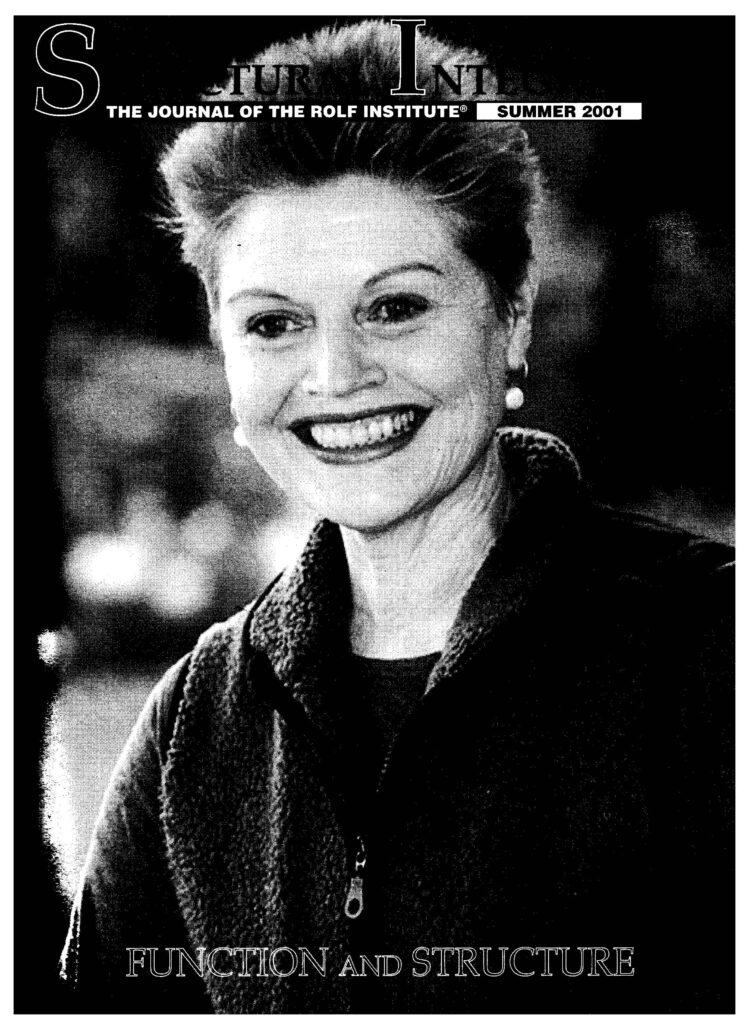
SI: Say something about what you were doing before you met Ida Rolf. How did you meet her?
JA: First of all, thank you for your invitation to talk with you. Should I talk about when I started teaching, or what I was doing before I met Dr. Rolf? Most people do not know anything about my work before I met Ida Rolf and so a lot of times they think that my work is Rolfing.
Actually, I started teaching for the L.A. schools in 1962, that was for the summer; and then in 1963, I started teaching at Long Beach Community College, where I created the movement education department for theater, dance, and physical education. I taught there from ’63 to ’72. I worked with a lot of athletes and actors, and of course all of the different physical education majors. Students can go through two years and get a rec degree so that they can go on into a program where they can teach physical education. I was also choreographing and performing and doing concerts and dance theater events. I called them dance theater events, as they involved live music, actors and dancers. In 1965 I got my Master’s degree in Fine Arts. My thesis title was: Dance as Directed Communication in Stillness and in Motion.
SI: Hm! That sounds like a familiar phrase.
JA: Don’t you think? I was always intrigued with patterns of expression, how people communicated whether they were moving or still, and the significance of all that. The reason I tell you this now is because it became part of the title I used when I developed the movement program for Rolfing. I got my B.A. and my M.A in Fine Arts from UCLA. I was very involved in dance education and communication, and because all this information was coming to me, I was looking for someone to direct me as to how I might best frame it or “teach it.” I went to different people, one of whom was Mary Whitehouse in 1966 or 1967, and she was so kind to me, she had me take a session with her, actually two sessions, and at the end of the second session, she said, “This is not what you are looking for, is it?”
I said, “Well, I mean, it’s very nice work, but, I… I…,” – stammering around -, and she said, “Well, I think it’s just coming through you, you should start teaching. I’ll tell you what, I have someone who is starting a program at Kairos, they’re opening up a new center like Esalen, and why don’t I give them a call and you should go down there and just start teaching.” I said, “Wow, okay!”
So from about ’67 to ’72, I taught at Kairos, which was another growth center near San Diego (actually near La Jolla). I became their “movement” person for group leaders like Fritz Perls. I did movement on Saturdays for his group. I was the Movement Lady. Then I hooked up with Dr. Tom Munson, who taught Gestalt and was trained by Fritz, and was a good friend of Fritz’. He first invited me to his workshop to observe, and I was most intrigued with a common occurrence: the only person who did not seem to know what was going on was the person in the “hot seat” (the other 30 people who were watching seemed so smart, and I wondered how could that be?).
So I asked him, based on my understanding about communication with self and others, if it would be okay if I developed a Gestalt movement program where I could help the person in the hot seat be as smart as the observers, and have a different way of working with Gestalt. He said, “Go for it!” So I did.
Creating new programs around a certain challenge had become a theme with me. I have always been fascinated with patterns, and can often see the common denominator or the common thread within a system or situation, whether it is, in this case, the Gestalt process, or later on with Rolfing. I developed this Gestalt movement experience, and that was very successful.
In the case of working with acting companies, I would see what the director had in mind with his ideas for working with his actors, and then I would come up with a program that would incorporate his ideas, that would also integrate my ideas for spiralling the transition from the actor to the character expression and back again.
In 1966 and ’67, I was in the wrong place twice and was hit in two car accidents. The first one was quite serious (I was stopped, and someone going 50 miles per hour rearended me, put me in the hospital for a while, and so on). I had all these problems through ’66 and’67, and Dr. Munson said, “You know, you don’t seem to be getting any help and I know they want to fuse your back (he was also a surgeon) and he said, “but I’ve heard of Ida Rolf, she’s a white witch, and if anyone could help you understand this, she could; I think you should go see her.”
I said, “Where is she?” And he said, “Well, she’s in New York, but she’ll be at Esalen.” I said, “Well, I’ll just go there.”
I got there and was told, “She’s booked totally, you know.” I said, “Well, just let her know I’ll be sitting outside her door.” So every time she opened her door, I would be there, sitting, and she would say, “Oh, not you again!” It was really kind of comical. She didn’t know me other than that I was friends with various people from Esalen. I don’t know how many days I did that, and on whichever day, the second or the third, she opened the door and said, “I have just received a message that one of my people had to cancel, do you want the session?” I said, “Oh yes, I do!” So I got into the session, and she said, “Tell me about yourself, and why do these people know you, and what are you up to?”
I said, “Well, this is what I do, I teach movement and I’ve developed programs for various groups.” I told her what I’d been doing, and that I was currently about to work on a project with Dr. Valerie Hunt, who had asked me to join her on an idea I had had for a research project on Directed Communication in Stillness and Motion, etc. (Dr. Hunt had been one of my professors at UCLA). Dr. Rolf seemed intrigued with that somehow, and before I knew it she said, “Well, do you think you could design a movement program for me, for Rolfing, to maintain the Rolf Line?” Without hesitation I said, “Sure!” because I was kind of like that; not even knowing what she meant, I said, “Of course!” That was where I was then.
I had the feeling that she was interested in my project with Dr. Valerie Hunt; I think she was interested in the fact that people knew of my work, they knew that I had done these programs and so on. I think she had a pretty good idea of my background and that’s why she asked me, but I have to say I was surprised that she asked me about this within a very short time during the first session. That was in April, 1968.
SI: Had she known Valerie Hunt previously?
JA: Yes, she’d heard of her. Dr. Rolf was always looking for the opportunity for research and funding. I think that that actually helped me in this particular experience. I told Dr. Valerie Hunt a couple of years ago, “You know, I actually think that you are probably one of the main reasons that Dr. Rolf asked me to do this in 1968. She said, “Anything that helps! I am glad I was able to help you!”
Dr. Rolf said, “Well, in order to do that, I would have to train you, and the first class starts this summer.” I said, “Oh no, not this summer! I finally have my money together and I am going to Europe.” And she said, “Well, the training starts this summer.” So that was that, and I started training with Dr. Rolf that summer. I audited in Big Sur, when Ed Maupin, A.A. Leath, Will Johnson, M.D., and others were training; I can’t think of all their names now.
SI What was it like receiving bodywork from Ida Rolf?
JA: It was extremely painful, and I had no idea it would be painful until I got there and she started working. The saving grace was that, just as she has always said, when she stopped working, it stopped hurting. I could immediately feel the change. I am so grateful to Dr. Rolf for opening my eyes to the magic of the body, that you could work on it in this way, and it could change immediately. Until that idea came through her, I believed what I had heard, including from the experts in the medical field whom I had seen for my severe back injuries and soft tissue injuries. I had been told that that was the best I was going to be able to get for the rest of my life, and I should get used to it! So the discomfort was well worth it. I remember after the first session, I leapt across the grass area over to the Melchiors’ house and told them that -I was just so excited to feel the changes, I was so hopeful, and, by the way, she had asked me to do this program design for her, did they believe that? So they would be seeing more of me…
SI: How many sessions did you receive from her?
JA: All ten sessions in the beginning, then she also did the advanced sessions with me.
Let me go back to 1963 for a moment, to my teaching at the college, as a course I had developed there for a very different reason became my saving grace for the Rolf training.
One of the courses I taught was Stage Movement for actors. I realized that these young students (we were actually about the same age, so that was a challenge), were unable to play an older characterization if they didn’t know what was going on with their own body movement, so I had to teach them to “see bodies.”
When I got to the first Rolfing class in the summer of ’68, in Big Sur, the practitioners would come to the back, and they’d say, “do you see that?” and I would say, “yes, see what’s going on is, dada dada da… ” Pretty soon they were all coming to me to explain how Dr. Rolf could see that the psoas on the left was tight, etc. They would take her word for it, but would not be able to see it on their own.
This experience set the trend for a role I have continued in to this day, that of teaching people to see body relationships.
Now here’s an amazing experience: I was Dr. Rolf’s Girl Friday (I think she called me her Girl Friday). I would run errands for her, and pick up her cleaning (I realize now that if I had been more mature in my youth, I could have been a more gracious servant. I wasn’t always a gracious servant, but I did appreciate being able to help her). I did all of that and audited, and traveled with her, and took her places, to dinner meetings and those kinds of things.
On the very last day of the Big Sur class, we walked out and everybody was hugging goodbye and getting into their cars, and Dr. Rolf said, “Wait a moment!” I was standing by my car and she motioned me to walk over to her car. She said, “I want to tell you, I’m not going to take you on.” I said, “Pardon me?” She said, “You’re too little; you will never make it in this field. I am turning you down.” I said, stunned, “Pardon me?” She said, “Now I just know that you’ll hurt yourself, you just are not going to be able to do this work. You’ll never make anything of yourself in this field. That’s it.” I said, “How could you not know this two weeks ago?” – because, you know, the class was six weeks. I was there six weeks! She said, “Well, I’ve been looking, and…” I interrupted her and said, “Well, you’re wrong. You’re absolutely wrong!”
And I got in my car and sped off. Now I used to drive these hot little Firebirds, 400, what do they call them?-400 horsepower engines and when I say I sped off, I sped off! What she said was really shocking, and I wondered whether it wasn’t the fact that she might have decided this earlier but also that I was a big help to her for those six weeks, so she thought she would wait-I never knew exactly what or why.
This was 1968; for all purposes, that should have been the end of my Rolfing experience. But I had said that she was wrong. So when I got back to the Los Angeles area, I immediately called the massage schools, and signed up for classes. I had been teaching at the college, I had been teaching officially at Los Angeles schools for six years. I no sooner started taking classes at Pomona School of Massage, than they made me one of their teachers. I don’t know how many pounds I gained, ten or twelve pounds, and collected my money for the training that I knew was to be in February, 1969, in Los Angeles (actually in Westwood). That was the training where Emmett and Peter came in to audit.
I was supposed to train in that course! I heard that she was going to come to Los Angeles sometime in October or November 1968 for some meetings. I said, “Well, I need to come and meet with her.” Sometimes Ida would have a group of people around for support, for a meeting, for brainstorming, whatever. All I know is that there was a group of people there. So I walked in through the front door with my “best Rolf Line”, contracting my psoas to tilt my pelvis to raise my knees straight forward, and my elbows straight out, the top of my head going up, with my check for the full training in one hand and my massage certificate, etc., etc., and I proceeded toward her and she just burst out laughing.
One of the things that I was able to do with Dr. Rolf was to make her laugh; and she enjoyed it, and I enjoyed it thoroughly. I guess I can be pretty entertaining sometimes. Anyway, she burst out laughing, and said, “Okay, okay, okay!” I said, “Fine, I’ll see you in February.” And that was that!
I did the training. Now mind you, all the while I am gathering Dr. Rolf’s ideas of what movement is supposed to be. She had very specific ideas about movement. I believe she had been influenced by Mensendieck and Yoga. She had a few movement patterns, not patterns, she called them designs, e.g., toes up, toes down, elbows out, etc.
SI: She called them designs?
JA: I can’t exactly remember, actually, I know they weren’t called patterns, because I brought that term in later. I can’t remember whether she called the movements exercises or not. She had only given about six of them in the auditing class.
During the Rolfing training she decided again that I was too small and that I should only work with children and small women; and that that would take up too much time in the class, so she asked Dorothy Nolte, who was assisting her in class, to supervise my session work in one of the other rooms. But other than that I was in the regular classroom.
Throughout the class I’d say, “Now, Ida, I’ve been thinking about this movement program for a while now, and you know my interest in patterns. I’m very interested in designing this for you, so if you have any more ideas on what you want, you should let me know.” Her idea of movement was to hold the Rolf Line while doing any other movement.
The Rolf Line was: feet straight ahead, ankles close together, knees slightly bent, waistline back, pelvic tilt, top of the head up, chin in, elbows straight out from the sides, palms facing back. That was the Rolf Line, and whenever possible you held that or you put that into your bodyworking, or doing your yoga, or what have you. That seemed easy enough; it wasn’t difficult for me to grasp, so I said, “If you have any more…” I think she then added variations on these six; she might have shown me ten or eleven designs (going up on half-toe, that was another one of them).
Now the class is finishing and here she goes again – at the very, very end of the training she says to me, “Dorothy Nolte has a movement program that she has been developing.” I said, “What?” She said, “Well, it seems as though Dorothy has a program called Structural Awareness. You should see about doing sessions with her.” In disbelief, I said, “Well, I’ll be!”
After the class was over, I went down to… I think it was Laguna Beach, where Dorothy lived, and I took a session. I took one session, maybe two. I remember calling Dr. Rolf from a phone booth in Laguna Beach right after the session (Dr. Rolf may have been in New Jersey by then, maybe still in New York), got hold of her and I said, “Listen. Dorothy Nolte’s work, Structural Awareness, is very nice, I’m sure it’s very helpful to people, but it is not at all what I had in mind. I wanted to put together a program that would apply this work to daily living, to exercise, to teaching people how to work, how to see, to training teachers… I have this whole program design. You are going to have to make up your mind. Do you want it or not?” And she said, “Well, okay.” And I said, “Okay. I’ll go ahead, and I’ll have it together by whatever date your’re coming here.” Let’s see, that was ’69… so l worked on it in ’70, and put it together.
Anyway, we made a special night of it where I had four people that I had been working with come and show her the designs, and she made a few comments, really very few. And I said, “Okay?” She said, “Now you understand, this is only to be used for people to maintain the Rolf line,once they have finished the ten sessions…” And I said [laughing], “Okay.”- meaning she didn’t want anything interrupting her ten session recipe. It was only for people who had completed the series. So I said, “Okay.” I had put all my ideas down, and to give the work a name I tried to take my interest in patterns, my interest in communication in stillness and motion, and I took “structural”; so then I gave it this very long title: “Rolf-Aston Structural Patterning in Stillness and in Motion.” That was its official copyrighted name.
I went to an attorney to inquire about all this and told Dr. Rolf what I was doing; so when I showed her, she wasn’t so happy with me for moving forward on it. I had the feeling that she kind of thought that I would drop the idea if given enough time, but actually I usually don’t do that.
Then in 1971, the Rolf Institute – was it named the Rolf Institute then? [The Rolf Institute came into being in May 1971-ed.] Or was it the Guild for Structural Integration? Well, it officially moved to Colorado, and I became a board member, I was on the education committee and was the head of the movement program.
In 1971, it seemed as though a lot of people asked me to teach “seeing” and “movement” modules for saving their bodies. In 1971, it became a requirement that all Rolfers had to take my class, which I entitled “Movement Analysis,” and that was teaching people to see and use better body relationships. And teach them how to use their body while they were Rolfing. It was offered just prior to a training. I remember Michael Salveson saying, “Yeah, unfortunately for me, it was now required.” And I said, “Oh, okay, fine!” [laughing]… you can appreciate that in any training, there are many challenges, difficult times, but generally people knew how to laugh and to create laughter.
Many people took the Movement Analysis course: Bob Prichard, Don Hanlon Johnson, Mark Reese, Tom Myers… in fact everyone who trained from 1971 to 1977 was required to take that course. Bill Williams, Roger Pierce, Joseph Heller, Annie McCombs Duggan, Heather Wing, Louis Schultz, and many others took my Movement Certification training and in fact took classes for years. I think we were called “the dancers.” I was offended then – now I realize my highest goal is to continue dancing through this life and beyond.
SI: So how long was that first course?
JA: Four days. Then I traveled all over. I went to Florida, Big Sur, San Diego; I did these four-day classes wherever there was interest. I offered my first Structural Patterning class in August of 1971, in Big Sur. The class was basically filled with people who were connected with Rolfers so that they could be supportive to the Rolfers doing the work. And I tried to squeeze in as much content as I could; I did everything in two weeks-in ten days; it was a ridiculous expectation, but I did that.
That was the official beginning, and then I started doing classes for other people interested in this type of information. The program started to expand, and then people started doing this movement stuff before they did Rolfing, or without Rolfing. People could see the terrific changes in the functional patterns. I felt this made it clear where people needed to focus their Rolf work. When functional patterns or habits could change, then suddenly the true structural patterns emerged and became clearer for Rolfers to see what to do. “Functional Holding Patterns” is one of the coined phrases that I started to use. Structural Holding Patterns needed hands-on work, while Functional Holding Patterns could be changed through movement, meditation, visualization, etc., etc.
By 1973 I was struggling with many of the givens of the Rolf model, so I started changing things just ever so slightly, thinking that I was just helping Dr. Rolf in her work. I thought that was actually my purpose.
SI: What things were those?
JA: Givens such as: the body is to move in straight lines, the person needs to hold good posture, the feet straight forward, etc. I questioned that the body should move in straight lines instead of diagonals (I later came to understand that the body moves in spiral patterns). I realized Rolfers didn’t have to work so hard if they changed the angle of their body to the impression point on the tissue, for example. If I could teach people to use their bodies slightly differently than the “waist back…,” etc., then the effort was less and the pain was decreased for the client…
SI: You could get the same results without causing as much pain.
JA: You could glide through the tissue more easily with less resistance, and that less resistance was coming from the practitioner, not the client. Sometimes I would hear Rolfers say that, the experienced pain was not caused by them but was in the tissue. But actually I was finding that body usage had a lot to do with the level of pain.
End of Part I
Contact Information: Aston Paradigm Corp.
PO Box 3568 – Incline Village, NV 89450
775-831-8228 www.astonenterprises.com
To have full access to the content of this article you need to be registered on the site. Sign up or Register.