

Note from Anne Hoff: Luiz Fernando Bertolucci visited Seattle this autumn, where a group of local structural integration (SI) practitioners were able to see a demonstration of his Tensegrity Touch® method of practicing Rolfing® Structural Integration (SI). This brought to life for me the concepts he’d written about in the December 2016 issue, in his article “Manually Evoked Tensegrity and Pandiculation, Part 1” (Bertolucci and Lobo 2016), and inspired this interview.
Anne Hoff: So, Fernando, you are here on a visit to Seattle, and I got to experience your work, which you call Tensegrity Touch®. I was very curious about it after you wrote for our theme on biotensegrity in the December 2016 issue. We had various authors talking about tensegrity and biotensegrity, and what struck me was that you seemed to have a way to take this directly into your practice. You weren’t just speaking conceptually – we all have heard for years about Rolfing SI and tensegrity; you were implementing it in a unique way of working. Now that I’ve watched you work and experienced your work directly, I want to comment on various things, and ask you to share more about Tensegrity Touch.
One of the first things I noticed is that your assessment of the person standing is more about touch than the usual Rolfing assessment, which is often dominantly visual. Your hands are on the person’s tissue, and you’re moving it, feeling for resistance. Your metaphor is that you are a “blind tailor” and you’re feeling for how the tissue drapes on the body. How did you get to this kinesthetic assessment?
Luiz Fernando Bertolucci: It really goes back in time to trying to help people who had very severe movement restrictions and impairments. I trained as a physiatrist, and I used to see patients and prescribe physical therapy that somebody else would do. But then I trained as a Rolfer, and when I put my hands on people, I realized how powerful it is, and how much the manual input can change peoples’ movement conditions. I was really awed at first, with this possibility. So having those very restricted clients coming in, I was trying to help them somehow. Most of these patients had already undergone surgery, so that was not an option, and I was trying to find ways to help them through exploring ways to accomplish more effective manipulation of the soft tissue. I don’t remember well, because it was a long time ago, but I have the image of, for instance, working in the hamstring area because of a hip condition, and I felt I needed firmer support – a firmer counter-pressure to my pressure. Perhaps this was the beginning. One of the main aspects of this tensegrity work is loading the tissue, shearing it. This really brings about a sense of firmness as a platform for the practitioner’s hands. Maybe I was searching for something steady and firm to give me back a base of support for my touch.
It was over time – years, actually – of experimenting and empirically researching how to characterize this work that this way of really assessing the whole system came about. The diagnosis and the treatment are the same thing, in a sense. For instance, using this example of working on a client’s hamstrings, I was at the same time both assessing the restrictions to tissue mobility and also treating. When you are assessing, even with the person standing, you are somehow relating parts in different ways and the body is already changing, especially if you consider specific neurological responses that may arise. That was how this assessment method, little by little, came about. I started to use my hands more, and my eyes less.
AH: You didn’t quite realize how you were diverging from the way you had been trained in Rolfing SI.
LFB: Exactly.
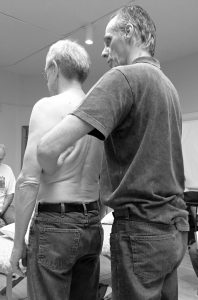
Figure 1: Bertolucci demonstrates the “blind tailor” assessing the draping of the soft tissue.
Luiz Fernando Bertolucci and Anne Hoff
AH: In your earlier article, I loved the story of how other people had to say to you, “What you’re doing is different; what are you doing?” Then, you had to go through this process of inquiry to actually understand the difference, because it seems like it just developed very organically.
LFB: Yes. I was doing something, but I was unaware of what I was doing. My focus was on the client. I was trying to help and trying to get the tissue to move, etc. All the rest was development out of this, in a sense.
AH: In your demonstration, you described the tissue restrictions you are feeling for in your “blind tailor” assessment, and the firm platform you are creating by shearing tissue around bone. In both assessment and treatment, you are moving tissue, moving parts, until you find where the movement of a part engages the whole. That gives you the firm platform. Another way to say it is that it gives you a ‘handle’ onto the biotensegrity of the structure. You are no longer relating to local tissue or to just one segment, you have engaged the whole.
LFB: Right. It is interesting how shearing and pressing tissue in a particular way unites body segments in a single unit. The underlying mechanisms, though, of how this takes place is still unclear. I guess the touch integrates segments – and creates tensegrity – by two discrete actions: one mechanical, that happens thanks to the myofascial force transmission, and another neurological, possibly related to reflexes fired by the particular proprioceptive input produced by the touch. We observed that when you start a maneuver, you often get a certain degree of tensegrity, which unites some but not all segments. As you continue the maneuver, more segments are progressively engaged, increasing the degree of tensegrity. When we performed EMG measurements, we noticed that it takes a certain amount of time, often minutes, for the spontaneous muscle activity to ensue and that it gets progressive higher. From this, I believe the mechanical component is present already from the beginning of the maneuver and the neurological component slowly kicks in, bringing more segments together in the tensegrity unit.
AH: Watching your work, I really saw the principle of holism (one of the Principles of Intervention) in action. I know that you know anatomy really well, and that you teach anatomy for the Brazilian Rolfing Association, but your way of working is not driven by anatomical structures. Rather, you’re coming at it from biotensegrity, from the sense of the body as one unit. In a way, you are asking “How can I activate the holism of the body so that my intervention is an intervention to the whole, rather than to some particular anatomical structure?”
LFB: Exactly.
AH: I think this is what makes your way of working particularly potent and the results dramatic. Even if you’re working the hamstrings, you’re putting this tension in so that in the moment the hamstrings are intimately relating to the whole as a biotensegrity structure. I think that Rolfing work always spreads through the fascial web, but the way you affect the “pre-tension” of the whole system seems to make it easier for the body to take your intervention and do with it whatever it needs to do.
LFB: Anatomy cuts and separates to study. I love anatomy, and I love science altogether, but I joke with my students. “Is it important to know anatomy? – Yes, it’s important to know anatomy. But as important is to forget anatomy when you’re working in this fashion.” You’re not ‘doing’ with your will, with your cognition, your voluntary drive, so to speak; you’re not doing something to a particular structure. When you load and shear the tissue in Tensegrity Touch, you are, as you said, working the whole and sensing for the relationship of parts, rather than the condition of the parts themselves. If you think about anatomy, it can be disruptive, actually.
We are working at a deeper felt level. I think there is something that’s already built in our systems that allows the client to know when something’s out of place. We, as helpers,, can also sense when there is something out of place. And then, from both perspectives, client and practitioner can also sense when things are going toward the right way, so to speak. I believe this probably comes from something that’s embedded in our nature to care for each other. I joke about the “catch-bug” reflex in monkeys, how they groom each other. Both share a sense of rightness, based on interoception, much like it feels right to drink water when we feel thirst.
AH: This recognition in the client of what feels right is the ‘beneception’ you talked about in your article.
LFB: Exactly. Yes. This is the biological reward, so to speak. When I’m working, I’m not thinking of anything, I’m sensing more than anything. The sensation of ‘rightness’ is probably the guiding star. Then, when the tissue starts to move, you can ‘fill in the gaps’, so to speak, with anatomical information, physiological information, biomechanical information, whatever, in the search to understand cognitively what is happening. So anatomy helps, but it can also disrupt this sensing state that has a kind of recognition that is not analytical; it’s more a sensitive, kinesthetic, and sensory driven state.
AH: I noticed, when you worked on me, sometimes you’re using a lot of pressure, but a lot of the time, you’re not. And either
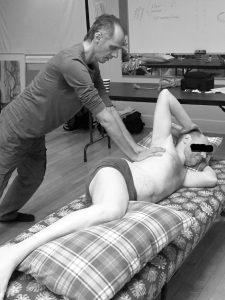
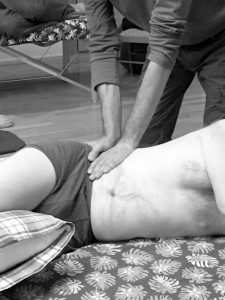
Figure 2: Tissue shearing as Bertolucci builds tensegrity to unify segments.
way, it wasn’t really like you were doing something – in the sense of a targeted intervention. It’s more that you were setting up conditions that the body can make use of.
LFB: Exactly.
AH: It can go incredibly deep without you, as the practitioner, deciding, “I am aiming at this particular deep structure and trying to change it.”
LFB: Yeah. I think that’s really what it is. You first artificially – with your will, so to speak – create biotensegrity, a heightened sense of the connection of all the parts in a whole. This will evoke responses on the client’s side. So my guess is that when you create/enhance biotensegrity with your hands, you invite the system to participate, through pandiculation-like reflexes, as well as with additional autonomic-mediated homeostatic maintenance reflexes. So yes, there are phases during an intervention. You first invite, ‘knock on the door’, so to speak – creating tensegrity. And then you wait – just maintaining the condition you set up through shearing and pressing. You just maintain it, just maintain. You see that a certain stillness then comes about, and right after that you often get what probably are autonomous autoregulatory responses like breathing and consciousness state changes, involuntary muscle activity – which we have measured – and even involuntary movements. As the practitioner, you’re just maintaining that shape, so to speak, and the client’s system responds to it. So it seems that the client is working from the inside out, and you from outside in. I believe such a blend of actions is one of the reasons that makes this style of work effective.
Another common response to the touch is a push, an expansion the practitioner can feel coming from the client’s system. This action is probably also caused by tonic involuntary muscle activity. In this condition then, the practitioner should just give a push back, maintaining the tensegrity form, and giving it containment, if you will, so that this freeing from inside out occurs. It seems that such containment gives support so that those reflexes produce deeper, faster, and more powerful, or more comprehensive results as compared to anything the client could do on his own. We are evoking spontaneous self-regulating motor activity. In fact, many different modalities can bring about these kind of responses, such as yoga, styles of qi gong, and also hands-on work. But we are bringing together something that’s done by the therapist and something that’s done by the client’s system, somehow helping and boosting this built-in self-regulatory motor maintenance system, of which we consider pandiculation a prototype. Something like that.
AH: The autonomous responses have some similarity with what can come up with craniosacral unwinding, but are also very different. Unwinding generally goes in the direction of ease, whereas with Tensegrity Touch you’re building into the direction of tension, because that’s what creates the stable platform and engages the holism of the body’s biotensegrity.
LFB: Yes. Many students ask if I was trained in craniosacral and stuff like that because they see similarities. I think there are some similarities, possibly this spontaneous motor activity is similar, but the way you get it is different, as we evoke it through manually evoking tensegrity. And also once such responses are present, the manual input is different: here, you go against the ease, so to speak. Actually, you are challenging the system. You are asking if the system can do something different than it’s been doing, so you are going in the direction that gives you the resistance.
AH: While both Tensegrity Touch and craniosacral unwinding have an autonomous regulatory effect, my experience is that the effect is not the same. This challenge you’re giving seems to have a stronger effect on the fascia. With craniosacral unwinding it more feels that the nervous system unwinds or relaxes, tissue softens, but with Tensegrity Touch I feel structural, fascial changes as well as profound and dynamic autonomous re-regulation.
LFB: That’s a good point! I’m not sure, but that is my guess from applying and receiving Tensegrity Touch, from clients’ and assistants’ reports of sensations during the maneuvers, and from the resultant structural changes, that indeed fascial changes are taking place. One curious observation in that direction is a sudden ‘snap’ that may happen during a maneuver – that can even startle both practitioner and client! – which seems to correspond to an abrupt change in the relative position of myofascial compartments. What I envision occurring is links within areolar tissue changing to a point in which the compartments can adopt a new – or renewed – mutual spatial relationship. More dramatic postural and functional changes follow such ‘snaps’, and I hope to be able to show this kind of change using ultrasonography in our next research project. So, yes, I think we are challenging parts to internally move in new ways and such effects are presumably happening in the fascial web. Such effects seem to take place in Tensegrity Touch because the ‘unwinding’ has something to relate to, as the practitioners’ manual input somehow mirrors what is happening within the body, anchoring the spontaneous push or expansion. In this condition, presumably, the shearing vectors are steered to the interfaces where tissue differentiation is most needed.
AH: The fullness and expansion seems to be the sense of biotensegrity, and that allows the body’s recognition of its wholeness.
LFB: Yes. I think so. The sense of fullness and expansion seems to show when the spontaneous tonic function of muscles arises so as to connect body segments, forming a single unit.
AH: You have renamed this work over and over again, as you described in your article, and it seems that as you understand more what you’re doing, a better name comes forth, each one more accurate to what actually is going on. Your first name was “Surgical Rolfing [SI].” And it is true that there can be this feeling of surgical precision, work being done at a deep level, but that initial name didn’t reflect the way that the work engages the holism of the body.
LFB: Right.
AH: Yo u re x ta m, “ M u s c lRepositioning,” said something about how tissues were moved, but it again didn’t capture the holism, it sounded more particularized. The latest name, Tensegrity Touch, expresses what’s unique about the touch, the way the touch relates to the body and what is activated in the body. I find it interesting that your process of understanding the work leads to these new names that get more and more precise.
LFB: Yes. They’re progressively more comprehensive, in a sense. There is still, as you said, a ‘surgical’ feature, so to speak, and also the muscles are probably changing their relative positions, as we mentioned, so both, surgery and muscle repositioning seems to occur through tensegrity. Another way of conceiving the work is as ‘assisted pandiculation’. You are assisting the
system, the system’s wisdom that comes about in pandiculation. I imagine there is a whole class of involuntary movements that help the maintenance of the system. Some are very common, like the pandiculation expressed in yawning and the so-called ‘morning stretch’, but I think it goes beyond that. I once read that yoga was not an invention but a discovery made by monks in meditative states that invited the system to move in whatever ways were needed as maintenance. Seen in this way, yoga poses are something that’s natural, that are aimed at maintaining homeostasis.
AH: Some yoga poses set up similar conditions of biotensegrity felt through a tensioning of the tissues.
LFB: Absolutely. I believe, there are two types of movements: one that is species-based, movements that are pretty much forms that repeat, like yoga poses and pandiculation patterns. But unique patterns can also arise, that can go into different kinds of expression, apparently more related to issues in the client’s history, patterns of movement that seem to arise uniquely suited to the circumstances. Vocalizations and interesting breathing patterns can also come about. I see both in my practice. I think the system can work everything; in a sense it is customized, tailored for the need and the possibility of the moment.
I also see that there is a certain progression and the movement patterns change over time. I’ve seen this in my body, and also in my closest assistants and clients, that the patterns evolve in a certain way. Perhaps the areas that most need tissue differentiation or movement are called on first, and then another, and then another, and so on. I believe that you can pretty much always enhance your quality of movement. It’s always possible to go further and develop another level of integration in movement.
AH: When clients get up off the table after receiving your work, there is often a process that needs to complete with movement. They are not done yet. It’s not the person actively or consciously sensing into what’s changed from the work, rather the body itself is still actively reorganizing, whether it’s through swaying back and forth, or some spontaneous movement in a certain direction. It seems that it’s vitally important in your work to allow adequate time for that to happen, because it may be quite a process. I remember one piece of work you did on me: when I stood, it was as if my feet were glued to the floor, and there was an imperative to stay exactly in that spot and let something happen. It took maybe ten minutes. I had to let my body experience swaying, little micromovements, all involuntary. It would have been wrong to stop the process and end the session because something was recalibrating that was very, very important. The embodiment piece is always important in Rolfing SI, for the client to stand and sense. With the deep autonomous responses that are triggered in Tensegrity Touch, it seems particularly important that there be time allowed for that and more.
LFB: Yeah. I like the way you described the experience as ‘an imperative to stay’, because this certainty, or rightness, is one of the features of the ‘homeostatic drives’. When we are thirsty, there is no doubt about it, is there? As for the movement, I envision that the mechanoreceptors, embedded as they are in the body, are used to being in a certain mechanical environment that I guess is now changed from the manual input. Such a change in the mechanoreceptors’ input will call for some sort of reset of the sensing system. It’s very common, for instance, that when the client stands, he feels that his body is in a certain position, but it’s not. The reading of the proprioceptors probably needs to reset and it’s very important to give time for that. It’s interesting, because the movements you witness in the person standing are, in a certain way, similar to the movements that we produce during the table work. In Tensegrity Touch, we put the body in a ‘unstable balance’, that’s one of the concepts of the work that we haven’t mentioned yet. You torque the tissue, and you put the system in a condition of instability, and this seems to be what we see with the person standing, for instance, the body may sway back and forth around a point of unstable balance. It’s the center – of the whole system, and the centers of rotation, so to speak, of joints. This condition of instability will actually give the most powerful sense of both ground and axial extension reflexes.
I believe that stability is always dynamic; something that’s still in a living body will never be stable, in a sense. Being still means that you already have a tendency. If you are in neutral, really in neutral, so that you can move in any direction at any given time, you should be unstable, in a sense. When we see those spontaneous movements, they seem to do exactly that – go to one side, go to the other side, past the center, and then back again, kind of swaying, and the center is in the middle. You see segmental organization of parts until you get the whole body working as a unit going, again, around a center.
AH: You have a strong background in medicine and research. Last year you went to the Fascial Research Summer School in Leipzig in Germany, right? Did you demonstrate your work there, and did you get any insights from other people’s understanding or discussion of your work?
LFB: Absolutely. I remember one Rolfer noticed that, somehow, the tensegrity condition created with the touch was like grabbing the ‘core’, to use Rolfing jargon. It’s like grabbing the core, the center, in a sense.
AH: That makes sense, because as you shear and shear and shear some more, you’re taking out the slack between the layers, so eventually you do have this really strong grip on the core. Which means the work can penetrate to the core easily too.
LFB: Yes, absolutely. The practitioner may apparently anchor the touch in superficial structures yet clients often describe tissue moving in deep structures, it’s very interesting!
In Leipzig I could further note how each modality views our nature from a certain perspective, each having its point of view; yet similar concepts are shared and, I believe, these shared concepts strengthen ways of describing our nature. For instance, some aspects of Tensegrity Touch can be seen in martial arts or in yoga or in craniosacral work, or whatever. I like that. Our nature is so complex, we cannot grasp everything so we’re going to grasp parts of it. As different people in history see our nature from different perspectives, little by little this builds a more and more comprehensive view. I like talking to people who bring similar concepts, and this happened some in Leipzig. For example, I met an osteopath who does a kind of reflex work based on osteopathy, awesome work with some similarities to Tensegrity Touch as related to the spontaneous activity of the body.
AH: I’m curious about your practice. As a medical doctor, you can practice rather differently. You told me that you mostly work with patients with very, very complicated situations these days. Give us an example.
LFB: I most often get people with musculoskeletal conditions, often where doctors want to operate. With our work, many of them can, at least to a certain point, avoid surgery. I think that points to our capacity, really, to change and adapt the body. We can change much more than we are aware of. Healthcare, in general, is aimed at correcting what is wrong. In this urge to correct what is wrong, you may overrun nature and not give the time or a chance for the client’s system to change.
I’ve seen how disruptive surgeries and traumas can be to the balance of the body, even surgeries done for aesthetic reasons, plastic surgery, can be very disruptive to the client’s ability to move in general. I have many clients coming in where some kind of surgery has been indicated, and I would say that for a fairly big percentage of them, the work can help, at the least to postpone the surgery, but perhaps even making it unnecessary.
AH: Do you work with the Ten Series?
LFB: No. I use more this palpatory assessment and mostly go with that.
AH: How do you decide how many times you will see somebody, how to progress in the work with each client, and when you’re done?
LFB: Normally, the development of the work goes mainly with the palpatory assessment – the blind tailor would like to feel the garments drape well, evenly. Also most clients come with complaints, and so the complaint is one indicator of progress. When determining if the client is getting better in regards to this certain complaint, I want to see him able to resume any physical activity he had to stop because of the complaint. And I want to ensure that he is well enough to go on alone, so in later stages of the work I may spread the sessions out further. When the client is moving, doing exercise, and the complaint is resolved enough, I discharge him.
At any given time, if the complaint comes back, or another complaint arises and doesn’t resolve on its own, that’s a concern. While it’s normal to have pains and aches at times in life, it’s a matter of concern if you have one complaint that gets worse or just is always there – this points to the inability of the system to move through it.
AH: I know there’s not a set number, but typically how many times might you see a client on average?
LFB: No less than ten sessions. And I have some cases that need continuous attention, especially elderly people with really bad conditions and surgery histories. The adaptability of their systems is degraded so that the system cannot maintain itself.
AH: Your work also points to a type of maintenance that clients need to do themselves – they need to understand pandiculation and the importance of it, and also the importance of recognizing beneception. If they learn to listen to their bodies and allow movement that feels good, they’re going to do a lot of their own maintenance.
LFB: Yes. I think this is a big part of it. In this kind of work, we need the support of nature; if the client is not there, things get more difficult. From the very beginning, I actually assign some things. Then clients themselves can feel, “I know it’s time to go back and do this and this,” because they feel they cannot, for instance, pandiculate as well as they would like to. It’s interesting: some people come back not because they are worse off, but because they want to improve more, and they are already in a state better than what they left in. They kept improving.
AH: That makes sense if they’re listening to their bodies more! Thank you so much for talking to us.
LFB: You’re welcome, and I also thank you for the interest and opportunity!
Luiz Fernando Bertolucci, MD, is a biologist and physician, specialized in physiatry (rehabilitation medicine). A Rolfing practitioner since 1990, he has been teaching anatomy, kinesiology, physiology, and myofascial release to the Rolfing community and other health professionals. Tensegrity Touch has been taught in various countries and within different therapeutic settings.
Anne Hoff is a Certified Advanced Rolfer in Seattle, Washington and the Editor-in-Chief of this journal.
Bibliography
Bertolucci, L.F. and A. Lobo 2016. “Manually Evoked Tensegrity and Pandiculation, Part 1.” Structural Integration: The Journal of the Rolf Institute® 44(4):19-23.‘The Blind Tailor’ and Biotensegrity