

This interview originally appeared in Structure, Function, Integration on April 14th, 2026, and has been edited by both authors for clarity.
As a regular contributor to Structure, Function, Integration, Mary Bond kindly sat down with us for an interview to discuss the recently completed course “Advanced Concepts in Biotensegrity,” taught by Susan Lowell de Solórzano, author of the 2021 book Everything Moves: How Biotensegrity Informs Human Movement.
We asked Mary, as she is so knowledgeable about movement, to share how she was integrating these new biotensegrity ideas into her movement concepts. The course was offered through Embodied Biotensegrity (embodiedbiotensegrity.sutra.co).
Mary noted during the editing process that it will take much longer than three months to embody this revolutionary paradigm describing the nature of life.
Dorothy Miller: Hi Mary, lovely to chat with you. Thanks for taking the time.
Mary Bond: You’re welcome. Always great to talk with you as well.
Dorothy: I understand that you recently took a three-month course about biotensegrity. As a posture and movement coach, student of Ida Rolf¹, and author, what stirred your interest in biotensegrity in particular?
Mary: When biotensegrity started to be mentioned in connection with fascia research I was intrigued; I scratched the surface of it in 2017 when I was writing about fascia for my book, Body Mandala (2018, 2023). I understood that tensegrity had to do with balanced tensions in a structure and balancing tensions within the body’s structure is exactly what structural integration does.
Especially interesting to me was what author Danièle-Claude Martin (2022) described as tensegral movement. It sounded like the spacious structure and fluid coordination that emerge when someone orients adaptively to both the ground and their surroundings – what I had learned in classes with Hubert Godard2. “Aha,” I thought, what I’m writing about is perceptual tensegrity! I introduced that idea in my book, but didn’t take it any further.
Later, during the pandemic, my interest was revived when the biotensegrity community organized what they called ‘biotensegri-tea parties’ on YouTube. Listening to their conversations, I began to see that their inquiry and purpose are light years beyond what I had thought.
Dorothy: How so?
Mary: Well, my understanding was that the tensegrity principle involves discontinuous compression elements suspended within a network of continuous tension. In that case, the wooden struts in your model are the bones, and the rubber bands are the soft tissues. If you pinch one of the rubber bands, it distorts the whole thing. On first acquaintance with this model, you think, okay, so it represents holism, adaptability, and continuity – so what?
Dorothy: That was how I thought of it. In my training at the Dr. Ida Rolf Institute®, they brought in a wooden tensegrity toy to illustrate Buckminster Fuller’s ideas3. The model shows how tension in one part of the body affects the whole. But there’s more to it, I guess.
Mary: The biotensegrity understanding of the model is dynamic, where those strings and struts represent the force vectors of tension and compression. When the forces are balanced, the structure stiffens omnidirectionally when it encounters an outside force. It’s impossible to see this if your model is constructed with rubber bands because placing a load on it makes the thing collapse. But you’ll clearly feel it if the model is made with a fishing line or a strong string. Then the model demonstrates that stability can be achieved with minimum energy expenditure.
Dorothy: Then it’s a model of energy management?
Mary: Yes, and minimal energy expenditure is one of the basic principles of living things. When a tensegrity structure takes on a compressive load, it condenses omnidirectionally; if something pulls on a tensegrity structure, it expands omnidirectionally. Both movements stop on their own, so resistance is inherent in the organization. But when a compression structure, like a brick tower or a person with the conventional idea of good posture, encounters either type of external load, extra energy must be recruited to sustain it. Either that or the structure begins to collapse.
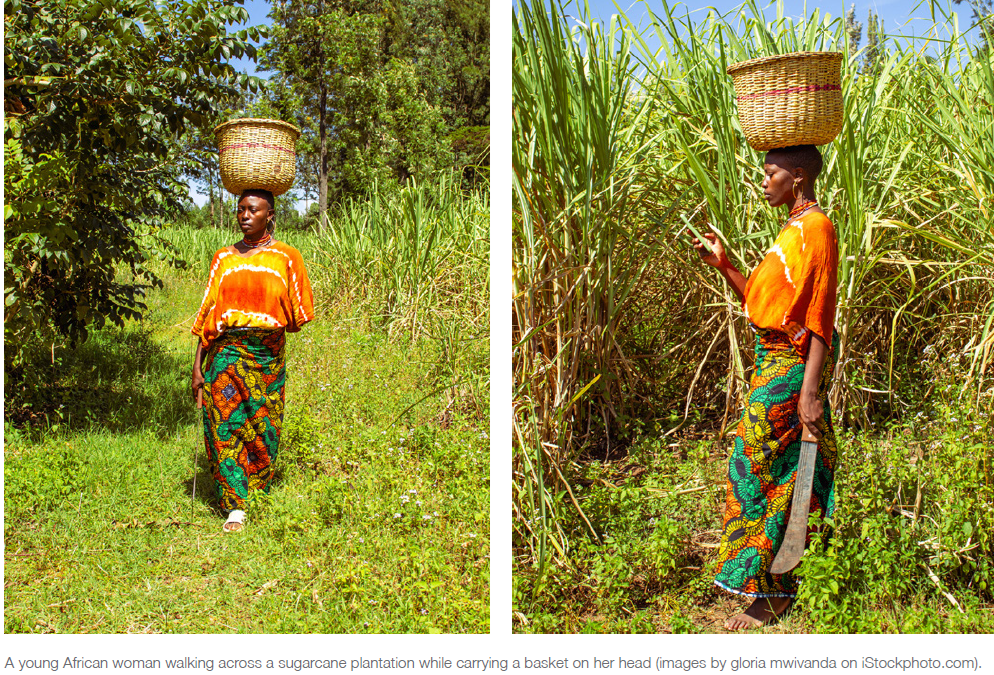
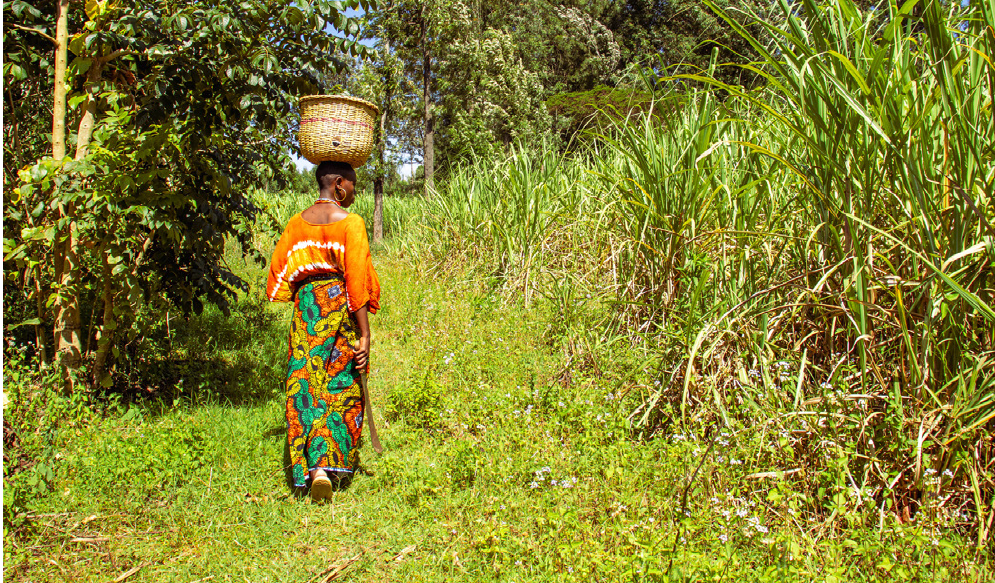
Dorothy: This reminds me of how people, typically in non-Western countries, can carry massive loads on their head, such as rocks, baskets of food, or buckets of water. The weight does not seem to be pushing them down into the earth. In fact, they move with a beautiful spiraling movement in their spine.
Mary: That’s a good example of how human tensegrity is a dynamic tension-compression system. This principle of balanced push and pull forces applies not only to whole organisms like people with the buckets on their heads, but also at every scale within the body, to the subcellular level. You might picture dozens of animated tensegrity models nested one inside another, like those Russian dolls.
The ideas of Fuller and other developers of the tensegrity principle actually arise from what biology has been doing for billions of years. So the biotensegrity endeavor isn’t
just about applying tensegrity to human structure and movement; it’s about showing that the tension-compression principle is the basis of all living things. The bio in biotensegrity distinguishes it from the purely structural application of the principle.
Dorothy: You’ve touched on some of these ideas in your tensegrity-in-motion group, and when I follow your cues, I experience inner spaciousness, support, and ease. Is it the difference between having support from within as opposed to effort from the outside?
Mary: Yes. What you experience is your body’s expansional balance. I find that many of Dr. Rolf’s ideas dovetail with the topics discussed by the biotensegrity community. But very few of the people are bodyworkers. They are from diverse professional fields, including anatomists, biologists, physical therapists, mathematicians, puppeteers, philosophers, and vocal coaches. There’s a horse trainer whose method is founded on biotensegrity ideas. The communal endeavor seems to be generating a new interdisciplinary science of nature.
Dorothy: That’s brilliant. A diverse group is well poised to question one another along the way and be more open to new insights. Heterogeneous groups are way better at solving problems than homogeneous groups. What are the topics like?
Mary: Truly, it is awesome, but also for me, a little daunting when the science gets complicated. One aspect of the inquiry involves chaos theory, the way order emerges in apparently chaotic systems. The biotensegri-tea party conversations range from soft matter physics and self-organization to the geometry of motion and the effectiveness of very light touch in therapy (Levin 2018). Sometimes there are guest speakers from the Fascia Research Society and other disciplines.
I was especially impressed by a presentation from an expert in ecological psychology, which is the study of how the environment influences behavior and of the physiological connection between perception and action. Incidentally, the Rolf Movement® themes of perceptual
…orientation and premovement derive from this area of study. Those themes are familiar if you’ve been exposed to Godard’s tonic function theory4.
Mary: During one biotensegri-tea party, the talk centered on a 1975 paper by Ron Kirkby, PhD, one of Rolf’s advanced students. The article was The Probable Reality behind Structural Integration: How Gravity Supports the Body.5 It discusses tensegrity at length.
Dorothy: I recently read that paper per your recommendation. I also listened to the audio recording on the Dr. Ida Rolf Institute website, where you can hear Dr. Rolf talking about the Kirkby paper, and Ron Kirkby also explains his ideas.6 I was blown away by the conversations and questions. They were really looking at the work through a mathematical and physics lens.
Mary: It is amazing to listen to the audio file, and it makes me wonder about the whereabouts of Ron Kirkby and why the tensegrity inquiry didn’t continue within the structural integration community.
It is pretty clear that Rolfing [Structural Integration] addresses tension and compression forces in the body.
Lately I’ve been thinking about the core and sleeve idea in those terms. It’s possible that Dr. Rolf was influenced by Fuller’s ideas, but maybe she just came to it on her own. We often forget about her extensive science background. Let me read from Ida Rolf Talks (1978), page 181. This paragraph sums it up for me:
“Support is a balance of elements that aren’t solid at all, elements that are incapable of withstanding the weight that presses down on them except as they are balanced. Could you translate this balance as tone? I don’t know. I don’t know what tone is in words, only in experience. I once equated it with span, but I don’t know how to define span. When you get span in a body, you get tone; when you get tone, you get span. Span is a spatial thing; tone is physiological. Both words refer to balanced structure in a living body. Both tone and span indicate a readiness to act and respond that is the touchstone of a healthy body.”
Dorothy: Sounds like tensegrity to me.
Mary: It does to me as well. I think that, as the Advanced Rolfing Instructors were formulating the curriculum after Rolf died, perhaps they translated her word ‘span’ as palintonicity. Span comes from spannen in German, meaning to connect, fasten, or stretch. It’s about the expansion that occurs when the body’s tension is balanced.
And although she wrote about balancing tensegrity-like properties of span and tone, Dr. Rolf prioritized the vertical line above all else. So how did her beloved verticals and horizontals fit in with the tensegrity idea? I was curious about that because all I could see in the usual six-strut tensegrity model were triangles. And Fuller’s geodesic dome was all triangles.
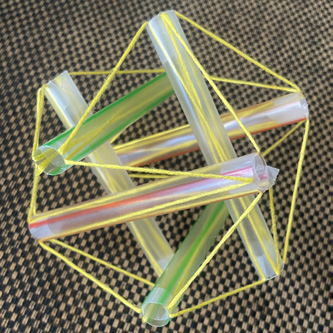

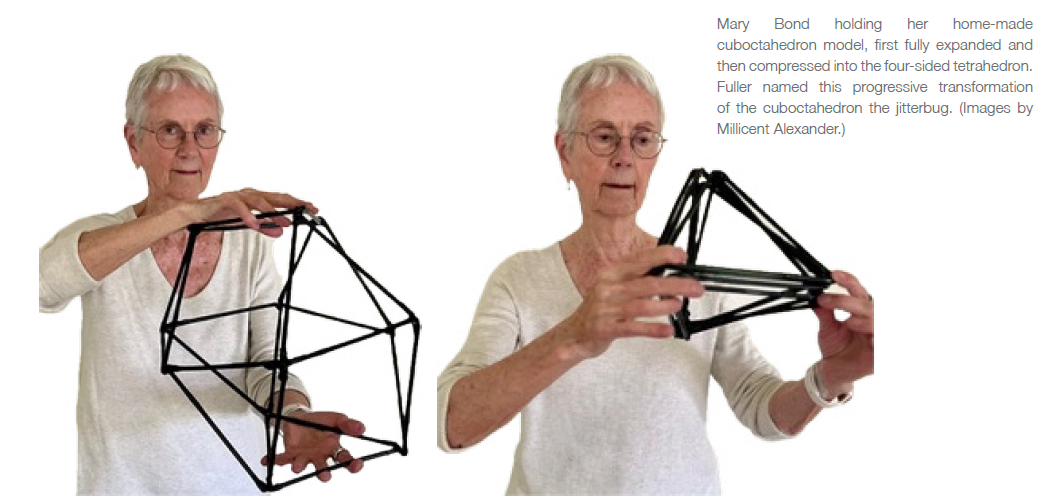
Mary: But then I built a different model. I was skeptical at first, but making your own model really does help you make sense of these ideas. I made a cuboctahedron, a geometric shape that, according to Fuller, represents a perfect balance of forces. When you push on it, the thing changes shape from icosahedron to octahedron to tetrahedron – twenty triangular sides, to eight sides, and then to four sides. The geometry and physics of it are still way beyond me, but when I push on my model, right angles appear and disappear as the shapes transform.
I had been struggling with Dr. Rolf’s emphasis on the vertical, because I saw that she was interested in this tensegrity idea, whether or not she framed it in those terms, and it is what happens when you receive a full Rolfing Ten Series®. Your body is more spacious, more fluid, and has more helical movement.
For many years, the idea of organizing the body around a vertical line has felt too static to me. What I saw when I played with the model was that, yes, there were all these triangles moving around in different configurations, but occasionally right angles would appear and disappear as the shapes changed.
The intermittence of the verticals and horizontals made me think of an upright stance. People don’t stand in a vertical line for very long, unless they’re in the military or are singing in a choir. Most of the time our bodies assume a myriad of other shapes as we interact with gravity from one movement to the next.
Seeing those right angles come and go in my model as I pushed on it helped me understand Rolf’s insistence on the line.
A biotensegrity structure doesn’t depend on gravity to maintain its integrity in every moment – consider an eagle or a gymnast. When an earthbound creature evolves into a tensegrity tower, then that central plumb line becomes a foundational reference. But I see the line emerging in relationship to the tension-compression principle rather than being the thing that was there first.
Dorothy: It makes sense that the line would reorganize as needed. We are self-assembling organisms, and we continually assemble and organize in response to our environment.
Mary: Great. You’re well beyond where I was when I heard about the biotensegrity course. The teacher was Susan Lowell de Solórzano, who had been Stephen Levin’s assistant and colleague for many years.7 Dr. Levin was the one who coined the term biotensegrity and initiated the field of study.
Upon joining Susan’s class, I found that other students had been studying it for many years, and so, for some of the conversations, I had to look up a lot of words. Later, though, I learned that everyone has to look things up. There’s so much to comprehend.
Dorothy: What were some of the complicated concepts?
Mary: In the beginning, we were looking at things I thought I understood through a lens that showed different realities about them. I know the body isn’t a machine, but it’s amazing how difficult it is to avoid mechanistic explanations of how it works.
I learned about movement in terms of levers and pulleys, even though it’s obvious there are no hinges in the body or anywhere in biology for that matter. The biotensegrity group proposes closed kinematic chains as an alternative way of describing movement.
Dorothy: Closed chains, like in exercise?
Mary: That’s what I thought at first, but those are ‘kinetic chains’ – not the same thing. Kinetics pertains to the
Mary: …energy of an object when it’s in motion. Kinematics describes the geometrical pattern of movement inside a structure as it changes shape or position. The idea is that kinematic chains form ubiquitous, interconnected loops within our bodies that are continually being reconfigured as we move. To understand the forces that cause movement requires a separate inquiry. Closed kinematic chains are like the changing patterns you see in a kaleidoscope, patterns that are separate from the action of your hand as it turns the toy.
Dorothy: Do these chains represent physical places in the body?
Mary: In theory, a chain link can be composed of bones, tendons, muscles, or other fascial forms. Joints between the components are not necessarily bone-to-bone joints like knees or elbows but can be intersections of any tissue type with another. That way, innumerable points within the body can link up and move as one. I found it hard to conceptualize this at first because it’s been so easy to analyze movement in terms of levers and hinges.
It’s helpful that Dr. Jean-Claude Guimberteau’s endoscopic images of fascia are real life displays of closed kinematic chains (2019). Imagine the motion you see in his films scaled down to occur within cells or scaled upward to create the elegance of Balinese dance – with all in between scales of that motion occurring simultaneously.
Such complexities make it impossible to define the dynamics of even a simple movement, such as reaching for your phone. Because any action can be produced by a number of different chains, that puts a much wider frame around the notion of ‘optimal movement’. And, to make things even more brain-rattling, the kinematic chain idea is only a model, like the lever/hinge/machine model. In time, there will likely be another model of movement, one that gets us even closer to reality. We’re in the realm of kinematic indeterminacy – where we get to say, “I don’t know,” and feel okay about it.
Dorothy: Yet, even if movement can be produced by a variety of different chains, it still seems helpful to know anatomy and have a general sense of which muscles are working together to make a movement happen, right? The biomechanical lens is still useful, but maybe it’s just not enough?
Mary: A basic understanding of joint mechanics definitely improved my Rolfing skills. But even so, biomechanics is based on understanding how machines work, and machines are governed by the physics of hard matter, like metal or wood. We resort to mechanistic thinking to explain things because that’s all we were taught. It makes so much more sense to understand our bodies as soft matter. This is a completely different domain that includes foams, gels, bubbles, and liquid crystals, as well as flesh. So maybe it’s time to take our biomechanics with a sprinkling of salt.
Soft matter turns out to be a world where mysteries and strange events are the norm. For example, in soft matter physics, it’s normal for a small local event to have a very large effect at a distance.
Dorothy: We see that in our treatment rooms all the time. It amazes our clients.
Mary: Yes, it amazes them. It amazes us. And consider Dr. Rolf’s maxim that where you think it is, it aint’. The experience of our own hands confirms this, but mechanical thinking can’t explain it. The term ‘soft matter’ wasn’t coined until the 1970s, but remember, Dr. Rolf was a biochemist, so she probably knew about the investigations that led to its being recognized as a field of study.
Dorothy: Excellent point about her being a biochemist. I wish I could have been a fly on the wall for some of those conversations she had with her students back then. Based on the Kirkby recording, I assume she was indeed thinking along those lines. They were looking for a model to explain what they were seeing and feeling with the work.
Mary: Ron Kirkby’s 1975 article was written the very same year as Dr. Levin’s epiphany on the Washington Mall. Do you know the story?
Dorothy: I don’t – please tell me.
Mary: Levin, an orthopedic surgeon at the time, was troubled that what he saw when he opened up a spine to operate was nothing like what he had learned in medical school. He saw that the vertebrae weren’t touching each other the way they appeared in the books. On his quest to understand this, he went to the Smithsonian Museum and got curious about how dinosaurs could manage their long tails without always dragging them on the ground.
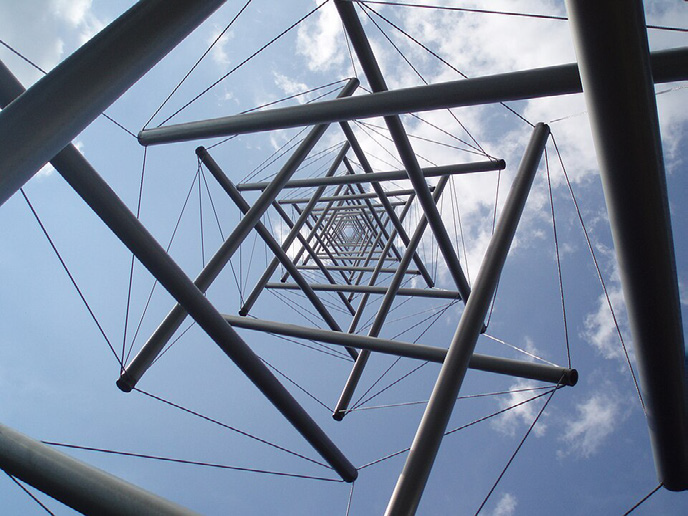
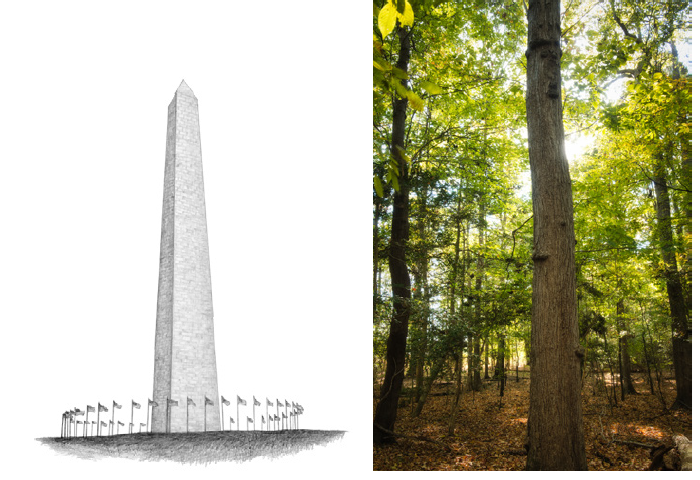
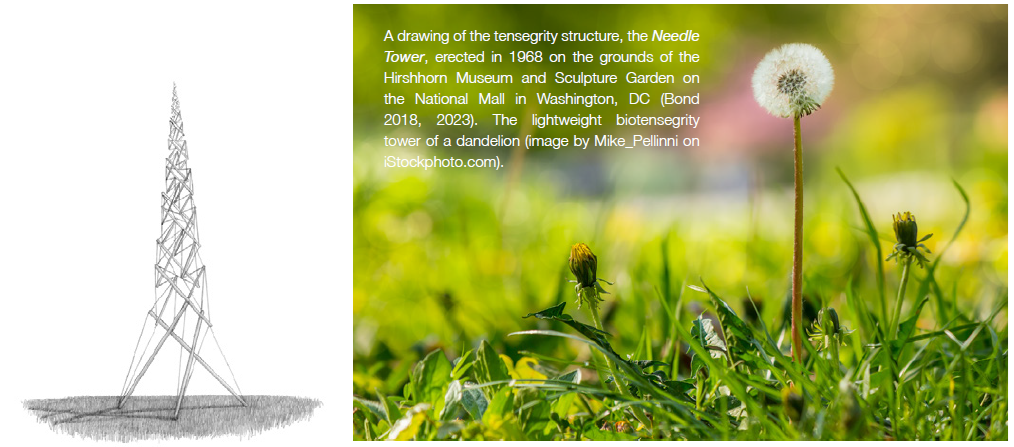
One afternoon, he sat on a bench outside the museum and gazed across the Washington Mall. To his right was the Washington Monument, a magnificent compression column. To his left was the Needle Tower, a sculpture created in 1968 by Kenneth Snelson8, who had been a student of Buckminster Fuller. The needle is a tensegrity mast constructed of aluminum compression struts within a network of tensioned stainless-steel cables. The parts are mutually supportive in such a way that the struts never touch one another.
Levin had walked past this sculpture many times, but this time – bingo! That’s how the spine could be organized – the vertebrae present but not touching within a tensioned webbing.
Dorothy: So when we are told that we are ‘bone-on-bone’ in a particular joint, we likely still have some space in the tensional webbing, but it’s no longer balanced with the compression.
Mary: Yes. Levin speculates that osteoarthrosis develops when soft tissue tension around adjacent bones is inadequate, allowing the articular surfaces to abrade.
Dorothy: Maybe inadequate in places and too much in others, resulting in imbalanced forces through the joint?
Mary: It’s a different way to look at everything, right? Going back to soft matter, another of its properties is auxeticity – that’s one of the words I had to look up. Remember that cornstarch semi-liquid we made in massage school? Ooblek? When you stretch it, it expands in all directions instead of just getting longer and thinner like elastic does. That’s the auxetic behavior of soft matter.
In one of Dr. Levin’s PowerPoint presentations, there’s a photo of the young Schwarzenegger’s ballooning arm muscles as Levin says something to the effect of, “The theory we’ve learned about muscle contraction with filaments overlapping and so on, is not correct.” He continues, to paraphrase, “Muscles don’t shorten when activated, they expand auxetically.” Also, muscles aren’t the principal generators of movement we’ve always assumed them to be. Muscles initiate motion, which is transmitted through the fascia by various routes, that is, by various kinematic chains, depending on the context of the action.
In his paper, Ron Kirkby writes about muscles in a similar vein (1975).
Dorothy: Movement is so complex! Even when we’re repeating a movement as we do at the gym, we never do anything the same way twice. So, when we make a small proprioceptive shift that changes the way movement feels, we must be tapping into different kinematic chains.
Mary: That’s a great way to think about it. And every day we learn more about the proprioceptive capacity of fascia. Current ecological psychology theory is that we gather signals and form responses through the fascia. And these responses are much faster than those of the nervous system. They propose that the nervous system evolved to provide refinement rather than direction. From this viewpoint, we’re just a few scales above jellyfish, who can do all the main things of living – they hunt, eat, hide, and procreate – with no nervous system and no brain. The nervous system takes a long time to develop, but fascia is there from the beginning. And that reminds me of another property of soft matter I’d like to talk about, but first I want to tell a little story.
Dorothy: Great. Please share!
Mary: A couple of years ago, a group of physical therapists took an introductory course with Susan, and ever since, they’ve met every week to refine their approach to physical therapy. Weekly meetings! That’s a lot of enthusiasm. Instead of focusing on complaints, they’re looking at bodies holistically. They’re following rather than leading. They’re unwinding and listening. Sound familiar?
Dorothy: Yes, it certainly does.
Mary: They came to this by being together in the biotensegrity headspace. And here is another property of soft matter: it can self-assemble, as the embryo does. And understanding that we are inherently self-organizing makes it clear that respecting the client’s process – their pace and rhythm – is the most organic approach to therapy.
Dorothy: This makes sense, yet when I put my hands on someone, I find I need something to guide me. Anatomy helps with that. For example, I might think about nerve pathways – I floss a nerve and think, “Oh look, the muscle tone changes.” It feels hard for my brain to see through all the lenses at once and listen to the whole.
Mary: Is it your brain? Or could it be that your education made you forget your own capacity for self-organization?
Dorothy: That sounds like a suggestion to trust my instincts. I will, that’s why it’s called a practice. One day it will come.
Mary: Of course it will. I’m so impressed that these physical therapists landed on the importance of self-organization while they were self-organizing themselves as a group. This speaks to the multi-scale level of the biotensegrity concept.
In my short association with this community, I’ve found that respect for self-organization is the ambiance of the whole endeavor. The remarkably respectful and inclusive way people speak with one another helps everyone’s understanding evolve. And there seems to be a common agreement that nobody can know everything, no matter how long they’ve been involved. It just feels really human.
Dorothy: How lovely. And have you been able to blend what you’re learning from this group with what you learned from Dr. Rolf and through Godard’s work, into something that others can apply in their practices with clients?
Mary: I think it’s a matter of using this lens to more deeply understand what I was already doing so I can speak with people about it – and hopefully write about it – in language that is clearer and richer.
Dorothy: That seems to be how it is with new ideas. You have to keep noodling the information until you can speak about it in your own voice.
Mary: Yes, and there’s something more. Hanging with the biotensegrity community has illuminated for me what a small aspect of the Earth’s ecology we humans really are. Last year I attended a webinar with Dr. Jean Claude Guimberteau through the Fascia Hub. I know you’re a member; did you see that one?
Dorothy: Yes, they screened his film Homofasciaticus (2026), which explores the inner world of fascia. You only have to watch that film, and it will make you go, “Who am I?”
Mary: Afterward, someone asked Dr. Guimberteau what people would be like if they could fully embody the profundity of the fascial system. If they could really let themselves feel the aliveness within their bodies.
Dorothy: What did he say? I don’t remember.
Mary: He said people would be closer to nature.
Dorothy: That’s so beautiful.
Mary: And simple. Ecological psychologists tell us that we are ecology. We may donate money to save the bees, but to really feel within ourselves that we are the bees. . . . That’s a different view of life. American Indians and people of indigenous cultures lived that way, but we’ve been captivated by the seeming efficiency of linear thinking.
Dorothy: You’re talking about more than just big picture thinking – it’s big picture being. Our capacity to zoom in and understand tiny details has resulted in amazing achievements like microsurgery. But when we maintain that granular focus, we risk losing our interconnectedness with everything beyond our immediate involvement.
Mary: Yes. I don’t think we can recognize ourselves as ecology unless we go where Guimberteau is pointing; where the biotensegrity community is headed.
You know, some people consider biotensegrity to be a sidebar to fascia research. But maybe it’s the other way around. Maybe fascia is the sidebar.
Dorothy: Hmm. . . Now I see what you meant earlier, when you said that the biotensegrity inquiry is light-years beyond what you had initially thought.
Thank you so much for sharing all this with us.
Mary: You are so welcome. I hope to meet readers in the biotensegrity rabbit warren…
1. Ida P. Rolf, PhD (1896-1979).
2. French Rolfer Hubert Godard is a professional dancer, Rolfing Instructor with the European Rolfing Association e.V., and researcher.
3. Buckminster Fuller, American architect (1895-1983), developed numerous structures, including the widely known geodesic dome.
4. Hubert Godard’s tonic function model, for an original source that describes this gravity response model, read the article by Rolf Movement Instructor, Kevin Frank.
(1995). Also, tonic function has been recently described by Rolfing Instructor Per Haaland in Tonic Function Model: The Human Gravity Response System (2022).
5. To obtain this article for yourself, go to the Ida P. Rolf Library for Structural Integration by Pedro Prado found at https://novo.pedroprado.com.br/, where you will need to make a free user account. Once you have logged in, search for “Ron Kirkby” as an author search. The Probable Reality behind Structural Integration: How Gravity Supports the Body (1975) is his only article on that platform.
6. The audio recording of Ron Kirkby explaining his hypothesis of the spine as a tensegrity structure and Dr. Rolf’s critique can be found at https://rolf.org/ida_teaches.php. You will need to scroll down to the section “Research, History, & Dissection” for the subheading “Ida Teaches: The Body is Like a Tensegrity Map-Research Paper.”
7. Dr. Stephen M. Levin is an orthopedic surgeon and has published many papers on biotensegrity. See www.biotensegrity.com for more information.
8. American sculptor Kenneth Snelson (1927-2016) sculptural works exemplified the idea of tensegrity, although Snelson preferred the descriptive term floating compression (Wikipedia Contributors 2026).
Mary Bond received her master’s degree in dance in 1969 from the University of California, Los Angeles, and trained with Dr. Ida Rolf as a structural integration practitioner from 1969 to 1972. Formerly the chair of the movement faculty of the Dr. Ida Rolf Institute® (originally the Rolf Institute® for Structural Integration), Bond has been involved in movement education for structural integration from the early days with Judith Aston, founder of Aston Kinetics®, to the current evolution of the work of French Rolfer and movement expert, Hubert Godard.
She is the author of Balancing Your Body (1996), The New Rules of Posture (2007), and Body Mandala: Posture, Perception, and Presence (2018, 2023). Since 2020, Bond has been offering online workshops for structural integration practitioners and other somatic educators. She hosts a popular blog at www.healyourposture.com. You can reach her directly at [email protected].
Dorothy Miller is a Certified Advanced Rolfer™ living in Bend, Oregon. She is a lifelong learner and is passionate about furthering her understanding of the human body. She loves languages, traveling, hiking, skiing, swimming, and biking. You can reach her directly through her website, www.rolfingconnections.com.
Bond, Mary. 2018, 2023. Body mandala: Posture, perception, and presence. Rochester, Vermont: Healing Arts Press.
___. 2007. The new rules of posture: How to sit, stand, and move. Rochester, Vermont: Healing Arts Press.
___. 1996. Balancing your body: A self-help approach to Rolfing movement. Rochester, Vermont: Healing Arts Press.
de Solórzano, Susan Lowell. 2021. Everything moves: How biotensegrity informs human movement. Pencaitland, East Lothian: Handspring Publishing Limited.
Frank, Kevin. 1995. Tonic function: A gravity response model for Rolfing structural and movement integration. Rolf Lines 23(1):12-20.
Guimberteau, Jean-Claude. 2026. Homofasciaticus. Available from https://www.endovivo.com/product/homofasciaticus/?lang=en.
___. 2019. Strolling under the skin 480×360. Available from https://www.youtube.com/watch?v=DroKc3w0-dA.
Haaland, Per. 2022. Tonic function model: The human gravity response system. Structure, Function, Integration 50(3):66-76.
Kirkby, Ron. 1975. The probable reality behind structural integration: How gravity supports the body. Boulder, Colorado: Rolf Institute of Structural Integration.
Levin, Stephen M. 2018. Biotensegrity archive. Available from https://www.youtube.com/@smlbtarchive.
Martin, Danièle-Claude. 2022. Living biotensegrity: Interplay of tension and compression in the body. Munich, Germany: Kiener.
Rolf, Ida P. 1978. Ida Rolf talks about Rolfing and physical reality. (R. Feitis, ed.) Boulder, Colorado: Rolf Institute of Structural Integration.
Wikipedia Contributors. 2026. Kenneth Snelson. Available from https://en.wikipedia.org/wiki/Kenneth_Snelson.
biotensegrity; tensegrity; structural integration; fascia; soft matter; closed kinematic chains; kinematics; auxeticity; self-organization; ecological psychology; tonic function; palintonicity; Buckminster Fuller; Stephen Levin; Susan Lowell de Solórzano. ■