

Editor’s note: This article was originally
published in German in pt Zeitschrift für
Physiotherapeuten (2016), the leading
physiotherapy journal in Germany. They
have given permission for this English
reprint. The author has done this English
translation.
Introduction
Even in my basic Rolfing® training, I sensed that manual work on the fascia alone – no matter how skillful – is not sufficient to effect lasting changes in clients’ structural and functional patterns. This initial observation has been confirmed throughout my years of practice as a Rolfer™. Releasing restrictions in the fascia does not automatically lead to better alignment, and even when it does, the changes often are not lasting. For almost all clients, some form of movement education is a beneficial addition to manual work. For many, it is the key ingredient to lasting change.
Some structures are more resistant to change than others. Patterns of hyperextension at the hip and knee level are often particularly vexing. Since we cannot tighten or shorten fascia – we can only lengthen, soften, and mobilize it – additional length in tissues that already exhibit excessive mobility can be counterproductive. If there is already excessive mobility and softness in a given area, additional length in the tissues is not
Introduction
Even in my basic Rolfing® training, I sensed that manual work on the fascia alone – no matter how skillful – is not sufficient to effect lasting changes in clients’ structural and functional patterns. This initial observation has been confirmed throughout my years of practice as a Rolfer™. Releasing restrictions in the fascia does not automatically lead to better alignment, and even when it does, the changes often are not lasting. For almost all clients, some form of movement education is a beneficial addition to manual work. For many, it is the key ingredient to lasting change.
Some structures are more resistant to change than others. Patterns of hyperextension at the hip and knee level are often particularly vexing. Since we cannot tighten or shorten fascia – we can only lengthen, soften, and mobilize it – additional length in tissues that already exhibit excessive mobility can be counterproductive. If there is already excessive mobility and softness in a given area, additional length in the tissues is not helpful. Under the influence of gravity, it may even deepen the existing pattern.
To address this, I use ‘Normal Function’ (Flury 1991), the system of movement education developed by the late Swiss Rolfer, Dr. Hans Flury (1945-2023). His system provides precise instructions to find the most economical form of any given movement. However, economy is not an end in itself in this regard. Rather, the most economical form of movement is usually the one that is physiologically most appropriate for our bodies.
The process starts by helping clients find positions of support in gravity while sitting, standing, and walking. From these points of support, movement is initiated by letting go of excess muscle tension, aided by gravity and passive tension in the fascial net. The main axes of motion (hips, knees, and ankles) are encouraged to move in their physiologically intended direction, enabling them to act as effective shock absorbers. Initiating movement by “letting go” and using minimal muscular force once in motion, creates length in the entire body and reduces strain on tissues and joints.
This article is based on an informal case study I conducted with a client who exhibited a strong pattern of hyperextended hips and knees. To achieve lasting structural order and physiologically appropriate movement, I used a combination of classical manual interventions known as the Rolfing Ten Series® and specific movement awareness exercises based on the principles of Normal Function (Ritter 2012).
Case Study
Ms. Winter (name has been changed) is a forty-three-year-old former dancer who intensely practices Ashtanga Yoga, a dynamic, athletic form of yoga. Ms. Winter reports pain in her lower back, which occurs particularly during certain yoga exercises. She has a feeling of imbalance between the left and right sides of her body – the left side feels more stable. She also feels tension between her shoulder blades and her neck.
Structural Analysis
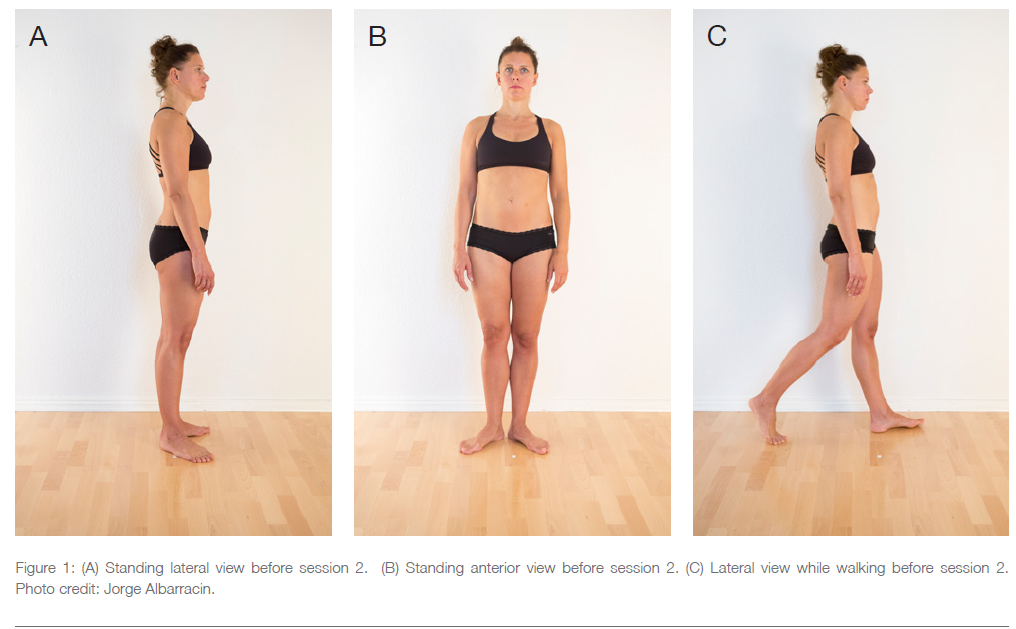
The standing lateral view (see Figure 1A) shows a forward shift of the pelvis relative to a plumb line through the base of support with a slight anterior tilt of the pelvis. This shift of the pelvis out of alignment is compensated cranially by a slight hyperextension and backward lean of the trunk. Caudally, compensation is achieved by hyperextending the knees.
The anterior view in a standing position (see Figure 1B) shows a strong external rotation of the legs (slightly stronger on the right than on the left) and a lateral shift of the pelvis and torso over the left leg.
Here is the crucial question: To what extent does the image described and shown above actually reflect the client’s structure? Are we really seeing the shape of the body as determined by the
It should be noted that most people stand habitually with their pelvis shifted slightly forward, regardless of their structure. This position feels comfortable, at least in the short term, and requires little conscious attention. This habitual posture pattern can distort the picture.
The characteristics observed when standing are even more pronounced in Ms. Winter when she is walking (see Figure 1C). This suggests that the forward shift of the pelvis observed when standing and the associated compensations are structural in nature, i.e., caused by the shape and tensional pattern of the fascial network.
The pattern described here has a number of adverse effects that may contribute to the development of Ms. Winter’s symptoms:
• The hyperextension of the torso leads to permanent compression of the lower back when standing and walking.
• The hip and knee joints are moving against their physiological direction at the moment of impact. As a result, the shock-absorbing effect of these joints is largely lost.
• The combination of a backward-leaning and hyperextended torso and hyperextended knees causes the body weight to land on the heel when stepping. This prevents the ankle joint and arch of the foot from performing their shock-absorbing function.
• The sum of these factors leads to a hard gait, in which the impact of the foot strike is transferred to the body with virtually no shock absorption.
• The lateral shift of the torso over the left leg means that Ms. Winter puts uneven weight on both sides and is less stable.
Analyzing the Gait
To determine whether the observed shift is structural or functional, it is helpful to analyze the gait. The movement sequence of walking, which is much more complex than standing, seems to cause us to move in a way that is dictated by our structure. A pelvis that is shifted forward not only functionally, but also structurally, will remain in this position when walking. A pelvis that is structurally shifted backward usually moves back toward the vertical line, at least a little, when walking.
Distinguishing between structure and function is helpful in understanding the shape of the fascial network. The better we understand the shape of the fascial network, the more targeted and specific our manual work on the fasciae can be. It is also helpful for movement education to know which patterns are inherent in the fascial network and which are more functionally determined.
Procedure for the Second Session
As part of the Rolfing Ten Series, the treatment documented here took place during the client’s second visit. The photos were taken immediately before and after the session.
As part of the structural analysis, I explained the client’s typical posture and movement patterns to her. Then I used Rolfing-specific manual techniques to release the shortened and tightened areas in the fascial network. She then developed a new movement pattern under my tactile and verbal guidance.
The manual work was performed while the client was lying down and also while sitting. I concentrated on the front of the lower legs, the front of the knees, all myofascial structures in the hip joint area, especially the fascial structures at the back of the hip joints, the lower back area, and the region between the shoulder blades. To close the session, I released the fascia in the neck and throat area, and at the transition between the neck and head.
Structural and Functional Work to Complement Each Other
When releasing tightness and eliminating shortening in the fascial network, it is important to remember that this does not always automatically lead to a repositioning of the segments towards the vertical line. In some structural

constellations, the additional length and suppleness of the fascia can even cause the body segments to shift or be pulled slightly further out of alignment under the influence of gravity. For the treatment to be successful in the long term, it is helpful to educate the client about movement, encouraging them to consciously feel and perceive the difference between the old and new patterns.
The movement education was carried out with the client standing and walking. I showed her the new pattern using tactile and verbal cues. Particular attention was paid to the hip and knee axes in order to bring the deviation from the gravity line “hip in front – knee behind” (like in Figure 1) into the physiological advantageous direction of “hip behind – knee in front” (see Figure 2A).
This arrangement provides better support for the body, and the lower back in particular is less compressed. Note that the repositioning of the axes and the associated improvement in alignment and support are not achieved through the use of muscle activity, but through targeted relaxation.
In the frontal plane, after the second session, we observe a clear stretching of the entire body and improved left-right symmetry (see Figure 2B).
The gait pattern at the end of the second session also shows an elongation of the torso and a better alignment of the neck and head region (see Figure 2C). The ankle, knee, hip, and shoulder axes are all closer to the plumb line. This arrangement allows for slight flexion of the knee and hip at the moment of stepping, as well as physiologically advantageous function of the ankle joint and arch of the foot. The entire body is thus better supported and requires less energy for upright posture and locomotion. At the same time, the impact is significantly better cushioned and thus gentler on the entire body.
The repositioning and reorientation described above represent a considerable challenge for Ms. Winter. On the one hand, the improved support and reduced strain on the lower back are usually clearly noticeable. On the other hand, the new pattern feels strange at first. The shortness of the fascial net, in this case, particularly in the groin and lower back areas, becomes apparent and more noticeable from within.
In subsequent sessions, I focused specifically on these areas to further lengthen the fasciae using manual techniques. The aim is to reduce the anterior tilt of the pelvis and the lordosis of the lower back. This will elongate the entire body even more, resulting in better posture when standing, walking, and sitting. At the same time, the client will become more and more accustomed to the new pattern and will no longer perceive it as strange. The advantages of the new arrangement, such as better support and less compression, will thus become more noticeable.
Structure, Function, Integration / June 2026
www.rolf.org
Lumbar Lordosis is Necessary for Shock Absorption
The criticism occasionally expressed that shifting the hip axis backward causes greater lordosis of the lumbar spine ignores several aspects:
• Lordosis is not caused by the reorientation of the pelvis; it only becomes more apparent.
• The shape that can be seen after the second session is not the end point of the treatment, but the beginning of a process.
• From a structural point of view, it is not enough to consider the shape of the spine alone. The decisive factor is whether the torso as a whole gains more length and better support.
• The view that the lordosis of the lower back is inherently problematic can be considered outdated. The reason is that lumbar lordosis is not a misalignment. It is physiologically normal and necessary for adequate shock absorption.
• In the end, it is not the external appearance that is most important, but the sensation perceived by the client from within, which is usually described as relief in the lower back.
Conclusions
Most clients of Rolfing Structural Integration benefit from movement education, in addition to manual fascia work. For those with patterns of hyperextension, movement is the key to lasting change. The case study shows how to work with clients with patterns of hyperextension at the hip and knee axes.
Manual fascia work is complemented by verbal and tactile movement cues to reorganize the axes of motion in their physiological directions, resulting in greater length, improved stability, and better shock absorption during movement.
Informal case studies are a good way to demonstrate potential problem-solving strategies and encourage further inquiry and discussion.
Hubert Ritter is a Certified Advanced Rolfer™ and has been practicing Rolfing Structural Integration since 1994. He lives in Berlin, Germany. He belongs to the following organizations: Dr. Ida Rolf Institute® (www.rolf.org), European Rolfing Association e.V.® (www.rolfing.org), the Swiss Society of Structural Integration (www.sgsi.ch), and Rolfing® Verband Deutschland e.V. (rolfingverband.de). He can be reached by phone: +49-030-313 98 79 or by Email: [email protected]; his website is: www.rolfing-ritter.de.
References
Flury, Hans. 1991. Normal function. Notes on Structural Integration 1:6-21.
Ritter, Hubert. 2012. Rolfing – Strukturelle Integration (in German). Munich: Noema Verlag.
Keywords
case study; Rolfing Structural Integration; fascia; fascial network; manual therapy; movement education; Hans Flury; Normal Function; hyperextension; structural integration; structural analysis; gait analysis; pelvic shift; shock absorption; lumbar lordosis; hip axis; knee axis; body alignment. ■