


Authors’ note: This conversation was recorded on February 20, 2026, and has
been condensed and edited by both authors for clarity. Miquel de Jong headshot by
Martijn Kappers. The individuals pictured are Dutch Rolfers at an annual meeting who have
graciously consented to allowing us to publish their photos.
What does it feel like to truly listen with your hands? For Miquel de Jong, Rolfer™, dancer, and Rolfing® instructor-in-training based in Rotterdam, Netherlands, this question sits at the heart of his practice. Over the years of working with dancers, Rolfers, and clients, Miquel has developed a movement exploration he calls “living tensegrity,” a partner exercise using bamboo sticks to cultivate sensitivity, nonverbal communication, and embodied presence.
The exercise was born from necessity – out of a contact improvisation class in China, where the usual tools of verbal instruction were falling flat. What emerged became something Miquel now brings to Rolfers as a lens for understanding touch itself: how we communicate through contact, how we receive information from a client’s tissue, and how our own embodiment shapes the quality of a Rolfing Structural Integration session.
This interview traces Miquel’s path from classical ballet dancer to Rolfer, explores the mechanics and philosophy of living tensegrity, and considers its potential as a professional development tool for the structural integration community.
Lina Amy Hack: When I heard about your living tensegrity movement exploration, I wanted to interview you about it for our Stressors, Forces, and Resiliency theme this June 2026 issue. For readers who don’t know you, could you tell us about your background?
Miquel de Jong: I have been a Certified Rolfer® since 2008, but I started to study Rolfing [Structural Integration] in 2003, and it took quite a long time because I was a professional dancer at the time. I was doing dance projects, and when I didn’t have a project, I would do part of the training, and then another dance project would come along resulting in me delaying more training for a year. So, it took a while to become a Rolfer.
Lina: What kind of dance was your specialty?
Miquel: I trained as a classical dancer – a real ballerino in that sense. But I never really performed that style. I always danced contemporary work, and later in my career, my work became much more theatrical. I was a human being telling stories with movement and dance. That was my first professional career. I started with a company in Holland, then one in France, then a second one in France, and then I met Russell Maliphant, a choreographer in London, UK. He was a Rolfer at the time, but I didn’t know that when I went to work with his dance company.
Lina: Oh, Russell Maliphant – he worked with us for the November 2021 issue. The cover of that issue was one of my favorites, performer Dickson Mbi in Russell’s The Rodin Project (Sadler’s Wells/Russell Maliphant Production 2012). And we interviewed him as well, he has a memorable way of speaking about movement (Koepke and Maliphant 2021). Did that connection with Russell lead you to becoming a Rolfer?
Miquel: I worked with Russell in Lyon, France, as part of this movement piece he presented there. I was blown away by the way he worked with us dancers. Instead of a classical warm-up in the morning, we were doing contact improvisation, tai chi-type movement, yoga, capoeira, and before we knew it, we were doing his work. His choreography was such a relief to enter in his style of work. He led us to where the body was totally prepared, our minds were prepared.
While in that experience, I said to Russell, “I would like to work with you for future projects.” And that became a kind of detour, I worked with him in London, UK. With Russell, as dancers, we would do hands-on work to help each other sometimes to start the day, and after rehearsal. We would have physical things left over from our intensive training the day before, and we were empowered to help each other. During one of our training sessions, he had invited me to help him with his shoulder, and as I touched his shoulder, he immediately looked up to me and said, “You have to become a Rolfer.”
Lina: Oh, wow. That’s so cool, such good guidance about what to do with talent and skill.
Miquel: I had no clue what Rolfing Structural Integration was. I didn’t know

he was a Rolfer. So, he gave me books, Ida Rolf’s book [PhD, (1896-1979)], and some others. I dove into them. In Europe at that time, the entry level course to Rolfing training was a three-week orientation in the German Alps, close to Munich. You would stay in a farm and there was a barn where we would do hands-on work and have anatomy and movement training.
Up until that point, as a dancer, I was already therapeutically touching dancers. They always came to me and said, “Ah, my knee. Can you help my ankle and my shoulder?” I had time doing that, but no education in how to do that. I was just following my hands; I followed what I was feeling. I knew I wanted to do something like this, helping my buddies was rewarding, and I could tell I had a good sense in my hands. But I didn’t want to become a physiotherapist, nor did I want years reading of in the library. I can do what I need to, to understand, but in general, textbooks are not my thing.
When I arrived at this introductory Rolfing course at the farm, I knew, “This is what I want to do.”
Lina: I remember that interview with Russell (Koepke and Maliphant 2021), even just reading his words on the page was inspiring. He is so creative with movement and bodies, and honors the body in his works in such a special way, it’s elevating to see.
Miquel: I connected so well with him because he has the same dance background as me. He was also a classical dancer doing Royal Ballet stuff, and then he moved towards doing capoeira movement after spending time in Brazil.
Lina: He’s so informed when he talks about the injuries he’s dealt with over the years.
Miquel: Exactly. He completed the Rolfing education and combined it with a way of working that engaged with the flow of movement, improvisation, instant composition, and contact improvisation.
When I was with Russell Maliphant’s dance company, Russell was teaching in various places around the UK, and at times, he would have me go and teach a class. He just dropped me into it. That’s where I actually started to develop my own way of working with groups of people, it was movement inspired by Russell, and inspired by Rolfing education. Everything kind of came together like that.
I was often doing partner work in dance, so to hold somebody with your hands and
put them on balance, you have to have a sense of where their center of gravity is.
Lina: That’s what I thought about when you said you were classically trained, that would mean you were lifting dancers.
Miquel: Yes, lifting them and supporting them to turn on one foot. To figure out where their balance point is and keep them there can be simple at times. But when doing promenade en pointe, that is very difficult because you have to walk around the person while they spin.
At that time, I was just dancing, and it was the most normal thing. But now, with all the years I’ve lived since then, I’ve realized that skill is still with me, it’s in my hands. I know how a body should feel, how it moves, where it doesn’t move, and where the center is. That’s a great resource.
Living Tensegrity:
The Exercise
Lina: Absolutely! Let’s talk about your group movement exploration. Why do you call it ‘living tensegrity’? How would you describe it in your own words?
Miquel: Living tensegrity is a good name because it captures something moving, dynamic, alive. A tensegrity structure on its own just stands there – it doesn’t go anywhere. We have to animate it – living tensegrity. And you said ‘group movement exploration’, and that is also key. If you think about a group moving together, then you can make this bigger shape. What I really love about it is what it asks of the people doing it.
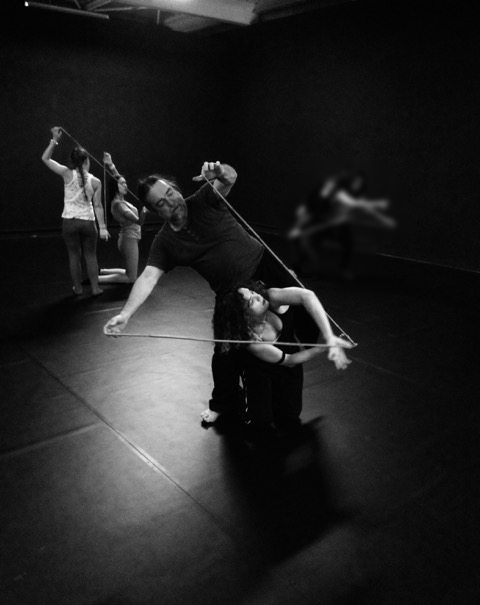
To start, I have people break into groups of two. Each group gets two bamboo sticks, one in each hand. I invite the partners to face each other with each stick bridging between them – held in place by fingertip pressure on each end. No gripping. Just enough engagement to keep it up. Each person has to listen to how their partner communicates through touch, through the stick, and how to communicate back.
Lina: So, probably using their index fingers? Pointer fingers holding up these lightweight sticks?
Miquel: Yes, two sticks, one for each hand. Each stick is about 120 centimeters long, which gives you room to move and still maintain connection. And then I invite the participants to begin to explore: How much is my partner pushing me? How much do I push back? Is there something being communicated to me through the sticks? Do I resist it, or follow it? If I want to move in space, I can’t just walk away – if I do, the stick falls. I have to bring my partner with me, to communicate my intention to move through the contact itself.
Participants are trying to keep the stick up off the ground but also communicate with the other person. It’s not about holding the sticks in place, it is an inquiry – how do I, with my touch, with my intention, communicate to the other person what I’m doing? Where do I want to go?
The sticks function as a kind of force transmission system, a literal tensegrity between two bodies. The goal is to listen, respond, and stay in dialogue. It’s a bit like tai chi push hands. Russell would have us dancers do push hands with each other, which is similar. But now, with the bamboo stick in between the two partners, that changes everything. It makes the communication visible. It slows things down. You cannot be forceful and expect cooperation. The stick tells you immediately.

Lina: How did this exercise come about?
Miquel: I didn’t develop it so much as it developed through me. I was teaching contact improvisation in China, and the bodies I was working with were very rough – not really sensitive to softness. The contact work was getting painful. I kept asking myself, “How do I help them slow down and get sensitive without using words?” Words flow into the brain, I wanted them to sense, not think.
Putting the bamboo sticks between them came to mind as an answer to that. Put something between people, and suddenly you can’t just power through. You have to lighten up. You have to get sensitive. The bamboo became a kind of translator.
Lina: It’s an inspired intervention – the prop literally creates space between people, while still maintaining contact, especially across a cultural context where people may not be accustomed to improvised touch.
Miquel: Yes. Then I started doing this with the Dutch Rolfers as a movement exploration, a kind of embodiment in the morning, when we had our meetings. With time, I realized this is actually great for developing our touch. It brought forward questions like, “How do I touch a client?” It’s feedback to myself. If I am forceful, I only receive resistance. It got me thinking about how we touch as Rolfers. How do we touch while also receiving input from the client, from the tissue? As Rolfers we give physical input to the tissues, talking to the tissue, and also we are receiving the information about what the tissue then does in response. It’s listening and talking through touch, receiving information, and still being able to actively move.
Application for Rolfers™
Lina: It sounds like a very engaging nonverbal conversation – an awakening of bodily intelligence between partners.
Miquel: Exactly. And that’s where it differs from a conventional touch workshop. If you say to someone, “Touch the superficial fascial layer.” That request becomes cerebral; all the participants will be in their heads, wondering if they’re doing it correctly. Put a bamboo stick between people and they stop wondering. They start investigating. The feedback is immediate and embodied.
Then, after five or ten minutes, I switch partners. They will have gotten comfortable with how to make it work with their partner and how to deal with the challenge, how to move with them. Next, they might have somebody who is rigid in the shoulders. They will notice,
“This person doesn’t move as the other one did.” For the Rolfer, the learning is immediate; it is the perspective of each of your clients. Every client is different. We have to adjust our touch for every client, for every different place we work with in their body; different needs, different approaches.
Lina: And it seems like it would require the participant to maintain contact with their own proprioception – their own organization in gravity – while simultaneously tracking the connection with their partner.
Miquel: Yes, and they will notice immediately when they tense up. People get excited or worried about the stick falling. When the flow stops, the stick falls. It’s the same in a Rolfing session. If you’re not grounded in your own body, the session doesn’t flow. The exercise is a mirror of that dynamic.
Lina: Did some of your participants find this confronting? If a person carries stiffness or relational tensions, does that get awoken by the exercise?
Miquel: Very much so. People get confronted with their personality, with what they want. I want to keep the sticks up, but it doesn’t work, so we have to ask – how do I have to change myself in order to get this happening? You can’t change the other person, and you can’t control them either. So, in that sense, it’s very confronting. In a student setting, if someone cannot find ease with four different partners in a row and the sticks keep falling, that is quite confronting to sit with.
At the same time, it’s very playful. It’s done without speaking; I ask the participants to not use their words. Then, they have to go into their senses. This can make it playful. After a while, people get a feel for how it can work, and they learn, they can adjust to many people. People are rewarded for opening up, when they ask themselves, “How do I have to change to make this work?” Instead of teaching from the head how to touch, we want practitioners to sense it, and this tensegrity exercise is a direct way into it.
Lina: When I imagine myself doing this, I’m worrying about the other person and what happens when the stick falls?
Miquel: I used to say at the start, “Don’t let the stick fall, just make it float.” But after a while, of course, I would hear a stick fall. I would say, “Ah, great.” Because they are exploring. They are trying something new. If the stick falls, you know something about that approach doesn’t work – and now you adjust. I try to make it okay to drop the stick, because that’s how to learn. The same is true in a Rolfing session: you can’t be afraid to try something new and find out that it wasn’t quite right. You recover and listen again.
Russell would also talk about this; the body has an ability to organize and respond before the thinking mind catches up. The mind can be in the way of what we think we can do, but the body is so much more intelligent. When improvising in dance, the movement happens before you think of it.
Say you are running and you see a big stone on the path ahead of you. Do you think about every coordinated movement to get past the stone? No. The movement happens before you think about it, your body has dealt with it. Pre-reflective movement is the movement that happens before you think about it. Imagine if we had to wait, to think, before the body could move. You would have to think, “Oh no, the rock, I must now do this, then that,” and before you know it, you’ve rolled through your ankle. The body knows how to move. The brain interferes. The bamboo stick exercise puts you back in your body’s intelligence, because you are sensing, not planning.
Teaching this living tensegrity movement exercise, I have seen people do things they thought they could never do, like getting into physical positions and ranges of movement that they assumed were beyond them. They weren’t thinking, they were listening with their whole systems, and their bodies were free to move.
Lina: You showed me some pictures of a class of yours working with the sticks. Where was this?
Miquel: Yes, that was in Ibiza, a Spanish island in the Mediterranean Sea. I go every year for a week-long men’s retreat. Last year, I was asked to do some embodiment exercises in the morning. And told them, I would like to introduce them to the living tensegrity exercise. They were nervous at first, wondering how a dancer was going to lead them with movement. But it went beautifully. Everyone enjoyed it, and particularly one man who was maybe twenty-two old.
Afterwards, we had a sharing circle, and he described it as a very playful way to understand who you’re dealing with, to truly get to know the other person. He said it gave him a lot of insights about himself as well and how he relates to
people. We had done one hour working with the bamboo sticks, and he walked away with genuine self-knowledge.
Lina: What a wonderful invitation – to make contact without the pressure of touching.
Miquel: Yes, the sticks create space between people while still creating a real connection. And I could have then taken the sticks away and guided the people to make contact with their hands directly, inviting them to move with each other through the room, when they are ready for more information, more intimacy of contact. The stick is the preparation.
I keep it open in the beginning to see what is happening, and I’m checking the room. If I see that a person has gotten stuck in a place, then I invite them to communicate to their partner. I ask them to think about going somewhere in the room, and I always ask them, “How would you do that through the stick?” Not with words and not walking away, how would you bring your partner with you into the new space?
Many times, what happens automatically, somebody starts pushing and the other one starts going backward. Sometimes a duo will get all the way against the wall. And then, they’re faced with not being able to go anywhere. So, then I invite them to consider, “You can resist somewhere to communicate.” They start talking, with movement, saying – I want to go this way. So many times, it starts happening automatically, the group will have movement in the space.
Lina: When you’re leading this exercise with Rolfers, are there specific invitations you make around how they use the sticks?
Miquel: Yes. While we are doing the work of Rolfing [Structural Integration], we are working with our touch sensing in our hands. But as we input our forces, we are also being moved by whatever part of our client’s system we are listening to. As Rolfers, we experience whole body fascia in ourselves, and that of our client. Eventually, the movement between the pairs becomes fluid. And think about how it is similar to what we are doing in our Rolfing sessions.
We do this exercise for an hour. Before we start, I have them walk around and feel how they are doing today? Which body parts are talking to them? And then I invite them to feel through their bodies, and remember those parts. And after the hour of the stick exercise, I have them walk again, and inquire within themselves of how they feel? And they say, “I feel open. I feel free. I’m more grounded.” In that hour, we were working on the quality of touch and how they relate with people. As a Rolfer, I have to know how I am with my client, and respond differently as each client is different. It works.
Lina: I’m imagining these living tensegrity duos, moving together to cross the room, and it’s not two people, it’s one system. And that is what happens in a Rolfing session: practitioners are in the system of forces being conveyed
to the client’s body. And, their body is conveying forces back to us. That’s what I hear you saying. This exploration amplifies awareness of being part of this system of giving gestures and noticing what happens afterward.
Miquel: Exactly. It’s like you are getting information which leads to the next input, which leads to the next information available to you, which leads to the next input. And then, you enter into flow in your session, instead of just doing one thing, the next thing, and the next thing, now you are in tune with this client. You know what the needs are and what part needs to come next. It is told to you by their body; they give that information to you. You don’t have to think, it’s great. It’s a communication channel that I get excited about.
Miquel: After a while, after they had changed partners a few times, I asked them to do trios. And that suddenly gave them information from two people at once. In that case, I direct people to think of the person to their left as giving information, and the person to their right as listening for information. And then after that, we do it with four people, and eventually, I put them all together as one whole group. We make one big group and then we do a little game. As a whole group, we move. And if the complexity of the movement leads to a stick falling, and you think it’s your fault, then you step out. The group becomes smaller and smaller until there are two left. The quality of movement and the gestures can be quite beautiful and surprising.
With that complexity, the brain is going to new places, and the body is opening like crazy. Then, we go back to just working with one person again, and then they fly through the room. It’s crazy to see, wow. Once they are back to how easy it is to deal with only one person, the flow is immediate.
Lina: That must look so beautiful, from the big group to the flowing dyads connected.
Miquel: Yes, it’s very nice. And you see people orient differently. A lot of people look at the sticks, as if they can control it with their eyes. Other people have their eyes closed and are going by feel. As facilitator, I get to see what resources they each have, and where they like to
come from for their movement. As a Rolfing instructor, to see the students do this exercise is very helpful because I can help them broaden these resources, expand where they orient.
The living tensegrity exercise is a nice embodiment game; Rolfers can try it out for this kind of fun and to feel good. I have introduced this at Rolfing trainings as embodiment in the morning. It is a small help in getting ready for the instruction.
I have never done this exercise with a client. With a Rolfing client, I don’t need the sticks because I am already doing it with my hands. The sticks are like training wheels for what your hands eventually become. Once you have developed the sensitivity, the bamboo is unnecessary.
Miquel: I offer living tensegrity for our Rolfing peer groups. When we meet to practice, here is a good embodiment game to play as well. You will come away from it feeling good and having worked on something real. Many practitioners have these community groups where they share and practice; this could be one more thing to bring into that space.
Lina: As a Rolfer, a professional dancer, and Rolfing instructor-in-training, I can see that you really care about us developing our sensitivity, regardless of where we are in our careers. This would be helpful for beginners, but me too, with decades of experience, we can benefit from experiencing this kind of opening.
Miquel: Yes, and it also reflects something I believe about life and about the body: the most resilient systems are the most fluid ones. Not weak, not passive – but able to receive movement, integrate that information, and respond with movement. A rigid system breaks. A fluid one finds a way. That’s what I invite people to experience by playing with bamboo sticks, and think about how similar that is to what we’re offering our clients every time when we work.
Lina: That’s a beautiful note to end on. Thank you so much, Miquel.
Miquel: And thank you, it’s been a pleasure.
Miquel de Jong is a Certified Advanced Rolfer™, mentor, Rolf Movement® Practitioner, and teacher in training with the European Rolfing Association e.V., and practices in Rotterdam, Netherlands. He trained from the age of ten with the Royal Conservatoire of Dance in The Hague, eventually graduating in 1989 with a Bachelor’s degree in dance. De Jong’s dance career began at Scapino Ballet Rotterdam, where he danced for six years. In 1995, he moved to France, working as a soloist at France’s most renowned and internationally recognized modern dance company, L’Opéra de Lyon, where he worked with top choreographers. It was there he met choreographer and Rolfer (at the time, now retired Rolfer), Russell Maliphant, who inspired him to discover a diversity of movement styles and techniques, such as contact improvisation, capoeira, acrobatics, as well as body-mind techniques like yoga, tai chi, meditation, and Rolfing Structural Integration. Now that de Jong has been a Rolfer for eighteen years, he’s found a beautiful connection between dance and Rolfing Structural Integration, where one inspires the other, and vice versa. Currently, in addition to delivering Rolfing sessions, he is a movement coach for choreographers and theatre directors. He teaches extensively at various academies in the Netherlands and teaches movement workshops nationally and abroad.
Lina Amy Hack, BS, BA, SEP, became a Rolfer™ in 2004 and is now a Certified Advanced Rolfer (2016) practicing in Canada. She has an honors biochemistry degree from Simon Fraser University (2000) and a high-honors psychology degree from the University of Saskatchewan (2013), as well as a Somatic Experiencing® Practitioner (2015) certification. Hack is the Editor-in-Chief of Structure, Function, Integration.
Koepke, Tristan, and Russell Maliphant. 2021. The flow of lifelong inquiry: An interview with Russell Maliphant. Structure, Function, Integration 49(3):68-77.
Sadler’s Wells/Russell Maliphant Production. 2012. The Rodin Project. Théâtre National de Chaillot, Les Théâtre de la Ville de Luxembourg, The Joyce Theater New York, and Arts Council England.
living tensegrity; contact improvisation; bamboo stick exercise; nonverbal communication; embodied presence; touch; proprioception; pre-reflective movement; Rolf Movement Integration; professional development; force transmission. ■
