Breathing and respiration should not be confused, as they are not the same thing.
Respiration, properly speaking, is the process of oxygen and carbon dioxide passing through the cellular walls of the villi in the lungs. Breathing is an action.
Carbon dioxide goes one way, leaving the body, and oxygen goes the other way, entering the body. Molecules cross the alveolar membranes between the liquid medium of life, the blood, and the gaseous medium of air (see Figure 1).
The human body is organized around this action. We breathe in air, with its 21% oxygen, and breathe out carbon dioxide (Sharma and Hashmi 2022). The lungs are a huge surface area of membranous fibers, all folded upon themselves, that have air-filled passages that resemble the branching of trees, separated from the fast-moving blood supply in the tissue. These capillary fibers are semipermeable; they contain the cells and fluid of blood, allowing oxygen and carbon dioxide to pass between the air and the fluid in opposite directions. The oxygen is drawn to the iron atom held deep inside each hemoglobin protein and whisked to the body, and the carbon dioxide arriving from the body is jettisoned from hemoglobin.
Around the lungs is dense membranous sac, the pleura. This is a serous membrane that “folds back on itself to form a two-layered membranous pleural sac” (Mahabadi, Goizueta, and Bordoni 2024, online). The outer layer of the pleura, the parietal pleura, attaches to the chest wall. Between the inner layer, the visceral pleura, and the lung is a partial vacuum, a volume of reduced pressure. When we breathe in by expanding the diaphragm inferiorly, opening each rib laterally, and lifting the sternum anteriorly and superiorly, that pleura-held space enlarges, so that the intensity of that vacuum increases, thus forcing the lungs themselves to expand into that newly formed space (see Figure 2). This sucks in air from the outside. It is effortful for the human animal to inspire. We breathe out by releasing these efforts, letting go of the expanded three-dimensional space; the vacuum is eased, the lungs return to a neutral state, and the air is expelled from the body. We expend some energy to compress the torso and force the carbon dioxide-enriched air out.
There are several actions that can expand the pleura (see Figure 3). Since it is attached to the chest wall, we can mimic the showmanship of a bodybuilder and expand the chest in that bravado way. We can inhale by raising the shoulders. I read long ago that in India, breathing from the shoulders was widely considered the sign of a sick man. This makes a degree of sense, in that the apical lobe of the lungs, which comes right up to behind and above the collar bone, just under the first rib, is very narrow, so adverse substances, just as dust or microorganisms, having been breathed in, can accumulate there and cause disease, where in the other lobes they are more likely to get breathed out again.
Now, as mammals, we have diaphragms, which in other animal forms was the upper layer of the body wall that descended. Reptiles and amphibians breathe with their whole body. Birds have a completely different system involving hollow bones. For humans, in the back of the throat, behind the larynx and esophagus, there are muscles called rectus capitis anterior, rectus capitis lateralis, longus capitis, and longus colli, responsible for lateral flexion of the head (See figure 4). In the back of the abdominal regions are the ‘anterior rectus muscles of the lumbar spine’: psoas major and psoas minor. Psoas major is one of the two major flexors of the hip, along with Iliacus, which originates along the inner rim of the pelvic crest. These muscles are considered important in the Rolfing Ten Series® as part of the process of breathing.
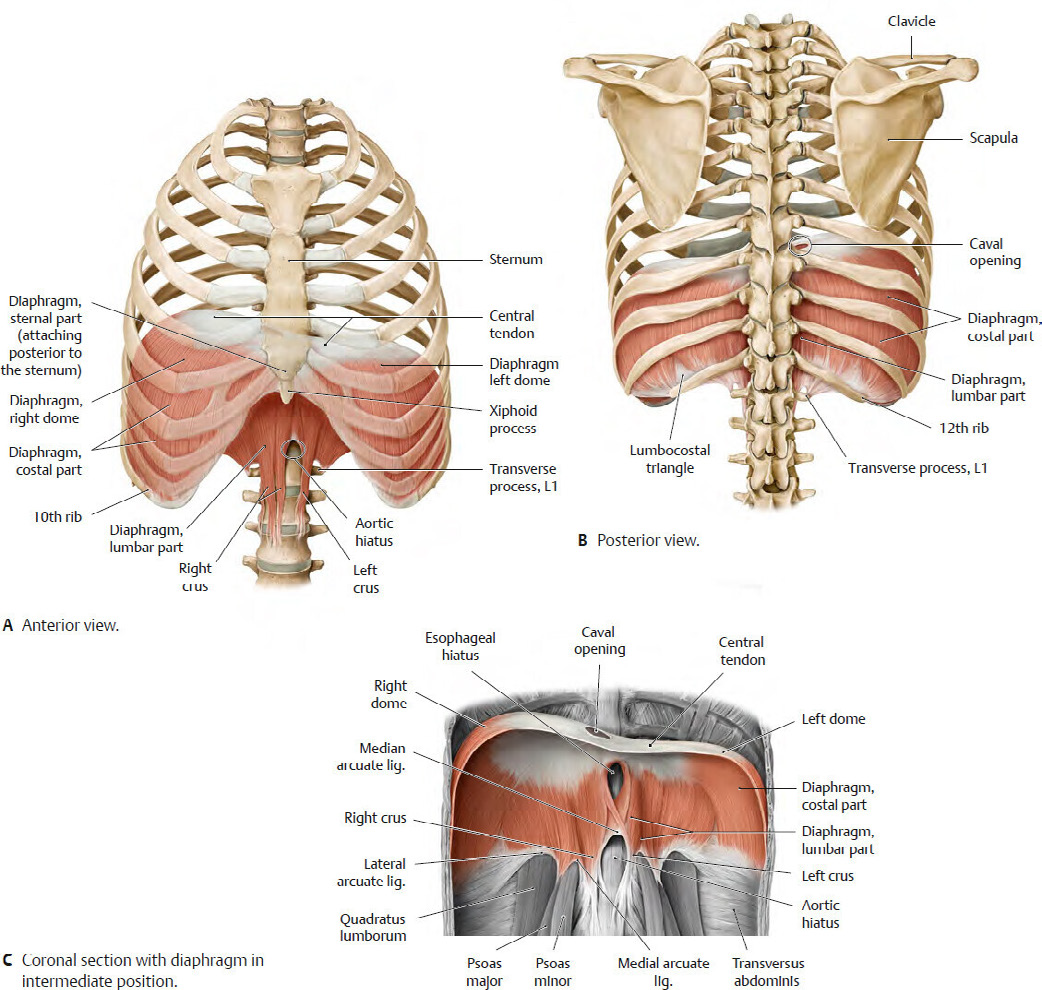
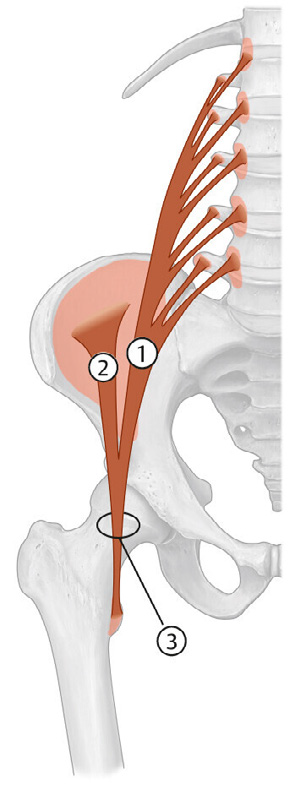
I remember in my Phase I of Rolfing® training at the then Rolf Institute® (now known as the Dr. Ida Rolf Institute®), when we had learned how to access those anterior rectus muscles, in the cervical and lumbar regions, I wondered how we could access the anterior recti of the thorax, with all those ribs in the way. We didn’t because they don’t exist. When we became mammals, those muscles descended along with the diaphragm to become the crura of the diaphragm. ‘Crura’ means ‘legs’. They attach to the lumbar vertebrae, L1 to L3, and their intervertebral disks (see Figure 5).
So, when most people are doing what they call ‘abdominal’ breathing, what they are doing is tilting the pelvis forward to exert a tension on these crura, thus pulling the diaphragm down to increase the volume of that space inside the pleura. This creates a vacuum and expands the actual volume inside the lungs proper, and draws air in. It also positions the diaphragm more diagonally when viewed from the side, in an almost upright position. That tilt is done with the iliacus and psoas muscles, the hip flexors, which cross the hip joint in a common tendon, the iliopsoas.
In doing so, the lordotic forward flexion of the lumbar spine is increased, leading to a divergence of alignment between the thoracic and lumbar spines and a disruption of structure between the legs
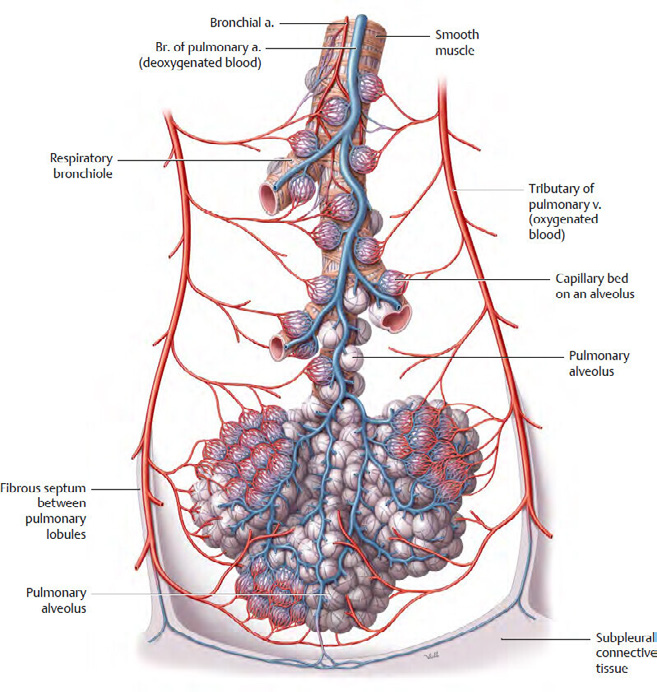
Figure 2:
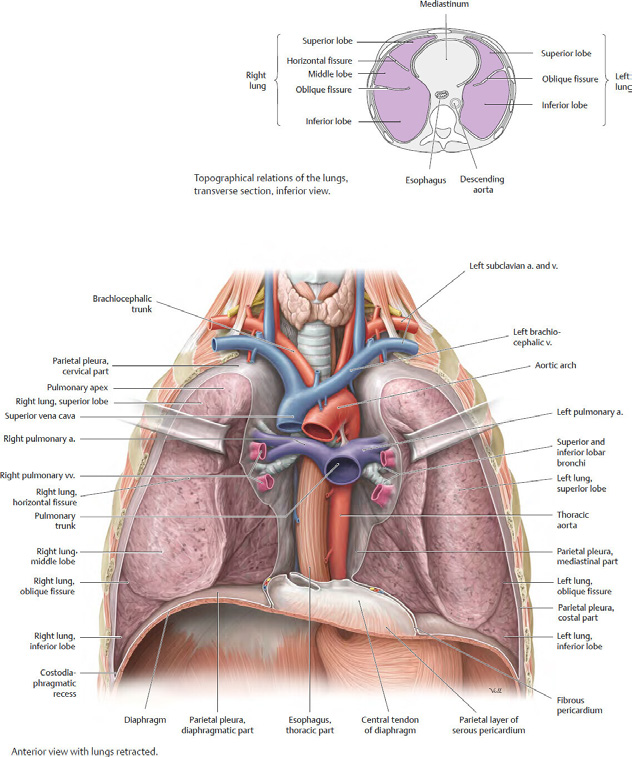
(A) The left and right lungs occupy the full volume of the pleural cavity. This is an anterior view of the pleural sac, with the anterior thoracic wall, the costal portion of the parietal pleura, some of the lungs, and the heart removed to show the lungs in situ. The pleural sac is bounded by two serous layers: the visceral pleura, tightly attached to the surface of the lung, and the parietal pleura attached to the endothoracic fascia of the thoracic wall. The two pleural layers are continuous with each other.
______________________________________________________________________________________________________________________
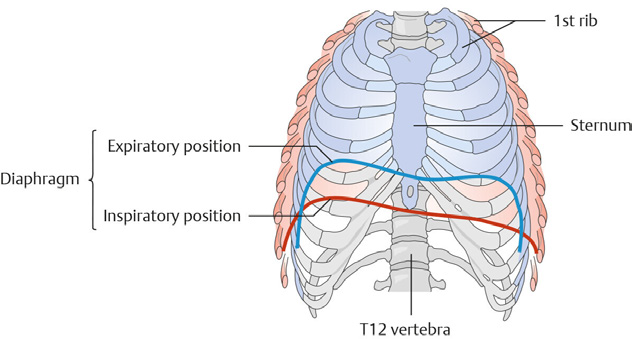
(B) Respiratory changes in thoracic volume when breathing, showing the changes in diaphragm position. Images copyright Thieme® 2026, published with permission.
and torso. Remember that when stepping or running forward, the power comes from the thrust of the back leg, driving the body forward. If the hip flexors are shortened or otherwise compromised, so is the thrust from the back leg of each stride. Consequently, compromised breathing structurally impairs the body’s forward momentum.
Think of a car driving down the highway. To move the car forward according to basic Newtonian physics means the road is being pushed backward. That, in turn, means for walking that you have to transmit force from your feet, up through your spine, to your arms. If your back alignment is in a straight, vertical line, then when you lean forward to start walking, the transmission of forces is more direct through the bones. If your upper body is behind your line, because of a curvy spine, hanging your arms behind you, this is a disadvantage because you have to contract your abdominal muscles because of the backward bend to overcome that weight behind the center line.
This leads to considering an alternative way to draw the diaphragm down: flattening the lumbar vertebrae, which may involve a slight posterior tilt of the pelvis. This action is powered by the gluteus maximus, the most powerful skeletal muscle in the body, along with the hamstrings and the abdominals. This does not necessarily involve an actual backward tilt á la Wing Chun Kung Fu, just a bringing of the back of the pelvis to vertical. The result is a more horizontal position of the diaphragm, with the abdominal muscles engaged. When this is done, instead of feeling the fullness of the air in the front of the abdomen, like a pregnancy, that pressure can descend to the area between the anus and genitals, the perineum, at the very bottom of the abdomen.
Another way to visualize this, as far as the torso is concerned, is to consider the body as one cylinder. The abdominal cavity with the digestive, elimination, and reproductive organs, the thoracic cavity with the heart and lungs, and the skull-spine cavity holding the central nervous system are like a tube in which air enters at the nose and travels downward. The sensation of breathing in can be tracked from the flaring of the nostrils, to the lift in our ribs, to the downward movement of the diaphragm, and to the pressure in the abdominal space that reaches the perineum.
As I often explain to my Rolfing clients, imagine a tennis player taking his tennis balls to the court. He does this in a cardboard tube. If he wanted to move balls from one tube to another, he would merely bring the tube mouth-to-mouth and tilt. But if the tubes were not in line with each other, the balls could not move from one tube to the other! Now, our internal organs have to move around to perform their functions of keeping us healthy. They are restricted by the bony cages that contain them. With an aligned thoracic and abdominal cavity that meet and extend into the head, the body cylinder balances these organ cavities and optimizes healthy potential (see Figure 6).
One benefit of flattening the lumbar spine with a slight posterior pelvic tilt, from a martial arts point of view, is that the structural unity of the body is maintained instead of being broken between the abdominal and thoracic regions. These can move as one, instead of the thorax always having to catch up with the lower body. It also means that an incoming force is resisted down to the floor, and an outgoing force uses the mass of the planet as a foundation. It also leaves the hip flexors free to lift the legs for stepping or kicking throughout their entire range of motion, instead of having their stride compromised by the previously described tension.
Going further with the flat-lumbar type of breath, it can be directed to breathe lower
 position of the diaphragm, with the abdominal muscles engaged. When this is done, instead of feeling the fullness of the air in the front of the abdomen, like a pregnancy, that pressure can descend to the area between the anus and genitals, the perineum, at the very bottom of the abdomen.
Another way to visualize this, as far as the torso is concerned, is to consider the body as one cylinder. The abdominal cavity with the digestive, elimination, and reproductive organs, the thoracic cavity with the heart and lungs, and the skull-spine cavity holding the central nervous system are like a tube in which air enters at the nose and travels downward. The sensation of breathing in can be tracked from the flaring of the nostrils, to the lift in our ribs, to the downward movement of the diaphragm, and to the pressure in the abdominal space that reaches the perineum.
As I often explain to my Rolfing clients, imagine a tennis player taking his tennis balls to the court. He does this in a cardboard tube. If he wanted to move balls from one tube to another, he would merely bring the tube mouth-to-mouth and tilt. But if the tubes were not in line with each other, the balls could not move from one tube to the other! Now, our internal organs have to move around to perform their functions of keeping us healthy. They are restricted by the bony cages that contain them. With an aligned thoracic and abdominal cavity that meet and extend into the head, the body cylinder balances these organ cavities and optimizes healthy potential (see Figure 6).
One benefit of flattening the lumbar spine with a slight posterior pelvic tilt, from a martial arts point of view, is that the structural unity of the body is maintained instead of being broken between the abdominal and thoracic regions. These can move as one, instead of the thorax always having to catch up with the lower body. It also means that an incoming force is resisted down to the floor, and an outgoing force uses the mass of the planet as a foundation. It also leaves the hip flexors free to lift the legs for stepping or kicking throughout their entire range of motion, instead of having their stride compromised by the previously described tension.
Going further with the flat-lumbar type of breath, it can be directed to breathe lower.

down in the body, past the pelvic floor, into the legs. I first got onto that years ago, when I would come home and get into bed. The lady I was living with at the time would already be in bed and asleep – we had different work schedules. So as not to wake her up, I would lie there and breathe just to slow my energies down enough to get to sleep. Well, I found myself sensing my breath down through the thighs, then lower to the lower legs and feet. There were obstructions at the acute angles of the hip and knee joints, and tension in the muscles throughout the legs. Of course, the lungs don’t actually continue as actual cavities. Still, the fascial envelopes that surround and separate the bodily organs continue down between the structures in the legs, so the sensation of expansion during inhalation and retraction from exhalation can be felt as movement that can be tracked down the body all the way to the legs. To find this, I had to keep the hips open (lumbar spine flat) and a slight tension in the thigh muscles to keep the knees slightly straight, which helps get the breathing effect down through the shins to the feet.
More recently, I’ve been making an even more subtle observation: beyond the breath, I am finding that I can track the pulse of the blood down through the same pathways, thus keeping my feet warm on wintry nights! Sometimes, when I think about the details of vascular anatomy after observing my breath, I get a powerful pulse in my hands.
Now, when doing ‘standing jong’ meditation posture, I sometimes feel the breath and pulse rebounding off the floor and up from my feet. This is the energy that rises from the ‘bubbling spring’ points referred to in the teachings of the esoteric Chinese Martial Arts. Many notable systems teach breathwork, one way or another. I submit that this pulse work builds on breath work; it is more subtle and has the potential for even deeper energetic inquiries.
[For those interested in the more esoteric aspects, I would recommend Waysun Liao’s T’ai Chi Classics, Shambhala, 2023. He spends two chapters on breathing, and on converting breath into the esoteric energies, ch’I, and ching.]*
John Panter, MA, is a Certified Advanced Rolfer™ with a Master’s degree in History, a Bachelor of Arts, Honors, in History, and a Bachelor of Science in Psychology. He has been in private practice as Eastern Canada’s only Rolfer since 1998.
References
Liao, Waysun. 2023. T’ai chi classics: Illuminating the ancient teachings on the art of moving meditation. Shambhala: Boulder, Colorado.
Mahabadi, Navid, Alberto A. Goizueta, and Bruno Bordoni. 2024. Anatomy, thorax, lung pleura, and mediastinum. Available from https://www.ncbi.nlm.nih.gov/books/NBK519048/.
Sharma, Sandeep, and Muhammad F. Hashmi. 2025. Partial pressure of oxygen. Available from https://www.ncbi.nlm.nih.gov/books/NBK493219/.
Keywords
breathing; respiration; alveoli; gas exchange; pleura; diaphragm; crura; iliopsoas; pelvic tilt; structural integration; Rolfing Ten Series; fascial continuity. ■