In 1998 a group of Brazilian Rolfers got together with the goal of creating a clinic for Rolfing Structural Integration that would function like the professional school clinics at universities and teaching hospitals. The clinic was set up to serve clients who might lack the resources to receive private sessions. Through this grass-roots project, we have served over 1000 clients.
What’s more, as it turned out, this project met several needs of the group, the school, and even the ABR (Brazilian Rolfing Association). It is a social activity at an institutional level, a way to promote the work, and a vehicle for participation in community projects. It has also promoted contact among colleagues, and become a space for discussion, supervision, and exchange of visions about the work.
<img src=’https://novo.pedroprado.com.br/imgs/2010/1138-1.jpg’>
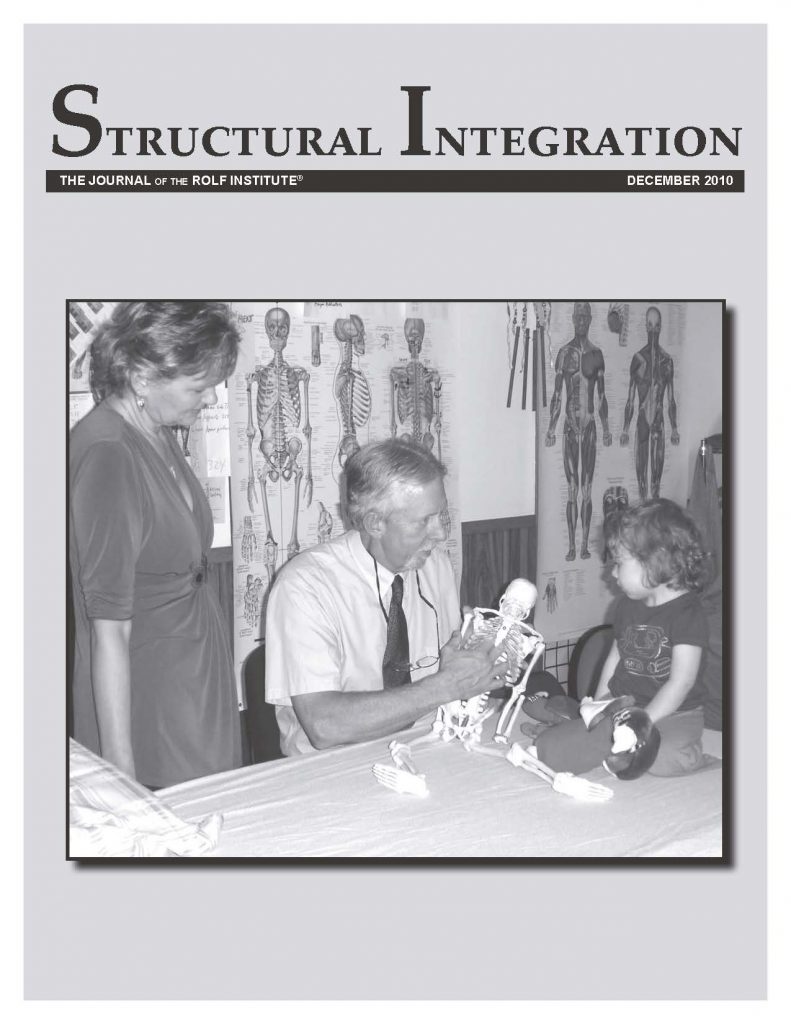
Rolfers Madalena Alveskog and Lucila Brandão in a Rolf Movement session in the children’s clinic, one of NAPER’s projects.
Ongoing Education
The project, named NAPER (Núcleo de Atendimento, PesquisaEstudo em Rolfing, or Center for Practice, Research and Study of Rolfing), also offers several exceptional educational opportunities. First, it is a study group that really works: practitioners at all experience levels – from recent graduates to senior clinicians and faculty – meet weekly to study various subjects and discuss cases. Second, practitioners do their clients’ body readings together and deliver their sessions simultaneously within the shared space. This format, much like a class context, allows practitioners to share among themselves the ideas and areas of emphasis of their various Rolf Institute instructors. As much as the faculty strives for consistency and uniformity in the basic curriculum, it is true and perhaps inevitable that not all potentially important material is even presented – much less taught at the same depth – in every class. While access to ideas not presented in one’s own basic training normally comes only from shared written materials, the live cross-fertilization through NAPER offers a far richer alternative.
NAPER also allows new Rolfers, who often have more energy than clients to serve, to practice immediately and gain the hands-on experience essential for professional growth. While new practitioners are investing the time required to build their own practices, they can put their skills and energy to work in the ambulatory clinic, where they continue to learn from their peers, as well as from the supervision of instructors and more senior colleagues.
NAPER supervision benefits not only the NAPER practitioners, but also the supervising faculty and the school itself. At NAPER, faculty have the opportunity to assess how well students have comprehended and are applying the lessons of their basic training. This is especially valuable here in Brazil, where graduates of basic trainings are certified in both structural and movement work, having been taught to combine movement and manipulation techniques. Besides bringing observations at NAPER to bear on future basic classes, we have the chance to correct or supplement individual practitioners’ trainings: keeping them on track, correcting mistakes, giving reminders, and nipping bad practices in the bud while cultivating good ones.
The rich educational opportunities NAPER offers have led the ABR and its faculty to consider making NAPER participation a part of the basic training. Through NAPER, students between Units II and III could use their existing skills in a professional, supervised setting. This would solidify the students’ learning, as well as allow the faculty to improve the Unit II curriculum. Following Unit III, the NAPER setting facilitates formal “for credit” continuing education, leading to preparation for the advanced Rolfing training.
Inspiring and Supporting Research
The group context has encouraged and supported research. Ongoing discussion, shared observation and the existence of a database have enabled us to develop a series of questionnaires for consistent tracking of client and practitioner processes.(1) As the questions were selected and revised, and the answers analyzed and tabulated, participants undertook research projects and prepared articles to share their findings. In this context, practitioners with aptitude for research and writing may discover and hone their strengths.
Promoting the Work to Other Professionals
Networking as an institution with other groups offering services in similar settings facilitates conversation between Rolfers and members of other professions. This gives our practitioners experience in explaining structural integration to others and promoting their work in an effective and positive manner, and allows us to correct misimpressions about the work that members of other professions might have. We are currently cross-referring clients with the Bioenergetics Association and the Homeopathic Clinic, as well as conducting multidisciplinary research in cooperation with these groups.
Endnotes
Resources on NAPER
Other articles concerning NAPER and the research conducted there include:
“Including the Stomatognathic System in Rolfing SI – A Collaborative Experiment in Broadening Our Scope,” which includes case reports regarding NAPER clients by Yahra Silveira Perdomo, Rosangela Baia, Beatriz Pacheco and Maria Beatriz Whitaker. Structural Integration, 2010, Vol. 38, No. 1.
“Reflections on the São Paulo Ambulatory Project,” by Paula Mattoli, and “The São Paulo Ambulatory Project,” by Pedro Prado, both in Rolf Lines, 2001, Vol. 29, No. 1.
“Profiles and Evaluations of Rolfing Clients in the Núcleo de Atendimento, PesquisaEducação em Rolfing (NAPER) Brazil,” by Yeda Bocaletto, Structural Integration, 2007, Vol. 35, No. 4.The NAPER Clinic: A Vehicle for Continuing Education and Professional Development in Brazil[:]
To have full access to the content of this article you need to be registered on the site. Sign up or Register.